
Idea 1
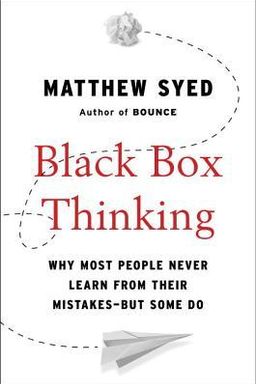
Black Box Thinking: How Progress Emerges from Failure
What if every mistake could make you stronger instead of ashamed? In Black Box Thinking, Matthew Syed argues that success—whether in aviation, medicine, business, or sport—depends not on avoiding error but on using error as fuel for improvement. The book’s central thesis is simple yet radical: you progress fastest when you treat failure as feedback. Syed contrasts industries that institutionalize this learning (like aviation) with those that suppress it (like medicine and social work), showing how culture, mindset, and systems determine whether failure leads to learning or repeated tragedy.
Learning from Failure: The Aviation Model
In aviation, the black box recorder captures unbiased, objective data. When an accident occurs, investigators retrieve that record and feed the insights back into training, design, and regulation. The crash of United Airlines Flight 173, for example, exposed communication barriers within cockpit hierarchies. Flight engineer Forrest Mendenhall noticed the fuel running low but failed to press his captain, R. McBroom, who was distracted by a landing gear issue. The subsequent investigation—not punishment—produced Crew Resource Management (CRM), a cultural shift that empowered subordinates to challenge superiors using structured communication (the P.A.C.E. model). As a result, air crashes plummeted by over 90% in ensuing decades.
When Failure Is Buried: The Healthcare Contrast
By contrast, healthcare too often conceals instead of examines mistakes. The tragic death of Elaine Bromiley—whose airway could not be secured during routine surgery—was initially chalked up as a complication rather than an error. Only persistent advocacy by her husband, Martin Bromiley, himself a pilot, led to an independent report that revealed systemic failings. His campaign sparked reforms that made simulation training and open error review more common in British hospitals. The difference between aviation’s open data and medicine’s blame culture illustrates Syed’s argument: progress needs psychological safety and systemic learning loops, not fear and secrecy.
Why Failures Teach: The Logic of Falsification
Syed embeds this argument in Karl Popper’s philosophy of falsification: knowledge advances only when you test and expose your own hypotheses to disproof. When institutions suppress falsification—like Lysenko’s Soviet biology or corporations hiding defects—they lock themselves into decay. The paradox is that safety and innovation depend on vulnerability: a willingness to let bad news surface. This mindset extends from science and aviation to innovation, entrepreneurship, and policy.
The Human Barrier: Ego, Dissonance, and Blame
Syed shows that human psychology naturally resists learning from mistakes. Cognitive dissonance research (Leon Festinger, Carol Tavris) demonstrates how people reframe evidence that threatens self-image. Doctors reclassify errors as “complications,” prosecutors reinterpret DNA exonerations, and managers airbrush failed pilots from reports—all to preserve a sense of competence. That self‑protection leads to institutional blindness. The only antidote is to design systems that separate learning from blame and lower the cost of honesty. A “just culture” replaces scapegoating with evidence-based accountability, ensuring that reporting mistakes is rewarded rather than punished.
Progress as a System, Not a Heroic Act
Ultimately, Syed reframes success as cumulative, collective learning. Whether you look at Virginia Mason Medical Center’s patient safety transformation, Mercedes F1’s micro-optimization loops, or Team Sky’s marginal gains strategy, the same principle appears: feedback systems create excellence. The book isn’t about specific industries—it’s about how to create cultures that learn systematically. True progress comes when errors are captured, analyzed, shared, and used to redesign processes, not when they’re hidden behind prestige or punishment.
Core lesson: You cannot learn what you refuse to examine. The most successful systems—scientific, technical, or creative—treat mistakes as data, build mechanisms to study them, and turn feedback into design. That is the real engine of progress.