
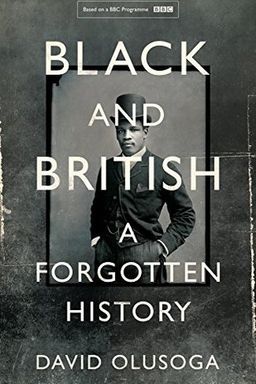
Black and British cover

Black and British

by David Olusoga

Black and British by David Olusoga is a revelatory exploration of the profound impact of Black people on British history, from Roman times to the modern day. It challenges the narrative of exclusion and highlights the essential role of Black Britons in shaping the nation''s identity.

A Global History of Black Britain

How can you understand Britain’s past without acknowledging Africa’s presence within it? In Black and British, David Olusoga argues that Black history is not separate from British history—it is central to it. Africans and their descendants have shaped, served, built, and challenged Britain across two millennia. To know Britain fully, you must discover the faces, voices, and struggles that have long been present yet often erased.

Olusoga weaves together archaeology, legal history, art, economics, and biography to show how Black experiences illustrate the global nature of Britain’s rise: from the Roman outpost at Hadrian’s Wall to the transatlantic slave system, from abolitionist courts to postwar migration. This synthesis shows continuity—not isolated moments of contact, but an unbroken thread of Black presence intertwined with the nation’s fortunes.

From Ancient Presence to Imperial Power

If you begin in Roman Britain, you already find African soldiers and citizens—"Aurelian Moors" stationed on Hadrian’s Wall and figures like the Ivory Bangle Lady in York, whose North African origins were revealed by isotopic analysis. Medieval imagination kept Africa alive through maps, myths, and legends, framing future encounters. By the Tudor period, the presence of John Blanke, the black trumpeter at Henry VIII’s court, and Jacques Francis, an expert diver, shows Africans part of Britain’s professional and cultural worlds. Their recorded lives demonstrate that Britain’s story has always been multiethnic.

Empire, Slavery and the Making of Wealth

The focus then shifts to empire and capital. Britain’s ascent as a world power was intertwined with the slave trade, plantations, and the commodification of human lives. At sites like Bunce Island in Sierra Leone—the “Pompeii of the slave trade”—the process of enslavement becomes tangible. Royal charters like those of the Royal African Company reveal how the monarchy, philosophers, and merchants together built global commerce from human suffering. Cotton, sugar, and gold created fortunes that flowed through cities like Liverpool, London, and Bristol, turning slavery’s profits into banknotes, coins, and cathedrals.

(Parenthetical note: Manchester’s rise as “Cottonopolis” exemplifies how enslaved labor fed the Industrial Revolution that later proclaimed itself a beacon of moral progress.)

Freedom, Law, and Abolition

You cannot miss the legal struggles that turned moral concern into political change. The Somerset case of 1772—where James Somerset’s lawyers challenged his enforced deportation—became a turning point. Lord Mansfield’s judgment, though narrow, allowed the public to believe slavery illegal on English soil. From this faith sprang abolitionist networks: Sharp, Clarkson, Wilberforce, and Sancho. They combined meticulous evidence-gathering with emotional storytelling, using models of slave ships, petitions, and firsthand narratives like Olaudah Equiano’s to awaken collective conscience. Black and white activists alike demonstrated that moral reform required strategy, persistence, and testimony.

Liberation and Contradiction in Africa

Sierra Leone stands as both monument and warning. It was envisioned as a “Province of Freedom” for freed slaves and Black Britons. Yet its settlers faced famine, disease, and betrayal, forced to rebuild amidst Bunce Island’s lingering trade. The colony’s evolution into Freetown—home to Nova Scotians, Maroons, and later Recaptives liberated from slave ships by the West Africa Squadron—embodied abolition’s paradox: freedom overseen by empire. While the Royal Navy seized slavers and returned captives, it also imposed new forms of hierarchy, turning humanitarianism into imperial management.

Racial Science, Empire, and Identity

As the nineteenth century progressed, racial “science” replaced overt morality. Victorians turned imperial rule into spectacle—human zoos, exhibitions, and pseudo-anthropological studies normalized hierarchy. Yet Black Britons like composer Samuel Coleridge-Taylor, Dr. John Alcindor, and soldier Walter Tull proved that Black excellence flourished despite exclusion. African kings such as Cetshwayo and Khama toured Britain, sometimes manipulating its press and politics with diplomatic brilliance. These encounters forced British society to confront its double image: humanitarian and racist, liberator and oppressor.

War, Migration, and Modern Britain

In the world wars, Black service again revealed contradictions. African and Caribbean soldiers fought for an empire that denied them equality—whether at Taranto in 1919 or on postwar London streets. The Windrush generation of 1948, arriving under legal citizenship, reshaped the nation’s culture and workforce. Yet hostility and discriminatory laws soon followed, culminating in the race struggles of the 1960s and beyond. The story comes full circle: Britain, once enriched by Black labor overseas, now had to confront Black citizens at home demanding recognition.

Core claim

Black history is British history. From the Roman Empire to Windrush, from Bunce Island to Birmingham, the Black presence is not a marginal footnote but a continuous, formative force. To see it clearly is to rewrite what Britain means.


Hidden Origins and Early Black Britons

Olusoga begins by dismantling the myth that Black Britain begins only with postwar immigration. Archaeological and historical evidence proves otherwise: African soldiers defended Roman frontiers, and African women were buried with elite honor centuries before Britain’s empire existed. Through items like ivory bangles and Latin inscriptions, you see that Black lives shaped daily life in ancient and medieval Britain.

Romans, Moors, and Medieval Perceptions

You encounter the “Aurelian Moors” stationed at Aballava and the famous Ivory Bangle Lady of York, whose isotopic signature linked her childhood to North Africa. In medieval imagination, maps like the Hereford Mappa Mundi showed Africa at the edge of the known world—a mix of monsters and myths that both distanced and fascinated Europeans. These legends prepared English culture for the paradoxical mix of curiosity and control that would greet later encounters with real Africans.

Tudor and Stuart Presence

Africans step out of myth and into record in Tudor England. John Blanke, the black trumpeter, appears twice in the Westminster Tournament Roll, petitioning Henry VIII for a raise; Jacques Francis gives court testimony as an expert diver. These figures are not isolated novelties—they reveal a broader range of Black experiences: servants, soldiers, and artisans already living as part of urban life long before slavery defined racial identity. The diversity of their roles unsettles assumptions about who belonged.

Historical breakthrough

Black presence in Britain predates empire and migration by over a millennium. This continuity reframes British history as inherently global, not insular.


Slavery, Profit and the Birth of Empire

The second great arc of the narrative follows money and power. Britain’s rise as an imperial power cannot be told without tracing its economic dependence on slavery and colonial commerce. At Bunce Island, near Sierra Leone, you see the process of enslavement made industrial: branding, sorting, shipping. From its yards, between thirty and fifty thousand Africans were sent to the Americas—mainly to Carolina rice fields. Archaeologist Joseph Opala calls it the “Pompeii of the slave trade” because its ruins freeze the system in stone.

Monopolies and Money

Chartered companies like the Royal African Company—backed by Charles II, the Duke of York, and even the philosopher John Locke—wove the trade directly into British governance. Coins like the “Guinea” bore elephant motifs symbolizing African gold. Sugar and cotton transformed Britain’s economy, generating both indulgent lifestyles and national industries. When you drink tea sweetened with Caribbean sugar, you are consuming the material residue of human bondage.

Economic Entanglement

Olusoga details how slavery fueled speculative finance as well: the South Sea Bubble and the Asiento contract bound Britain’s early capitalism to human trafficking. Plantation owners returned home as gentry, buying estates and parliamentary influence. The trade shaped culture as well as commerce: portraits of noble households often included Black pages as symbols of wealth. In this way, human exploitation became aesthetic as well as economic.

Lesson

Slavery was not a colonial aberration—it was a foundation of modern Britain. Its profits built industries, coins, and cultural forms that still shape the nation today.


Abolition, Law and Moral Revolution

The story of abolition is not simply moral awakening; it is a masterclass in activism, legal strategy, and public persuasion. Beginning with Granville Sharp’s defense of Jonathan Strong and culminating in the Somerset case, Olusoga shows how individual stories catalyzed national conscience. Lord Mansfield’s judgment in 1772 may have been legally narrow, but its symbolic power was vast—sparking belief that England’s air itself was free.

Building a Movement

The Society for the Abolition of the Slave Trade (1787) turned faith into organization. Thomas Clarkson, Josiah Wedgwood, and Quaker networks turned evidence into propaganda and moral conviction into politics. Clarkson’s model of the Brooks slave ship—showing human bodies packed below decks—became the most influential image in eighteenth-century reform. The movement pioneered mass petitions (1.5 million signatures) and consumer boycotts long before modern NGOs or viral campaigns existed.

Black and Female Voices

Black activists like Equiano, Cugoano, and the Sons of Africa brought authenticity and intellect to the campaign. Their testimonies countered pseudo-scientific racism by proving literacy, reason, and moral equality. Women, too, transformed moral appeal into logistics: Elizabeth Heyrick argued for “Immediate, not Gradual” abolition, while female committees coordinated sugar boycotts and public fundraising. In their persistence you find the roots of later humanitarian and feminist organizing.

Beyond 1807

The 1807 Act ended the trade, not slavery itself. Yet it altered Britain’s moral identity: now the empire claimed to be a civilizing crusader, sending the Royal Navy’s West Africa Squadron to enforce its laws. Thousands of freed captives were landed in Freetown—a living contradiction of liberation under colonial rule. This evolution from profiteer to moral policeman shows how reform can both redeem and justify power.

Key Idea

Abolition succeeded because it fused moral authority with organization, evidence, and diversity of voice. It teaches that social change demands both conscience and craft.


Liberation, Freetown and Imperial Contradictions

Sierra Leone’s story captures abolition’s paradox perfectly: an experiment in freedom built by empire. The 1787 Province of Freedom settlement gathered poor Black Londoners and freed slaves, promising safety and land. Instead, disease and disaster struck, and some survivors even found work at Bunce Island’s slave fort. Only with the 1792 arrival of Nova Scotian settlers under John Clarkson and Thomas Peters was Freetown truly founded—a community born from double displacement.

Hybrid Beginnings

Nova Scotians built timber houses reminiscent of American style; later came Jamaican Maroons and African Recaptives freed by the West Africa Squadron. Together they formed Krio identity—English-speaking, Christian, literate, and cosmopolitan. Place names like Susan’s Bay and Wilberforce Street memorialize their founders. Yet the colony was controlled by the Sierra Leone Company and later the Crown, ensuring philanthropy never escaped imperial structure.

Ambiguity and Legacy

The West Africa Squadron’s operations freed tens of thousands but imposed new inequalities. Liberated Africans were registered in King’s Yard and sometimes apprenticed involuntarily. Some joined imperial regiments; others created diasporic bridges, returning to places like Lagos as missionaries and traders. Harper, Crowther, and other Krio leaders became both products of and participants in empire. Olusoga calls this a moral and political contradiction—a story of freedom sustained by colonial constraint.

Reflection

The birth of Freetown shows that liberation under empire often meant substitution rather than emancipation. Humanitarianism can reproduce the systems it aims to end.


Race, Empire and Victorian Culture

Victorian Britain claimed moral leadership in ending slavery yet simultaneously built its racial hierarchies through science, spectacle, and empire. Olusoga maps this cultural transformation: from anti-slavery compassion to Social Darwinist condescension.

Science, Panic and Policy

Carlyle’s essays, Hunt’s Anthropological Society, and Winwood Reade’s Savage Africa fused racism with pseudoscience. They justified conquest as “natural order” and moral duty. The Morant Bay Rebellion of 1865 exposed the danger: Governor Eyre’s massacre of Jamaican protesters divided Britain between justice and racial fear. Intellectuals like Darwin and Mill clashed with defenders like Dickens and Carlyle, revealing a culture torn between humanitarian ideals and imperial brutality.

Spectacle and Resistance

Exhibitions like “Savage South Africa” and human zoos turned empire into theatre. Yet Black Britons also thrived: Samuel Coleridge-Taylor composed acclaimed music, Pablo Fanque ran a circus, and Walter Tull became an army officer. Their successes broke stereotypes even as society commodified Blackness as exotic display. African rulers’ visits—Cetshwayo’s rehabilitation and Khama’s diplomatic campaign against Cecil Rhodes—proved that Africans could master British publicity and politics to resist exploitation.

The Height of Empire

The Scramble for Africa transformed ideology into geography. New medicine, guns, and steam made conquest swift; maps turned entire civilizations into zones of resource extraction. Paternalist rhetoric masked profit motives, while racial science declared domination “inevitable.” Olusoga’s portraits of exhibitions and explorers show how empire became entertainment—a performance of superiority that haunted British identity well into the twentieth century.

Insight

Empire was as much a story told at home as a regime built abroad. Science, art, and spectacle made racial hierarchy feel ordinary—and that normalization became imperial Britain’s greatest illusion.


From War to Windrush: A New Britain Emerges

The twentieth century’s wars tested the empire’s conscience. Black soldiers fought, labored, and died for a state that denied them equality. Wartime service became a crucible of both pride and betrayal.

The World Wars and Aftermath

During World War I, West Indian and African regiments served globally but were barred from equal ranks and parades. The Taranto mutiny and subsequent riots in Liverpool revealed postwar racism reinforced by new immigration restrictions. Yet service also politicized a generation, sowing seeds for later Pan-African thought.

World War II brought these questions home. American Jim Crow reached British towns alongside U.S. troops, forcing British civilians to witness imported segregation. Learie Constantine’s successful lawsuit in 1944—after being denied a hotel room—established a new precedent for racial justice in domestic law. Victory highlighted hypocrisy: how could Britain fight fascism abroad yet tolerate racism at home?

Windrush and New Identity

The arrival of the Empire Windrush in 1948 exemplifies postwar transition: the empire’s subjects became citizens. Caribbean migrants found both opportunity and hostility, building new communities amid riots and discrimination. Subsequent legislation—Commonwealth Immigrants Acts and the rise of figures like Enoch Powell—defined a new politics of race. Despite that, Black Britons transformed national culture, enriching music, sport, and civil life.

Olusoga ends by reminding you that the Windrush generation did not begin Britain’s Black story—they renewed it. From Roman forts to modern London, the recurring truth remains: Black lives have always been woven into Britain’s fabric. What changes is whether the nation chooses to see them.

Dig Deeper

Get personalized prompts to apply these lessons to your life and deepen your understanding.

Go Deeper

Get the Full Experience

Download Insight Books for AI-powered reflections, quizzes, and more.