
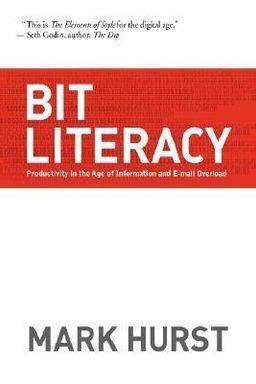
Bit Literacy cover

Bit Literacy

by Mark Hurst

Bit Literacy is your essential guide to navigating the overwhelming digital landscape. Discover powerful strategies to manage your information flow, empty your inbox, and organize digital files efficiently. Transform your productivity and enjoy a balanced, stress-free life in the digital age.

Mastering the Age of Bits: How to Live Productively Amid Digital Overload

Do you ever feel like you’re drowning in emails, notifications, and endless streams of digital “stuff”? Mark Hurst’s Bit Literacy: Productivity in the Age of Information and E-mail Overload opens with that very anxiety—the feeling of being buried under the weight of digital bits. Written as both a wake-up call and a practical manual, Hurst introduces a revolutionary mindset shift: in a world dominated by bits, the key to productivity and peace isn’t managing more, but managing less.

Hurst, who studied computer science at MIT and went on to found one of the earliest user experience consultancies, argues that most of us have mastered computer literacy but remain illiterate when it comes to bit literacy. We know how to click, type, and search—but not how to survive the storm of emails, files, media streams, and data pouring into our lives. “Bits are heavy,” he writes, even though they’re weightless. They demand mental attention and emotional energy, slowly suffocating our ability to think clearly or be creative. The goal of bit literacy, then, is freedom—freedom from overload, distraction, and digital chaos.

The Core Promise: Let the Bits Go

At the center of the book lies a deceptively simple prescription: let the bits go. For Hurst, this is not digital minimalism in the ascetic sense but a kind of digital mindfulness. It’s the capacity to engage with bits intentionally, to process and release them rather than cling to them. Just as Zen emphasizes emptiness as the path to awareness, Hurst proposes emptiness as the path to digital sanity. This might sound abstract, but it becomes very concrete once he applies it to everyday bitstreams—emails, to-do lists, photos, and media.

He uses a metaphor of a whiteboard covered in ink: when there’s too much information scrawled across it, no new message can be seen until you erase. The act of erasing—of curating, deleting, and completing—isn’t loss, but liberation. “When bits are infinite,” Hurst insists, “the only way to thrive is to pick up the eraser.”

From Computer Literacy to Bit Literacy

Hurst critiques what he calls “the myth of computer literacy.” In the 1980s, being technologically fluent meant knowing how to operate software. Today, however, software is secondary: it’s the flow of bits that defines our reality. Yet we still train people to use programs, not to manage bits effectively. The result? Overload, inefficiency, and anxiety. According to Hurst, this mismatch between reality and skillset fuels the modern productivity crisis. We have infinite information but finite attention; bits multiply faster than our capacity to process them.

Bit literacy introduces a new hierarchy: bits first, tools second. The user—not the computer, the app, or the company—must be in control. That shift, Hurst argues, means rejecting the belief that technology companies can or should solve our overload. Their business model depends on selling complexity and constant upgrades, not simplicity. The responsibility for productivity falls squarely on the individual: “Those who know how to work with bits will master the age; those who don’t will be left behind.”

The Path to Digital Emptiness

The book’s method is radically practical. Hurst translates “letting the bits go” into specific, actionable disciplines. Each represents an essential literacy skill: managing email to zero, building digital to-do systems that truly scale, curating one’s media consumption, cleaning up the photo chaos, and creating more empathetic, efficient digital communication. Every chapter provides concrete processes based on his consulting work at Creative Good, where employees are trained to keep inboxes empty and minds clear.

The discipline of keeping an empty inbox (a precursor to the now-famous “Inbox Zero” movement) becomes a daily ritual of release. Similarly, bit-literate to-do systems like Hurst’s own GooTodo app train users to separate tasks by time, priority, and mental focus. The goal isn’t just efficiency—it’s completion, the feeling of being “done,” which Hurst says is increasingly rare in the digital era.

Why Bit Literacy Matters

Beyond productivity, bit literacy is a call for sanity and humanity. Bits are not neutral—they reshape how we think, work, and live. They create false urgency, reward distraction, and replace deep engagement with constant reaction. If you’ve ever checked your phone compulsively or felt guilty about unread emails while spending time with loved ones, you’ve felt this erosion of attention. Hurst’s framework restores balance: you can master the bits, rather than be mastered by them.

Throughout the book, Hurst blends philosophy and technique, from digital decluttering to ethical file naming. But the underlying message is timeless: control your inputs, or they will control you. In this sense, Bit Literacy echoes Cal Newport’s Digital Minimalism and David Allen’s Getting Things Done yet predates both. Where Allen focused on task capture and Newport on intentional living, Hurst bridges the digital and the human, arguing that technology must serve thought, not suffocate it.

“Emptiness brings relief. To thrive in a world of infinite bits, you must first learn to let them go.”

In the end, Bit Literacy is less about mastering technology than mastering yourself. It invites you to make peace with the digital age—to unclutter your inbox, your desktop, and your mind. Because when the bits are finally quiet, that’s when real work, clarity, and creativity can begin.


Bits Are Heavy: Understanding the True Cost of Digital Overload

Imagine carrying a backpack that never gets heavier, no matter how much you put in it—but somehow, you feel more exhausted every day. That’s what Hurst means when he says, “Bits are heavy.” Though immaterial, bits exert real psychological and emotional weight. Whether they arrive as emails, unread articles, or unfiled photos, they demand attention, energy, and decision-making power. The overload isn’t physical—it’s cognitive.

The Illusion of Lightness

Unlike stacks of paper or cluttered desks, bits don’t take up visible space. Because digital clutter hides behind screens and folders, it often multiplies unnoticed. Hurst compares bits to “electronic gravity”: imperceptible forces pulling on your time. A computer, he notes, weighs the same no matter how full its hard drive is, but the more you store, the harder it becomes to use. Infinite storage and speed, ironically, make the user slower. The paradox is clear—what feels light in data form burdens us mentally.

Paper vs. Bits: A Tale of Transparency

Hurst contrasts bits with paper to highlight why digital overload is so insidious. Paper sits visibly on a desk or shelf, giving immediate signals of volume and priority. You can sense when it’s too much. But bits remove that sensory feedback. Thousands of emails or files can lurk invisibly, contributing to what he calls “emotional debt”: the nagging feeling that something important is undone or forgotten. The anxiety doesn’t come from the work itself but from the uncertainty of what lies buried beneath the digital pile.

Busy Man and the Myth of Importance

Hurst introduces the archetype of “Busy Man,” a character you’ve likely seen—or perhaps been. Busy Man races through airports, glued to his smartphone, feeling validated by the flood of incoming bits. He mistakes urgency for significance. To him, being “maxed out” is a badge of honor. But Hurst dismantles this illusion: busyness is not productivity, and reacting to bits is not the same as managing them. Like an addict chasing the next notification high, Busy Man is enslaved by digital inputs.

“Bits have paradoxical power—they are weightless, but they weigh us down.”

The real harm comes not just from overload but from misplaced responsibility. Most users assume that software, filters, or new gadgets will manage bits for them. Hurst insists that this is impossible: no tool can replace personal discipline. Computers automate, but they cannot curate or prioritize for you. Without the skill to deliberately process bits, even the most sophisticated technology will merely accelerate chaos.

Becoming Literate in the New Material

The chapter ends with a powerful call: bits are a new kind of “material,” like paper or steel once were. Every major age—the Industrial, Atomic, and now Digital—creates new literacies. The difference is that bit overload is invisible, global, and self-reinforcing. To navigate this new world, you must recognize that bits, though small, are consequential. The first step to managing them is acknowledging their weight—and reclaiming your right to decide what truly deserves space in your attention.


Taking Responsibility for Your Bits

If bits are the new raw material of life, then who’s in charge of shaping them? Hurst makes the answer unambiguous: you are. He rejects the passive assumption that technology companies will fix our digital problems. The tech industry, he reminds readers, sells tools, not productivity. Their incentive is profit, not your personal clarity. Expecting Microsoft or Apple to deliver peace of mind through a software patch is like expecting fast food companies to design your nutrition plan.

Stop Outsourcing Control

Many users, he observes, fall into one of two camps: the overwhelmed and the overconfident. The first admit defeat with resignation—“I’m just not a tech person.” The second run faster on the treadmill, believing that new apps or faster devices will make them more in control. Both surrender responsibility. True bit literacy begins when you reject both apathy and dependence. “It’s a Copernican shift,” Hurst writes: technology should orbit around you, not the other way around.

The False Promise of Features

Hurst critiques the constant buzz of “the next big thing”—new operating systems, cloud services, or email clients promising salvation. He argues that such innovations often worsen overload by adding features instead of stripping them away. Real efficiency isn’t about more power; it’s about better habits. Tools are amplifiers: they magnify good workflows but can also magnify bad ones. Without control, every new device simply increases the velocity of distraction.

“No company can make you productive. Only you can do that.”

Responsibility, for Hurst, is the defining trait of the bit-literate user. He insists that everyone—from CEOs to students—can learn these skills. No one is born “bad with computers.” Poor design, he says, is often to blame, but poor habits are the greater enemy. The act of becoming bit-literate is not technical but moral: it’s a decision to own your attention and mental space. Each person’s digital behavior reflects how they value time, focus, and ultimately, themselves.

Freedom Through Discipline

By taking control of your bits, you reclaim freedom—not by opting out of technology, but by mastering it. Hurst’s approach resists both reactionary “digital detox” trends and the technophile fantasy of total automation. Instead, it models sustainable self-management. Once you decide that your inbox, calendar, and desktop exist to serve you, not your employer or app developer, every decision gains clarity. Bit literacy, in this sense, is not just a skill—it’s an ethical stance in a world designed to distract.


Emptiness: The Paradoxical Solution

Imagine a square filled entirely with black ink—it’s unreadable, impenetrable. Now picture the same square erased back to white: suddenly, you can write, communicate, and think clearly again. This image, drawn from Hurst’s seminars, illustrates his core solution to bit overload: emptiness. Paradoxically, the healthiest digital spaces are the ones that are empty—where attention is free to focus, create, and choose.

Emptiness as Progress

In our culture, more is often equated with success: more emails, more files, more “data.” Hurst argues the opposite. Because bits are infinite but your attention is finite, the real measure of digital mastery is how much you can let go. He defines bit literacy as “the constant attempt to achieve emptiness in a world of infinite bits.” Emptiness isn’t nihilism—it’s a practical method of control. A clear inbox, a simplified file system, or a pruned photo library all represent spaces where possibility opens again.

The Psychological Weight of ‘Undone’

Hurst calls being “done” one of life’s most underrated joys. The end of a project, the last day of school, the sense that nothing is hanging over your head—these moments of completion give psychological relief. In digital life, that feeling has nearly vanished. The work never ends, because the bits never stop. Emptying your inbox daily or finishing your task list weekly becomes a modern act of self-recovery, a rare opportunity to exhale. This emotional benefit, Hurst argues, is as vital as any productivity metric.

“Today’s abundance of bits demands a new kind of discipline: the discipline to erase.”

Emptiness as Ethical Practice

Emptiness has a moral dimension, too. By filtering what you engage with, you respect not only your own focus but other people’s time. You send shorter, clearer messages. You create fewer unnecessary bits. In business, teams who adopt “emptiness” become faster and kinder communicators. In life, you reclaim hours lost to compulsive clicking. As Lao Tzu warned centuries ago, abundance blurs purpose; emptiness reveals it. Hurst’s Zen-like insight reframes productivity as a spiritual as well as a practical act: letting go is how you make space for what matters.


Email Mastery: Achieving Inbox Zero Before It Was Cool

Long before “Inbox Zero” became a buzzword, Bit Literacy set the standard. Hurst’s email method, detailed in his fourth chapter, is both simple and rigorous: empty your inbox every day. Not “mostly empty,” not “under ten emails.” Zero. The payoff is enormous—clarity, confidence, and control. For Hurst, the inbox is not a filing system, a task list, or a diary. It’s a temporary holding area for bits that need quick processing and release.

Three Steps to Emptiness

Hurst’s “steady-state” method approaches email triage like cleaning a workspace. Step 1: read and delete personal messages first (“because life comes before work”). Step 2: nuke the spam. Step 3: process FYIs and action items—delete, file, or move them to your separate to-do system. Every message must leave the inbox by the end of the day. “No half measures,” he warns: letting even a few linger opens the door to clutter and guilt.

For chronic hoarders, he introduces “induction”—a one-time mass cleanup of backlog messages. Sorting by sender or subject, deleting whole newsletter threads, and moving any active todos to a list can clear thousands of emails in hours. The relief, he notes, is instant and addictive. One user described their first empty inbox as “strange, freeing, and efficient.” Another felt “withdrawals.” But the emotion that lingers is calm.

Why It Works

The psychology behind inbox zero is simple: an inbox full of messages is a pile of unmade decisions. Each email represents mental friction. By clearing the inbox daily, you externalize tasks into the right containers—calendars, to-do lists, or archives—freeing your attention for real work. Hurst clarifies that emptiness doesn’t mean every task is complete; it means that every bit is where it belongs. This distinction transforms email from a source of stress into a manageable flow.

“If overload is the problem, then removing the load is the solution.”

The discipline extends beyond personal email to team communication. Hurst advocates for shared policies—limiting CCs, banning unnecessary attachments, and preferring calls or meetings for complex discussions. Because each outgoing message contributes to someone else’s bitload, true literacy means writing fewer, clearer emails. In doing so, you don’t just declutter your digital space—you model a healthier, more humane way of interacting in the information age.


Todo Mastery: Designing a System That Scales

Once your inbox is empty, what’s next? Hurst argues that productivity really begins when you manage your todos properly. Like emails, todos can multiply infinitely, but unlike emails, they carry responsibility—you must actually do them. Paper systems, he says, collapse under the scale of digital life. Post-it notes and notebooks can’t handle hundreds of tasks, and complex paper-based “organization systems” merely disguise clutter as structure.

From Paper to Bits

The solution is a bit-based system that respects two dimensions paper can’t handle well: scale and time. Digital todo lists scale effortlessly—they can hold thousands of items—and operate intelligently across time, activating tasks only when relevant. Hurst’s own tool, GooTodo, embodies these principles through four features: 1) each todo is tied to a day, 2) todos can be created via email, 3) they’re rank-ordered by priority, and 4) each has a detail field for context. This keeps future tasks invisible until their time arrives, aligning perfectly with the “emptiness” principle.

Time and Attention Management

Hurst reframes todos as a time management problem: the challenge isn’t doing everything but knowing what not to do today. By sending tasks to future dates, you “procrastinate productively.” In practice, this means focusing only on today’s finite list—and feeling done when it’s empty. Even follow-ups become automatic: CC or BCC yourself into GooTodo (“1w@gootodo.com”) to create future reminders effortlessly. The result? A constant, gentle rhythm of action and closure.

“To thrive in the bit world, procrastinate deliberately: send bits to your future self.”

Hurst’s todo philosophy anticipates modern task management systems like Todoist or Asana but keeps a minimalist core. He warns against feature creep—color-coding, tagging, and micro-categorizing—because they reward fiddling, not finishing. “Productivity is not time spent organizing the list,” he writes, “but time spent doing the work outside it.” The real metric isn’t how fancy your system looks, but how often you reach zero.


The Media Diet: Feeding Your Mind Intentionally

In a world where “content” grows exponentially, how do you decide what’s worth your attention? Hurst’s media diet offers a framework for controlling consumption as consciously as production. Drawing inspiration from food diets, he observes that most people eat indiscriminately—bingeing on information without nutrition. Just as junk food leaves you sluggish, random media leaves you anxious and unfocused.

Creating a Media Portfolio

Hurst proposes building a “media lineup” divided into three categories: Stars (the few sources you read deeply), Scans (general awareness sources), and Targets (niche or purpose-driven items like a rival’s newsletter). Everything else should be ruthlessly pruned. He likens this to hiring advisors: each must earn their place on your team. Tryouts are short, renewals optional, and no media source should consume time beyond its value. The fewer sources you trust, the more trustworthy your worldview becomes.

Digital Discernment

Equally critical is knowing how to identify credible online sources. Hurst dedicates an entire section to reading URLs and verifying digital authorship—a necessary skill in an era of viral misinformation. By understanding domain structures and metadata, you save yourself from scams, hoaxes, and wasted clicks. Sharing becomes an act of empathy: include the source, title, and author so your recipient doesn’t waste time chasing context. “Never forward without a source,” he warns. This ethic of clarity builds trust in a noisy world.

“Your time is the scarce resource; bits are infinite. Say no more often than yes.”

The media diet transforms information intake from passive digestion to active curation. Instead of reacting to what the Internet serves you, you select what nourishes your goals. It’s not about isolation—it’s about integrity. Just like sustainable eating, sustainable reading preserves long-term focus and mental health. Once applied, you not only consume less but understand more.


Creating Better Bits: Writing, Naming, and Sharing Mindfully

Once you can manage incoming bits, it’s time to create better ones. Hurst’s later chapters teach you how to make every byte you produce clearer, kinder, and more durable. The principle is simple: brevity and empathy. Every email, file, or photo you generate adds to someone else’s mental load—so create thoughtfully. As he puts it, “Be the person who sends fewer, better bits.”

Frontload the Hook

Hurst offers practical writing lessons that predate modern UX copywriting. Always frontload the hook—put the most important words first, especially in subject lines. “Please fill out forms by Dec. 7 for new 401(k) match” beats “Announcement about the new benefits plan.” Recipients scan, not read, and hooks respect their attention. Similarly, structure every message with Context → Hook → Support → End. End as soon as the message’s goal is achieved.

Choose Simpler Formats

Hurst devotes an entire discussion to file formats and naming discipline. Word documents, he notes, are relics of a print era—bloated, proprietary, and insecure. For most text, simple ASCII (.txt) files are better: fast, universal, and future-proof. If formatting is required, use PDFs, which preserve layout without hidden data. Every file should have a clear name following this pattern: initials-date-topic.extension (like mh-0925-bookdraft.txt). This ensures anyone, years later, can locate and understand the file instantly.

“Elegance in digital work is not in decoration, but in reduction.”

Designing for Longevity

Mindful bit creation extends to structure and storage. Use simple hierarchies (like year → project → file) and keep desktops clean. Avoid proprietary tools that lock you in. Always back up your bits—because losing them is like “burning a library.” By naming, formatting, and sharing responsibly, you not only save time—you respect others’ time. Digital empathy, Hurst argues, is the future’s rarest virtue.


The Future of Bit Literacy: Ownership, Privacy, and Humanity

In the final chapters, Hurst looks forward—and the view is both inspiring and cautionary. As technology accelerates, our management of bits will determine not just productivity but human freedom. Tomorrow’s user will juggle new bitstreams—GPS data, wearables, “life recorders” capturing every moment. Without literacy, these innovations risk turning us into digital tenants renting our own experiences. But with literacy, we can harness them for good.

The Battle for Bit Ownership

Hurst warns that most modern file formats are designed for corporate control, not user freedom. From DRM-protected music to cloud-stored photos, ownership of bits is slipping away. The only defense is independence: keep your files local, in open formats, accessible via the file system—not trapped behind proprietary walls. Bit literacy is self-reliance in a digital economy of dependency.

Humanity Amid Automation

Despite ominous trends, Hurst remains hopeful. He envisions workplaces, governments, and individuals empowered by clarity and compassion. In business, bit-literate teams will outpace rivals because they think clearly; in government, citizens literate in bits will demand transparency. Technology, in this future, serves human attention instead of exploiting it. The defining skill of the century, he predicts, will not be coding—but curation.

“Bits are the new paper—those who can write clearly upon them will shape the world.”

Ultimately, Bit Literacy is a manifesto for personal agency in the digital age. You cannot stop the flood of bits, but you can learn to surf. By managing information with integrity, empathy, and emptiness, you reclaim not just your productivity—but your humanity.

Dig Deeper

Get personalized prompts to apply these lessons to your life and deepen your understanding.

Go Deeper

Get the Full Experience

Download Insight Books for AI-powered reflections, quizzes, and more.