
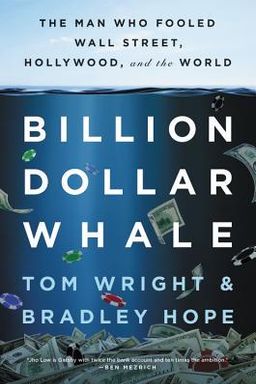
Billion Dollar Whale cover

Billion Dollar Whale

by Tom Wright and Bradley Hope

Billion Dollar Whale unveils the gripping story of Jho Low, the mastermind behind a multi-billion dollar fraud that shook the world. Through meticulous research, the authors reveal how Low''s audacity and manipulation of global finance led to one of the biggest financial scandals, toppling Malaysia''s ruling party and leaving a trail of chaos.

Power, Performance, and the Architecture of Fraud

How does someone transform perception into power? In the story of Jho Low and the 1MDB scandal, you learn that image can become capital—and capital can be weaponized against an entire nation. The book traces how Low constructs an identity of wealth and legitimacy through spectacle, social engineering, and elite manipulation, culminating in one of the largest financial frauds in modern history.

You follow Low from Penang to Harrow, Philadelphia, Kuala Lumpur, Hollywood, and Abu Dhabi, observing how a provincial background is converted into cosmopolitan credibility. He studies the grammar of influence: who you appear to associate with often matters more than what you truly control. Every setting—school parties, yacht meetings, film premieres—becomes a stage for his performance of affluence. (Note: Think of this as the sociological counterpart to F. Scott Fitzgerald’s Jay Gatsby—money as theater.)

Constructing a Myth

Low invents his own aristocratic legend: swapping family photos on borrowed yachts, claiming princely lineage, and using school networks to infiltrate Gulf wealth circles. His genius lies not in finance but narrative control. You can see how he learns to exchange borrowed prestige for real investment—convincing billionaires and sovereign fund officials that he can deliver access others cannot.

Spectacle as Legitimacy

Lavish parties with celebrities like Leonardo DiCaprio, Paris Hilton, and Jamie Foxx are not merely indulgence. They’re instruments of branding. When bankers or government officials see Low surrounded by famous faces, they infer credibility and scale. The Hollywood connection through Red Granite Pictures, which produced The Wolf of Wall Street, transforms stolen funds into cultural capital. (Parenthetical note: Sociologists often call this process “status laundering,” where popular recognition masks questionable money.)

Building the Financial Maze

Behind the glamour, Low constructs a vast web of offshore companies—Good Star, Tanore Finance, and look‑alike entities like Aabar Investments Ltd.—registered in the Seychelles, the British Virgin Islands, and Curaçao. These structures let him move funds through multiple jurisdictions with minimal traceability. Shell layering and bearer-share companies obscure real ownership, while friendly intermediaries—banks like BSI and Falcon Private Bank—process transfers with weak oversight. Every wire looks superficially legitimate.

Political Capture and Social Engineering

Low’s mastery of persuasion reaches its apex when he aligns himself with Prime Minister Najib Razak. He sells 1MDB as a development fund to attract Gulf investment, while secretly repurposing it into a vehicle for graft. Money circulates between political power and private luxury—funds for electoral concerts and charity events, jewelry for Najib’s wife Rosmah, and secret AmBank accounts used for campaign financing. This merger of state policy and personal indulgence ensures compliance at the highest level.

From Local Fraud to Global Reckoning

The heists unfold in three acts: the PetroSaudi joint venture in 2009, the Goldman–IPIC bond deals in 2012, and the $3 billion bond in 2013 leading to the $681 million transfer to Najib’s private account. Each act scales up the complexity—from small private banks to global investment platforms. When leaks and investigative journalism uncover the trails, the scheme morphs into a global enforcement test case involving the U.S. Department of Justice, Swiss and Singaporean regulators, and Malaysia’s political turnaround after Najib’s fall.

Key insight

The 1MDB story isn’t only about theft—it’s about how narrative and system design intersect. When performance substitutes for proof, and prestige overrides process, global institutions can become actors in their own deception.

By the end, you understand that financial corruption is never purely financial—it’s cultural, political, and psychological. The myth of Jho Low exposes the vulnerabilities of a world where status is mistaken for legitimacy, and where the spectacle of success becomes its own credential.


Inventing Influence

You watch Jho Low invent influence rather than inherit it. Born into moderate comfort, he discovers early that elite circles run on performance. At Harrow and Wharton, he learns the choreography—how introductions, favors, and visible wealth convert into social power. Every borrowed yacht, orchestrated party, and invented lineage is deliberate branding. He manufactures a presence others want to believe in.

Schools as Laboratories of Status

Elite schools expose him to dynastic wealth and royal heirs, prompting an obsessive drive to close the gap. You see Low reimagine himself as a broker of opportunity—offering introductions to Gulf royals like Yousef Al Otaiba and Hamad Al Wazzan. This "connector" role lets him operate without real capital, since he trades access rather than assets. When he hosts Philadelphia nightclub parties, he’s already practicing influence marketing.

From Pretension to Strategy

Low internalizes one principle: perception drives investment. His early social successes—leasing offices in Petronas Towers, claiming partnership in government-linked deals—prepare him for more elaborate schemes. As long as others believe he intermediates powerful money, he can solicit real investments. That transformation—from insecure student to self-defined financier—sets the psychological foundation for the 1MDB operation.

Key insight

Influence can be manufactured through performance and repetition. If you act like power’s messenger long enough, systems built on appearances mistake you for authority itself.


Spectacle as Financial Strategy

Low turns showmanship into corporate infrastructure. Parties, yachts, and luxury events become mechanisms of trust building. His 28th birthday at Palazzo Las Vegas, the champagne stunts in Saint-Tropez, and movie premieres with Leonardo DiCaprio function as calculated marketing campaigns. Each photo spreads social proof: bankers, actors, and princes in one frame signal that his network is authentic.

Celebrity Capital

Celebrities validate Low’s existence as a global player. He pays appearance fees—Paris Hilton, Britney Spears, Jamie Foxx—and curates exclusivity with NDAs and no-phone policies. Red Granite Pictures amplifies the myth by financing major films. Hollywood visibility converts dubious money into legitimate branding. (Note: Red Granite’s involvement mirrors historical cases where entertainment capital cloaked questionable funding sources.)

The Loop of Glamour and Access

Each spectacle attracts financiers who crave proximity to perceived power. Nightclub owners, producers, and investment bankers begin courting Low—assuming genuine wealth behind the glitter. You witness a loop: social capital buys financial access; access reinforces social capital. This self-sustaining illusion fuels billion-dollar fraud.

Observation

Spectacle becomes a legitimate business model when institutional actors mistake attention for evidence.


The Machinery of Offshore Theft

To understand how billions vanished, you must trace Low’s offshore architecture. He constructs an intricate chain—Good Star, Tanore Finance, look‑alike Aabar entities—that moves public money through opaque jurisdictions. Each company masks real beneficiaries through bearer shares, nominee directors, and friendly trust administrators.

Layering and Shell Networks

Funds travel through British Virgin Islands and Seychelles shells, then split into Swiss accounts and Curaçao mutual funds administered by Amicorp. This layering transforms direct theft into complex interbank transactions. Each layer adds paperwork, correspondence, and authentication—enough to fool auditors into assuming proper investment channels.

The PetroSaudi Pattern

The 2009 joint venture with PetroSaudi sets the template: 1MDB invests $1 billion; $700 million quietly diverts to Good Star under the guise of a loan repayment. Deutsche Bank and Coutts process wires, compliance flags appear, but Low and 1MDB executives personally reassure bankers. That maneuver demonstrates how formality of documents trumps substance of purpose.

Global Scaling

By 2012, Goldman Sachs and IPIC elevate the scheme. Bond deals guaranteed by Abu Dhabi’s Aabar/IPIC move billions. Low and Khadem Al Qubaisi establish a BVI entity mirroring Aabar’s name to receive diverted funds. The sophistication turns private deception into systemic breach—major institutions enabling sovereign fraud.


Banks, Auditors, and the Willing Blindness

You discover that institutions fail not because rules are absent, but because incentives corrupt vigilance. Banks, lawyers, and auditors—gatekeepers of integrity—often choose profit over scrutiny. The book’s catalogue of compliance lapses is staggering.

Commercial Pressure and Complicity

Private banks like BSI and Falcon treat Low as a prized client. Relationship managers override compliance warnings to preserve deposits and commissions. Goldman Sachs earns $600 million from bond deals, prioritizing speed and secrecy. Auditors rotate—Ernst & Young’s refusal to validate Cayman assets leads to replacement by more pliant firms. Legal trust accounts (IOLTAs) at Shearman & Sterling provide anonymity under attorney-client privilege, further blurring trails.

Systemic Weakness

Each participant—bank officer, lawyer, auditor—is bound by codes, yet each yields under economic pressure. Compliance debates become formalities. When profit incentives outweigh control checks, institutions act as enablers rather than defenses. (Comparatively, Enron’s auditors faced similar moral hazard dynamics.)

Lesson

Integrity systems collapse when reputation management and client retention rank above truth verification.


Politics, Power, and Patronage

At the scheme’s core lies Malaysia’s political machinery. 1MDB doesn’t operate in isolation—it thrives on top-level sponsorship from Prime Minister Najib Razak and his wife Rosmah Mansor. Low’s genius is recognizing political ambition as the ultimate vulnerability. By offering luxury, campaign funding, and social illusion, he binds the nation’s leadership to his fraud.

Capture and Compliance

Board members who question anomalies are replaced with loyalists. Parliamentary oversight collapses under party discipline. Najib and Rosmah receive jewelry, properties, and direct transfers—most infamously the $681 million into Najib’s AmBank account. This personal enrichment ensures political cover even as evidence accumulates.

Elections and Political Financing

Low deploys stolen funds to influence Malaysia’s 2013 election—concerts with Psy, charitable giveaways under the 1Malaysia brand, and widespread cash disbursements. Through Tanore Finance and Joanna Yu’s account management, secret transfers bankroll UMNO’s campaign. The Prime Minister narrowly survives, demonstrating how graft can secure temporary legitimacy.

Takeaway

Financial crime at sovereign scale depends on political protection—it’s where private deceit meets public silence.


Culture as Cover

The book reveals a subtler mechanism: how art, film, and celebrity become instruments of money laundering. Low’s purchases aren’t just aesthetic—they’re strategic. Red Granite Pictures, Basquiat paintings, freeport storage, and diamond gifts embody the conversion of stolen funds into legitimacy.

Hollywood and Symbolic Cleaning

Through Red Granite, Low turns fraud into film financing. The Wolf of Wall Street, ironically a movie about greed and deception, becomes his cultural alibi. Stars like DiCaprio receive artwork and donations; media coverage turns him into a glamorous investor instead of a suspect.

Art and Asset Portability

Basquiat’s Dustheads and other masterpieces stored in Geneva Freeport demonstrate how the ultra-rich shield assets from public scrutiny. Freeports transform tangible items into anonymous stores of wealth, ideal for high-end laundering. Jewelry, particularly Lorraine Schwartz’s multimillion-dollar pieces for Rosmah, adds another layer—luxury as secrecy.

Lesson

Culture can sanitize corruption. When luxury and celebrity validate success, they obscure ethical and financial origins.


Leaks and Global Unraveling

The turning point arrives through leaks and journalism. Xavier Justo’s PetroSaudi server data—140GB of internal emails—exposes the empire’s skeleton. Clare Rewcastle-Brown’s Sarawak Report and The Edge transform private files into public evidence. Global media pick up the thread, leading to Wall Street Journal revelations linking transfers to Najib’s accounts.

Resistance and Retaliation

The Malaysian government retaliates—raiding banks, detaining journalists, branding leaks as foreign sabotage. Yet digital evidence transcends borders: regulators in Singapore, Switzerland, and the U.S. initiate investigations. The spread illustrates how interconnected data and media ecosystems now underpin accountability.

Evidence as Weapon

Leaked documents give investigators the chain required for prosecution—email threads, wire instructions, account ownership. They transform anecdote into legal proof. (Comparable to Panama Papers revelations in scale and consequence.)


Global Reckoning and Lessons in Accountability

By 2016, the 1MDB scandal becomes the world’s benchmark for transnational enforcement. The U.S. Department of Justice’s Kleptocracy Initiative seeks to seize over $1 billion in assets: luxury homes, artwork, and a stake in The Wolf of Wall Street. Singapore revokes BSI’s license; Swiss regulators prosecute, and Goldman faces global scrutiny. Tim Leissner is sanctioned; Najib Razak is later voted out and convicted.

Global Coordination

The response spans continents—proving that cross-border cooperation can dismantle opaque financial systems. Civil asset recovery in the U.S. combines with domestic reformation in Malaysia under Mahathir’s leadership. The story becomes both cautionary and instructive for future anti‑corruption cases.

Final takeaway

Accountability in global finance demands transparency across borders and courage at home. Without public scrutiny and institutional independence, spectacle can still disguise theft.

Dig Deeper

Get personalized prompts to apply these lessons to your life and deepen your understanding.

Go Deeper

Get the Full Experience

Download Insight Books for AI-powered reflections, quizzes, and more.