
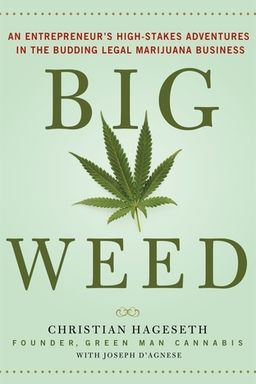
Big Weed cover

Big Weed

by Christian Hageseth

Big Weed offers a thrilling exploration into the legal marijuana industry through the eyes of entrepreneur Christian Hageseth. Discover the challenges and opportunities of this burgeoning market, learn essential business strategies, and understand the evolving legal landscape shaping the future of cannabis entrepreneurship.

Building Big Weed: Transforming a Taboo into an Industry

What does it take to turn one of the most vilified substances in American history into a mainstream, multi-billion-dollar industry? In Big Weed, entrepreneur Christian Hageseth invites readers into the trenches of the legal cannabis revolution, blending personal memoir, business building, and social commentary into a story that’s equal parts entrepreneurial guide and cultural awakening. It's the tale of how one man went from selling ice cream and real estate to growing award-winning marijuana, redefining what professionalism, legality, and opportunity look like when laws change faster than attitudes.

Hageseth argues that marijuana’s legalization represents not just a new market, but a shift in the American psyche—from stigma and secrecy to transparency and sustainability. He sees marijuana as a vehicle for personal transformation, environmental mindfulness, and capitalist renewal. But he’s also brutally honest: pioneering in legal weed means navigating paranoia, cash-only banking, endless regulation, and cultural hypocrisy. Through Green Man Cannabis—his Denver-based company that went on to win multiple Cannabis Cup awards—Hageseth explores how to craft the first major cannabis brand, one designed to rival Starbucks or Sam Adams for mainstream legitimacy.

A New Frontier of Legal Weed

The book opens during the early 2010s, when Colorado's legalization wave thrust entrepreneurs into undefined legal territory. Hageseth’s early years involved growing in converted warehouses, conducting cash deals, and designing innovative facilities that made cannabis both visible and respectable. He calls this the “New World” of weed—a sharp contrast to the old hippie underground or the black-market chaos of prohibition. He envisions a future where cannabis is a normalized consumer good, cultivated in sustainable greenhouses rather than hidden basements.

That vision crystallizes into the idea of the Green Man Cannabis Ranch, a first-of-its-kind “weedery” meant to do for marijuana what vineyards did for wine. The facility would mix cultivation, hospitality, and tourism—a destination where guests could learn, tour, and consume safely. It’s not just a business dream but an act of rebranding marijuana as legitimate culture. Through this lens, Hageseth asks you to rethink what growing a new industry means when you must build trust, infrastructure, and legal precedents all at once.

Entrepreneurship in the Wild West of Regulation

What makes Hageseth’s story particularly gripping is that it unfolds amid uncertainty. He couldn’t open a bank account, couldn’t take checks, and carried $40,000 in cash to pay vendors. Every transaction felt like walking the line between business and felony. His lawyer told him to live “open and notorious”—meaning to disclose everything to everyone—to prove legitimacy through transparency. He accepted that paradox: to be a legal drug dealer, he had to act like a corporate citizen while constrained to the edges of legality.

From the relentless licensing bureaucracy and security laws to employees dealing with burnout, Big Weed paints entrepreneurship as an act of endurance and vision. Like any startup story—echoing Howard Schultz of Starbucks or Steve Jobs of Apple—Hageseth focuses on branding, customer education, and relentless iteration. But unlike coffee or computers, his product was still federally illegal. This duality turns Big Weed into a broader reflection on American capitalism: what happens when passion for profit collides with outdated laws and social fear?

From Failure and Fear to Flourishing

The book’s heart lies in resilience. Hageseth chronicles business missteps—failed grows, untrustworthy partners, burnt crops—and transforms them into entrepreneurial lessons. Every setback forces a shift in mindset: from small-scale, paranoid growers to confident corporate operators. He coins a pattern of recognition: “More lights, more pounds; more pounds, more money.” His breakthroughs come when he realizes that the old outlaw mindset of secrecy (the Adam story) doesn’t scale. The new marijuana industry demands standardization, transparency, and professionalism.

Meanwhile, he uses vivid analogies to make the learning curve relatable. He compares the cannabis evolution to Prohibition’s repeal—a moment when vice became viable business. Just as alcohol spawned bars, brands, and billionaires, marijuana would soon require tour guides, investors, and compliance officers. But for Hageseth, the moral isn’t greed—it’s integration: proving that cannabis can coexist with community values, responsible use, and environmental healing.

Cultural Redemption and Personal Growth

Above all, Big Weed is also a personal redemption arc. The author describes how after chasing hollow wealth in real estate, marijuana became his “salvation.” The plant reconnected him to nature, family, and meaning. The psychological pivot is stark: from ego-driven CEO to visionary cultivator stewarding living things. By grounding his capitalism in nature’s rhythm, Hageseth reshapes business as a creative, almost spiritual act—one he calls his “cathedral to Mother Nature.” Through that metaphor, he implicitly invites readers—especially entrepreneurs—to consider a version of success that’s both financially and ethically high.

In the chapters that follow, Hageseth dissects each stage of building an industry: from hiring an ex-con grower who thinks the DEA will bust him at Home Depot, to learning from cannabis legends in Amsterdam, to structuring multimillion-dollar investments under state restrictions. Big Weed becomes both cautionary tale and blueprint for revolutionaries. It shows how an outlaw economy can evolve into a responsible market—and how those bold enough to believe in transformation can change not only their lives but the culture of an entire nation.


From Failure to Flowering: Learning to Grow

In the early chapters, Hageseth confesses a blunt truth: he knew nothing about plants. Yet this admission becomes the ignition point of his metamorphosis. Like many entrepreneurs, he approached a new industry with curiosity and overconfidence. He placed a Craigslist ad for a “master grower,” only to realize he was appealing to a paranoid underground of people used to hiding from law enforcement. The results were bizarre, funny, and sometimes frightening—candidates using aliases, fearing IP traces, convinced he was a narc. Hiring in the cannabis world, he learned, meant earning the trust of people who lived in constant fear.

The Anatomy of Early Failure

Hageseth’s first grow was a mess of naïveté and optimism. His hire, Adam—a Zen-like hippie who had grown underground since sixteen—introduced both experience and paranoia. Together they built a small-scale operation in a warehouse but vastly underestimated scale and design. Instead of efficient centralized systems, Adam created four tiny grow rooms with tangled cords and timers like Christmas-fused fire hazards. The plants were beautiful, but the operation bled money. Then, disaster struck: a roof fire destroyed their second harvest. His wife’s reaction captured the frustration: “I told you so.”

But failure, Hageseth insists, is “fertilizer” for growth. Each catastrophe taught him more about design, efficiency, and professionalism. The metaphor runs deep: just as weed requires precise cycles of light and patience, business requires resilience and rhythm. You can’t rush nature or entrepreneurship—both bloom on their own timelines.

The Shift from Fear to Scale

The real breakthrough came when Hageseth realized Adam’s core flaw: he represented the old marijuana world, steeped in secrecy. Adam refused to buy equipment publicly for fear of license plates being recorded. His worldview was stuck in illegality, unable to imagine scale. Hageseth needed to act like a legitimate CEO, not a basement grower. The divide between the outlaw and the entrepreneur defines much of the cannabis transition—the moment when paranoia must yield to process.

When his third harvest failed, he finally understood that success required professionalization. The next generation of growers needed electricians, ventilation engineers, architects, and horticultural scientists—not duct tape and DIY paranoia. That shift mirrored his own development: from backroom hustler to legitimate businessman fighting for an entirely new economy.

Lessons in Humility

As the story unfolds, Hageseth’s tone evolves from self-deprecating to deeply reflective. He compares his arrogance during the real estate boom—when chasing a billion-dollar deal blinded him—to the humility forced upon him by a plant that refused to conform. “Plants don’t cram,” he writes. “They follow nature’s clock.” That line becomes a mantra for entrepreneurs in any industry: growth can’t be forced. His early failure wasn’t a setback but a pruning stage, trimming away ego so that wisdom could blossom.

“It’s not enough to grow marijuana—you have to grow yourself.”

By the time he rebuilt, Hageseth transformed into a disciplined leader who saw cannabis less as rebellion and more as renewal. He replaced fear with systems, replaced burnout with curiosity, and rebuilt his team around competence. From those ashes grew Green Man’s first healthy harvest—and the seeds of a brand that would one day redefine an industry.


Money Without Banks: The Cash Crisis

Imagine running a multimillion-dollar company where you can’t accept checks, wire transfers, or credit cards—and walking around Denver with $40,000 in your backpack. That was Christian Hageseth’s everyday reality. Chapter five, “Don’t Bank On It,” exposes the surreal financial limbo of the marijuana business when federal banking laws made it illegal for banks to service dispensaries or growers. This section reads like a business thriller crossed with Kafka: monthly rent paid in $100 bills, armed cash pickups, and tax payments delivered in duffel bags.

Why the Cash Problem Exists

Because marijuana remains federally illegal, any bank handling such funds risks its charter under the Federal Deposit Insurance Corporation (FDIC). Even as states legalized sales, federal law treated marijuana income as “drug money.” So, when Hageseth founded Green Man Cannabis, every bank—regardless of state policy—eventually shut his account. One manager awkwardly confessed: “You guys are great clients, but we can’t service your account.” He even began collecting his rejection letters as “souvenirs of progress.”

The irony was glaring: Colorado’s budget deficits were being plugged with marijuana tax revenue, but the businessmen generating that revenue couldn’t legally bank their earnings. They were forced back into the shadows of physical cash—the exact criminal image they were trying to escape.

Survival in a Cash-Only World

To survive, Hageseth built a complex system of safes scattered across Denver and a holding company through which he could legally pay taxes. Employees and vendors were paid in envelopes; armored trucks became their version of mobile banking. The absurdity peaked when he had to convince contractors, architects, and even yoga studios to take cash without flinching at the phrase “drug money.” Paying taxes required literal carry-ins to the Colorado Department of Revenue.

“I am not Tony Montana. I am not Walter White. Yet every day I commit two federal crimes.”

That dark humor captures the absurd duality: he was a law-abiding taxpaying entrepreneur forced to maneuver under frameworks built for criminals. The comparison to Breaking Bad underscores his point: crime and compliance looked disturbingly similar when systems lag behind progress. The cash crisis made entrepreneurship more dangerous and expensive—armed escorts, security systems, and risk premiums raised operational costs dramatically.

Capitalism in Contradiction

For Hageseth, this paradox became symbolic of wider policy dysfunction. He couldn’t transfer funds electronically to pay federal taxes yet was required to submit them electronically. He reveals that every time he pays employees or vendors in cash, he is technically “laundering money.” His point is sharp: legality without infrastructure is still illegitimacy by another name. Through satire and outrage, the chapter becomes a meditation on how policy can suffocate innovation when ethics outpace law.

By framing banking as moral theater, Hageseth invites you to question where legality ends and hypocrisy begins. “The law forced us to behave like criminals,” he writes. In that line, Big Weed captures the essence of early cannabis capitalism: civilized in purpose, outlaw in practice.


Marijuana Mecca: Learning from Amsterdam

In chapter eleven, “Marijuana’s Mecca,” Christian Hageseth finally meets his idols and sees the future. Traveling to Amsterdam with cannabis legend Ed Rosenthal—the “Guru of Ganja”—he embarks on a cultural pilgrimage to the world’s most mature marijuana ecosystem. This journey functions as both education and revelation: what Amsterdam had achieved through tolerance, Colorado was now attempting through legalization.

Mentorship from the Masters

Dinner with Rosenthal transforms Hageseth’s understanding of cannabis. Rosenthal explains how terpenes—the aromatic compounds responsible for flavor and aroma—are nature’s chemical fingerprint, revealing how plants evolved to attract humans as partners in propagation. Smoking Rosenthal’s own “Super Bud” strain beside its namesake becomes a spiritual masterclass in craftsmanship. Later, they visit Amsterdam’s iconic cafés like Grey Area and Greenhouse Seeds, where marijuana menus mimic wine lists and strains like “Jack Herer” and “Super Lemon Haze” are discussed like vintages.

Everywhere they go, Ed is treated like royalty. For Hageseth, it’s humbling: he realizes Colorado’s revolution was built on decades of underground research by outlaws who risked everything. The tour connects cannabis history from rebellion to legitimacy, making clear that cultural acceptance always precedes economic normalization.

Seeing the Limits of Liberalism

Ironically, Amsterdam’s laws prove to be more restrictive than Colorado’s. Smoking is tolerated, but growing remains illegal. Cafés may stock only 100 grams—barely a few ounces. Supply arrives secretly by bicycle courier while tourists sit oblivious. Hageseth realizes how fragile progress is—freedom always balanced on bureaucratic contradictions. It makes him appreciate Colorado’s boldness and strengthens his resolve to build a sustainable model that doesn’t rely on government hypocrisy.

His encounters with icons like Soma of Soma Seeds—who turned his apartment into a temple of hemp, crystals, and ganja—reveal another key lesson: marijuana isn’t just commerce; it’s culture. Soma’s story, from IBM suit to dreadlocked mystic, mirrors Hageseth’s own transformation from corporate entrepreneur to green visionary. That shared lineage inspires him to keep pushing legalization toward legitimacy.

Global Legitimacy

The climax comes at the Cannabis Culture Awards hosted by the Hash, Marihuana & Hemp Museum. Hageseth finds himself among dignitaries like Richard Branson and former heads of state, all advocating for rational drug policies. That surreal mingling—businessmen and presidents celebrating cannabis reform—cements his conviction that marijuana’s normalization isn’t fringe; it’s inevitable. The contrast between Amsterdam’s tolerated cafés and America’s rising industry symbolizes a global handoff: the pioneers of rebellion passing their torch to the entrepreneurs of reform.

By the time he returns home, Hageseth’s perspective is expanded forever. He’s no longer simply running a company—he’s participating in a global shift of consciousness. And when he later wins the Cannabis Cup himself, he knows he’s standing on the shoulders of giants who turned defiance into art and art into business.


Cannabis Capitalism: The New Marijuana Economy

By the book’s final act, Hageseth transforms from outlaw entrepreneur into policy philosopher. His chapter “The New Marijuana Economy” distills lessons from the industry’s infancy into predictions for its future—and a moral challenge to every businessperson entering it. Marijuana, he argues, will shape twenty-first century capitalism the way steel or oil shaped the last. The question is: will it do so responsibly?

Predictions for a Green Gold Rush

Hageseth sees consolidation ahead: small dispensaries will vanish, large corporations will dominate. He cites Warren Buffett’s definition of capitalism as “the ability to deploy capital”—now applied to cannabis branding and logistics. Like Starbucks or Ben & Jerry’s, marijuana brands will rise through flavor loyalty—think customers debating “SkunkBerry” versus “Ghost Train Haze” like pint flavors. But industrialization brings danger: Big Tobacco and Big Pharma are circling, ready to convert artisanal weed into mass commodity. His warning is clear: without ethics, legalization risks replaying history’s corporate excesses.

Legalization’s Ripple Effect

The new economy won’t stop at dispensaries. Hageseth envisions ripple industries—tourism, packaging, consulting, software, wellness, even wedding planning. Lawyers, real estate brokers, and yoga teachers will all find niches in cannabis culture. He predicts universities will teach cannabis horticulture and retailers will pursue “micromovements”—local boutique strains like craft breweries. He calls it “the second-wave renaissance,” where cultural authenticity becomes a competitive advantage.

Still, true progress requires systemic reform: federal banking access, standardized dosing, and workplace fairness. He calls for adults to receive the same drug education about marijuana as they do tobacco and alcohol—honest risk comparison rather than fear propaganda. This mirrors scholars like Mason Tvert and Steve Fox (Marijuana Is Safer), whom he credits for reframing debate through science and reason.

The Ethical High Ground

For Hageseth, the industry’s destiny hinges on conscience. He critiques early excesses—greed, shady partnerships, underhanded investors—and advocates business grounded in transparency and compassion. His own vision, the Green Man Cannabis Ranch, aims to embody that integrity. Unlike hidden grows, it will stand in the open, powered by renewable energy, welcoming tourists and families. “From the darkness into the light,” he writes, turning the literal greenhouse into a metaphor for cultural redemption.

By tying eco-consciousness to profit, Hageseth proposes a pragmatic spirituality of business. He ends not with bravado but with gratitude: marijuana saved his career, reconnected him with nature, and healed relationships once strained by ambition. For him, the future of weed depends on whether its entrepreneurs can stay high in both purpose and practice. That’s the new marijuana economy—not the pursuit of money, but the integration of meaning, growth, and good business.

Dig Deeper

Get personalized prompts to apply these lessons to your life and deepen your understanding.

Go Deeper

Get the Full Experience

Download Insight Books for AI-powered reflections, quizzes, and more.