
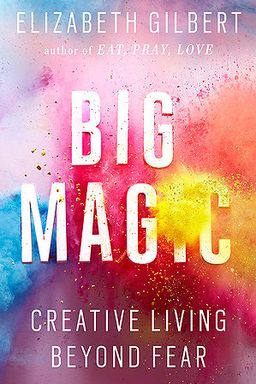
Big Magic cover

Big Magic

by Elizabeth Gilbert

Big Magic by Elizabeth Gilbert provides a roadmap to creative living, helping you overcome fear and embrace inspiration. Discover strategies to transform ideas into reality, value authenticity, and find joy in creation. It’s a guide to unleashing your inner artist and living a life driven by curiosity and true passion.

Living Beyond Fear: The Heart of Creative Life

When was the last time you felt a creative spark—an idea so vivid it almost had a pulse? In Big Magic: Creative Living Beyond Fear, Elizabeth Gilbert invites you to reclaim that spark by daring to participate in the mysteries of inspiration. Her core argument is simple yet transformative: creativity is not reserved for geniuses or professionals—it’s an inherent part of being alive. The challenge is not to find our creativity, but to find the courage to live alongside the fear that often suppresses it.

Gilbert redefines creative living as any life guided more strongly by curiosity than by fear. This isn’t about quitting your day job to paint full time or becoming the next Mozart; it’s about reclaiming the urge to make, explore, and play. Through personal stories and reflections drawn from writers, explorers, and artists—including her own struggles before and after the success of Eat Pray Love—she explores what it means to live a soul-expanding life grounded in persistence and trust rather than perfectionism or validation.

Courage as the Gateway

The foundation of Gilbert’s philosophy is courage. Every creative act, she insists, must coexist with fear. Fear is ancient—it keeps us safe—but it is also overprotective. It’s that inner voice that says, “Don’t write that book,” “Don’t try that class,” “What if you fail?” But as Gilbert reminds us, fear’s favorite word is “stop.” By learning to coexist with it, rather than eradicate it, you open the door to creative possibility. She likens this relationship to a road trip: fear comes along, but it’s forbidden to touch the steering wheel. Only courage and creativity get to drive.

The Magic of Inspiration

One of Gilbert’s most fascinating ideas is her belief that ideas themselves are living entities. In her version of magical realism, inspiration is not a psychological trick but a supernatural collaboration. Ideas, she says, float around the world “seeking human partners.” If one person ignores them, they move on to someone else. In one uncanny example, Gilbert describes abandoning a novel about the Amazon jungle, only to discover that her friend—and fellow author—Ann Patchett independently began writing nearly the same story years later, complete with identical plot details. Gilbert sees this as proof that ideas want to be born and simply find new hosts when we aren’t ready to nurture them.

Permission, Persistence, and Play

At the heart of creative freedom is the idea of permission. Too often, people wait for external validation—a degree, approval, or recognition—before daring to create. Gilbert demolishes this notion. You don’t need anyone’s permission to paint, garden, write, or dance. You simply need the willingness to begin. This playful defiance runs throughout her philosophy: she encourages you to let yourself “have an affair” with your creativity—to be enchanted, flirtatious, and passionate about it. You don’t have to make money from it, she emphasizes; don’t demand that art pay the bills if you want to keep it alive. Instead, support it through your day job and let it remain a joyful, sacred space.

Rejecting Perfection and Embracing the Process

Gilbert warns against perfectionism, calling it “fear in high heels”—a disguised form of anxiety that tells us not to start unless we can be flawless. Her alternative is to be a “disciplined half-ass”: to show up, do the work, and release it when it’s good enough. Done is better than good, a mantra she credits to her mother, allows creators to finish rather than freeze.

This humility contrasts sharply with our cultural obsession with genius. Drawing from ancient Greek and Roman ideas, Gilbert reminds us that creators once believed they had a genius—a spirit that helped guide their work—rather than that they were a genius. This distinction frees creators from taking full credit or full blame, allowing them to play, fail, and experiment without ego.

Trusting in the Process

If courage begins the journey, trust sustains it. Gilbert’s later chapters urge you to trust your creativity as something that loves you back. She challenges the cultural stereotype of the “tortured artist,” arguing that suffering doesn’t deepen art—connection, curiosity, and love do. She calls for stubborn gladness: the determination to stay grateful and curious even when inspiration fades, rejection arrives, or projects fail. The goal is not success but wonder—to live, as she says, “through devotion to inquisitiveness.”

The Sacred and the Simple

Gilbert’s closing metaphor, drawn from Balinese dance rituals, captures her philosophy perfectly. The Balinese blurred the line between sacred and profane art—adapting their sacred dances for resorts, then re-sacralizing them later when they evolved into something beautiful. Creativity, she concludes, is both divine and ordinary. It is holy, and it is play. By allowing those paradoxes to coexist—seriousness and lightness, devotion and ease—you can live a life of Big Magic.

"Creativity is sacred, and it is not sacred. What we make matters enormously, and it doesn’t matter at all." Gilbert’s paradox is her invitation—to live a bigger, braver, more enchanted life not by erasing fear, but by walking hand in hand with it.


Cultivating Courage over Fear

Fear, Gilbert argues, is our oldest evolutionary companion. It’s kept us alive for millennia, warning us away from cliffs and predators. But in creative life, fear has become overactive—like a mall cop who thinks he’s a Navy SEAL. It tries to protect you from imaginary dangers, like failure or embarrassment. The real trick, she says, is not to kill fear but to coexist with it.

Making Space for Fear—Without Letting It Drive

Gilbert personifies fear as a passenger on life’s road trip: it can come along, but it doesn’t get to choose the music or the route. This metaphor transforms fear from an obstacle into a companion you acknowledge but don’t obey. “You’re allowed to have a seat,” she writes to her fear, “but you’re not allowed to drive.” The key is not fearlessness—that’s for sociopaths and toddlers—but courage: doing the thing anyway, with fear in tow.

The Boredom of Fear

What finally pushed Gilbert to stop living as what her father called “Pitiful Pearl” wasn’t therapy or heroism—it was boredom. Fear is repetitive, she realized. Its advice is always the same: “STOP!” Whether it’s fear of rejection, fear of being too old, fear of not being perfect—it’s a script on autoplay. Creativity, on the other hand, offers surprise, color, and curiosity. By leaning into curiosity instead of fear, you trade a static life for a dynamic one.

Fear as a Sign of Life

Gilbert reframes fear as evidence that you’re growing. If you feel afraid before starting a project or sharing your art, it means you’re doing something meaningful. She encourages creatives to step into discomfort as a signal of movement and to practice “bridge moments” where they act even while trembling. Like courage researcher Brené Brown (author of Daring Greatly), Gilbert links vulnerability to creativity: fear is not the enemy, it’s proof that you care.

Courage isn’t the absence of fear—it’s a decision that something else matters more. When you choose curiosity over caution, you unlock creative potential that fear had kept sealed away.


Permission to Create

Gilbert grew up in an ordinary, non-artistic family. Her parents were practical, hardworking people—an engineer and a nurse—who raised goats, built furniture, and did everything themselves. Their quiet creativity taught her that one doesn’t need a title or degree to make things. Nobody in her family waited for permission to start projects; they simply started. That attitude became the heart of Gilbert’s creative philosophy: stop waiting for someone to tell you it’s okay to make something.

The “Arrogance of Belonging”

To live creatively, you must claim what poet David Whyte calls “the arrogance of belonging.” This isn’t arrogance in the egoic sense—it’s a gentle self-belief that you have a right to exist, speak, and contribute. Gilbert contrasts this with self-doubt’s inner critic, which says, “Who do you think you are?” The answer, she writes, should be: “I’m a child of creation, and I’m here to make things.” Without this modest arrogance, art suffocates under self-censorship.

Rejecting External Validation

Gilbert’s challenge extends to all who’ve been trained to seek approval—whether from academia, critics, or social media. She warns against paying for expensive degrees in art simply to feel “legitimate.” You can learn your craft through persistence, community, and curiosity. The greats—Dickens, Ellison, Toni Morrison—found their voices through life itself, not through permission slips. Creativity, she reminds us, is our birthright; its lineage goes back 40,000 years, to cave painters who adorned their lives not for money or fame but for joy.

Practical Freedom

Her advice is intensely practical: keep your day job, pay your bills, and write or paint anyway. Don’t demand that art support you—support it yourself. She admires artists like Toni Morrison, who wrote her first novels while working full-time and raising children. For Gilbert, the goal isn’t professional art—it’s creative living. You can be a city clerk who paints after dinner, a mechanic who plays violin at night. You don’t owe anyone a masterpiece; you owe yourself participation.

Creativity doesn’t require credentials—only an invitation from yourself. The sooner you grant it, the sooner your creative life begins.


Perfectionism: Fear in Fancy Shoes

One of Gilbert’s most piercing chapters dismantles perfectionism—the seductive illusion that if something isn’t flawless, it isn’t worth doing. She calls perfectionism “fear in fancy shoes”: a form of disguised terror that whispers, “Don’t start until you can do this perfectly.” But perfection is an illusion, she says, because art is never flawless and never finished. It’s better to be a “disciplined half-ass” who finishes imperfect work than a tortured genius who never releases anything.

Done Is Better Than Good

Gilbert’s mother taught her a mantra that changed her approach to writing: “Done is better than good.” Completion, she argues, is often the most admirable creative act, because most people never finish. To complete something—even something imperfect—is to stand miles ahead of the crowd. The creative life is messy, but it’s only through finishing imperfect projects that you become stronger for the next round.

Let the Work Go

She recounts how her novel The Signature of All Things wasn’t flawless—she could name its weak points—but it was finished, and the world didn’t end. Critics had opinions, good and bad, and then everyone moved on. What remained was her memory of the joy and transformation of writing it. She’d rather live as a “disciplined half-ass” than a frozen perfectionist. This echoes Anne Lamott’s advice in Bird by Bird about embracing “shitty first drafts”: perfectionism doesn’t protect your art; it kills it.

The Freedom of Imperfection

“Be a trickster, not a martyr,” Gilbert advises. Tricksters play, experiment, and keep things light; martyrs obsess, suffer, and die for their art. The trickster says, “Let’s make a deal,” while the martyr declares, “Death before dishonor.” Gilbert knows which side she’s on. Creativity flourishes under play, not perfection. Your crooked houses, she insists—your flawed outputs—are what make your creative life human.

Perfectionism disguises itself as virtue, but it’s really fear wearing designer shoes. To finish imperfect work is to defy that fear—and that’s when art truly lives.


Persistence and the Practice of Devotion

If inspiration is the spark, persistence is the oxygen. Gilbert calls persistence the marriage vow of creativity—the promise you make to your art to stick around even when the love cools. When she was sixteen, she literally took vows to be a writer. She didn’t promise success; she promised devotion: to write forever, “regardless of the result.”

Devotion Without Demand

In her twenties, even when unpublished and broke, Gilbert wrote every day after her waitressing shifts. She likens her practice to a musician doing scales—daily devotion to one’s craft. She never asked writing to support her financially; she supported it. Holding on to day jobs, even after her third novel was published, allowed her creativity to stay free. This philosophy protects creativity from the toxins of desperation—where art becomes a servant to survival rather than a source of joy.

Frustration Is the Process

Quoting Mark Manson’s notorious “favorite flavor of shit sandwich,” Gilbert reframes frustration as a built-in part of the creative job. Every pursuit comes with its own brand of suffering. If you love something enough, you’re willing to eat its “shit sandwich.” For her, the rejections, slow progress, and creative dry spells were worth it. As she says: “Frustration is not an interruption of your process; frustration is the process.”

Learning from Failures

Gilbert’s story of her short story “Elk Talk” encapsulates this spirit. Initially rejected by Story magazine, years later it was accepted by the same editor—who didn’t even remember turning it down. Her takeaway? Never surrender. Success often depends less on talent than on showing up again and again. Inspiration respects loyalty.

Persistence isn’t glamorous, but it’s sacred. Every time you show up for your work—tired, uncertain, uncelebrated—you renew your vows with creativity. That’s devotion.


Trust, Love, and Stubborn Gladness

The fifth pillar of Gilbert’s creative philosophy is trust—a belief that your creativity is not out to harm you. Many artists, she notes, nurture toxic relationships with their art, treating it like a cruel lover who tortures them. Gilbert flips this narrative: what if creativity actually loves you back?

Rejecting the Cult of Suffering

From Oscar Wilde’s “one long, lovely suicide” to the self-destructive legends of Hemingway and Amy Winehouse, Western culture romanticizes the suffering artist. Gilbert dismantles that myth. Art doesn’t require despair; it requires engagement. Suffering, she argues, often silences creativity—it “shrinks your world to the size of your own head.” Joy, curiosity, and play, by contrast, expand it.

The Trickster over the Martyr

Borrowing from myth, Gilbert contrasts two creative archetypes: the martyr and the trickster. The martyr dies for their art; the trickster plays with it. Martyrs say, “Life is pain.” Tricksters say, “Life is interesting.” By embracing the trickster, you engage creativity with curiosity rather than resentment. It’s a sly survival tactic for a joyful life. Brené Brown, taking Gilbert’s cue, later applied this mindset to her own work to overcome burnout—writing with laughter and tacos instead of suffering in solitude.

Stubborn Gladness

Trust culminates in what Gilbert calls “stubborn gladness”—the decision to choose joy even when things go awry. She cites Marcus Aurelius, who urged himself to create “without expecting Plato’s Republic.” You do your work because it is your nature to do so. Whether you fail or succeed, the act of making itself is its own reward.

To live creatively is to trust that your work loves you back. It isn’t trying to kill you—it’s trying to meet you halfway. All you must do is keep saying yes.


Playfulness, Curiosity, and the Joy of Making

When passion fades, Gilbert says, curiosity is your lifeline. Rather than chasing grand inspiration, follow small threads of interest. Her own novel The Signature of All Things began not with a divine fireworks moment but with a mild curiosity about gardening. That curiosity led her to study botany, evolution, and ancient expeditions—fueling years of research and eventual passion. The creative process, then, begins not with fireworks, but with gentle questions: “What am I interested in today?”

Curiosity Over Passion

Passion can be intimidating. It demands total devotion and burns out quickly. Curiosity, on the other hand, is humble—it asks only for your attention. Gilbert advises you to follow curiosity like a scavenger hunt. Each clue may lead to another, opening unforeseen paths. The end goal doesn’t matter; what matters is the pursuit. (This echoes Julia Cameron’s The Artist’s Way, where creating small, joyful acts keeps the artistic spirit alive.)

Creating for the Joy of It

The final chapters celebrate play. Through stories of musicians, painter Clive James painting stars on bicycles, and Tom Waits’s whimsical songwriting methods, Gilbert insists that art is decoration for the imagination. It’s our “intracranial jewelry,” meant to delight, not doom us. When you stop demanding that your art save the world and instead play with it, inspiration returns. As Waits realized, after years of struggle: “The only thing I do is make jewelry for the inside of people’s minds.”

When It’s Not Life or Death

For those living in safety, Gilbert reminds us—creativity is not an emergency. Most of us aren’t painting under censorship or risk of death; our art’s stakes are low. That should be liberating. If no one’s life depends on it, why not play? The stakes are low, the rewards infinite. Make something. Then make the next thing. That’s Big Magic.

Follow curiosity instead of chasing passion. Play lightly. Create freely. The joy is not in the applause—it’s in the making.

Dig Deeper

Get personalized prompts to apply these lessons to your life and deepen your understanding.

Go Deeper

Get the Full Experience

Download Insight Books for AI-powered reflections, quizzes, and more.