
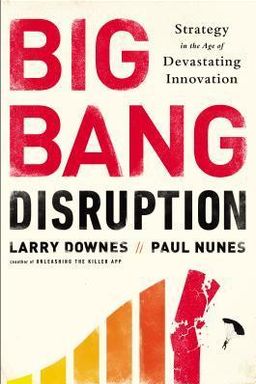
Big Bang Disruption cover

Big Bang Disruption

by Larry Downes and Paul Nunes

Big Bang Disruption reveals how businesses can survive and thrive amidst relentless innovation and market upheavals. Learn to navigate the four stages of disruption with 12 actionable rules, leverage exponential technologies, and prepare for the future of business.

Thriving in the Age of Big Bang Disruption

How can a business survive when technology changes everything—faster than ever before? In Big Bang Disruption, Larry Downes and Paul Nunes argue that the very nature of innovation has transformed. No longer does disruption happen gradually, allowing big organizations time to respond. Instead, innovations now arrive like explosions: products that are instantly better, cheaper, and more customized, toppling entire industries almost overnight.

Downes and Nunes describe a new business reality shaped by exponential technologies—those that improve at a rate faster than our ability to predict, such as computing, mobile networks, sensors, and artificial intelligence. These forces create what they call a Big Bang Disruption: a burst of innovation that simultaneously outperforms existing solutions on every level, capturing markets in weeks, not years.

A New Era of Devastating Innovation

The book identifies the profound difference between yesterday’s “disruptive innovation,” popularized by Clayton Christensen, and today’s reality. Christensen described disruption as something that started small—an inferior product serving a niche market—and improved upward until it displaced incumbents. Downes and Nunes show that in the age of digital connectivity, disruptions now appear fully formed and immediately irresistible. They enter the market as products that are better in quality, lower in price, and more customizable—all at once.

The smartphone, for example, did not rise slowly by offering cheap but limited functions. It exploded into dominance because it was immediately superior to every competing device: it replaced cameras, GPS units, clocks, MP3 players, and maps. Within a few years, entire industries were gone—from printed atlases to dedicated GPS manufacturers like TomTom and Garmin.

The Four Stages of Disruption: The Shark Fin Model

Downes and Nunes visualize the life cycle of disruptive innovation not as a gradual S-curve, but as a sharp “shark fin.” It has four stages:

  • The Singularity – The chaotic early stage, where innovators and truth-tellers experiment with new combinations of technologies without clear purpose. Think of the early days of 3-D printing or personal drones, where hobbyists and small teams created experiments that paved the way for industries.
  • The Big Bang – The sudden, meteoric rise when one combination of technologies “clicks” and scales rapidly. Twitter’s overnight growth or Airbnb’s viral rise are prime examples.
  • The Big Crunch – Saturation arrives fast; success turns into collapse as profits disappear and markets implode. The life cycle of games like Draw Something illustrates this phenomenon—rising and crashing within months.
  • Entropy – The aftermath of disruption, when remnants of the old industry are forced to reinvent, consolidate, or die. Kodak’s fall, contrasted with Fujifilm’s reinvention into healthcare and cosmetics, offers a vivid example.

Why Traditional Strategy Fails

In a world of exponential change, conventional business models break down. Michael Porter’s idea that firms must choose between being “better” (differentiation) or “cheaper” (cost leadership) no longer holds. Today’s disruptors are both. The authors show how firms like Google, Apple, and Amazon have shattered these boundaries. Their innovations—such as Google Maps and the Kindle—don’t just enter markets; they obliterate them.

Companies can no longer rely on early adopter markets to test products, because early adopters and mainstream users now adopt simultaneously. Similarly, scaling strategies built on long product cycles are obsolete. As Downes and Nunes warn, time to market is now often longer than time in market; the pace of innovation outstrips the life span of products themselves.

From Creative Destruction to Continuous Reinvention

The central challenge of Big Bang Disruption is survival in a landscape of accelerating creative destruction (a concept first introduced by economist Joseph Schumpeter). While Schumpeter described innovation as an evolutionary cycle, Downes and Nunes show that those cycles now spin much faster and reach farther. The only way to survive is to reinvent your business continuously—learning to create, scale, and abandon innovations at lightning speed.

“Few companies can operate for long at the pace of exponential change,” the authors write. “But the winners figure out how to work at the pace of a start-up, fueled by unrealistic hopes and too much caffeine.”

This book matters because it challenges every assumption about how innovation happens. It’s not just a manual for startups aiming to disrupt industries—it’s a survival guide for incumbents trying not to become the next Blockbuster or BlackBerry. You’ll learn how to spot early disruptive signals, time your market entry, survive catastrophic success, prepare for the inevitable crunch, and rebuild from the ashes of entropy. Ultimately, Big Bang Disruption teaches that the only sustainable advantage left is speed: the capability to pivot, experiment, and reinvent faster than anyone else.


The Economics of Exponential Change

To understand Big Bang Disruption, you must first grasp the mathematics of exponential change. Downes and Nunes explain that innovation today is driven by three interlocking forces that relentlessly lower costs: the cost of creation, the cost of information, and the cost of experimentation. Together, they dismantle traditional boundaries between innovation, production, and consumption.

1. The Declining Cost of Creation

Digital components get smaller, faster, and cheaper with every cycle of Moore’s Law. A phone in your pocket today has more power than a 1950s mainframe that filled a room. The same principle applies to every product built on computing power—from cameras to cars. As costs fall, creators are free to pack more performance into every design. The authors call this phenomenon “undisciplined strategy”—because now, you can make things that are simultaneously better, cheaper, and more customized.

2. The Declining Cost of Information

Near-perfect market information has changed the fundamentals of commerce. Thanks to smartphones and online reviews, you can instantly know the quality, reputation, and price of nearly anything. In the book’s memorable example, two travelers pick a restaurant not by intuition but by consulting Yelp and TripAdvisor on their phones. Traditional signals like brand or advertising no longer guarantee customer trust—peer-driven data does. Ronald Coase’s classic theory of transaction costs comes alive here: as the cost of search and coordination falls, markets become hyper-efficient, and middlemen vanish. That’s why industries like travel agencies, taxi services, and newspapers have struggled to survive.

3. The Declining Cost of Experimentation

Finally, the Internet allows entrepreneurs to experiment rapidly and cheaply. You can prototype new hardware with 3-D printers, crowdfund your idea on Kickstarter, and tweak it using community feedback—all before you even form a company. The authors trace this to a cultural shift toward what they call combinatorial innovation: building new things by recombining readily available components. MakerBot’s early 3-D printers, for example, were hacked together from off-the-shelf parts, while early drone startups emerged because smartphone sensors could be repurposed for flight.

This decline in experimentation cost turns every market into a laboratory. Even giants like General Electric and Nike now use open innovation platforms to collaborate with customers, while small inventors like the creators of the NeoLucida—a $30 update of a nineteenth-century drawing device—can raise hundreds of thousands online within days. When everyone can experiment, innovation becomes chaotic but unstoppable.

The result: old pricing and strategic models collapse. It's no longer a question of who has capital—it’s who can recombine ideas and data fastest.

When creation, information, and experimentation all get cheaper, the line between producer and consumer blurs. Customers co-design products, data itself becomes currency, and innovation migrates out of R&D labs into open networks. This is why, according to Downes and Nunes, “the life cycle of industries has become so compressed that businesses can rise and fall in the span of a college degree.”


The Shark Fin Lifecycle

Forget the traditional bell curve of product adoption. Big Bang Disruption follows a new pattern—what Downes and Nunes call the Shark Fin. Instead of slow growth, steady maturity, and gradual decline, the Shark Fin shows rapid explosion, abrupt saturation, and sudden collapse. The authors explain that survival now depends on recognizing which stage you’re in and adapting before it’s too late.

From Gradual Adoption to Instant Explosion

In the old model, innovators marketed first to early adopters, then gradually to mainstream users. Geoffrey Moore called the gap between them “the chasm.” In Big Bang markets, that chasm no longer exists. Products like Twitter, Angry Birds, or the iPhone move from experiment to mass adoption almost overnight. Near-perfect market information means everyone knows about a successful innovation at the same time. Adoption is simultaneous and viral—creating what the authors call “catastrophic success.”

A Case Study: The Rise and Fall of Pinball

The book uses the pinball industry to illustrate all four stages of the Shark Fin. Once a dominant form of arcade entertainment, pinball’s demise came suddenly. Home video consoles like the Sony PlayStation, offering better graphics and lower cost, created an immediate Big Bang. Within a few years, arcades closed and pinball vanished. Manufacturers like Williams and Bally disappeared, while a lone survivor—Stern Pinball—reinvented itself by selling machines to nostalgic home buyers. Even so, the authors note, the inevitable shift to digital ‘virtual pinball’ showed that no product, however physical or beloved, is immune to exponential technology.

Learning to Surf the Fin

Navigating the Shark Fin means excelling at four very different skills: spotting early experiments (The Singularity), surviving explosive demand (The Big Bang), scaling down fast (The Big Crunch), and letting go or reinventing after collapse (Entropy). As Nintendo’s history shows, this can mean deliberately cannibalizing your successes. Each new console—from NES to Wii—represented Nintendo’s willingness to destroy its own market before competitors did.

The Shark Fin, therefore, is not just a diagram—it’s a mindset. You must embrace impermanence, build flexible organizations, and run innovation cycles faster than traditional competitors can react. Downes and Nunes warn, “In Big Bang Disruption, you can either be the flipper or the pinball.”


The Singularity: Where Innovation Brews

Every Big Bang Disruption begins in the Singularity—a chaotic zone teeming with experimentation. Here, ideas collide, fail, and recombine until something sparks. Downes and Nunes describe this as the phase “when time to market exceeds time in market.” Products evolve faster than companies can plan for them.

Truth-Tellers: Your Early Warning System

The key to surviving the Singularity is finding what the authors call truth-tellers—people who can see the future without denial. These visionary misfits predict where industries are headed long before mainstream analysts. Kevin Ashton, the Procter & Gamble engineer who coined the term “Internet of Things,” is one such truth-teller. When he pressed his employer to experiment with RFID sensors, it wasn’t a fad—it was foresight. Leaders, the authors argue, must listen to these voices rather than silence them for being inconvenient or unconventional.

The Power of Early Experiments

In this stage, experimentation is cheap and failure is essential. Hackathons, crowdfunding, and rapid prototyping allow inventors to test ideas instantly. The creation of the NeoLucida—a modern $30 revival of a 19th-century artist’s tool—epitomizes this stage. Two art professors crowdsourced, produced, and sold out their product in a week, proving that global markets can materialize overnight without corporations or capital.

Pinpointing Market Entry

Timing is everything in the Singularity. Amazon and Apple mastered this by waiting for the perfect moment when technology, infrastructure, and consumer readiness aligned. Bezos didn’t invent the first e-reader, but the Kindle launched when screens, storage, and wireless networks matured. Similarly, Steve Jobs turned Toshiba’s forgotten 1.8-inch hard drive into the iPod’s breakthrough advantage. The lesson: study failed experiments carefully—they’re the road signs pointing to your own success.

In the Singularity, you don’t need to predict the future—you need to prototype it. The faster you test, the faster you learn, and the more likely your next experiment becomes the next Big Bang.


The Big Bang: Surviving Catastrophic Success

The Big Bang phase is exhilarating—and perilous. It’s the moment your product goes viral and everyone wants in. Twitter’s launch at South by Southwest or Airbnb’s early hypergrowth exemplify it. But Downes and Nunes call this stage “catastrophic success” because scaling too slowly kills momentum, while scaling too fast drains resources. In this stage, fortune favors the bold and the prepared.

Survive Catastrophic Success

The authors liken this to running a marathon at sprint speed. You may wake up one morning with 10,000 orders—like Dollar Shave Club after its viral YouTube ad—and realize your web servers can’t handle the demand. Airbnb nearly imploded when customer service requests overwhelmed their staff until they tripled their support team in months. Lesson: plan for success as aggressively as you plan for failure. Use flexible supply chains and cloud infrastructure that can expand instantly.

Capture Winner-Take-All Markets

In Big Bang markets, first place wins everything. Netflix dominates streaming not because of licensing luck but because it scaled faster and smarter than its rivals. Similarly, Apple’s iTunes didn’t just sell digital songs—it reinvented distribution, capturing the entire ecosystem from device to content. As Downes and Nunes note, “There’s no silver medal in a winner-take-all market.” Once consumers flock to a platform, network effects lock them in, forcing latecomers to fight over scraps.

Create Bullet Time

For incumbents under assault, one survival tactic remains: bullet time. Borrowed from The Matrix, it means slowing the disruptor just long enough to respond—often through legal, regulatory, or strategic maneuvers. Patent wars among smartphone makers, or taxi unions lobbying against Uber, are attempts at bullet time. But Downes and Nunes warn that such tactics only buy time, not salvation. Success requires using the pause to reinvent your own offerings, not to cling to the past.

In this stage, speed becomes your greatest asset. The question isn’t whether you can outrun the bear of disruption—it’s whether you can outrun the other campers.


The Big Crunch: When Success Turns to Obsolescence

After the thrill of the Big Bang comes the inevitable compression—the Big Crunch. As markets saturate and consumer attention shifts, products decline as suddenly as they rose. The danger isn’t failure; it’s being paralyzed by success. Downes and Nunes give us three survival rules: anticipate saturation, shed assets before they become liabilities, and quit while you’re ahead.

Anticipate Saturation

The story of Draw Something—acquired by Zynga for $180 million just days before its user base collapsed—illustrates how quickly fads flip into failures. Market saturation now arrives in weeks, not years. Companies must use data analytics to sense when engagement is peaking—and exit early enough to preserve profits. Starbucks learned this lesson the hard way when its over-automation and store sprawl diluted its brand. By firing its espresso machines and redesigning stores around authenticity, CEO Howard Schultz turned decline into renewal.

Shed Assets Before They Become Liabilities

In this stage, inventory and infrastructure can sink you. THQ, the video-game maker, collapsed under millions of unsold uDraw tablets, while Corning thrived by repurposing Gorilla Glass into new markets before demand fell. Smart executives, the authors argue, treat “assets as experiments”—selling, repurposing, or leasing them before depreciation destroys value. The same principle saved Texas Instruments, which pivoted from selling consumer electronics to supplying core components to others.

Quit While You’re Ahead

The boldest move is the hardest: end a profitable business before the market forces you to. Philips Lighting did exactly that by announcing the death of incandescent bulbs a decade early, shifting to LEDs on its own timetable. By leading the transition, Philips rewrote the rules and kept its industry leadership. The lesson: in the Big Crunch, courage and foresight matter more than sentimentality. The companies that survive are the ones that burn their ships before the storm burns them for you.


Entropy: Reinventing After the Fall

What happens after markets collapse? The final stage—Entropy—is where survivors reinvent themselves or fade into irrelevance. Downes and Nunes call it the “cold and lonely” end of the shark fin: when profits vanish and firms must either escape their own black holes or become something new entirely.

Escape the Black Hole

Legacy businesses like AOL, which still profits from dial-up users who don’t realize they’ve moved on, illustrate the danger of clinging to yesterday’s customers. Similarly, the U.S. Postal Service, bound by law and debt, shows how regulation can trap organizations in unsustainable models. Escaping requires brutal honesty about sunk costs and obsolete infrastructure. Companies must accept that protecting the past is costlier than building the future.

Become Someone Else’s Components

Downes and Nunes urge companies to pivot by leveraging their surviving strengths. Texas Instruments escaped by supplying its chips to others. Fujifilm turned its expertise in chemical coatings into biotechnology and cosmetics. When one market ends, your unique skills may still be valuable in another ecosystem—just not in the way you expect. As they write, “When you’re losing the war, become an arms merchant.”

Move to a New Singularity

Finally, the best incumbents create their own rebirth. They partner with startups, sponsor hackathons, and invest in venture capital arms. AT&T’s Developer Program and Citi Ventures are examples of corporations turning innovation into a renewable resource. By collaborating with entrepreneurs instead of competing against them, these companies rejoin the innovation cycle and set themselves up for the next Big Bang. As the authors conclude, the time to reinvent is not after you crash—it’s while you still have momentum.

Dig Deeper

Get personalized prompts to apply these lessons to your life and deepen your understanding.

Go Deeper

Get the Full Experience

Download Insight Books for AI-powered reflections, quizzes, and more.