
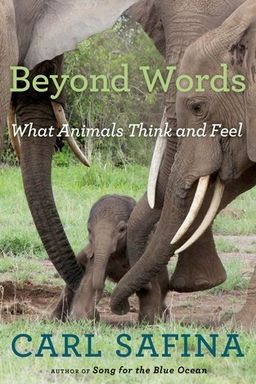
Beyond Words cover

Beyond Words

by Carl Safina

Beyond Words by Carl Safina delves into the intricate minds and feelings of animals, showcasing their complex societies and emotional depth. This enlightening exploration challenges human-centric views, revealing how animals think, feel, and communicate in ways that mirror human experiences.

Minds of Other Beings

What does it feel like to be an elephant, a wolf, or a dolphin? Carl Safina’s work radically reframes that question. He argues that human consciousness and animal consciousness aren’t separate miracles but points along a shared evolutionary continuum. Using evidence from field observation, neuroscience, and ethology, he shows you that many species live as sentient, emotional, and social individuals—beings with subjective experience, memory, empathy, and even culture.

Consciousness as Continuum

Drawing on Christof Koch’s definition (“consciousness is the thing that feels like something”) and Jaak Panksepp’s affective neuroscience, Safina rejects the idea that awareness is uniquely human. From rats responding to antidepressants to crayfish treated with anxiety drugs, neural continuity appears everywhere. Pain circuits, reward chemistry, and stress hormones are ancient tools—oxytocin shapes bonding in worms as nematocin, serotonin modulates mood in bees. These shared architectures turn the old “man versus beast” divide into a sliding scale of feeling.

Seeing Minds in Action

Safina’s field reporting lends flesh to these abstractions. Elephants respond to death with tactile ritual; wolves show political restraint and loyalty; dolphins teach and name one another; parrots and rats display compassion beyond utility. Rather than romanticizing, Safina asks you to see these scenes as evidence that cognition and emotion evolved together under social pressures. When elephant matriarchs guide families through drought or a wolf leader spares a rival, you’re witnessing mind-making behaviors—not instinctual reflexes but decisions embedded in memory and empathy.

Fieldwork over Laboratories

The book insists that real understanding begins in the field, not in sterile labs. Laboratory tests often underestimate intelligence because they ignore natural context (wolves failed pointing tests only when fenced, elephants ignored mirrors because they rely on ground vibration and scent). Watching animals where they evolved reveals flexible problem-solving, teaching, and emotional nuance that standard metrics miss.

Ethical Shifts

The central aim is moral as well as scientific. Once consciousness and feeling extend across species, every policy—regarding poaching, captivity, meat, or experimentation—becomes a moral crossroads. Elephants mourn; whales sing culturally; wolves form enduring loyalties. These traits transform them from “it” into “who.” Safina concludes that recognizing that truth changes how you use land, money, and law: conservation shifts from protecting populations to safeguarding cultures and relationships among animals.

A Human Reflection

Finally Safina flips the lens. Domestication and self-domestication have shaped us as well—humans evolved cooperative sociality by filtering aggression out through selection and culture. The saga of empathy, communication, and shared brain architecture culminates here: humans are not exceptions but outcomes of the same social and emotional evolution we trace in other animals. To understand them is, implicitly, to know ourselves.

Essential Idea

Safina’s overarching claim: many nonhuman lives are felt, storied, and socially intelligent—and realizing that fact redefines what it means to be mindful, moral, and human.


Roots of Consciousness

Safina begins with the biological bedrock: feelings are not modern perks of the human brain but ancient circuits that date back hundreds of millions of years. You learn that a worm’s bonding hormone (nematocin) and our oxytocin differ only slightly in chemistry and function. These hormonal cousins underpin attachment, empathy, and social comfort in almost every animal tested.

Deep Emotional Circuits

Jaak Panksepp’s mapping of core systems—Rage, Fear, Seeking, Play—reveals that emotional life is woven into evolution from early vertebrates onward. Roger, a human missing most of his cortex yet still self-aware, proves consciousness doesn’t rely solely on high-level architecture. Evolution recycles neural patterns: from crayfish to humans, stress and comfort are mediated through similar neurotransmitters.

The Sliding Scale

Instead of a binary—conscious versus not—Safina describes a continuum. At one extreme are simple organisms like sponges; at another are elephants, octopuses, and corvids with flexible problem-solving and emotional nuance. Between these points lie countless shades of sentience. Accepting this scale changes how you interpret evidence: bees showing pessimism after stress aren’t metaphorical—they exhibit measurable mood bias.

Scientific and Ethical Consequences

Recognizing shared roots makes welfare a quantifiable science. If crayfish exhibit anxiety, experimentation must include humane consideration; if stress alters bee cognition, farm practices must adjust. Safina pushes you toward a research ethos based on feeling as data, bridging neurology and compassion.


Social Minds and Family Memory

Across elephants, wolves, whales, and dolphins, Safina documents societies that depend on elders, learning, and kinship. These families are not aggregate herds; they’re structured cultures where individuals remember, teach, and mourn.

Elephant Matriarchs

Cynthia Moss’s Amboseli elephants embody female-led governance: matriarchs guide families off ancient routes, store drought survival maps, and transmit social etiquette. When poaching removes elders, whole clans lose knowledge, echoing human cultural collapse. Elephant grief—lingering at bones, touching tusks—reveals continuity between memory and emotion.

Wolf Leadership

Yellowstone wolves like Twenty-one and Oh-six demonstrate political acumen. Leadership relies less on aggression than restraint and cooperation. When key individuals die (often from human hunting after delisting), social networks implode—a mirror of community disruption in elephants deprived of matriarchs.

Whale Grandmothers

Post-reproductive killer whales boost descendants' survival—an evolutionary parallel to human grandmothers. Matriarchs carry sonar maps and cultural food knowledge. These societies depend on teaching; mothers train calves to hunt safely and share food, proof of learning beyond instinct. Social brains, aided by spindle neurons, enable quick moral judgment and empathy.


Communication and Translation

Safina reconstructs animal communication as a genuine language field. He shows that animals express intent, identity, and context in modes humans barely detect.

Elephants Speak in Vibrations

Elephants rumble infrasonically, sending seismic cues through ground miles away. Their calls aren’t just emotional blurts but structured signals: the “Let’s go” rumble coordinates movement; greeting rituals reinforce bonds. Field translators like Joyce Poole decode meaning through repeated association of call and context, not arbitrary human words.

Dolphin Whistles and Whale Songs

Bottlenose dolphins assign signature whistles functioning like names, remembered decades later. Humpback whales modify songs by cultural diffusion, a pattern akin to musical contagion. Killer whales maintain dialects marking clan identity—cultural fences that persist even among overlapping populations. Communication, in these cases, supports memory and belonging, not just alert or defense.

Language vs Meaning

Safina warns against anthropomorphic translation: calling a rumble “Hello” risks misleading if detached from observable behavior. Instead, true understanding arises through correlations—voice plus act plus social response. To appreciate animal language is to watch the dance of signal and life itself.


Empathy, Compassion, and Grief

Safina weaves scenes of care across species into an evolutionary ladder of empathy. Emotional contagion mutates into sympathy and finally compassion—helping behavior intended to relieve suffering.

Elephants at the Heart

You see mothers rescuing calves from rivers, families extracting trapped infants, and even elephants shielding injured humans. Daphne Sheldrick’s orphan elephants demonstrate both nurture and grief; some succumb to sorrow after losing companions.

Cross-Species Kindness

Rats free cagemates before eating chocolate; dolphins guard dying calves; parrots mourn human partners. Safina stresses that automatic empathy—mirroring emotion—may be the biochemical seed of morality. Recognizing grief repositions these species within your ethical sphere.

The Moral Expansion

By documenting earnest mourning and compassion, Safina transforms empathy from sentiment to evidence. When elephants linger at bones or wolves attend a fallen packmate, they exhibit relational consciousness. The result: empathy becomes not human exceptionalism but shared heritage.


Evolution of Friendliness

Safina connects friendliness and cooperation to evolutionary trade-offs described as domestication syndrome—a suite of changes triggered when selection favors tameness.

Patterns of Domestication

In Siberia’s fox experiment, breeding for friendliness spontaneously produced floppy ears, smaller brains, and juvenile demeanor. Genes controlling fear and aggression also shape body development and hormones; behavioral peace rewires appearance.

Self-Domestication and Human Roots

Bonobos, less violent cousins of chimpanzees, show self-domestication: flatter faces, playfulness, and sexual fluidity evolved under social rules discouraging male aggression. Humans exhibit the same pattern—smaller faces, cooperative temperament, and larger cultural life implying we domesticated ourselves through social ostracism of aggression. Our "Peter Pan" physiology—the retention of juvenile traits—represents evolutionary success through friendliness.

Key Reflection

Safina uses domestication to blur species lines, showing that evolution favors gentleness as a survival technology. The story of foxes and bonobos mirrors our own civilization’s path.


Science, Context, and Cultural Conservation

Safina’s final argument merges science with activism. Observation reveals mind, but action determines survival. Human policy, economy, and culture decide whether empathetic animal societies endure or vanish.

Policy and Pressure

Ivory bans once reduced poaching; later “legal sales” reignited slaughter. In Yellowstone, delisting wolves undid ecological recovery. Such reversals teach that politics can erase decades of progress faster than nature can adapt. Amboseli elephants roam far beyond protected borders; wolves and whales traverse invisible lines. Real conservation must treat movement and community as core design principles.

Human Dimensions

Safina emphasizes coexistence: Lucy King’s bee-fence project reduced elephant raids and gave people income; wildlife tourism grounded economic incentive in empathy. Environmental justice and cultural respect become conservation tools.

Whales Under Threat

He closes with Ken Balcomb’s orcas: once captured for aquaria, now corners of decimated salmon ecosystems. Noise pollution, toxins, and sonar destroy these social minds invisibly. Saving them means defending not only bodies but inherited culture—the songs, dialects, and familial ties passed through generations.

Final Message

Safina’s closing appeal is simple and haunting: these creatures are someone, and the fate of their stories depends on the choices you make every day.

Dig Deeper

Get personalized prompts to apply these lessons to your life and deepen your understanding.

Go Deeper

Get the Full Experience

Download Insight Books for AI-powered reflections, quizzes, and more.