
Idea 1
Moving Beyond Outrage: Reclaiming Democracy and the Economy
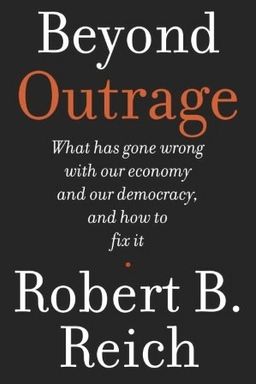
Have you ever looked around and felt the system was somehow rigged against you? Like no matter how hard you worked, the rules of prosperity seemed to benefit only a small elite? In Beyond Outrage, Robert B. Reich — former U.S. Secretary of Labor and one of today’s most respected progressive thinkers — takes direct aim at this feeling of betrayal. He argues that your sense of disillusionment isn’t misplaced: the American economy and democracy have indeed become rigged in favor of the wealthy few. But, Reich insists, outrage isn’t enough. To rescue democracy and rebuild the economy, ordinary citizens must turn indignation into action.
The book’s central argument is that systemic inequality—both economic and political—creates a self-reinforcing cycle. As wealth concentrates at the top, so too does power. This distorts not only markets but also public institutions, leading to more political decisions that favor the few at the expense of the many. Reich’s purpose isn’t simply to diagnose the disease; it’s to mobilize citizens to act. He offers a roadmap for collective engagement, arguing that true reform doesn’t come from politicians alone but from an energized public demanding accountability.
The Rigged Game
Reich begins by revealing how the structure of the U.S. economy has shifted over the past thirty years to benefit those already at the top. The richest 1% now control more wealth than the bottom 150 million Americans combined. Meanwhile, the middle class—the traditional engine of spending, productivity, and democracy—has stagnated or declined. Reich calls this the breakdown of the basic bargain—the implicit social contract that once allowed workers to be paid enough to buy what they produced. By contrast, wages today fail to support consumer demand, leading to recurring financial crises and a weakened democracy. These aren’t isolated trends; they form a web of interconnected problems that erode opportunity and unity alike.
Connecting the Dots: From Economics to Politics
The book’s early chapters read like a careful forensic report on the synergy between money and power. Reich connects seven “dots” that reveal how rising inequality feeds political corruption: stagnating wages, anemic recovery, the flow of political clout to the wealthy, deregulation, shrinking public budgets, rising social competition, and the resulting political cynicism. Each of these feeds into the next. As corporations and the super-rich secure tax loopholes and deregulation, government revenues plummet. Communities face crumbling infrastructure and overcrowded schools. Instead of solidarity, citizens turn against one another—native-born against immigrants, the private sector against public employees. The final product is a toxic political climate characterized by anger and paralysis.
Reich’s insight here is profound: the economy doesn’t exist apart from democracy—it mirrors it. When markets fail to distribute gains fairly, political institutions eventually fail to represent the public. The consequences, he argues, extend beyond income disparity to a moral crisis of public trust. “You can’t have a functioning democracy,” he warns, “when most people believe the game is rigged.”
The Rise of the Regressive Right
Reich devotes the second portion of his book to understanding what he calls the Regressive Right—a coalition of radical conservatives, corporate lobbyists, and media demagogues whose mission is to drag America back toward a social Darwinist past. Rather than conserving America’s institutions, they seek to dismantle them. This ideological movement, bankrolled by billionaires like Charles and David Koch, thrives by dividing ordinary citizens—pitting public workers against private ones, or the middle class against the poor. In his telling, the Tea Party movement’s anti-government rage was less a grass-roots phenomenon than an elite-fueled diversion from the real problem: the wealthy’s domination of government.
Beyond Anger: Toward Collective Action
Having diagnosed what’s broken, Reich turns to what must be done. His call to action is both practical and moral. Outrage, while necessary, is merely the spark. What sustains reform is organization. Citing Franklin D. Roosevelt’s admonition to reformers—“Make me do it!”—Reich argues that no president or policymaker can overcome corporate power without mass public mobilization. The final part of the book offers a blueprint: citizens must educate themselves about the system, engage in local organizing, pressure elected officials beyond election cycles, and build broad coalitions around shared values like fairness, opportunity, and accountability. He even proposes creative initiatives such as a “Corporate Pledge of Allegiance,” challenging companies to act in the public interest.
Why This Matters Now
Reich wrote Beyond Outrage in 2012, but the forces he describes—economic domination, partisan toxicity, an eroding middle class—remain vividly relevant. His insights anticipate many of today’s debates over wealth inequality, corporate influence, and the future of democratic institutions. As he notes, reform cycles are woven into the DNA of American history: every time greed and concentration threaten democracy, the public eventually rallies back—whether through the Progressive Era, the New Deal, or the Civil Rights Movement. The question Reich poses to you, the reader, is timeless: will you move beyond outrage to shape the next great reform movement yourself?
“Moral outrage is the prerequisite for social change,” Reich reminds us. “But by itself, it accomplishes nothing. Only when people act together—mobilized, organized, energized—does real change happen.”