
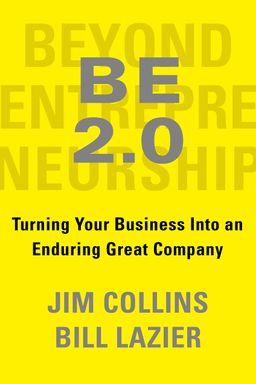
Beyond Entrepreneurship 20 cover

Beyond Entrepreneurship 20

by Jim Collins and Bill Lazier

Beyond Entrepreneurship 2.0 is a modern business playbook that blends classic advice with current case studies, helping entrepreneurs turn their businesses into lasting enterprises. Learn to harness leadership, vision, and discipline to capitalize on opportunities and drive sustained success.

Greatness Built Through People, Purpose, and Discipline

Why do some organizations achieve greatness that lasts for decades while others fade after bursts of early success? In BE 2.0, Jim Collins (co-author of Built to Last and Good to Great) argues that enduring greatness is not a function of luck or genius—it is the result of disciplined people, disciplined thought, and disciplined action all aligned around a clear sense of purpose. He advances the idea that leadership greatness comes from humility, resolve, and the ability to build an organization stronger than any one individual.

The book expands on Collins’s foundational framework: first who, then what; Level 5 leadership; vision-driven strategy; the flywheel and 20-Mile March; and return on luck. It shows how to weave people decisions, cultural values, strategic focus, innovation, and disciplined execution into a system that not only wins today but endures across generations. You’ll see examples from Apple, Pixar, Patagonia, L.L.Bean, Merck, Intel, and Southwest—all compounding lessons about leadership maturity and organizational design.

Disciplined People First

Everything begins with people. A brilliant vision can crumble without disciplined execution, and the wrong people can turn even inspired ideas into failure. Collins’s bus metaphor—get the right people on before you decide where to drive it—underscores that talent selection and cultural alignment precede strategy. He suggests tracking one crucial metric: the percentage of key seats filled with the right people. If fewer than 90% of your seats contain the right people, fix that before anything else. True greatness depends more on who joins the journey than on where you plan to go.

Leadership as Service and Stewardship

Unlike celebrity CEOs, Level 5 leaders combine humility and fierce resolve. They channel ambition toward the mission and the institution rather than personal fame. Katharine Graham at The Washington Post and Anne Mulcahy at Xerox exemplify this kind of stewardship—leaders who absorbed blame, distributed credit, and built systems that survived their departure. Collins reminds you that leadership maturity often evolves—Steve Jobs transformed from an impulsive genius (Jobs 1.0) into a disciplined architect of Apple’s sustainability (Jobs 2.0). The question to ask daily is not “How do I look as a leader?” but “What cause do I serve?”

Vision Beyond Profit

Collins’s vision framework distinguishes between immutable core values, enduring purpose, and time-bound missions or BHAGs (Big Hairy Audacious Goals). Values are your DNA—they rarely change. Purpose answers why you exist beyond money. BHAGs focus energy around a compelling mountain to climb. Merck’s dedication to human life, or DPR’s rallying cry to “build great things,” show how purpose and BHAGs combine to inspire commitment and guide decision-making. Beware the “we’ve arrived” trap—when a company achieves one mission, it must define the next mountain to sustain momentum.

Discipline as a System

The engine of endurance runs on disciplined thought and disciplined action. Concepts like the Hedgehog, Flywheel, and 20-Mile March form the execution core. Find your Hedgehog—the intersection of passion, excellence, and economic logic—and use it to focus resources. Push your Flywheel consistently through a sequence of small wins until momentum compounds. Commit to a 20-Mile March: a consistent performance rhythm that resists overreach in good times and paralysis in bad ones. Fire bullets (small, low-risk experiments) before cannonballs (large strategic investments) to avoid catastrophic bets. Collins calls this disciplined empiricism—the philosophy of testing before scaling.

Luck, Persistence, and Endurance

Luck matters, but return on luck—the ability to capitalize on it—distinguishes great companies from average ones. Tommy Caldwell’s persistence climbing the Dawn Wall and Jobs’s resilience after Apple’s rejection both highlight that enduring success favors the persistent, not the fortunate. Great organizations prepare systems, buffers, and adaptability to seize opportunity and survive bad luck. Their final test lies in three outputs: superior results, distinctive impact, and lasting endurance.

From Values to Practices

Throughout BE 2.0, Collins and Lazier transcend textbook strategy by grounding success in human behavior. They show that respect and trust forge speed; autonomy and small teams spark innovation; and SMaC systems (Specific, Methodical, Consistent) turn vision into reliable performance. Execution excellence depends on clear ownership—one person ultimately responsible (OPUR)—and disciplined milestone management. Culture, not slogans, is your operating system: people do extraordinary things when they feel respected, trusted, and inspired by purpose.

Ultimately, Collins’s formula for enduring greatness is simple yet demanding: disciplined people who are humble and resolute; disciplined thought that aligns vision with empirical reality; and disciplined action that converts purpose into consistent results. Combine those elements, and your company—and your leadership—can endure well beyond you.


People First and Cultural Foundations

Collins insists that people decisions determine long-term destiny. Vision and strategy are fragile without the right team to execute them. When you prioritize hiring for values and adaptability over short-term fit, you create an enterprise capable of evolution. Great leaders obsess over one metric: the percentage of key seats filled with the right people. If you are below 90%, your first job is to fix it.

Hiring for Values and Adaptability

Hire people who embody your values and can adapt as the company changes. Ed Catmull’s Pixar principle captures it perfectly: great people can turn bad ideas into masterpieces, but bad people ruin even great ideas. Jorge Paulo Lemann’s “People Machine” demonstrates how a culture that relentlessly recruits flexible, meritocratic talent creates sustainable growth. In short, choose talent based on cultural DNA rather than static skillsets.

Grow Yourself to Grow Others

You cannot develop your people unless you develop yourself. Anne Bakar’s Telecare story illustrates this: as her company scaled, she grew into the leader it needed. Great leaders model continual learning. By being visibly engaged in improvement, you authorize others to do the same. Culture cascades from the top; your growth signals permission and expectation for collective growth.

Trust and Respect as Performance Engines

Bill Lazier’s “Trust Wager” asks leaders to start from trust and accept occasional disappointment. Trust, when paired with discretion, creates a virtuous cycle: trust begets responsibility, and responsibility yields performance and loyalty. Respect infuses this ethic—companies like L.L.Bean or FedEx thrive on radical respect for workers and customers alike. Respect in practice—clear accountability, recognition, and fairness—generates speed and voluntary effort that no micromanagement can buy.

People decisions, cultural discipline, and psychological trust form the foundation of enduring excellence. Get these right, and everything else becomes easier to improve and scale.


Leadership That Endures

Level 5 leadership sits at the heart of Collins’s model. These leaders combine humility with fierce resolve—a paradox rare but powerful. They channel personal ambition toward purpose and institutional success rather than self-promotion. Charismatic personalities can spark temporary triumphs; Level 5s build legacies that last.

Humility Plus Resolve

Level 5 leaders view success as collective and failure as personal. They point out the window in success (crediting others) and into the mirror in failure (accepting responsibility). Dwight Eisenhower and Katharine Graham exemplified this selfless stewardship. True ambition is about advancing the mission, not the ego. Collins’s data show such leaders produce organizations that outperform and survive succession transitions.

Cultivating Level 5 in Yourself

Ask yourself daily, “What cause do I serve?” Real humility grows from devotion to something bigger than you—whether it’s a product, team, or ideal. Support others’ growth instead of hogging spotlight moments. As General Lloyd Austin notes, “Take care of your people, and your career takes care of itself.” Encourage team-focused recognition and build successors who can run their own minibuses effectively.

Discipline Over Glamour

Level 5 leaders prefer disciplined habits to dramatic gestures. They act methodically, confront facts bravely, and persist through setbacks. Their modesty conceals their tenacity—they simply keep turning the flywheel until momentum compounds beyond personal reach. You grow into Level 5 through experience, reflection, and purpose clarity. That journey transforms leadership from position to vocation.


Vision Anchored in Purpose and BHAGs

A clear and compelling vision gives an enduring organization direction and meaning. Collins’s vision framework integrates three pillars: core values, purpose, and BHAGs (Big Hairy Audacious Goals). Each plays a unique role: values define identity, purpose defines why you exist, and BHAGs define what mountain you’re climbing now.

Values as Organizational DNA

Values must be authentic, not invented for branding. Hewlett-Packard’s respect-for-people ethic and L.L.Bean’s customer promise exemplify this integrity. You don’t “trade” values for expediency; they rarely change. Use values to decide whom to hire, what projects to pursue, and how to behave under pressure.

Purpose Beyond Profit

Purpose answers the question: why do we exist? It guides decades-long decisions. Merck’s mission “to preserve and improve human life” reflects this enduring orientation. It’s broad enough to withstand strategy shifts yet meaningful enough to inspire employees. A purpose beyond profit fuels intrinsic motivation and stewardship.

BHAGs: The Mountain You Climb Next

Unlike purpose, BHAGs are finite. They give urgency and focus. DPR’s 2000 goal to become a great construction company galvanized its team. Kennedy’s moon-shoot defined an era. BHAGs reallocate resources and force concrete milestones. When one is achieved, set a new one immediately; complacency kills progress. Communicate your vision through vivid imagery—pictures and stories ignite belief more than metrics ever will.

Vision transforms abstract purpose into tangible pursuit. Keep values sacred, express purpose clearly, and pick audacious mountains that reenergize your team generation after generation.


Disciplined Thought and Strategic Clarity

Discipline separates fleeting success from enduring greatness. Collins outlines several frameworks—Genius of the AND, Hedgehog Concept, Flywheel, and 20-Mile March—that all illustrate how disciplined thought translates into execution clarity. Each helps you confront reality, channel effort, and sustain results without burnout or overreach.

Genius of the AND

Reject false choices. The most effective organizations combine opposites: creativity and discipline, long-term and short-term, humility and audacity. This intellectual flexibility allows leaders to hold tensions and find balanced solutions. It keeps thinking sharp and prevents polarization around extremes.

Hedgehog Focus

Clarify what you’re deeply passionate about, what you can be best at, and what drives your economic engine. That intersection is your strategic north star. Bob Miller at MIPS demonstrated this clarity by asking, “What do we want to be five to ten years from now?” Once answered, difficult trade-offs became simpler.

Flywheel and 20-Mile March

Progress accumulates through consistent turns of the flywheel—each solid decision builds momentum. The 20-Mile March reinforces the discipline of steady pace regardless of conditions. Great companies hit achievable performance marks annually through both boom and recession. Together these create reliability that compounds into breakthrough.

Fire Bullets, Then Cannonballs

Experiment small to learn cheaply, validate results, then scale with confidence. Intel’s memory-chip story demonstrates this: the founders tested bullets, found empirical success, and then fired the cannonball that defined their future. You lower risk and increase learning by sequencing experimentation this way.


From Vision to Strategy and Execution

Strategy transforms vision into practical moves. Collins teaches you to start with vision—values, purpose, BHAG—then create a three- to five-year plan that spells out how to achieve it. Strategy should be realistic, leverage strengths, and involve implementers early. It succeeds only when translated into concrete, measurable priorities.

Vision First, Always

Without shared vision, strategy dissolves in departmental confusion. Hardrock Products aimed to be #1 in rock-climbing gear, and that clarity shaped product focus, hiring, and pricing. Make sure employees understand the mountain you intend to climb—vision slots every later move.

SMaC and OPUR Discipline

Turn plans into execution reliability through SMaC—Specific, Methodical, Consistent processes. Assign OPURs (One Person Ultimately Responsible) for each major task to ensure clear accountability. Use milestones with firm deadlines proposed by the responsible owner. Commitment drives performance far better than imposed dates.

Measure and Learn

Measure progress relentlessly—shipment accuracy, service indices, turnaround times—and use After-Action Reviews to learn. Track results publicly so everyone sees what matters. Measurement plus disciplined learning updates your SMaC system continuously, increasing repeatability and resilience.

In practice, strategy is a living bridge between vision and action. Make it clear, assign ownership, track progress, and refine habits. That is how lofty purpose turns into predictable excellence.


Innovation, Growth, and Productive Paranoia

A great company must continuously reinvent itself. Collins identifies innovation as a repeatable system—not a lucky break. You create this by cultivating receptivity, autonomy, experimentation, and fair reward. Simultaneously, you grow at a sustainable pace and protect flanks through buffers and paranoia.

Systemic Innovation

Be receptive to ideas from everywhere. Encourage inbound suggestions, hire creative outsiders, and become your own customer so you solve real problems (like Brian Maxwell with Powerbar). Treat each initiative as an experiment: fire bullets, learn, and scale the winners. Maintain a “popcorn” culture—many small teams running concurrent trials. Reward innovators visibly to motivate learning.

Choosing Growth Rates Wisely

Growth must match capability. Rapid expansion often erodes margins and culture—Lightcraft One’s troubles prove it. Slower growth can yield higher returns and stability, as University National Bank showed. Select your rate consciously based on mission: audacious but sustainable. Hewlett’s warning “don’t grow too fast” endures as sage advice.

Productive Paranoia and Buffers

Protect your flanks with reserves and foresight. Great-by-Choice research reveals enduring firms maintain conservative balance sheets and build buffers in good times. Churchill’s twenty-five squadrons metaphor illustrates preparation as defense and opportunity. Productive paranoia means thinking about what could kill you—then acting early to prevent it.

A balanced organization innovates constantly, grows deliberately, and remains calmly paranoid. That triad keeps creativity alive and survival certain.


Luck, Endurance, and the Outputs of Greatness

Collins’s concept of “Return on Luck” reframes randomness as opportunity management. Great companies do not receive more luck; they extract more value from the luck they get and are prepared to withstand misfortune. Luck becomes neutral—it’s your response that defines the outcome.

How to Handle Luck Events

A luck event is any unexpected external occurrence with significant potential impact. The skill lies in pivoting quickly when good luck strikes and buffering effectively when bad luck hits. Steve Jobs’s firing and comeback demonstrate this mastery—his persistence kept him in position to leverage chance when Apple needed NeXT years later.

Persistence and Preparation

Tommy Caldwell’s climb of the Dawn Wall epitomizes persistence intersecting with favorable luck. Nineteen days of perfect weather arrived only after years of painful iteration. Similarly, companies earn good luck through readiness—productive effort attracts serendipity. The moral: keep showing up and build systems ready to scale instantly when fortune smiles.

Judging Greatness

Three outputs quantify enduring greatness: superior results (sustained performance), distinctive impact (a meaningful difference others cannot easily replicate), and lasting endurance (an identity that persists beyond market cycles or leadership changes). Fewer than ten percent of companies achieve all three—because most neglect disciplined preparation for luck and longevity.

You cannot control the winds, but you can build a ship that sails true. That ship—disciplined people, resilient systems, and a clear purpose—delivers high return on luck and fulfills the definition of greatness that endures.

Dig Deeper

Get personalized prompts to apply these lessons to your life and deepen your understanding.

Go Deeper

Get the Full Experience

Download Insight Books for AI-powered reflections, quizzes, and more.