
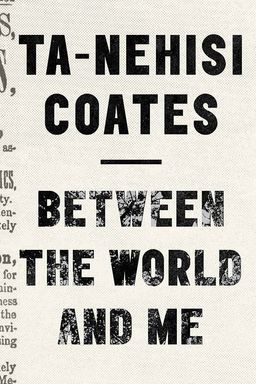
Between the World and Me cover

Between the World and Me

by Ta-Nehisi Coates

Between the World and Me is a profound letter from Ta-Nehisi Coates to his son, detailing the harsh realities of being Black in America. Through personal stories and historical context, Coates examines systemic racism, offering a powerful narrative on identity, resilience, and hope for future generations.

Living in the Shadow of the American Dream

How can you live freely when your body itself is defined as an object of fear? In Between the World and Me, Ta-Nehisi Coates writes to his son to explore this haunting question. Presented as an intimate letter, the book reflects on what it means to inhabit a Black body in America—a nation built on dreams of freedom yet sustained through the exploitation of those bodies. Coates contends that America’s “Dream,” that glittering ideal of perfect houses and lawns, is not a collective triumph but a haunted mirage sustained by plunder, violence, and forgetting. His book seeks not to comfort but to awaken readers to the visceral truth that race itself was invented to justify the domination of certain people by others.

The Dream and the Body

Coates begins with an encounter on a television talk show, where a journalist asks him to explain what it means to “lose his body.” That question expands into the central metaphor of the book: the Black body as the site where American abstractions—freedom, democracy, opportunity—have always turned violent. He urges his son never to forget that racism is not merely a social ill but a physical assault, one that “dislodges brains, blocks airways, rips muscle, extracts organs, cracks bones, and breaks teeth.” America’s progress, Coates argues, is inseparable from this centuries-long confiscation of Black life and labor.

Throughout the book, Coates contrasts this grim knowledge with America’s cherished self-image—a country of idealists, dreamers, and innocent believers. “The Dream,” as he calls it, is white America’s myth of safety and prosperity. Its sweetness lies in treehouses and cookouts, but its foundation lies in the brutal subjugation of generations. Coates mourns not only the tragedy of that theft but the seductive peace of ignorance denied to him and his son. Where others can sleep unfazed by history, Black people must live awake, burdened by the truth of their vulnerability.

Fear as Inheritance

One of Coates’s most striking ideas is that fear among Black Americans is not pathology but inheritance. Growing up in Baltimore, he sees fear everywhere—in the sharp clothes and swagger of street boys, the belts of anxious fathers, and the laughter of girls who wield defiance like armor. Each act is a defensive performance against a world primed to destroy them. Coates realizes that this pervasive fear was the logical product of history, an echo of the lynch mobs and slave patrols that once claimed Black lives with impunity. The streets and schools of Baltimore may seem their own prisons, but they are modern manifestations of the same design.

The Search for Meaning and Identity

As Coates recounts his intellectual journey—from Black Panther literature and Malcolm X’s speeches to Howard University’s campus, “The Mecca”—he reimagines Black identity as something that transcends victimhood. Howard becomes a cosmic gathering of the African diaspora, a living museum of Black possibility. There, his understanding shifts from nationalism and myth toward critical consciousness. He learns that being “Black” is not biological destiny but historical invention, and yet within that invention lies real beauty and culture. His eventual realization—that the search for nobility in skin color mirrors the very logic of the Dream—marks his evolution from nationalist to humanist.

Parenthood and the Limits of Protection

Writing to his fifteen-year-old son, Coates refuses to offer false reassurance. After the non-indictment of Michael Brown’s killers, he cannot promise safety or redemption. Instead, he insists that to live freely in a Black body requires a constant awareness of its fragility. Love, for Black parents, often carries the guilt of fear—the impulse to toughen children against a world bent on breaking them. His letter exposes the painful contradiction at the heart of Black fatherhood: the desire to nurture joy and softness, paired with the duty to teach survival.

From Individual Tragedy to Collective Reckoning

The murder of Prince Jones, a Howard friend killed by police, crystallizes Coates’s understanding that such violence is not an aberration but the logical outcome of a society built on hierarchy and fear. Even those striving and educated—“twice as good”—remain vulnerable, because no accumulation of status can erase the mark of race. Prince’s death, like that of countless others, represents not the moral failure of individuals but the systemic continuation of America’s founding thefts.

Why It Matters Now

Ultimately, Coates’s letter is not a manual for survival but an invitation to consciousness. He rejects hope when hope demands forgetting; instead, he advocates struggle—not because struggle ensures victory, but because it preserves our humanity. His insight resonates far beyond race, echoing James Baldwin’s warning that “they think they are white”—a delusion that endangers not only Black lives but the planet itself. The Dreamers’ addiction to innocence, Coates warns, fuels not only racism but environmental destruction, as the same logic of exploitation extends to the earth.

Reading Between the World and Me confronts you with uncomfortable truths about power, belonging, and identity. It asks that you look directly at the bones beneath democracy’s smile. You walk away not with easy resolution, but with a sharpened awareness—that liberation begins not in comfort but in clarity.


Race as an Invention, Not a Truth

Coates dismantles one of America’s most enduring ideas: that race is a natural or biological fact. He reframes it as an invention—a deliberate construct used to rationalize exploitation. “Race is the child of racism, not the father,” he writes. That reversal changes everything. It means that the hierarchies we take as inevitable are human designs, not cosmic laws.

The Machinery of Whiteness

According to Coates, whiteness did not exist as a fixed identity until people found profit in defining it. Catholics, Jews, Welsh, and Corsicans were once separate tribes, but each was washed “white” through the flaying of other bodies. Whiteness became less an ethnicity than a badge of privilege—a title granted through exclusion. The “new people who believe they are white” were born not from culture but from conquest. Their lineage is power itself.

The Illusion of Innocence

To maintain their innocence, Coates explains, Americans reframe racism as a natural disaster—like a tornado or earthquake—rather than a deliberate act of human will. This absolves them of accountability. Slavery, segregation, and police violence are treated as unfortunate but inevitable events, not deliberate crimes. In this way, the fiction of race shields the Dreamers from moral reckoning. They can remain good people living in a good country, even as they benefit from plunder.

Why This Matters

Understanding race as invention liberates us from fatalism. If race is constructed, it can be dismantled. Coates invites readers to view America’s contradictions not as flaws in an otherwise noble experiment but as the essence of its creation. The political term “the people” has always excluded certain bodies. Genuine democracy, he suggests, requires facing that history, not romanticizing it.

(Note: Coates’s view parallels thinkers like James Baldwin and Toni Morrison, who argued that “whiteness” is a moral posture, not a color—a way of avoiding history by pretending it isn’t yours.)


The Geography of Fear

Coates’s childhood in Baltimore reveals how fear becomes geography—how neighborhoods, schools, and daily routines are structured around protecting the body. For Black children, each day is navigation through invisible but lethal boundaries. Unlike thrill-seekers who flirt with danger for excitement, Coates and his peers never choose the edge; it is simply where they live.

Streets and Schools as Dual Prisons

He describes the streets as coded worlds where missteps can cost your life: a wrong glance, a misread tone. At school, a failure to comply—talking back, straying from the rules—means eventual return to those same streets. Both systems deliver the same lesson: survival requires submission. Coates’s father’s warning—“Either I can beat him or the police”—captures the grim logic of parenting amid fear. Violence becomes both punishment and protection.

Children Without Innocence

Unlike in the Dream, where childhood is idyllic and secure, Black children are denied innocence. Their days are measured not by cartoons and homework but by vigilance. They must learn early how to guard their bodies—their walk, expression, and tone—and how to avoid becoming a target. Fear substitutes for freedom, and even love carries danger. When Coates’s mother beats him “to beat him back to life,” it is love weaponized by terror, tenderness twisted into defense.

Why This Fear Persists

This fear is not accidental. It is the predictable result of a state that polices Black mobility but subsidizes white comfort through home loans and generational wealth. While the Dream guarantees safety to some, others must earn survival through discipline and pain. The law defends property more than people. Coates’s insight reframes violence not as deviance but as design—the intended consequence of policies stretching back centuries.

The geography of fear, then, is not confined to Baltimore. It is the map of America itself, organized by red lines and remembered beatings—a landscape of bodies marked for caution.


Howard University and the Mecca of Identity

When Coates arrives at Howard University, he encounters a miraculous collision of the Black diaspora—his “Mecca.” It is not merely college but a galaxy where Blackness manifests in infinite variations. Here, he discovers that Black identity is not singular but cosmic, stretching from Ghana to Gary, Lagos to Los Angeles.

Multiplicity and Liberation

On the Yard, Coates sees African aristocrats in suits shaking hands with street poets in Timbs, Muslim women in hijabs debating Pan-Africanists, and jazz musicians carrying instruments where others once carried books. Each encounter fractures narrow definitions of what “Black” means. This realization dismantles the binary between “white world” and “Black world.” At The Mecca, Blackness becomes not opposition but complexity.

The End of Simple Narratives

Coates enters Howard seeking heroes—royalty from Africa, saints of resistance—but finds arguments instead. Hurston battles Hughes, Du Bois debates Garvey, and scholars like Linda Heywood force him to confront uncomfortable truths: even African empires were built on class and conquest. True study, he learns, is not worship but questioning. His professors destroy his romantic nationalism, teaching him to differentiate between myth and evidence. Education becomes liberation from illusion, not validation of pride.

Art and Self-Awakening

Through poetry and journalism, Coates channels this awakening into art. Writing becomes a discipline of truth—the practice his mother began when she made him write essays on his behavior. At Howard, he learns that the act of questioning is itself freedom. The Mecca introduces both joy and discomfort, reminding him that discord and confusion are the necessary conditions of growth. In the end, he emerges not as a nationalist but as a seeker—a thinker who sees beauty and terror intertwined.

(Note: This turning point recalls the intellectual journey of Baldwin at Harlem and Wright in Chicago—each moving from racial pride toward radical doubt as a form of honesty.)


Parenting and the Fragility of Love

Coates writes through the lens of fatherhood, addressing his son Samori amid national headlines of Black death. His letter reveals a paradox at the heart of Black parenting: the need to protect through truth, not comfort. Unlike sentimental traditions that promise redemption, Coates warns that survival demands realism. Love, in his world, is inseparable from fear.

The Limits of Protection

When Michael Brown’s killers go free, Coates resists the urge to say “it will be okay.” To do so, he says, would be deceit. He teaches his son that no faith, no polite behavior, no education can perfectly secure the Black body. Parental love cannot outvote national policy. Yet passing on fear is not cynicism—it is honesty that empowers awareness.

Inheritance of Struggle

Through his son’s eyes, Coates revisits the continuum of fear stretching from enslaved ancestors to contemporary police shootings. He understands his mother’s fierce discipline anew; it was rebellion against helplessness. Now he must teach his child to live without false safety, but with purpose. The name “Samori,” echoing the African freedom fighter Samori Touré, becomes emblematic of resistance—not triumph, but continual engagement against domination.

A New Vision of Hope

Though he rejects “hope” in the comforting sense, Coates offers another kind: the resolve to struggle meaningfully, even without guarantee. The reward of this awareness is depth. To live without illusions is to live awake. The lesson he gives his son—and, by extension, the reader—is not “be twice as good,” but be conscious, and live fully within your humanity.


The Death of Prince Jones and the Machinery of Plunder

The murder of Prince Jones by police becomes the book’s emotional and political fulcrum. For Coates, Prince’s killing is no isolated tragedy—it is the inevitable consequence of a system designed to protect the Dream at any cost. Even Jones, privileged and pious, could not transcend the mark placed upon his body.

From Fear to Rage

Though the officer who killed Jones was Black, Coates refuses to interpret this as contradiction. The police, he writes, are not fascist exceptions but reflections of America itself—the democratic will made visible. Their authority stems from collective belief, from citizens who demand security even when it requires domination. This insight turns local crime into national conscience.

Forgiveness and the Void

At Jones’s funeral, mourners call for forgiveness; Coates cannot join them. He professes atheism: there is no divine redemption for systemic crimes. The death of a man is the death of a universe. This denial of transcendence makes his grief sharper but more real. He refuses the soothing fable that loss ennobles; he insists that loss obliterates.

The Economics of Theft

Jones’s death represents centuries of extraction—the conversion of bodies into wealth. From plantations to prisons, Black labor and suffering have financed the Dream. Even modern “safety” narratives—homeownership, policing, suburban order—repackage old forms of control. Coates’s journalism, studying redlining and mass incarceration, reveals continuity: plunder persists through law and bureaucracy rather than open chains.

Each indignity accumulates, from Jones’s shattered body to the tears of his mother to the stolen futures of his daughter. Their grief is not private—it is national debt.


Awakening Beyond the Dream

In the book’s final movement, Coates offers not solace but clarity. Visiting the mother of Prince Jones years later, he encounters a mirror of strength and sorrow. Her composure—calm amid devastation—embodies the paradox of surviving in America as Black and still human. Through her, Coates redefines resistance as endurance, not reconciliation.

The Dreamers and Their Sleep

Dr. Mable Jones tells him, “We don’t understand that we are embracing our deaths.” She speaks as someone who has achieved the highest rungs of respectability only to see it stripped away. For Coates, she symbolizes the fatal reach of the Dream—that even success within its rules cannot protect the body from its appetite. America’s forgetfulness of its foundations is the real act of violence: the willful erasure that makes repetition possible.

The Broader Reckoning

Coates weaves this personal tragedy into planetary logic. The same mindset that plunders Black bodies—extract, consume, deny consequence—now plunders the earth. The Dream’s hunger for innocence demands endless exploitation. Like James Baldwin, Coates foresees collapse, not as revenge but inevitability. The planet itself, he warns, will revolt before the Dreamers do.

Living, Struggling, Remembering

Still, Coates refuses despair. He ends where he began—with his son, urging him to struggle consciously. “Do not struggle for the Dreamers,” he writes. “Struggle for your ancestors, for wisdom, for the warmth of The Mecca.” Freedom lies not in escape but in awareness. To live fully is to remember that every body—your own, your family’s, your planet’s—is fragile, finite, and sacred.

In that truth, Coates finds meaning enough: not salvation, but sense, not paradise, but presence. Between the world and him, there remains pain—but also possibility.

Dig Deeper

Get personalized prompts to apply these lessons to your life and deepen your understanding.

Go Deeper

Get the Full Experience

Download Insight Books for AI-powered reflections, quizzes, and more.