
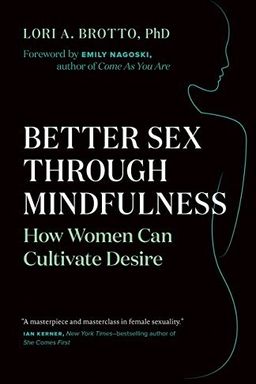
Better Sex Through Mindfulness cover

Better Sex Through Mindfulness

by Lori A Brotto, PhD

Better Sex Through Mindfulness by Lori A Brotto, PhD, delves into how mindfulness can address the root causes of sexual dissatisfaction. By focusing on presence and body awareness, women can enhance desire and satisfaction, both inside and outside the bedroom.

Mindfulness: The Missing Ingredient in Sexual Fulfillment

When was the last time you were truly present during sex—fully aware of each sensation, smell, and emotion without worrying about how you looked, whether you’d finish, or what your partner was thinking? In Better Sex Through Mindfulness, Dr. Lori Brotto, a psychologist and researcher at the University of British Columbia, makes a revolutionary claim: the best way to rekindle desire and deepen sexual pleasure isn’t through pills or hormonal fixes—it’s through attention. Specifically, through the ancient practice of mindfulness.

The book argues that women's sexual difficulties, particularly low desire and arousal, are not flaws or dysfunctions but natural expressions deeply affected by stress, depression, cultural conditioning, and disconnection from their own bodies. Brotto contends that when a woman learns to pay attention—nonjudgmentally and compassionately—to her sensations, emotions, and sexual triggers, she can break free from shame and reclaim authentic desire. In short, mindfulness reconnects body and mind, the very circuit that many modern women have been taught to suppress.

Why Attention Matters

Brotto begins with an unsettling truth: nearly half of all women around the world experience some form of sexual difficulty. Large-scale studies, from the United States to the Middle East, show that low interest and unsatisfying sex are alarmingly common—and getting more frequent as chronic stress and multitasking dominate modern life. Our attention, she says, is scattered like a puppy chasing distractions. We text, plan, monitor performance—even during intimacy. Our bodies may respond automatically, but our minds are elsewhere. The result? Desire dwindles, pleasure fades, and sex feels mechanical.

Mindfulness teaches us to retrain attention—to notice sensations, thoughts, and emotions in the moment without judgment or effort to change them. This shift from performance to presence restores the natural link between physical arousal and mental excitement. Brotto calls this a radical yet gentle form of sexual healing: one where you cultivate awareness instead of striving for perfection.

The Science Behind Mindful Sex

Decades of research inform Brotto’s work. She and collaborators examined brain activity, genital response, and emotional well-being in women with low desire—revealing that mindfulness strengthens communication between the mind’s emotional centers and the body’s sensory signals. This connection, called interoception, helps women detect internal cues such as excitement or pleasure. In women who practice mindfulness, interoceptive awareness intensifies, and sexual concordance—alignment between mental and physical arousal—increases (a concept earlier identified by sex researcher Meredith Chivers).

Building on traditions from Buddhist Vipassana to Jon Kabat-Zinn’s westernized mindfulness-based stress reduction (MBSR), Brotto translates these ancient practices into tangible exercises: the raisin meditation (a mindful eating exercise that demonstrates sensory awareness), the Body Scan (focusing on every region, including genitals), and direct sexual awareness meditations. Through these, women learn to shift from goal-oriented sexual behavior to open curiosity—where moments of pleasure arise naturally from focused attention.

Healing Stress, Trauma, and Depression

One of Brotto’s most hopeful messages is that mindfulness doesn’t just revive sexual desire; it heals emotional wounds that suppress it. Depression, anxiety, menopause-related changes, and sexual trauma often mute natural arousal. Mindfulness helps women observe painful sensations and emotions without collapsing into them. Acceptance—“the paradoxical path to change”—frees the mind to feel again. In clinical studies, women with depression or past sexual abuse reported significant improvements in mood, desire, and enjoyment after group mindfulness sessions. Simply noticing the body, even in pain or numbness, became the first step toward recovery.

A Social Transformation

Ultimately, Better Sex Through Mindfulness is both scientific and spiritual. It challenges the cultural myths that have taught women to detach from themselves: that they must look or perform a certain way, that desire should be spontaneous, and that aging equals sexual decline. Brotto reminds readers, echoed by Emily Nagoski in the foreword, that mindfulness works even when you feel you’re bad at it—if you can notice your wandering attention and treat it with kindness, you’re already practicing. In a world obsessed with productivity and distraction, Brotto’s central promise stands out: paying attention—gently, patiently, and without judgment—can lead not only to better sex but also to a better relationship with yourself.


The Science of Desire

Desire, for Brotto, is not a spontaneous spark but a process—a conversation between body and mind shaped by context, emotion, and perception. Drawing on decades of research, she dismantles the stereotype that libido is fixed or purely hormonal. Instead, desire emerges from the intricate balance of what neuroscientists call excitation and inhibition—the brain’s gas and brake pedals.

Gas and Brake Dynamics

In the dual control model (first articulated by researchers at the Kinsey Institute and popularized by Emily Nagoski), sexual motivation depends on both the willingness to engage (excitation) and the removal of tension or anxiety (inhibition). Brotto illustrates this through Sarah’s story—a perfectionist professor whose sexual desire vanished under the weight of stress and multitasking. Her mind’s brake pedal was pressed to the floor: anxiety, performance pressure, and distraction blocked every spark of arousal.

Mindfulness acts as lubrication for the mind. It lessens inhibition by teaching you to notice thoughts like “I’m not turned on enough” or “I’m failing sexually” without reacting to them. Once the brakes ease, natural excitatory cues—touch, emotion, fantasy—reignite effortlessly. Through practice, you learn that sex rarely starts with desire; often, arousal comes first, then desire follows (Dr. Rosemary Basson’s circular response model). This realization frees women from the myth of instant lust and validates their lived experiences.

From Physiology to Psychology

Brotto weaves neuroscience into psychology, showing that sexual response isn’t confined to hormones like testosterone or serotonin. Although drugs such as Addyi can tweak neurotransmitters, the research shows minimal effect on genuine desire. The brain’s attentional networks, memory centers, and emotional regulators play a far greater role. Arousal begins when attention turns toward sexual cues—and dies when it shifts elsewhere. Multitasking, stress, and self-criticism hijack that attentional system, explaining why sex feels mechanical or joyless for many.

Mindfulness as Desire Training

Through meditation, body awareness, and sensory exercises, Brotto trains women to interrupt these mental loops. In Sarah’s case, practicing mindful breathing and body scans taught her to remain inside erotic moments rather than drifting to her to-do list. Eventually, she found herself enjoying touch again—and craving it spontaneously. The transformation wasn’t physiological but cognitive: mindfulness replaced anxious monitoring with compassionate noticing. Brotto’s takeaway is clear—when you learn to pay attention without judgment, you stop trying to “fix” your body and start listening to it.


The Mind–Body Connection in Sex

Why does your body sometimes react sexually even when your mind feels indifferent—or vice versa? That disconnect, Brotto explains, lies at the heart of many women’s frustrations. Her laboratory research on sexual concordance reveals that mental arousal and physical arousal often fail to align. Mindfulness bridges this gap, turning internal signals back into conscious pleasure.

When the Mind Says No but the Body Says Yes

In studies by Meredith Chivers and colleagues, women watching erotic films often showed genital arousal even when they reported neutral or negative feelings. This mismatch—called discordance—reflects the body’s automatic response and the mind’s learned suppression. Brotto warns that misunderstanding this phenomenon has historically led to damaging myths (as in court cases where physiological arousal was mistaken for consent). Sexual concordance, then, is not about morality—it’s about awareness: recognizing when body and mind are out of sync.

Training Concordance Through Mindfulness

Through clinical interventions, Brotto teaches women to watch their genital sensations without judgment or fear. Gianna, one of her participants, discovered that although her body responded vividly to erotic stimuli, her thoughts—about shopping lists or self-image—blocked emotional arousal. After eight weeks of mindfulness training, her mental and physical responses began to align. She could feel desire emerging from noticing sensations, not chasing them.

Brain imaging supports this: mindfulness quiets the amygdala (the emotion center) while activating the insula (which tracks body sensations). This neural tuning makes it easier to interpret arousal signals accurately. The result isn’t forced excitement but authentic sexual presence—being fully aware when pleasure happens.

Beyond Biology: The Power of Awareness

For Brotto, concordance isn’t about controlling arousal but expanding how you experience it. Whether you feel disconnected due to trauma, surgery, or daily stress, the remedy isn’t a hormone but awareness. Paying attention rewires the brain’s internal feedback system, turning sensation into connection. When you synchronize mind and body through observation—not critique—you rediscover that pleasure is already present, waiting for your attention to catch up.


Mindfulness as Sexual Therapy

Turning meditation into medicine, Brotto developed mindfulness-based sex therapy—a structured eight-week program combining attention training, sensory awareness, and body-focused exercises. Born from Jon Kabat-Zinn’s work with chronic pain patients, her adaptation applies the same principles of nonjudgmental awareness to desire and arousal.

From the Laboratory to the Bedroom

Women in Brotto’s studies, such as survivors of gynecologic cancer, learned simple yet transformative techniques. Beginning with the raisin meditation—a practice of observing a raisin with all senses—they trained the ability to notice subtle sensations without judgment. Later, through the Body Scan, they extended this awareness to the entire body, including genitals, treating every sensation—not just sexual ones—as worthy of attention. This focus normalizes pleasure and reduces fear, guilt, and shame.

When applied to sexual activity, mindfulness encouraged participants to focus on sensations during touch rather than performance or outcome. They learned Basson’s circular model: arousal comes first, desire follows, and both grow as attention deepens. Women reported feeling more alive sexually and emotionally—many even rediscovered pleasure after years of numbness or pain.

Why Practice Works

Results from Brotto’s clinical trials are remarkable. In groups where women practiced daily mindfulness between sessions, sexual desire, arousal, and satisfaction increased dramatically—often lasting six months or longer after treatment. Participants found not only improved sex but reduced anxiety and depression. The mechanism was attention: focusing on the present moment rewired the brain’s associations from fear to curiosity.

Integrating Mindfulness into Daily Life

Brotto encourages readers to integrate mindfulness beyond therapy sessions—during meals, showers, or simple breathing. These practices train consistent awareness so that, when sexual moments arise, the mind is ready to stay present. The goal isn’t perfection but practice: learning to return attention kindly every time it wanders. Just as a pianist learns scales before performing symphonies, a mindful lover learns awareness before achieving intimacy.


Depression, Emotion, and Sexual Healing

Mindfulness isn’t only for stress—it’s a powerful treatment for depression, a condition deeply intertwined with low sexual desire. In Chapter 7, Brotto examines how emotional numbness, guilt, and hopelessness block sensual experience, and how paying attention restores the ability to feel.

The Downward Spiral

Depression’s hallmark symptom—anhedonia, or loss of pleasure—creates a cruel feedback loop: low mood dampens libido, and unfulfilling sex worsens mood. Her patient Sheila endured this cycle after losing her parents and job, sinking into apathy despite antidepressants. Mindfulness offered what medication alone couldn’t—the capacity to notice and accept pain without collapsing into it.

Mindful Awareness of Emotion

Mindfulness-Based Cognitive Therapy (MBCT), derived from Kabat-Zinn’s stress reduction, helps women like Sheila identify depressive thoughts early (“Things will never get better”) and treat them as transient mental events rather than truths. Instead of avoiding sadness, practitioners learn to observe it—its sensations, rhythm, and intensity—without judgment. Brotto likens this to Rumi’s poem The Guest House: welcoming all emotions, even painful ones, as teachers rather than enemies.

Through studies, Brotto found that mindfulness reduced both depression and sexual distress. Women who were more depressed at baseline improved most—suggesting that noticing pain is the gateway to healing. By practicing awareness, Sheila rediscovered desire and pleasure within months. Depression didn’t vanish, but her relationship with it changed—she could feel again.

Believing in Recovery

Hope, Brotto reminds us, begins with belief. Women who imagine themselves as sexually fulfilled—through positive self-statements or the pleasurable touch exercise—ignite arousal more effectively than those who dwell on negativity. This psychological reframing turns identity into therapy: pretending you’re sexually satisfied can train the brain to respond as if you are. For those struggling with sadness, mindfulness delivers a simple gift—permission to be present with feeling, which paradoxically opens the door to joy.


Relationships and Mindful Intimacy

Sex doesn’t happen in isolation—it’s a dance of two minds and bodies. Brotto expands mindfulness from individual healing to relational intimacy, showing how awareness transforms communication, empathy, and touch within couples.

From Conflict to Connection

Sharon and James, a married couple in therapy, illustrate this transformation. Their weekly date nights often ended in argument or avoidance. Mindfulness helped them notice emotions before reacting—anger, shame, fear—and understand each other’s triggers. By observing conflict as momentary storms rather than identity battles, they reduced what relationship researcher John Gottman calls diffuse physiological arousal, the body’s stress overload that blocks empathy.

Mindful Exercises for Couples

In the Mindfulness in Sex Therapy and Intimate Relationships program by Agnes Kocsis and John Newbury-Helps, Brotto highlights practices like back-to-back sensing (feeling a partner’s presence without words), loving kindness meditation, and mindful listening. These exercises cultivate empathy, reduce defensive communication, and strengthen emotional bonds. Through them, couples learn to listen without mind-reading and to touch without expectation.

Another cornerstone is sensate focus—originally developed by Masters and Johnson—where partners explore nonsexual touch first. When paired with mindfulness, nondemand touching becomes a gateway to awareness rather than performance. As Sharon noticed sensations rather than “trying” to feel aroused, her desire returned naturally.

The Art of Presence Together

Ultimately, mindful intimacy is about slowing down. Couples who practice together notice every breath, sound, and movement as shared experience. They rediscover novelty within familiarity, transforming routine sex into exploration. Brotto’s message is simple: when both partners are fully present—embodied, connected, and curious—sex becomes not just an act but a meditation in union.


Mindfulness for Sexual Pain and Recovery

Pain is one of sex’s most misunderstood barriers. In women with conditions like Provoked Vestibulodynia (PVD), painful intercourse often extinguishes desire altogether. Brotto demonstrates how mindfulness helps women tune into pain rather than flee from it—transforming suffering into acceptance and healing.

Understanding the Pain Cycle

Sierra’s story captures this cycle. Her sharp pain during penetration led to fear, avoidance, and self-blame. Traditional treatments—creams, hormones—failed because they targeted only the body, not the brain’s pain circuits. Brotto explains the concept of central sensitization: when nerve pathways become hyperreactive, the brain registers even gentle touch as pain.

Tuning In Rather Than Turning Off

Contrary to instinct, mindfulness teaches women to observe painful sensations moment by moment. Like Kabat-Zinn’s methods for chronic pain, focusing on “bare sensations” reduces emotional distress. When Sierra practiced mindful breathing while gently touching her genitals, she noticed pain’s texture and rhythm instead of catastrophizing it. Over weeks, pain decreased and desire returned—not from numbing, but from understanding.

Studies comparing mindfulness to cognitive behavioral therapy (CBT) found equal or greater reductions in pain and distress. By replacing avoidance with curiosity, mindfulness quiets neural overactivation and reestablishes the brain’s tolerance for sensation. Brotto also suggests combining pelvic floor physiotherapy with awareness practices to retrain both muscles and mind.

The Paradox of Acceptance

Pain will happen; suffering is optional. When you shift focus from “making pain stop” to “observing pain kindly,” the cycle of fear and tension dissolves. Sierra’s journey ends with newfound pleasure—not because pain vanished instantly, but because she learned to meet it with compassion. For women who feel betrayed by their bodies, Brotto’s insight is profound: awareness is not surrender; it’s liberation.


Attention, Stillness, and Everyday Practice

In closing, Brotto reminds readers that mindfulness is not about fixing what’s broken—it’s about noticing what’s already alive. Attention becomes both a science and an art, influencing everything from stress resilience to sexual vitality.

Why Stillness Heals

Our fast-paced culture rewards doing over being. Multitasking and constant stimulation scatter attention, dulling pleasure. Brotto cites studies showing that rapid cognitive switching elevates cortisol and kills desire. Her counterprescription is radical simplicity: sit, breathe, notice. Whether washing dishes, eating, or touching a lover, the act of slowing down restores calm and engagement.

Mindfulness Works Even If You Think It Doesn’t

Many participants protest, “I’m terrible at meditating.” Brotto reassures them that noticing distraction is success. Emily Nagoski’s foreword echoes this beautifully: if you can see your mind wandering, you’re doing it right. Mindfulness is not the absence of thought but awareness of it. Treating your runaway attention like a puppy—kindly guiding it back—builds long-term focus and compassion.

Living Mindfully Beyond Sex

Through examples and exercises, Brotto shows how mindfulness enriches all aspects of life: reducing anxiety, deepening relationships, and enhancing health outcomes. She compares this to Kabat-Zinn’s idea that meditation isn’t about isolating moments of peace—it’s about how you live your life. “The real meditation,” Kabat-Zinn says, “is how you live.”

Letting Go to Find Fulfillment

In the end, mindfulness offers a paradox: you discover desire by ceasing to hunt for it. Brotto cites psychologist Thomas Borkovec—when we stop obsessing over outcomes and instead focus fully on the present, success follows naturally. For sex, this means letting go of the goal of orgasm or perfect performance. As awareness replaces striving, presence becomes pleasure, and you finally inhabit your own body—the true secret to better sex through mindfulness.

Dig Deeper

Get personalized prompts to apply these lessons to your life and deepen your understanding.

Go Deeper

Get the Full Experience

Download Insight Books for AI-powered reflections, quizzes, and more.