
Idea 1
Why Criticism Matters for Living Well
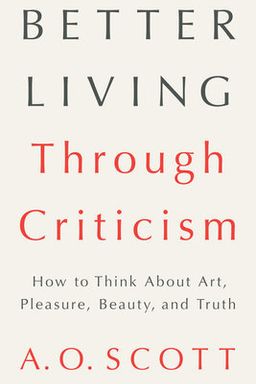
When was the last time you paused to ask yourself why you liked or disliked something—a film, a song, a meal, or even someone’s opinion? In Better Living Through Criticism, Anthony O. Scott, longtime film critic for The New York Times, argues that learning to think about our judgments—especially our aesthetic ones—is not an idle pastime but a vital human act. He contends that criticism isn't just the province of professionals with cultural authority; rather, it’s the everyday work of being awake and reflective in a world awash in art, opinions, and noise.
This book begins with a deceptively simple question: What good is a critic? Scott uses a real-life confrontation with actor Samuel L. Jackson to explore the hostility and misunderstanding critics face, especially in our age of social media backlash and instant reactions. When Jackson attacked Scott for reviewing The Avengers unfavorably, it sparked a global mini-drama that exposed a collective suspicion: aren’t critics just joyless haters? Scott’s retort is profound: everyone is a critic, because judgment is inseparable from consciousness itself.
Criticism as the Art of Thinking
Scott reframes criticism as a mode of engaged thinking—a process of examining how and why things move us. Drawing on philosophers from Immanuel Kant to Susan Sontag, he asserts that our responses to beauty and art aren’t passive pleasures but acts of intellectual and emotional participation. When you evaluate art, you’re also evaluating your own beliefs, taste, and capacity for meaning. The heart of the book lies in Scott’s conviction that criticism is creative. It adds new dimensions of insight to already created works and keeps art alive by provoking conversation and revision.
The Twin of Art
Scott insists that criticism is not a parasite on art but its sibling—its mirror, its late-born twin. Both spring from humankind’s urge to interpret and revise reality. Artists make things as they struggle with existence; critics make meaning from those things to understand that struggle. The critic becomes, in Scott’s romantic view, a dreamer who sees the dawn before others do (borrowing from Oscar Wilde’s notion that the critic as artist discovers what the original creator did not know they had made).
Criticism for Everyone—Not Just Experts
One of Scott’s most important ideas is that we all engage in criticism constantly, even outside art. From deciding which meal is delicious to judging what counts as truth in news or politics, we are always evaluating. Criticism therefore becomes the backbone of democratic and cultural participation. To think critically is to resist manipulation and lazy conformity. Scott laments that modern society prizes easy pleasure and group identity over reflection, creating a kind of intellectual passivity. Criticism, uniquely, teaches us to slow down, to wonder, and to defend art’s ambiguity in a climate of certainty and outrage.
Why It Matters Now
In a world overwhelmed by content, algorithms, and quick opinions, Scott argues that criticism is not dying—it’s exploding. Though professional critics have lost institutional authority in the Internet era, the instinct to interpret hasn’t vanished. Every tweet, review, and comment reflects criticism’s democratic spread. But without discipline, this explosion risks triviality. Hence, the better way to live—through criticism—demands thoughtfulness, sincerity, and self-awareness. For Scott, criticism is a celebration of freedom of mind. It’s the act of turning everyday judgment into artful inquiry, enabling us to live not just as consumers of experience but as conscious participants in culture’s ongoing conversation.
Through lively dialogues, history, and anecdotes—ranging from Marina Abramović’s performance art to Rilke’s encounter with a Greek statue—Scott demonstrates that criticism is the bridge between art and life. It’s how we translate experience into understanding, how we change our lives after being changed by something beautiful. Ultimately, Scott’s thesis invites you to think of every moment of delight, confusion, or indignation not as reaction but as opportunity: an invitation to discern meaning. In defending criticism, he defends your right to think deeply about what you love, what you reject, and why. That’s what makes criticism not just necessary—but life-enhancing.