
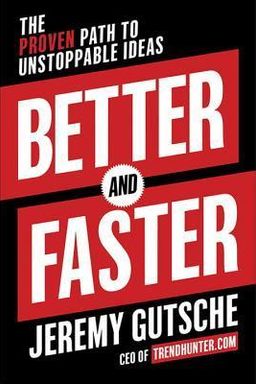
Better and Faster cover

Better and Faster

by Jeremy Gutsche

Better and Faster provides a roadmap to success in today''s dynamic marketplace. Jeremy Gutsche offers actionable insights through real-world examples, teaching readers to harness change, avoid stagnation, and exploit market opportunities for unstoppable business ideas.

Becoming a Better and Faster Opportunity Hunter

Have you ever wondered why some people or companies always seem to spot opportunities before anyone else—and act on them faster? In Better and Faster, trend expert Jeremy Gutsche argues that the difference isn’t luck, resources, or intelligence—it’s mentality. The world changes faster than ever, but most people and organizations are still wired for a slower age. The book contends that to thrive amidst instability, you must shed your “farmer” tendencies—those instincts toward safety, repetition, and protection—and awaken your inner “hunter,” someone wired for adaptability, curiosity, and speed.

Gutsche’s core insight is that humans—and the companies they build—are evolutionarily predisposed to resist change. Farming civilization trained us over millennia to value predictability and routine, but modern disruption requires the opposite mindset: experimentation, risk, and rapid adaptation. To innovate successfully, you must recognize and escape the psychological traps of the farmer: complacency, repetition, and protectiveness. In their place, you must cultivate three hunter instincts: insatiability, curiosity, and a willingness to destroy.

Awakening the Hunter Mindset

The first part of the book, “Awaken,” introduces this shift through compelling stories. The tale of Amancio Ortega, the founder of Zara, contrasts with entrepreneur Roy Raymond of Victoria’s Secret. Raymond, the archetypal farmer, clung too tightly to his initial success and failed to see the broader potential of his brand. Ortega, the relentless hunter, built a fashion empire on speed and adaptability, creating an organization capable of pushing a dress from design to store in just two weeks. Zara’s “fast fashion” disrupted an entire industry by operating with hunter-like responsiveness, curiosity about customers, and a willingness to destroy its own bestsellers to stay fresh.

Gutsche explains that hunter instincts aren’t innate—they can be awakened through deliberate practice. For example, a “hunter” organization doesn’t rely on long research cycles or fixed plans but constantly experiments, fails quickly, and learns faster. It studies unexpected sources of inspiration, much like origami master and engineer Robert Lang in the book’s prologue, who turned an ancient art form into modern aerospace and medical innovations simply by looking for patterns others ignored.

The Proven Path to Unstoppable Ideas

After awakening your hunter mindset, Gutsche guides you through the “Hunt” stage—learning how to recognize recurring patterns of opportunity. Across industries, he identifies six universal patterns that explain how the world’s best innovators—from Tesla to Dove, Red Bull to IKEA—continually find ideas that move the world forward:

  • Convergence: Combining multiple ideas or trends to create something new and valuable, as with Dave’s Killer Bread blending organic food, prison culture, and social good.
  • Divergence: Breaking from the mainstream to attract passionate audiences, illustrated by UglyDoll and Red Bull’s subversive marketing.
  • Cyclicality: Capitalizing on predictable social, economic, or cultural cycles, like fashion’s nostalgia trends or Nasty Gal’s vintage boom during recession.
  • Redirection: Channeling problems or perceptions into strengths, as McDonald’s did by confronting its online critics through transparency.
  • Reduction: Simplifying and specializing to serve a niche brilliantly, championed by Jack Dorsey’s creation of Twitter and Square.
  • Acceleration: Radically amplifying a key strength to dominate a category, from Tough Mudder’s extreme races to IBM’s Watson redefining machine intelligence.

These six patterns, validated by Trend Hunter’s analysis of more than 250,000 products and billions of consumer interactions, form a “mathematics of innovation.” Each represents a proven shortcut to identifying opportunity amid chaos. By mastering these lenses, you stop reacting to change and instead predict where disruption will occur next.

From Ideas to Action

Finally, the book’s “Capture” section teaches you how to apply these patterns to your own business or career. Gutsche presents practical frameworks for identifying opportunity clusters—emerging intersections of trends—and translating them into action. He shows how entrepreneurs like Jeremy Gutsche’s own sister Kyla built Cosmetic Transformations by combining art history, prison tattoos, and medical technology (a vivid example of convergence), and how restaurateur Sang Kim launched two new restaurants in thirty days by combining cyclicality, courage, and speed.

In a conversational yet data-backed tone, Better and Faster doesn’t just tell readers to “think different”—it proves how pattern spotting can turn chaos into fuel for creativity. In the end, Gutsche argues that the future belongs to those who are curious enough to question, bold enough to destroy, and hungry enough to adapt. If you can master these instincts and see the patterns connecting the world’s change, you’ll uncover not one path to success—but an infinite number.


The Hunter vs. The Farmer

Gutsche’s central metaphor compares two mindsets—the ancient Farmer and the modern Hunter. Ten thousand years ago, early humans transitioned from nomadic hunters to settled farmers. Farming rewarded consistency and routine, while hunting required risk-taking, awareness, and experimentation. The evolutionary habits that helped farmers thrive now hold us back in a fast-changing, opportunity-rich world.

Farming Traps: Comfort and Control

As organizations grow successful, they create rules, hierarchies, and systems to safeguard the harvest—that is, to protect what works. Yet those same systems eventually choke innovation. This “farmer mindset” manifests as three predictable traps: complacency (believing current success will last), repetition (continuing what worked before), and protectiveness (fearing to disrupt one’s own achievements). Kodak’s refusal to pursue Steven Sasson’s invention of the digital camera epitomizes the tragedy of protectiveness.

These traps affect individuals too. People often repeat what’s safe, overinvest in familiar skills, or protect their career choices even when they no longer serve them. As Bill Gates once said, “Success is a lousy teacher.” To thrive, you have to relearn how to hunt.

Hunter Instincts: Curiosity, Destruction, and Drive

In contrast, hunters stay insatiable, always seeking the next opportunity. They are naturally curious, read signals around them, and move fast without demanding perfection. And they are willing to destroy what no longer works—even their own best ideas—to make room for something new.

Take chef Eric Ripert of New York’s Le Bernardin. Despite holding Michelin stars and a near-perfect menu, Ripert constantly deletes his signature dishes. He argues that repeating success leads to stagnation, proving that “willingness to destroy” sustains creative leadership. Similarly, Amancio Ortega at Zara refuses complacency, producing fresh lines every two weeks and eliminating slow sellers instantly.

These instincts are psychological as much as strategic. Hunters draw energy from change itself. They understand that “being good” can become the enemy of becoming great. In one vivid story, Gutsche recounts a fiery CEO who likens his stagnant insurance company to “a sleeping lion” surrounded by hyenas. The leader’s rallying cry—“we need to remember we’re a lion, and roar”—is a corporate call to awaken the hunter spirit.

Awakening the Hunter Within

For individuals, awakening your inner hunter means embracing change as the norm and fear as a compass. When things feel risky or uncomfortable, that’s often where opportunity lies. For organizations, it means fostering experimentation and speed. Instead of punishing mistakes, celebrate those who test new ideas.

Gutsche’s own journey mirrors this philosophy. Before founding Trend Hunter, he spent years helping others innovate as a corporate consultant. When his website unexpectedly exploded in popularity, he abandoned a steady banking career to chase his new calling—becoming a full-time hunter. His lesson: you can’t farm your way to breakthrough success. You have to hunt for it every day.

Ultimately, “The Hunter and the Farmer” isn’t just business psychology—it’s a philosophy for thriving in any uncertain environment. The hunter reacts not with fear but with fascination. In a world where opportunities move at lightning speed, the modern hunter’s ultimate weapon isn’t power or experience—it’s pattern awareness, the ability to see the signals others miss and pounce before the moment passes.


Escaping Farmer Traps

In Chapter 2, Gutsche digs deeper into the three “farmer traps” and their corresponding hunter instincts, revealing how successful businesses and individuals sabotage themselves without realizing it. These stories serve as cautionary tales—and roadmaps for awakening—from complacency, repetition, and protectiveness.

Complacency → Be Insatiable

Complacency is the silent killer of innovation. Companies like BlackBerry and Smith Corona once dominated their markets but lost touch with their customers. BlackBerry, focused on enterprise clients, ignored everyday users dazzled by Apple’s and Samsung’s designs—and paid the price. The antidote is insatiability: the restless drive to keep improving before someone else forces you to.

Capital One’s founder Richard Fairbank exemplified insatiability by running thousands of product tests, empowering even junior staff to experiment with new credit card features. The company’s culture of perpetual testing mirrors Ortega’s daily design reinventions at Zara. Both leaders refused to assume success would continue automatically; instead, they institutionalized curiosity.

Repetition → Stay Curious

Repetition breeds stagnation. Blockbuster clung to its franchise model even as Netflix introduced streaming, ultimately transforming from a $5 billion success into a symbol of obsolescence. Individuals suffer the same fate when they repeat old routines rather than explore new frontiers. The cure is curiosity.

Through the story of Los Angeles designer Ron Finley, Gutsche shows curiosity as rebellion. Finley looked at his food-desert neighborhood and saw not blight but potential gardens. By planting vegetables illegally in public spaces, he redirected the landscape—and people’s thinking—toward possibility. Curiosity makes innovation inevitable because it transforms constraints into creative fuel.

Protectiveness → Be Willing to Destroy

The third trap, protectiveness, stems from fear of losing what you’ve built. Kodak’s executives literally buried the digital camera to protect their film business. Encyclopedia Britannica turned down digital collaboration with Microsoft, leading the way for Wikipedia. Both clung to past success and lost the future.

The remedy is willingness to destroy: the discipline to break your own model before competitors do. Gutsche illustrates this through Crayola’s pivot from arts-and-crafts supplies to “children’s free-time experiences.” By reframing its market and embracing the messy destructive creativity of children, Crayola stayed relevant in the digital era. Likewise, J.K. Rowling reinvented herself under a pen name after Harry Potter, risking her reputation to explore new genres. Both acts of destruction paved the way for reinvention.

“Every culture contains the seed of its own destruction,” inventor Steven Sasson told Gutsche, reflecting on Kodak’s demise. The insight doubles as encouragement: if decline is inevitable for those who protect too tightly, then liberation is inevitable for those who dare to destroy proactively. To truly lead, you must be both builder and arsonist—planting the next opportunity even as you burn the old field.


Finding Patterns of Opportunity

Once you’ve awakened your hunter instincts, the next challenge is learning where to hunt. Gutsche’s research at Trend Hunter suggests that across 250,000 innovations, six recurring patterns of opportunity explain nearly every major breakthrough. Instead of chasing megatrends—like “social media” or “AI,” which everyone already knows—successful hunters spot how these trends create ripple effects across industries.

The Six Patterns at a Glance

  • Convergence: Combining products, services, or ideas in novel ways.
  • Divergence: Doing the opposite of the mainstream or creating something niche.
  • Cyclicality: Leveraging recurring social, cultural, or economic cycles.
  • Redirection: Turning momentum or perception to your advantage.
  • Reduction: Simplifying or specializing for clarity and efficiency.
  • Acceleration: Amplifying a successful element to an extreme.

Each pattern provides a path to “ride the wave” of change rather than resist it. Gutsche compares it to the ancient Blackfoot tribe’s buffalo hunt: they redirected a herd’s momentum toward a cliff to harvest abundance. Likewise, modern innovators use the flow of consumer attention, technology, and culture to propel their ideas rather than fight existing forces.

Pattern Awareness: Seeing What Others Don’t

Pattern recognition is a transferable superpower. Once you see how Facebook’s “permanent sharing” model led to Snapchat’s opposite “temporary sharing” divergence, or how Red Bull’s edgy rebellion inspired luxury health drinks through convergence, you start to view innovation less as magic and more as math.

For example, Gutsche’s team used crowd-sourced pattern detection to forecast trends like “credit crunch couture” before the 2008 recession and the rise of Twitter as an advertising medium long before mainstream adoption. Their data proved that opportunities aren’t random—they follow predictable psychological pulses of desire, nostalgia, rebellion, and simplification.

As Gutsche puts it, “It’s not about what’s happening—it’s about what could happen next.” Using pattern awareness, even small entrepreneurs can turn megatrends into micro-opportunities. When Facebook rose, others didn’t compete head-on but built adjacent successes like Instagram and WhatsApp by following pattern logic. Spotting these intersections turns chaos into a roadmap for growth.

Ultimately, learning to see patterns trains you to view the world like a hunter scanning a landscape—alert, adaptive, and opportunistic. You stop asking, “What’s trending?” and start asking, “Where will this trend lead?” That single shift in perception transforms prediction from guesswork into strategy.


Convergence: Mixing, Layering, and Reinvention

Convergence is the art of combining multiple products, trends, or ideas to create something greater than the sum of its parts. Every major innovation—from smartphones to Starbucks—springs from convergence. The pattern works because our lives, too, are converging: work and leisure, digital and physical, technology and culture.

From Illness to Innovation

Gutsche illustrates convergence through the remarkable story of Kyla Gutsche—his sister—who turned personal adversity into innovation. After surviving cancer and losing her eyebrows to chemotherapy, she sought a better cosmetic tattooing technique. By fusing medical micro-pigmentation, insights from prison tattoo artists, and Renaissance painting methods inspired by Titian, she created Cosmetic Transformations, a company restoring realism to surgical and cosmetic tattoos. NASA might call this “cross-disciplinary innovation,” but Gutsche calls it convergence: combining unexpected worlds to create something beautiful and useful.

Mixing Trends, Cultures, and Meaning

Similarly, ex-convict Dave Dahl reinvented his life through Dave’s Killer Bread, merging organic food, environmental sustainability, and prison redemption narratives into one brand. His loaves sold because they resonated on multiple levels—health, social good, and storytelling. By aligning with multiple trends at once, Dahl multiplied his odds of success.

Another vivid case is 360 Screenings, a pop-up cinema experience that combined theater, film, and live role-play. Participants didn’t just watch movies—they stepped inside them. These layered experiences reflect a hybrid world where consumers crave participation, not spectatorship. (Similarly, authors Pine and Gilmore in The Experience Economy argue that immersion is the new frontier of value creation.)

Convergence in the Workplace

At his own company, Trend Hunter, Gutsche applied convergence by blending online research, data analytics, and playful culture into a millennial-friendly academy. The office itself acted like a mashup of startup energy and university-style learning. Productivity soared 80 percent when he gamified work and added “Feel Smarter Fridays.” Convergence isn’t just about products—it’s a state of mind that links fields, experiences, and human motives.

Ultimately, convergence rewards those who can connect seemingly unrelated dots. When you find a way to mix industries—like Tesla combining technology, design, and sustainability—or ideas that trigger emotion, you move beyond incremental improvement toward exponential relevance. The modern hunter’s best skill is synthesis.


Divergence: Standing Out by Breaking Away

If convergence is about connection, divergence is about separation—breaking from the mainstream to find new value in difference. Modern consumers crave individuality, and divergent ideas satisfy the instinct to stand out. Gutsche calls divergence the “anti-gravity principle” of innovation: going against the pull of uniformity.

Rebelling Against the Ordinary

Artists David Horvath and Sun-Min Kim did just that with their creation of UglyDolls. When Horvath’s professor dismissed his sketch as “ugly,” he embraced the insult, turning imperfection into a brand. UglyDolls tapped into a cultural backlash against artificial beauty—similar to Dove’s “Real Beauty” campaign—and grew into a $100 million brand celebrated for its authenticity.

Likewise, Red Bull built a $15 billion empire by defying beverage norms. It tasted terrible, cost more, and flaunted controversy instead of avoiding it. Founder Dietrich Mateschitz marketed Red Bull as a rebellious lifestyle—not just an energy drink. Rumors that its ingredients came from bull testicles (false but viral) only amplified its mystique. By intentionally alienating some consumers, Red Bull magnetized others.

The Power of Niche Appeal

Divergence thrives on specificity. BeautifulPeople.com built an exclusive dating site where only attractive applicants voted in by members could join. It offended many but attracted 750,000 paying customers who loved its honesty. Similarly, Tinder, JDate, and 420Dating illustrate how every niche can birth a thriving community. The takeaway: by being “irresistible to a specific group,” you gain loyalty that mass appeal rarely earns.

Divergence as Creative Fuel

Beyond business, divergence drives art and emotional engagement. Mountain Dew, with decades of countercultural campaigns, consistently targets rebels. Jerry Garcia’s quote—“You don’t want to be the best of the best; you want to be the only one who does what you do”—captures Gutsche’s message perfectly. Divergence asks you to define not how you fit in, but how you stand apart.

The risk of divergence is alienation—but the reward is devotion. When you embrace what makes you different, you turn critique into character. As Gutsche demonstrates through Red Bull and UglyDoll, being polarizing is better than being forgettable.


Cyclicality: Predicting the Inevitable Return

While divergence looks forward, cyclicality looks backward—recognizing that patterns of taste, culture, and economics repeat. Gutsche compares it to the sea turtle’s migration: seemingly random short-term movements that, from a higher view, form perfect cycles. Smart hunters anticipate these returns before others notice.

In fashion and business alike, nostalgia is predictable. When AMC’s Mad Men revived 1960s style, brands from Banana Republic to Canadian Club whiskey rode the wave. When recessions hit, thrifty mindsets return: home cooking, DIY gifts, and “credit-crunch couture.” Gutsche’s example of Sophia Amoruso’s Nasty Gal shows how selling vintage clothing during a downturn wasn’t luck—it was timing a cyclical craving for authenticity and affordability.

Riding Economic and Emotional Waves

Cyclicality spans emotions as much as markets. After decades of opulence, Shu Uemura’s diamond eyelashes captured the early-2000s “bling” obsession—then the 2008 crash swung fashion toward frugality. Gutsche’s Trend Hunter foresaw this by tracking pattern clusters like “return to the kitchen” and “rental culture.” Spotting these rhythms turned chaos into clarity.

Cyclicality also reappears in storytelling and culture: old myths return with new technology. The key isn’t nostalgia itself—it’s knowing when to reintroduce it. Just as fashion reissues vintage sneakers, industries from automotive to entertainment thrive by refreshing classic designs at the right moment.

Ultimately, recognizing cycles prevents panic during disruption. Hunters expect downturns, rebounds, and cultural repetition. Instead of fighting change, they time it—understanding that what’s old will always become new again, just dressed in the style of the future.

Dig Deeper

Get personalized prompts to apply these lessons to your life and deepen your understanding.

Go Deeper

Get the Full Experience

Download Insight Books for AI-powered reflections, quizzes, and more.