
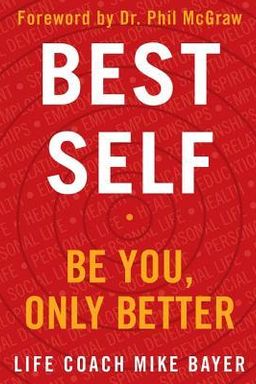
Best Self cover

Best Self

by Mike Bayer

Best Self by Mike Bayer guides you to shift from mere survival to thriving by embracing your best self. Through practical tips and personal insights, Bayer helps you overcome fears, manage negativity, and build authentic relationships, fostering genuine growth and self-awareness.

Becoming Your Best Self: Living Authentically in Every Sphere of Life

When was the last time you truly felt like the best version of yourself—confident, focused, self-assured, and fully alive? In Best Self: Be You, Only Better, life coach Mike Bayer argues that becoming your best self isn't about perfection, image, or success—it's about authenticity. Bayer contends that each of us has a 'Best Self' and an opposing 'Anti-Self' and that the quality of our lives depends on which of these voices we empower each day. His premise is simple but profound: when you live in alignment with your authentic values, purpose, and strengths, you create inner peace and external success in every area of your life.

Bayer’s model breaks life into seven interconnected “SPHERES”—Social life, Personal life, Health, Education, Relationships, Employment, and Spiritual development. Within these domains, he provides exercises, stories, and reflection questions designed to help you identify what’s working and what’s blocking your growth. His approach blends psychology, practical coaching, and deeply human storytelling—from meth addiction to mentoring celebrities alongside Dr. Phil—to show how self-awareness can lead to lasting transformation.

The Journey from Darkness to Alignment

Bayer opens with a striking contrast from his own life: the darkness of his meth addiction versus his later clarity while kneeling on a bathroom floor in Kurdistan, reaffirming his life purpose before helping refugees. This personal ritual—kneeling to symbolize humility, then affirming his mantra “You got this”—illustrates the book’s core process: pausing, realigning with purpose, and acting intentionally. His practice embodies his larger message: living as your Best Self is not a one-time achievement but a recurring act of alignment.

To live authentically, you must recognize that your life is happening for you, not to you. In other words, every challenge is an opportunity to move closer to your authentic self rather than an obstacle designed to block you. Bayer demonstrates this through clients who confront fear, self-doubt, or stagnation—transforming pain into growth once they see how their own Anti-Self, not external circumstances, has been running the show.

Best Self vs. Anti-Self

Everyone, Bayer asserts, carries two opposing inner characters: the Best Self, rooted in truth, compassion, courage, and purpose; and the Anti-Self, driven by fear, ego, self-sabotage, or resentment. Your goal is not to destroy the Anti-Self—it’s to understand its triggers, give it a name, and intentionally choose your Best Self instead.

He illustrates this idea through stories like Suzanne’s “Road Rage Regina,” who lashes out when she feels overextended, and “Nell,” who shuts down from self-doubt. By naming and sketching these Anti-Selves, clients see them as manageable parts rather than defining traits. The exercise transforms shame into awareness—what Carl Jung might call “integrating the shadow.” By contrast, the Best Self—be it a wizard named Merlin or a nurturer named Joy—embodies the traits that reflect your truest, most empowered nature.

The Seven SPHERES: A Framework for Whole-Life Balance

Bayer’s SPHERES model functions like a life diagnostic. In each area—your social connections, personal wellbeing, health, learning, relationships, work, and spirituality—you identify what’s thriving and what’s misaligned. His argument echoes holistic thinkers like Stephen Covey (The 7 Habits of Highly Effective People): your success in one area depends on harmony in all others. If your health or integrity falters, every sphere suffers. Conversely, consistent self-honesty and small daily acts of authentic alignment can lift the whole system.

For example, in the Health sphere, Bayer explores how diet, exercise, and even gut health influence mood and cognition. In the Education sphere, he reframes learning as lifelong curiosity, not formal schooling. And in Relationships, he dismantles myths about romance and teaches communication grounded in values rather than ego.

From Awareness to Action: The Seven Steps to Goal Acquisition

Awareness alone, Bayer warns, isn’t enough. His final chapters map out a seven-step framework for turning insight into tangible results. You begin by defining specific, measurable, and controllable goals—because vague desires like “being happy” lack actionable shape. Then you plan a strategy, break it into steps, assign timelines, and establish accountability. Through stories of clients like Margaret revitalizing her spiritual life and Maurice regaining his health, he shows that disciplined action—combined with emotional authenticity—transforms even long-standing struggles.

Bayer insists that the process is not about willpower but structure: “Anyone who has ever achieved something great first named that victory.” By writing down goals, scheduling time, and checking in with accountability partners, you make your commitment real and keep ego at bay.

Why This Matters

In a culture obsessed with productivity and validation, Best Self offers a quieter revolution: self-honesty. Bayer’s clients don’t just fix habits—they rewrite the internal dialogue driving them. The book’s practical structure—assessments, journaling prompts, and visualization exercises—turns introspection into a daily discipline. Its message resonates with recent psychology research on mindfulness and neuroplasticity: when you change your inner language, you literally reshape your brain.

Ultimately, Bayer argues that becoming your Best Self is a lifelong practice of small, courageous choices. Whether you’re confronting addiction, apathy, or ambition without meaning, the solution is the same: honesty, authenticity, and action across every Sphere. The reward isn’t perfection—it’s peace, purpose, and presence in your own life.


Understanding the Anti‑Self

If your Best Self represents light, your Anti‑Self is the shadow that blocks it. Mike Bayer describes the Anti‑Self as the collection of fears, insecurities, and ego‑driven impulses that sabotage your happiness. This side of you isn’t evil—it’s protective. It tries to shield you from pain by keeping you small, defensive, or numb, but in doing so, it keeps you disconnected from truth.

Naming the Inner Saboteur

Bayer helps readers tame this force by first naming it. By turning abstract emotions into a character—like Suzanne’s “Road Rage Regina” or his own “Angelos”—you externalize destructive patterns and gain control over them. Regina rants in traffic when Suzanne feels powerless elsewhere. Nell, Suzanne’s other Anti‑Self, hides when she fears failure. Once she identified these personas, she could tell them, “You don’t get to drive today.”

Clients often have multiple Anti‑Selves: jealous, angry, or perfectionist sub‑personalities. By drawing them, naming them, and recognizing their triggers, you transform them from saboteurs to signposts—signals that you need to recalibrate toward your Best Self.

Patterns Beneath Behavior

Bayer’s technique reflects cognitive‑behavioral therapy principles: awareness precedes change. When you notice patterns—like anger after feeling ignored—you replace reactive ego with mindful response. He reminds readers that the Anti‑Self often emerges from genuine wounds: childhood criticism, relationship trauma, or unmet needs. What once protected you now imprisons you. Healing requires compassion toward that fearful part while no longer letting it rule.

Reclaiming Power from Ego

In one story, Bayer confesses that his own Anti‑Self, “Angelos,” surfaced during management conflicts—quick‑tempered, rigid, and judgmental. By naming Angelos, he learned to pause, breathe, and respond with curiosity rather than control. The point isn’t to repress these impulses but to channel their energy. Anger becomes assertion; fear becomes focus.

Key Insight

What you name, you can manage. Self‑awareness disarms the illusion that you are your worst thoughts.

This exercise parallels the “inner child” and “shadow work” approaches of authors like Debbie Ford and Carl Jung. By bringing unconscious patterns into light, you stop fighting yourself and start integrating. The more familiar you are with your Anti‑Self, the faster you can summon your Best Self when challenges arise.

The Anti‑Self Evolution

Because life constantly changes, new Anti‑Selves appear at new stages. Stress at work may awaken “Imposter Irene,” while parenthood may birth “Control Carl.” Bayer suggests revisiting the exercise regularly to keep pace with growth. Each time you update these characters, you reclaim creative authority over your identity. The Anti‑Self stops being a prison guard and becomes a teacher.

By learning to identify, dialogue with, and outgrow your Anti‑Self, Bayer argues, you move from self‑criticism to self‑leadership. That is the foundation of living authentically: not pretending to have no darkness, but choosing light every day.


The Five Tenets of Change

Transformation, Bayer insists, begins with five essential attitudes: Curiosity, Honesty, Openness, Willingness, and Focus. These tenets form the psychological backbone of his Best Self method—mindsets that prepare you to shift behavior sustainably. Without them, any plan collapses under ego and resistance.

Curiosity: Seeing Yourself with Wonder

Change starts with curiosity—the childlike urge to ask, “Why do I act like this?” Rather than judging yourself, you explore patterns. Bayer tells clients to examine their reactions as scientists, not prosecutors. Curiosity dissolves shame and opens new options. As Walt Disney said, “Curiosity keeps leading us down new paths.” (Psychologist Carol Dweck’s research on “growth mindset” reinforces this: curiosity fosters adaptability.)

Honesty: Facing What You Resist

“We are only as sick as our secrets,” Bayer writes. Honesty means acknowledging inconvenient truths—addictions, resentments, emotional exhaustion—without distortion. Transparency with yourself dismantles denial. The courage to admit what’s not working unlocks wisdom. Honesty keeps ego in check and aligns you with integrity, just as Thomas Jefferson said, “Honesty is the first chapter in the book of wisdom.”

Openness: Being Teachable

Openness is the willingness to consider new information even when it contradicts old beliefs. Like Socrates’s famous observation—“the only true wisdom is in knowing you know nothing”—Bayer urges readers to drop defensiveness and allow learning. Every breakthrough he’s witnessed, he notes, began with someone whispering, “Maybe there’s another way.”

Willingness: Choosing Action over Intention

Willingness bridges thought and behavior. In Bayer’s sobriety story, recovery required total willingness to follow guidance—attending daily meetings, volunteering, and accepting mentorship. He learned that growth doesn’t come from wanting change but from acting on that desire, even before feeling ready. As Richard Branson quipped, “Life is a lot more fun if you say yes rather than no.”

Focus: Sustaining Momentum

Finally, focus turns scattered intention into traction. It’s both mental discipline and environmental design: reducing distractions, prioritizing what matters, and committing attention. Oprah Winfrey’s mantra—“Feel the power that comes from focusing on what excites you”—captures this principle. Bayer encourages readers to experiment with conditions that help them concentrate, whether solitude or social energy. Focus transforms goals from fantasy to habit.

Together, these tenets make change inevitable. With curiosity, you notice; with honesty, you admit; with openness, you learn; with willingness, you start; and with focus, you persist. Every transformation story in Best Self—from addicts finding recovery to professionals rediscovering purpose—follows this sequence of mindset before method.


Reprogramming the Inner Dialogue

Your most influential relationship, Bayer reminds you, is the one between your ears. The voice narrating your life can be a cruel critic or a compassionate coach. Neuroscience now proves that changing this voice literally rewires your brain through neuroplasticity—the brain’s ability to form new connections. Thus, altering your self‑talk transforms both mindset and biology.

Listening to Your Thoughts

Bayer asks clients to record internal monologues over a day. Many are shocked to discover persistent self‑judgment or catastrophic worry. He notes that “our harshest critic lives between our ears—but our best friend can live there too.” Studies from King’s College London confirm that repetitive negative thinking increases risk of cognitive decline—making positive dialogue a form of mental fitness.

Coaching Yourself

Once you recognize negative loops, you can reframe them as supportive coaching. When you hear “I’m a failure,” respond, “This is an experiment, not a verdict.” Bayer models this in his daily mirror ritual, where he affirms statements like “You are enough.” This approach mirrors psychologist Kristin Neff’s concept of self‑compassion: treating yourself with the kindness you’d offer a friend. Over time, affirmations build new “mental grooves” that override self‑doubt.

Building a Stress‑Proof System

Beyond mental language, Bayer connects inner talk to self‑care—what he calls “stress management architecture.” Through breathwork, exercise, sleep hygiene, and unplugging from screens, you stabilize your physiological baseline. These habits reinforce optimism neurologically by calming the limbic system and strengthening prefrontal self‑control. (Harvard’s research on mindfulness and neuroplasticity supports this biochemical loop.)

Through consistent practice—writing gratitude lists, reframing self‑talk, and designing restorative routines—you create internal safety. When your mind becomes a friendly place, every external challenge becomes easier to face. In Bayer’s terms, you stop surviving life and start collaborating with it.


Aligning the Seven SPHERES of Life

Bayer’s SPHERES framework—Social, Personal, Health, Education, Relationships, Employment, and Spiritual life—acts as a full‑system check‑up for authenticity. Each Sphere influences the others; imbalance in one eventually ripples through all. Working through them helps you assess where your Best Self leads and where your Anti‑Self dominates.

Social and Personal Spheres

Social well‑being measures how authentically you connect with others. Bayer links socializing with cognitive benefits—University of Michigan research shows engaging discussions boost mental agility. Meanwhile, the Personal Sphere explores inner relationships: self‑talk, self‑care, and play. Here Bayer echoes Robin McGraw’s wisdom: “It’s not selfish to take care of yourself first.” Nurturing your inner life replenishes the energy that fuels all other domains.

Health and Education

In the Health sphere, Bayer dives into physical vitality and cutting‑edge science on the gut‑brain connection. He describes how probiotics and nutrition affect mood—drawing on research from The Psychobiotic Revolution. Exercise and fasting become tools for clarity, not aesthetics. In Education, he reframes learning as lifelong curiosity. Whether you study languages or life lessons, learning keeps your brain flexible and your spirit humble.

Relationships, Employment, and Spiritual Life

Healthy relationships, Bayer argues, hinge on shared values and realistic expectations, not fairy‑tale myths. Companionship requires honesty and empathy more than constant harmony. Employment, meanwhile, should align with your “art”—the unique way your gifts serve others. When work expresses your art, passion replaces burnout. Finally, the Spiritual Sphere grounds the model, connecting you to meaning beyond ego. Whether through prayer, meditation, or gratitude, spirituality restores perspective: that life is not punishment but partnership.

By rating each Sphere from one to ten and setting small goals within them, you create a dynamic map of your life’s balance. The power lies in seeing patterns—perhaps neglecting health drains career focus, or spiritual stagnation fuels emotional fatigue. Awareness lets you rebalance consciously, turning existence into an ongoing experiment in wholeness.


Setting and Achieving Authentic Goals

Mike Bayer’s seven‑step goal method transforms vague wishes into measurable reality. Borrowing principles from behavioral psychology and coaching practice, he insists that authentic goals reflect your Best Self—not ego, comparison, or external pressure. Achievement for its own sake, he cautions, “doesn’t serve a positive purpose.” True success arises when your goals express your values.

1. Define and Measure

Start by defining goals as specific events or behaviors. “Be happier” becomes “Plan and take a weekend trip with friends.” Then make it measurable: identify exactly what you’ll do and how you’ll know you’re done. Clarity turns emotion into execution.

2. Control What You Can

Effective goals depend solely on your actions, never others’ reactions. You can commit to exercising three times a week, not to someone loving you back. This distinguishes empowered responsibility from frustration.

3. Strategy, Steps, and Timeline

Bayer shows how emotions fade but systems endure. Create a strategy that includes obstacles and solutions—schedule workouts, plan meals, anticipate disruptions. Then deconstruct big aims into incremental steps and assign realistic dates. Deadlines harness the “power of the ticking clock.”

4. Accountability and Application

Finally, enlist accountability partners—trusted allies who celebrate progress and confront procrastination. Bayer’s client Maurice, who stopped late‑night overeating through shared check‑ins, illustrates how collaboration sustains commitment. In another example, Margaret’s spiritual volunteering goal revitalized her marriage and faith. When goals align with authenticity and structure, change compounds across all SPHERES.

He concludes each section with the reminder, “No more somedays.” Dreaming delays life; planning experiences it. Writing, scheduling, and reporting your actions convert vision into lived evidence of your Best Self.


Spiritual Growth and Letting Go of Control

Bayer saves spirituality for last, calling it the foundation beneath all spheres. Spirituality, he clarifies, is not religion—it’s connection to something greater than ego. Whether you name it God, the Universe, or Love, the principle is surrender: life flows best when you stop gripping every outcome.

Faith Over Fear

In his story of “Handcuff Henry,” an advertising executive trapped in toxic work, faith becomes liberation. Henry’s fear of losing status chained him to misery. Only when he prayed for guidance—and believed opportunity could exist beyond control—did a new job appear almost miraculously. Bayer calls this the law of alignment: when you act from faith, not fear, circumstances reorganize around your truth.

Cultivating Daily Connection

Bayer recommends simple rituals: morning intention‑setting, quiet reflection, gratitude, and generosity. He cites research connecting faith practices with better health, lower stress, and longevity. Spiritual life, he argues, isn’t about perfection but perception—the ability to see meaning in randomness and peace in uncertainty. When you replace “Why me?” with “What is this teaching me?” the world stops punishing you and starts partnering with you.

Giving and Receiving

Generosity anchors spirituality in action. Like the biblical principle of sowing and reaping—or the Eastern law of karma—what you give multiplies. Bayer’s advice to “pay it forward” through time, kindness, or mentorship echoes psychological findings on altruism: helping others activates the same neural pathways as joy. Spiritual alignment, therefore, is not escape from the world but service within it.

By trusting in something larger than self, you gain paradoxical power: the freedom to act without fear. Bayer ends his own story kneeling before a mirror, whispering, “It’s not about you.” That phrase captures the heart of Best Self: when you stop proving your worth and start serving with authenticity, you finally live as the person you were created to be.

Dig Deeper

Get personalized prompts to apply these lessons to your life and deepen your understanding.

Go Deeper

Get the Full Experience

Download Insight Books for AI-powered reflections, quizzes, and more.