
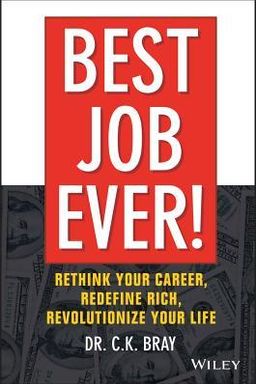
Best Job Ever cover

Best Job Ever

by Dr C K Bray

Discover the steps to transform your career with ''Best Job Ever'' by Dr. C K Bray. This guide provides practical strategies to overcome fears, leverage your strengths, and craft a strategic plan for a fulfilling career change, helping you redefine success and happiness in your professional life.

Creating Your Best Job Ever: The Power of Intentional Career Design

What would it feel like to wake up excited for work every morning—to know that your career aligns perfectly with your values, passions, and ambitions? In Best Job Ever: Rethink Your Career, Redefine Rich, Revolutionize Your Life, Dr. C.K. Bray argues that this level of fulfillment isn’t a fantasy reserved for a lucky few—it’s the result of deliberate career design, consistent self-reflection, and a willingness to act boldly in the face of fear.

Bray contends that most people stay stuck in jobs they dislike not because those positions are inherently bad, but because they have never taken the time to define what success and satisfaction mean to them. They cling to security, ignore their innate strengths, and avoid change, creating a cycle of frustration and disengagement. His central claim is simple yet profound: you can craft your “best job ever” right where you are—without waiting for the perfect opportunity, quitting your job impulsively, or chasing an abstract version of passion. The key lies in learning how to rethink your relationship with work, recognize your power to change, and make strategic, incremental moves that build toward long-term fulfillment.

The Real Problem: Career Drift

Research cited by Bray reveals that 87 percent of employees worldwide report being unhappy at work. Most of them feel disengaged, overworked, underappreciated, or trapped by poor management. Yet few take action. Bray compares them to his former self—high-achieving, outwardly successful, yet internally depleted. He describes winning a top sales award early in his career, only to feel hollow and unfulfilled at the celebration dinner. This moment of clarity launched his lifelong study of how people find—or fail to find—career satisfaction. His conclusion: people must stop letting their employers or circumstances dictate their professional narrative. Instead, they must create a career plan based on intentional design.

From Reaction to Design: The Career Revolution

The book unfolds as both a practical system and a motivational blueprint. Bray divides the journey into three parts: why people get stuck and unhappy, how to redefine success and personal wealth, and how to plan and execute the career they truly want. By combining psychology, business insight, and personal storytelling, he invites readers to diagnose what they dislike about their current job (from poor leadership to lack of meaning), discover their strengths and passions, and then map out one-, three-, and five-year goals to achieve transformation.

He draws on examples ranging from burned-out executives to recent college graduates. We meet Tim, who overcame career boredom by reigniting his sense of challenge through studying for the bar exam, and Alan, who recovered from job loss through networking with his community. Throughout these stories, Bray illustrates that career transformation doesn’t happen in giant leaps—it grows from understanding yourself, improving your mindset, and doing the hard, sometimes unglamorous, daily work that builds mastery.

Redefining Rich and Success

A pivotal concept Bray introduces is the idea of redefining rich. Rich, he asserts, is not about wealth, status, or luxury—it’s about time, relationships, and purpose. He invites readers to make a list of what they truly value and to align their career choices accordingly. For some, that might mean maximizing flexibility and family time; for others, it might mean creative freedom or the opportunity to mentor others. This redefinition helps dismantle the illusion that success equals working harder or earning more. Instead, real success means creating work that enhances the whole of your life.

The Courage to Change and Work

Bray acknowledges that change is hard. Fear—especially fear of failure—keeps most people tethered to complacency. He teaches readers how to recognize and reframe fear as a signal rather than a stop sign. Fear doesn’t disappear; you move “despite” it, as he puts it. Work itself is presented not as an obligation but as a healing force—“the greatest remedy for both mental and physical afflictions.” Through stories of persistence and sacrifice, Bray demonstrates that success is born from the willingness to keep moving, learning, and doing meaningful work even when it’s uncomfortable.

Building a Plan: Steps Toward Fulfillment

The second half of the book translates inspiration into action. Bray’s nine-step plan helps readers identify their core job responsibilities, discover their strengths, define excellence, set measurable goals, uncover their “why,” build networks, overcome barriers, and transform effort into results. His approach emphasizes reflection coupled with execution—it’s not enough to dream or strategize; you must take specific, consistent actions to build momentum. Each step reinforces the idea that your career isn’t something that happens to you—it’s something you design, revise, and refine over time.

Ultimately, Bray’s message is both empowering and demanding. Finding your Best Job Ever means abandoning passive thinking and fully engaging in the creative act of living. Your career becomes an ongoing project—a dynamic intersection of self-awareness, hard work, and contribution. It’s not about perfection or easy success; it’s about courage, growth, and the satisfaction of knowing that you’re shaping your own story.


Overcoming Fear and Excuses

Fear is the invisible barrier standing between you and your best career. C.K. Bray devotes several chapters to dissecting fear’s power, showing how it sabotages ambition and perpetuates mediocrity. He tells stories of professionals like Rob, Amanda, and Rich—all talented but stalled because they were afraid to fail, speak up, or change course. Fear whispers that you’re not smart enough or ready enough, and excuses reinforce that lie. Bray’s answer: name your fears, understand their roots, and move forward anyway.

Understanding Fear’s Voice

Fear disguises itself as logic—it tells you you’re being sensible by staying safe. Bray personifies fear as a manipulative companion that lies with “a pinch of truth.” You hear, “It’s not the right time,” “You’ll embarrass yourself,” or “You can’t afford to fail.” He reminds readers that these are the same mechanisms that kept his client Lisa trapped in a miserable job she claimed she “couldn’t leave.” Fear convinced her that her bills and responsibilities held her hostage, when in reality, it was her aversion to change.

From Reaction to Courage: The ‘Despite’ Mentality

Bray introduces a transformative word—despite. You act “despite” fear, rejection, or barriers. Instead of waiting to feel confident, you decide to move forward regardless. His client Jeff illustrates this mindset when facing potential job loss. By choosing to respond with purpose rather than panic, Jeff discovered he could take control of his future. This small linguistic shift creates empowerment: you may not eliminate fear, but you can render it powerless by acting despite it.

Stopping Excuses Before They Start

Excuses, Bray says, are fear’s backup army. They sound rational—“I’m too old,” “I don’t have the right education,” “I don’t have time”—but they serve the same purpose: keeping you safe and stagnant. Psychologists describe this as self-handicapping, undermining success before you begin. His unforgettable example of Kerri Strug, the injured gymnast who vaulted through pain to win Olympic gold, reveals that excellence is born from doing hard things in spite of fear. Bray doesn’t romanticize recklessness, but he values persistence—a daily discipline of courage over comfort.

(Similar ideas appear in Susan Jeffers’s Feel the Fear and Do It Anyway, which aligns with Bray’s habit-building notion that fear never disappears, but your tolerance grows through action.)


Redefining Rich and Success

Dr. Bray’s concept of “rich” turns traditional success upside down. Instead of defining wealth by possessions or income, he reframes it around feelings, time, and values. Rich isn’t measured by the number of cars in your garage—it’s determined by how much control you have over your time and the joy you derive from your relationships.

Rich as a Feeling

Bray tells the story of Lincoln, a young Silicon Valley millionaire who realized after his company’s IPO that money didn’t bring meaning. He already had the cars, vacations, and watch, but still felt lost. Bray’s conversation with him—“You’re rich, just not the rich you thought you would be”—captures the book’s thesis. Many of us don’t want to be millionaires; we want to feel like millionaires, to experience freedom, joy, and security. He challenges readers to identify what truly makes them feel rich right now—more time with family, creativity, simplicity, or health.

Time and Relationships as True Wealth

Time, Bray argues, is life’s ultimate currency. Everyone has the same 24 hours, but truly rich people guard theirs. He recounts stories of executives who traded higher pay for more flexibility or the ability to attend their kids’ soccer games. Fulfillment, not money, determines richness. He encourages readers to ask, “How much money is enough?” and to calculate the lowest comfortable income that supports their values. (This perspective echoes Vicki Robin and Joe Dominguez’s Your Money or Your Life, which also equates conscious spending with freedom.)

Aligning Career and Values

Bray provides exercises to rank what matters most—family, creativity, security, or growth—and to test current work against those priorities. Misalignment causes unhappiness. A high-paying executive who values family but travels constantly will never feel rich. Realigning the job around your top values—whether through negotiations, changes, or new roles—can restore meaning without sacrificing income. His conversation with a female manager who delayed a promotion to stay home evenings with her children demonstrates mature decision-making rooted in value-based “richness.”


Finding Purpose and Passion Without Quitting Your Job

“Follow your passion,” Bray warns, is one of the most dangerous career myths. He shares the cautionary tales of Dave the dentist, Shawn the accountant turned realtor, and Julie the jewelry maker—all who left stable careers chasing dreams that proved tougher than imagined. Some succeeded; others lost money and confidence. Bray’s insight: you can follow your passion *without* sacrificing security. Passion isn’t an either/or—it’s a skill you can integrate into your current work or life gradually.

Mastery-Induced Passion

One of Bray’s most useful frameworks is mastery-induced passion. He observes that you often grow passionate about what you become good at—not the other way around. Like children learning to play piano, enjoyment follows mastery and recognition. By identifying aspects of your job that energize you or come naturally, you can rekindle passion without drastic change. Bray illustrates this through his early pharmaceutical career—he disliked paperwork but loved mentoring new reps and studying motivation. That realization guided his eventual shift into organizational psychology.

Three Steps to Discover Passion at Work

  • Identify what you love in your current role—observe your daily energy and strengths.
  • Recognize what you dislike and analyze the gaps between your values and tasks.
  • Decide which aspects are negotiable and what can be changed through influence or skill-building.

Instead of quitting, Bray advises leveraging this understanding to redesign your position. If teaching lights you up, offer to mentor juniors. If creativity fuels you, seek projects that allow innovation. Change starts from within before extending outward. This principle aligns with Cal Newport’s So Good They Can’t Ignore You, which similarly argues passion follows competence and contribution.


The Career Plan: Building a Roadmap for Growth

Dr. Bray’s second half delivers the heart of his practical model: the nine-step career plan. These steps transform vague hopes into actionable strategy. Each builds on the last, moving from self-assessment to execution. Bray reminds readers that without a plan, your career is like “a paper boat heading down a river”—carried by circumstance instead of choice.

The Nine Steps

  • Identify your four main job responsibilities to clarify focus.
  • Discover your strengths using tools like StrengthsFinder or MBTI.
  • Define what makes you excellent—your unique contribution at work.
  • Create one-, three-, and five-year goals including salary, role, and skills.
  • Find your “Big Why”—the motivation driving your efforts.
  • Build your community and network.
  • Identify personal and professional barriers.
  • Achieve your plan through focused work—including the power of hard work itself.
  • Calculate your return on investment by giving back and mentoring others.

Writing It Down and Acting It Out

Bray insists on writing goals and deadlines—not keeping them in your head. The act of writing clarifies priorities and exposes inconsistencies. His example of planning an MBA before pursuing promotion shows how sequencing matters. Once written, the plan must be executed through consistent hard work. Bray’s Oklahoma catchphrase “Go get’er done!” sums up the philosophy: thoughtful planning paired with relentless doing.

By building this roadmap, you shift from waiting for opportunity to creating it. Bray’s steps resemble Stephen Covey’s principle in The 7 Habits of Highly Effective People: begin with the end in mind. His plan empowers readers to move deliberately toward their goals and adapt along the way.


The Community Advantage: How Networking Accelerates Success

Networking, Bray argues, isn’t manipulation—it’s collaboration. He dismantles the stereotype of shallow schmoozing by redefining networking as authentic relationship building that benefits everyone. His story of Alan, the well-liked neighbor who lost his job and hid out of embarrassment, demonstrates how isolation kills opportunity. When Alan finally reconnected with his community, he found a job within six weeks.

Networking as Information and Support

Your network has “invisible knowledge”—news of openings, company expansions, and opportunities before they’re public. Bray outlines strategies: send concise introduction emails (like Nate, who secured 99 percent replies), follow up regularly, and nurture connections that feel genuine. Every person counts, from interns to assistants. “The people you’re meeting now,” he warns, “may be the leaders who hire you tomorrow.”

Overcoming Fear of Networking

For introverts, Bray offers practical tips—prepare two or three questions, limit conversations to ten minutes, and leverage social media for low-pressure follow-ups. If shyness persists, bring a friend or use the “fly-by” method: quick introductions with follow-up emails. These micro-interactions compound into meaningful connections.

Giving Back Through Your Network

The best networkers are helpers. Bray cites examples like Ryan, who routinely sent brief emails connecting others and checking in—creating mutual benefit and lasting goodwill. Networking becomes less about personal gain and more about building community capital. This aligns with the book’s recurring theme: lasting success is cooperative, not solitary.


The Power of Work and Contribution

Work, for Bray, is not merely about earning a paycheck—it’s a form of therapy, creativity, and purpose. Quoting Kosaren, he calls work “the greatest remedy available for both mental and physical afflictions.” He celebrates labor as the antidote to fear, idleness, and despair. When you work—with commitment and faith—you heal yourself.

Joy in the Process, Not the Outcome

Bray challenges the myth that the goal of success is permanent leisure. He cites stories of retirees and millionaires who fell into unhappiness after abandoning work. The joy, he says, is in the journey—the becoming, not the arrival. Even unpleasant jobs can offer growth and insight. He recounts his own early career dissatisfaction but gratitude for the skills he gained through perseverance. “It is better to work,” he writes, “than not to work.”

Creating Satisfaction Through Effort

Bray’s story of earning an MBA and two PhDs while others watched TV demonstrates his conviction that sustained effort produces freedom. You earn satisfaction through mastery, not indulgence. His mother’s Saturday chore lists taught him early that work builds character. The lesson: don’t resent work—embrace it. It’s the raw material of fulfillment. This echoes Viktor Frankl’s idea in Man’s Search for Meaning that purpose arises through dedication to meaningful tasks.

Return on Investment: Giving Back

Success completes itself through contribution. Bray introduces the ninth career step—Return on Investment—not as financial giving but as mentoring and service. Like Percy Ross, who gave away fortunes, or Benard Opiyo, who built a girls’ school in Kenya, your skills and experience are gifts meant to be shared. When you help others advance, you amplify your own fulfillment. Giving, Bray insists, makes you “far richer than when you started.”


Taking Action: Turning Insight into Results

After inspiration comes discipline. Bray’s closing chapters drive a single message home: do the work. Intentions are powerless without action. You must translate your plans into daily measurable steps. The best time to start is now—not when circumstances are perfect.

Action Beats Intention

Bray teaches readers to measure life by results, not intentions. “At work, in sport, and in life,” he writes, “results matter.” He uses stories like Max Sidorov’s viral fundraiser for bus monitor Karen Klein—a 15-minute act that raised $700,000—to show how small deeds compound into major change. Likewise, fifteen minutes of career effort daily—networking, skill learning, reflection—creates transformation within months.

Grace, Progress, and Resilience

In adversity, Bray urges grace under pressure. Drawing from his dissertation disaster and his neighbor’s tragic loss, he advocates seven tools for enduring setbacks: adjusting perception, controlling emotion, focusing on controllables, avoiding comparison, rejecting self-pity, acting proactively, and showing grace. Each tool strengthens perseverance—a muscle essential for success.

Just Start, Just Do

His final advice reads like a rallying cry: “Bless the world with your talents. Make a difference in what you do.” Write one action step daily and complete it. Momentum, not perfection, defines success. In other words, your Best Job Ever begins the moment you stop thinking and start doing.

Dig Deeper

Get personalized prompts to apply these lessons to your life and deepen your understanding.

Go Deeper

Get the Full Experience

Download Insight Books for AI-powered reflections, quizzes, and more.