
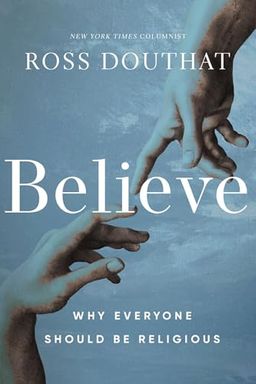
Believe cover

Believe

by Ross Douthat

A New York Times Opinion columnist sets forth his reasons why he thinks religious faith makes sense of things.

Why Being Religious Is Reasonable

What if the most reasonable response to your own life—its order, its wonder, its strange interruptions—were not skepticism, but religion? In Believe: Why Everyone Should Be Religious, Ross Douthat argues that a religious outlook is the sanest way to match what your mind actually encounters: a universe that looks fashioned, a consciousness that won’t be reduced to chemistry, a world that keeps leaking the supernatural, and a human story that is clarified—not clouded—when you commit to a living tradition. He contends that you don’t need a PhD in metaphysics to reach this conclusion. Ordinary reason, applied honestly to experience, points you past materialism to faith—and then urges you to act on it.

The Core Claim: Four Converging Beams of Light

Douthat’s case moves on four tracks that keep intersecting. First, the cosmos itself carries the signature of intention: the Big Bang’s beginning, the exquisite fine-tuning of physical constants, and the strange role of observers in quantum mechanics. Second, your mind will not stay inside a materialist box: the “hard problem” of consciousness resists reduction, and our rational grasp of mathematics and physics outstrips what unguided evolution alone would predict (echoing Thomas Nagel’s critique in Mind and Cosmos). Third, the world is not actually disenchanted: credible reports of near-death experiences, healings, apparitions, and uncanny coincidences persist—even among skeptics like Michael Shermer (whose late grandfather’s dead radio played love songs on his wedding night). Fourth, when you move from hunch to habit, committing to a tradition is more rational than dabbling; it gives you community, guardrails, and tested practices in a landscape where some doors should not be opened lightly.

Why Now: Disillusioned Atheism, Restless Seekers

Douthat writes in the long wake of New Atheism’s combative moment. What remains, he observes from his inbox as a New York Times columnist, is less triumphal disbelief than unhappy drift. Readers confess they miss what church once gave them; others admit spiritual experiences that don’t fit the secular script. As public life fragments, we discover that tearing down religion didn’t leave a clear, humane center. It left competing tribes, new superstitions, and a loneliness that self-help can’t fix. In that vacuum—where AI researchers microdose psychedelics and the metaphysical peeks through again—religion’s intellectual case is both stronger and more needed.

What You’ll Learn in This Summary

You’ll start with the "fashioned universe"—from Copernicus and Darwin to modern physics’ fine-tuning. You’ll then enter the mind’s mystery: why neuroscience maps activity but can’t generate a theory of consciousness; why AI’s “black box” looks less like a Model T and more like a conjuring circle. Next, you’ll test disenchantment’s myth against today’s data on near-death experiences (Sam Parnia’s multi-center research), medical case reports of healings (like the 23-year-old cured of lifelong gastroparesis after prayer), and fieldwork from Stanford’s Tanya Luhrmann (whose batteries literally began smoking during a power-laced train reading). From there, you’ll weigh why commitment beats solo spirituality, how to choose among big traditions (monotheism or polytheism? reincarnation or final judgment? decisive revelation or perennial wisdom?), and how to face three moral stumbling blocks: evil, religion and violence, and sexual ethics.

A Map for Moving from Curiosity to Practice

Douthat doesn’t demand that you leap directly into one faith in a single bound. He argues that reason gives you warrant to become a seeker first, then a joiner. If you fear arbitrariness, he suggests you start with the largest, longest-enduring faiths; if you fear hypocrisy, he reminds you that the point is practice, not performative certainty. If you fear danger in the supernatural landscape, he recommends the protective wisdom of tradition over DIY spiritual tourism. And if you’re tempted to quit because the options feel overwhelming, he gives you a permission slip to begin where Providence placed you—your family’s faith, your spouse’s community, the tradition whose scripture won’t leave you alone—while you keep testing and growing.

A Book for Real People

This isn’t an abstract apologetics treatise. It’s a bridge for thoughtful atheists, spiritual-but-not-religious neighbors, and believers with doubts. Expect Douthat’s journalism-trained clarity, a patient tour through science and experience, and a sober warning: secularism lowers the stakes of existence, but at the price of shrinking your humanity. Religion raises the stakes because it treats you as more than atoms—someone whose choices matter eternally. That “weight of glory” (C. S. Lewis) can feel daunting. Douthat wants it to feel like sanity.

Where the Argument Lands

The final chapter shows why Douthat, personally, is a Catholic Christian: not by private vision, but by a convergence of reasons—the Church’s capacious system, the sacramental promise that God meets even non-mystics, the stability of big tradition, and the singular historical strangeness of Jesus and the Gospels (Richard Bauckham, N. T. Wright, Peter J. Williams). But he keeps the door noticeably wide for readers who will land differently—at least at first. His invitation is simple: follow reason to wonder, wonder to seeking, and seeking to a communal, tested way of life. If you do, you won’t just believe more things. You’ll live as if the cosmos you already inhabit were true.


A Universe That Looks Fashioned

Douthat starts with what your eyes and equations already tell you: reality looks exquisitely arranged. This isn’t a nostalgic return to pre-scientific faith; it’s a recognition that modern science has deepened religion’s original hunch. The Copernican shift didn’t banish design—it exposed more of it. The Darwinian picture didn’t erase teleology—it assumed a law-bound theater in which life could emerge. And twentieth-century physics added two surprises: a literal beginning and laws balanced on knife-edges of possibility.

From Big Bang to Fine-Tuning

The Big Bang tells you space and time had an origin (a point that delighted Augustine’s ex nihilo intuition and unsettled early 20th-century materialists like Walther Nernst). Fine-tuning tells you the origin came with extraordinary calibration. Stephen M. Barr catalogs “anthropic coincidences”: a cosmological constant fine-tuned to roughly 1 in 10^120; a nuclear force that, if increased by a tiny fraction (imagine moving less than an inch on a universe-sized ruler), would have burned away all hydrogen; the delicately set ratio of gravity to electromagnetism needed for life-friendly stars. Stephen Hawking concedes the strangeness: alternate settings would yield “no one able to wonder at that beauty.”

Fred Hoyle, no creationist, thought this looked like “a superintellect has monkeyed with physics.” Douthat’s point is modest: the shape of reality seems chosen. Life—and, strikingly, mind—looks not like a random accident but like an allowed, even invited, outcome.

But What about the Multiverse?

To escape fine-tuning’s theistic scent, some posit a multiverse: countless universes, most barren, ours lucky. Douthat notes the price tag: you trade one invisible thing (God) for an infinity of invisible things (universes you can’t access), while still leaving untouched the laws generating those universes. The “factory” that bubbles off realities itself looks ordered, still subject to mathematics. Simplicity, a scientific virtue, isn’t served by multiplying worlds without observational hope. (Philosopher Paul Davies makes a similar point in Cosmic Jackpot.)

Key Idea

Explaining away design with an infinity of undetectable universes looks less like physics and more like metaphysics in denial.

Quantum Weirdness and the Role of Mind

Quantum mechanics complicates the materialist picture further. In the Copenhagen interpretation, observation collapses a cloud of possibilities into a definite outcome. However you interpret the mathematics, human observers—and, by extension, mind—seem entangled with the emergence of the physical. Spencer Klavan puts it boldly: perhaps “there was someone there” at the beginning for the kind of “years” and “photons” we name to exist meaningfully at all.

Are We Alone? The Fermi Poke

If consciousness is favored, why aren’t the heavens chatty? Enrico Fermi’s question (“Where is everybody?”) still bites: despite the lavish time and space available, the silence suggests that civilizations like ours are rare. If the cosmos is life-friendly by design, it may also be telling you your species matters—cosmically.

Why This Matters to You

You don’t need to decide whether God fine-tuned constants one by one. You can simply accept what the data suggests: the universe prefers intelligibility, and it appears aligned with life and mind. That makes it reasonable—not wishful—to ask what the Designer intends and to seek the forms of life (worship, justice, sanctity) the design seems to invite. As Douthat writes, it’s a return not to credulity but to common sense: treat a crafted thing as crafted; then ask, by whom and for what?

(Context: This line of argument complements Stephen Meyer’s Return of the God Hypothesis and echoes Robin Collins’s fine-tuning case; Douthat’s distinct move is to keep the reasoning clear and non-technical—appealing to your ordinary inference-making, not professional metaphysics.)


Mind First, Not Matter Only

You live inside the only thing you know directly: your own consciousness. Modern neuroscience maps brain activity with astonishing granularity; psychopharmacology modulates mood; AI writes prose and passes bar exams. Yet beneath the dazzle sits a stubborn datum: nobody knows how physical processes generate the felt reality of a self—the redness of red, the sting of shame, the choosing of a choice.

The Hard Problem Won’t Go Away

Philosopher David Chalmers named it in 1995: explaining functions (vision, memory, attention) is the “easy” part; explaining why any of it is accompanied by experience is the hard one. You can point to Wernicke’s area for language and the amygdala for fear, as Steven Pinker tours in How the Mind Works—but location isn’t generation. As neuroscientist Erik Hoel quips, take location away and watch the explanations thin out. Leibniz anticipated this in 1714: even if you enlarged a thinking machine to walk inside it like a mill, you’d see only parts pushing parts, not the emergence of a thought.

AI’s Black Box Looks like a Conjuring Circle

Large language models simulate thought without selves. Their mystery is their opacity (even to their creators), not subjectivity. To hope that stacking more layers will suddenly produce a “me” is less engineering than incantation—waiting for spirit to descend into silicon. Douthat’s point isn’t to deny AI’s power, but to note the metaphysical leap: you’re trusting a complexity-threshold unknown to produce the one thing science cannot currently explain.

Two Materialist Escapes—and Why They Fail

Emergence: say consciousness “emerges” from complexity. But this often redescribes the gap rather than bridging it. “Motion” emerging from an engine is visible and continuous with parts. Consciousness isn’t: knowing a neuron fires when you see Bill Clinton tells you nothing about what it’s like to recall a Clinton scandal or write a Clinton essay.

Illusionism: say the self is an illusion (per Daniel Dennett’s line). But who’s being fooled? The claim eats its own tail. As Thomas Nagel retorts, “only a philosopher could convince himself of something so implausible.” If will, knowledge, and meaning are illusions, argument—an act of will appealing to meaning—deflates on contact.

Key Idea

Consciousness looks “super-physical”—not outside reality, but not reducible to billiard balls. Your mind seems to participate in the structure of the world rather than merely reporting on it.

A Key That Fits a Lock

Your mind’s reach is weirdly excessive for survival. Why should a savannah-optimized ape intuit quantum fields, write symphonies, or translate the math that underwrites cosmic evolution? Nagel presses the point: it’s not just that thought is subjective; it’s that thought reliably discovers what’s objectively the case, far beyond utility. That power looks less like a fluke and more like design—mind answering Mind.

What This Means for You

You don’t need to pick a technical theory of consciousness to act on its significance. Treat your subjectivity as data: it is real, irreducible, and mysteriously in sync with the world it studies. That makes a religious posture—gratitude, reverence, attention—fitting. It also makes practices aimed at aligning mind with the world’s Source (prayer, meditation, sacrament) rational exercises, not opiates. In short: science maps mind’s correlates; religion attends to mind’s meaning.

(Context: Douthat’s approach rhymes with David Bentley Hart’s The Experience of God and Philip Goff’s panpsychist turn, while remaining open to theism as the simpler, fuller explanation.)


The World Isn’t Disenchanted

Official Knowledge (journals, bureaucracies, elite media) acts as if the supernatural were socially impolite. Lived experience refuses to cooperate. Douthat gathers cases where sane people, with no incentive to self-deceive, meet the numinous. The range runs from the subtle nudge to the lab-coated anomaly to the jaw-drop miracle—across cultures, centuries, and scientific epochs.

Everyday Anomalies from Honest Skeptics

Start with Scientific American skeptic Michael Shermer: on his wedding day, a long-dead, unfixable 1978 Philips radio from his late-grandfather-in-law suddenly played love songs all night, then died forever the next morning. Or Stanford anthropologist Tanya Luhrmann, reading an occult adept on a train: she felt power like “water through a chute,” grew hot, and then wisps of smoke rose from her backpack—her bike light melting as if energized from nowhere. Neither episode proves a theology. They undercut a tidy metaphysic.

Near-Death Experiences that Refuse to Be Noise

Modern medicine—the very force secularists expected to crush afterlife talk—has multiplied near-death reports. Bruce Greyson’s decades of research and Sam Parnia’s multi-center studies point to a “paradox”: heightened lucidity and life review at moments when the brain is severely impaired or flatlined. Content patterns recur: encounters with a loving light, panoramic moral memory, sometimes hellish vistas. If all we saw was dreamlike jumble, that would count against religion. But the data’s consistency should count for it.

Healings under Scrutiny

The Catholic canonization process requires rigor: documented incurability, sudden recovery, no confounding treatments. Far from drying up in the scientific age, approved miracles have increased with John Paul II’s canonization wave (two required per saint rather than three, but far more saints). Consider a 23-year-old with lifelong gastroparesis (tube-fed since childhood), who felt “pulsating, electrical” force during prayer; he ate normally that night and was weaned off the tube within a month. His pediatric gastroenterologist called it “difficult to explain.”

Key Idea

If extraordinary claims need extraordinary evidence, our era quietly supplies it—not by randomized trials (which agency-shaped events resist) but by converging lines of credible testimony and case documentation.

UFOs as Proto-Religion

D. W. Pasulka’s work shows how many “alien” encounters function like initiation narratives, with gurus, secret knowledge, and pilgrimage sites. Douthat doesn’t insist “they’re demons”; he does warn that a spiritual vacuum will fill with something—often without the creeds and protections that old religions provide.

Why Labs Can’t Bottle Miracles (and Why That’s Okay)

“Double-blind or it didn’t happen” makes sense for aspirin. It makes little sense for encounters with persons—for love, say. You can raise the odds of romance (go on dates), but you cannot demand reciprocation under lab conditions. Likewise, religion offers practices that dispose you to encounter (prayer, pilgrimage, sacrament), not a vending machine for the divine. The unpredictability matches the hypothesis: agency is on the other end.

(Context: William James made a similar point in Varieties of Religious Experience; Douthat updates it for a world of MRIs, psychedelics, and peer review.)


From Seeking to Committing

Grant the plausibility of religious belief. What next? Douthat’s answer is blunt: move from browsing to belonging. Religion isn’t just ideas; it’s a way of life in time, with others, under guidance. That shift isn’t a betrayal of reason. It completes it.

Three On-Ramps You Can Actually Take

Ethical: You start by living the moral vision—justice, fidelity, mercy—because you find it true and humane. Liberal Protestantism sometimes emphasizes this lane; so do austere Reformed communities and many forms of Islam focused on submission to God’s law.

Experiential: You hunger for the God who acts now. This is the Pentecostal and charismatic promise: healing prayer, prophecy, deliverance. It’s what drew Douthat’s own family into Christianity through illness and surprise.

Liturgical: You want steady transcendence: smells and bells, feasts and fasts, the sacramental hum that makes Monday make sense. Catholicism and Orthodoxy, Sufi Islam, and Tibetan Buddhism keep this current alive.

Community Makes Faith Livable

Humans don’t master hard things alone. You don’t learn violin, sobriety, or soccer without a group; likewise prayer, doctrine, and charity flourish with pastors, teachers, and friends. Even sacred space does work on you. Philip Larkin, an unbeliever, still called church “a serious house on serious earth” where “compulsions meet” and “are robed as destinies.” You need that architecture—spiritual and literal.

Safety in a Dangerous Landscape

Not every spirit means you well. As psychedelic therapy spreads, even enthusiasts report “negative entities.” Traditions exist to discern and protect—naming the real hazards of pride, deception, and darker powers. Douthat’s rule of thumb could be printed on a fridge magnet: don’t mess with demons. An institution that sometimes restrains your curiosity is not an enemy of freedom; it’s a friend of your soul.

Key Idea

Commitment isn’t arbitrary conformity. It’s apprenticeship to the best collective practices we have for aligning finite minds with an infinite good.

Start Where Providence Placed You

Overwhelmed by options? Douthat gives you permission to begin at hand. Ayaan Hirsi Ali moved from atheism toward Christianity partly because it undergirds the civilization she loves. Novelist Paul Kingsnorth wandered through Zen and Wicca only to “arrive where [he] started and know the place for the first time”—baptized into the old English faith, now alive. Don’t despise small starts or mixed motives. In Jesus’ parable of the talents, the master praises those who invest what they have—even if they end with different sums. He rebukes the one who buried his gift in fear. Better to take a step than to hoard your questions underground.

(Note: This complements James K. A. Smith’s emphasis on habit-formation and Charles Taylor’s analysis of belief in A Secular Age; Douthat uniquely braids the rational case with a pastoral nudge.)


Picking a Map: The Big Faiths

If you’re going to bind your life to a tradition, which one? Douthat doesn’t hand you a single answer; he gives you a way to choose that respects both conscience and history. His counsel: start with the faiths that built civilizations, survived centuries, and still form countless souls—Christianity, Islam, Hinduism, Buddhism. Then weigh a few basic, decisive questions.

The Emeth Principle: Truth Outside Home Base

C. S. Lewis’s Narnian soldier Emeth served the wrong god sincerely and is welcomed by the true God for his virtues. Douthat’s version: many religions carry real light. You don’t need to assume everyone else is worshiping a hallucination. This tempers both triumphalism and paralysis. You can get meaningfully closer to God—even if you’re not yet at the finish line.

Why Start with the “Big Four”

A new revelation might be true—but if God means to speak decisively, we should expect it to bear global fruit, not stay a boutique option. Long endurance and broad formation suggest deep contact with reality. The big traditions also host internal diversity and living schools, so you won’t stall the moment you change your mind on a sub-question.

Key Decision Points

One God or Many? Philosophically, monotheism often wins the unity-of-explanation prize (and remains a strand inside Hindu thought). Practically, polytheistic landscapes bring intimacy—with risks. Post-Christian pagan revivals can romanticize nature while forgetting that nature devours. Historic polytheisms built hedges (Brahman above the gods); today’s spiritual marketplaces often don’t.

What Are the Eternal Stakes? Is this life one decisive drama (Abrahamic faiths), or one of many (reincarnation in Hinduism/Buddhism)? Universalism has a noble pull, but it can make embodied life feel oddly optional. Reincarnation honors embodiment but risks an eternal treadmill with amnesia. Final judgment raises the stakes—soberingly.

Does God Act in History—Once for All? Are there decisive revelations (Sinai, the Incarnation, the Qur’an) that anchor interpretation, or a series of partial insights that never climax? If a text or a figure seizes you—Jesus in the Gospels, the Gita’s Krishna, the Qur’an’s cadence—don’t ignore the summons while you polish your metaphysics.

Bridges between Paths

The great faiths overlap. Muslims already revere Jesus; Christians await a consummation that Muslims frame differently; Buddhists and Christians converge on humility, compassion, and detachment from ego. That overlap means your first commitment need not be your last move. But it should be real enough to form you now.

Key Idea

Pick a tested map, knowing it contains roads to other vistas should God ask you to cross over later. Faithfulness today is the path to clearer sight tomorrow.

(Context: This selection framework complements Stephen Prothero’s God Is Not One—acknowledging real differences—while preserving Lewis’s generous hope.)


Answering Three Moral Roadblocks

Even if religion seems plausible, three moral objections can stop you: the problem of evil (“an all-good, all-powerful God wouldn’t allow this”), religion’s supposed record of violence, and traditional sexual ethics. Douthat meets each without hand-waving.

1) Why Does God Allow So Much Suffering?

First, notice the presumption at work: to judge God’s world you already assume a non-animal stature—real moral knowledge and a vantage on the whole. That’s a theistic inheritance, not a materialist deduction. Second, Christianity intensifies the dilemma by portraying a God of intimacy and compassion; yet it also gives the most startling answer: God enters our suffering, dying in it, and transfigures it. That’s not a syllogism; it’s an event. Finally, even if you doubt classical theism’s omnis, religion remains reasonable: lesser divinities (or a God who self-limits) still make practice, prayer, and morality meaningful. The world’s evident goodness, as well as its pain, should keep you seeking the Good that grounds both.

2) Isn’t Religion Uniquely Violent?

History says no. In a survey of 1,763 wars, only 121 were primarily religious (Phillips & Axelrod). In Matthew White’s catalog of the 100 worst atrocities, roughly a dozen are chiefly religious—far fewer than secular ideologies of the 20th century (nationalism, fascism, communism). Religion can be co-opted, yes. But religion has also birthed peaceable correctives: just war criteria, human rights (the Universal Declaration’s architect was a Catholic), abolition (Quakers, evangelicals), and the rhetoric of Gandhi and King. The more a faith grabs power, the more temptations it faces; hence the comparative gentleness of Anabaptists versus inquisitorial regimes. Choose traditions and expressions accordingly.

3) What about Sexual Ethics?

It’s fashionable to assume that a wise God wouldn’t care about what consenting adults do. But sex forms bodies and binds futures; it creates and wounds; it makes children or loneliness. If God cares about anything human, sex would be near the top. You can debate particular rules; you can find reformist synagogues or churches; you can argue for prudential updates. But it’s unreasonable to expect a serious religion to be casual here. And our era’s outcomes—declining fertility, rising porn addiction, delayed marriage, and reported unhappiness—should chasten our self-confidence about throwing the old codes away wholesale.

Key Idea

Mature faith faces suffering without surrender, restrains power rather than baptizing it, and treats sex as sacred fire—precious, perilous, and ordered to love and life.

(Context: Alasdair MacIntyre’s After Virtue offers a philosophical version of the sexual-morality argument; Douthat presses the pastoral logic.)


Why Douthat Bets on Christianity

Douthat’s personal landing place—Catholic Christianity—flows from biography and reasons. As a child, he stood beside intense charismatic experiences that passed him by; as an adult, he wanted a tradition that could systematize experience, sanctify the ordinary through sacrament, and hold together intellectual seriousness with mystical openness. Catholicism did that for him. But his boldest claim is historical: the Gospels, read soberly, remain peerless as sources about a figure whose life remade the world.

Eyewitness Texture and Early Proximity

Against the “late myth” narrative, Douthat follows Richard Bauckham (Jesus and the Eyewitnesses), N. T. Wright (The Resurrection of the Son of God), and Peter J. Williams (Can We Trust the Gospels?): the four Gospels fit what we’d expect from eyewitness-based memories—place-name accuracy, era-appropriate personal names, and “undesigned coincidences” (Lydia McGrew) where one account quietly explains another’s gaps. They were composed close to the events; rival “gospels” are later and less moored to Palestine’s geography and Judaism’s world.

The Strangest Story, Told in Daylight

The Jesus narrative isn’t like myth parked in the mists; it’s dated under Roman procurators, in named towns, with named witnesses. Its shape is stranger than saintly legends: the transfiguration precedes humiliation; the Messiah is crushed, abandoned, and dies with a cry of forsakenness; then, in a second act no tradition expected, he rises. The earliest community does not conquer by sword; it builds, suffers, and writes only after its founder’s death—yet within three centuries it overturns an empire’s moral imagination. Tom Holland (Dominion) calls this inversion—glory in a tortured body—the root of what still feels humane in the West.

Key Idea

Treat the resurrection not as a plot device but as the simplest explanation for a historically weird and world-changing aftermath. Then live as if it happened.

Why Catholicism, Specifically

Catholicism’s “both/and” holds Douthat: reason and mystery, scripture and sacrament, saints and sinners, a triune God transcendent and immanent, purgatory as moral realism. It’s big enough for his head and steady enough for his heart. He’s candid about the Church’s sins (abuse, power temptations), but reads its endurance and fruit as signs of Providence rather than disproofs. A loving God who acted decisively in history would not abandon the stewardship of that revelation entirely to error.

The Urgency for You

Douthat ends not with triumphalism but with Jesus’ own tempo: “Stay awake.” Life is short; the stakes are high. Reason has brought you to the border. Step through with a people who can teach you how to pray, to repent, and to receive. If you’re not ready for Rome, begin where the light is strongest for you. Let practice clarify belief. Then decide again.

(Parenthetical note: Even readers who won’t share Douthat’s endpoint can use his method—follow converging reasons, test them in practice, privilege historically thick traditions, and expect reality to respond.)

Dig Deeper

Get personalized prompts to apply these lessons to your life and deepen your understanding.

Go Deeper

Get the Full Experience

Download Insight Books for AI-powered reflections, quizzes, and more.