
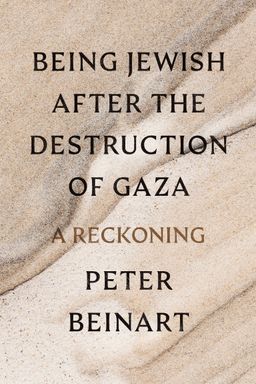
Being Jewish After The Destruction Of Gaza cover

Being Jewish After The Destruction Of Gaza

by Peter Beinart

The editor at large of Jewish Currents and a contributing opinion writer at The New York Times evaluates potential narratives following the war in Gaza.

From Supremacy To Equality: A New Jewish Story After Gaza

When do your loyalties ask more of your conscience than you’re willing to give? In Being Jewish After the Destruction of Gaza, Peter Beinart argues that Jewish life needs a new moral story—one that trades a comforting script of perpetual victimhood for an ethic of equality, accountability, and shared security with Palestinians. He contends that the dominant narrative—“they tried to kill us, we survived”—has become a moral sedative that masks Palestinian subjugation as Jewish self-defense and licenses unlimited force done in our name.

Beinart’s core claim is stark: Israel is not simply exercising Jewish self-determination; it is exercising Jewish supremacy over millions of Palestinians without equal rights. The Gaza war stripped away euphemisms—flattened universities, famine warnings, tens of thousands killed—and revealed a communal theology that treats the Jewish state as beyond judgment. He urges you to see how this story imperils Jews, too: violence begets violence, and a strategy to “destroy Hamas” without offering political equality only reproduces the conditions for the next war.

Why This Reckoning Now?

October 7 shattered Israelis and Jews globally. Beinart does not minimize it. He details the terror in Kfar Aza (six-year-old Amalia telling her grandmother her parents were dead), the Cunio family’s captivity (moldy pita, no bathrooms, thirty-pound weight loss), and hostages’ fear that Israeli airstrikes would kill them. But he pairs these with Gaza’s agony: parents grinding hay to bake bread; UNICEF officials saying “the depth of the horror surpasses description”; over eleven thousand named children dead by late summer 2024, with total fatalities surpassing thirty thousand.

For Beinart, we face two moral failures at once: some antiwar voices dismissed Israeli grief; many Jewish voices refused to see Palestinians as human beings with names, families, and rights. The book is his attempt to repair both—by insisting we hold griefs together and judge power honestly.

The Old Story—and Its Blind Spots

Beinart dissects the ways Jews, especially in establishment institutions, edit tradition and history to perpetuate innocence. Purim’s finale (Jews kill 75,000 in Esther 9) vanishes beneath noisemakers and hamantaschen. The Zionist origin story leaps from biblical promise to Jewish kings, skipping Joshua’s conquest that earlier Zionists once proudly cited (Jabotinsky called Joshua’s forces “brigands”). 1948 becomes a tale of Arab armies causing a refugee crisis—though many Palestinians fled before Israel’s declaration of independence, often amid assaults like Deir Yassin, Jaffa, and Haifa.

Crucially, “self-determination” is stretched to justify ruling another people. Beinart shows how, between the river and the sea, Israel holds decisive power: West Bank law is military for Palestinians and civil for Jewish settlers; Gaza’s borders, skies, and seas are controlled by Israel even post-2005; Palestinian citizens of Israel vote but face land and planning discrimination. Human rights monitors—from B’Tselem to Amnesty to Human Rights Watch—call this system apartheid. The old story can’t explain that away.

What the New Story Centers

Beinart proposes a narrative grounded in three commitments:

  • Equality over supremacy: Replace the demand that Jews must rule with a demand that everyone live under one law, in one state or two—confederation, federation, or another shared arrangement.
  • Shared security: Don’t fight insurgency with body counts. Offer political horizons that make violence less rational for ordinary people (compare to Northern Ireland’s Good Friday Agreement or South Africa’s transition).
  • Accountability without idolatry: Stop treating the Jewish state as an untouchable deity. As the theologian Yeshayahu Leibowitz warned, making the state holy is a form of avodah zarah (idolatry) that corrupts Judaism itself.

How the Book Builds the Case

The argument unfolds in five moves. First, he exposes the “they tried to kill us” script that blinds you to Jewish power and Palestinian pain. Second, he contextualizes October 7 within a century of dispossession and decades of thwarted nonviolence—Oslo’s collapse, the criminalization of boycotts, the Great March of Return’s snipers. Third, he dismantles exculpations—“human shields,” “fake casualty counts,” “ISIS/Mosul analogies”—and notes IDF spokesperson Daniel Hagari’s admission: “Destroying Hamas” by force alone is a mirage.

Fourth, he challenges the “new antisemitism” frame that tars anti-Zionism as Jew-hatred. Original research (Hersh and Royden; UCLA) shows antisemitic attitudes skew higher on the right; most progressives distinguish between Jews and Israeli policy. Still, Beinart urges campus activists to be explicit about protecting civilians—because moral clarity must run both ways. Finally, he returns to theology: Korach’s error was declaring Israel “holy” by identity, not by conduct. When you sanctify a state above the law, you justify anything it does.

The book’s wager

“Proclaim release throughout the land for all its inhabitants” (Leviticus 25:10). Beinart reads this Jubilee line to mean: freeing the enslaved liberates the masters, too. Equality isn’t charity; it’s the only path to Jewish and Palestinian safety—and the only way to make Judaism’s universal moral voice credible again.

If you’ve felt your heart split—grieving Israelis you know, recoiling at Gaza’s devastation, and confused by the slogans and counter-slogans—this book gives you a map. It doesn’t promise ease. It promises moral adulthood: the courage to love your people without worshipping your state, and the vision to see that in Palestine-Israel, no one gets to live safely unless everyone can.


The Victimhood Script—and Its Costs

Beinart starts by holding up a mirror to a familiar story many of us learned at the Shabbat table: Jewish holidays rehearse the same plot—“They tried to kill us, we survived, let’s eat.” It’s funny, and often true. But when it becomes your master narrative, it edits out the parts of Jewish memory that complicate innocence and responsibility. You start hearing only Esther’s courage and never the blood-soaked ending where Jews kill 75,000 Persians and then feast. You celebrate Chanukah’s rededication of the Temple, and forget the Hasmonean dynasty’s corruption later condemned by the Rabbis. You retell Exodus and ignore that Abraham and Sarah enslaved Hagar (as several scholars and midrashim note). The old script turns textured tradition into a single chord: perpetual Jewish victimhood.

How History Gets Edited

The same editing distorts modern history. Many communal materials jump from biblical promise to Jewish kings and then leap to Roman exile—skipping Joshua’s conquest (which early Zionists openly invoked) and glossing 1948 as a story in which Arab states caused the Palestinian exodus. Yet archival evidence shows a third to half of Palestinians fled before May 14, 1948; that Jaffa and Haifa were largely depopulated in the spring; that massacres like Deir Yassin terrorized villages; and that Israel didn’t allow refugees to return. Even Israeli historian Benny Morris, no leftist romantic, has acknowledged that large-scale transfer was intrinsic to consolidating a Jewish majority.

Beinart narrates individual lives to interrupt abstraction: Nazmiyya al-Kilani hobbling on a broken leg toward Haifa’s port, losing her husband and siblings to forced removal; Eilaboun’s villagers marched as human shields, robbed, and some executed. Without names, Palestinian suffering becomes an unfortunate weather event. With names, it becomes history you must account for.

Self-Determination vs. Supremacy

“Self-determination” is a human right—until it is used to deny someone else’s. Beinart uses a simple analogy (from philosophers Avishai Margalit and Joseph Raz): your right to steer your own car doesn’t license you to seize the lane and force everyone else off the road. In practice, Israel “determines” not only Jewish life but the lives of over seven million Palestinians across Gaza, the West Bank, and East Jerusalem, most without citizenship.

Consider concrete gears of dominance: the Israel Land Authority (with near-half its board seats allocated to the Jewish National Fund) manages over 90% of land inside Israel for Jewish development; Palestinian citizens attend segregated schools and face relentless zoning denial and demolition (Bedouin village Al-Araqib has been razed more than two hundred times). In the West Bank, Palestinians live under military law while nearby settlers enjoy Israeli civil law. In Gaza, even pre-October 7, Israel controlled sea, air, population registry, and two primary crossings (and significant sway over the Egyptian Rafah gate). “Open-air prison” wasn’t metaphor—it was policy.

The “Right to Exist” Sleight-of-Hand

Beinart parses a phrase that inflames debate: “Israel’s right to exist.” States don’t have inherent rights in Jewish ethics (Abraham Joshua Heschel would say only people are made in God’s image), and in political theory a state is an instrument that must be judged by how it treats all under its power (Max Weber). What’s really at issue is a political system—Jewish supremacy from the river to the sea—not the existence of a sovereign power or powers in that land. Americans routinely question the legitimacy of foreign political systems (the “Islamic Republic” of Iran or “People’s Republic” of China) without implying a people’s right to life is void. Jews understandably hear “no right to exist” as a mortal threat. Beinart urges you to disaggregate that fear: criticism of a discriminatory system is not a call for genocide—just as demanding equal citizenship in 1960 Alabama was not a call to kill whites.

Why This Matters to You

If your Jewish identity rests on a story of exclusive innocence, any Palestinian claim feels like an erasure. But if your identity includes Jewish power—and power’s temptations—then Palestinian claims look like mirrors, not threats. That shift doesn’t make you less Jewish. It makes your Judaism more adult.

(Context: This critique echoes Hannah Arendt’s warnings against sacralizing the nation and aligns with Yeshayahu Leibowitz’s insistence that chosenness means obligation, not virtue.) By questioning the victimhood script, you don’t discard survival; you place it inside a larger moral arc where survival and justice rise together.


How Oppression Fuels Violence

You can oppose deliberate attacks on civilians and still ask what social and political conditions make violence more likely. Beinart insists on both. He catalogs the horror of October 7 with specificity—Amalia’s fourteen hours in a closet, four-year-old Avigail taken hostage, David and Sharon Cunio’s twins reunited in a Gaza hospital under siege—and then asks a hard question: does making Palestinian freedom impossible reduce violence, or incubate it?

From Hopes to Ruins

In the 1990s, many Palestinians supported Oslo’s promise that limited autonomy would become full statehood. When that horizon receded—settlement construction surged, closures strangled mobility, and Camp David offered a cantonized state—support for violence rose (Khalil Shikaki’s longitudinal polling tracks this swing). Israeli leaders saw terror as proof that Palestinians spurned peace; Beinart reads it, with help from scholars, as despair’s grim dividend. People were more likely to back suicide bombings after relatives were arrested, injured, or killed (Saleh; Brym & Araj). Exposure to political violence made both Israelis and Palestinians less likely to support peace (Hirsch-Hoefler et al.).

The biographies of militant leaders repeat this loop. As children in 1956 Khan Younis, Ziad al-Nakhalah (Islamic Jihad) and Abdel Aziz al-Rantisi (Hamas) watched Israeli forces kill family members. Decades later, they led violent movements. This is not excuse; it’s explanation. As W. H. Auden wrote, “Those to whom evil is done, do evil in return.”

Nonviolence, Thwarted

Nonviolent strategies repeatedly hit walls. Salam Fayyad professionalized Palestinian Authority institutions and opposed armed struggle; he left office saying “in deeds, Israel never got behind me.” Boycott campaigns were criminalized by Israel and punished by U.S. state laws. Appeals to the U.N. Security Council and ICC were blocked or threatened. The 2018 Great March of Return—tens of thousands marching to a fence with Palestinian flags while Hamas paused rockets—met sniper fire calibrated to shatter legs. An amputee soccer league formed in Gaza. What message does that send a teenager choosing tactics?

Beinart closes this loop with a devastating personal coda: his friend Muhammad Shehada’s closest friend, Ali, a fierce critic of Hamas, lost home after home in the 2023–24 war, scavenged for water under bombardment, and in January was killed by a missile near Deir al-Balah’s hospital. Before he died, he told Muhammad that he now supported armed attacks to deter Israel. Violence reproduces itself where politics and dignity are locked out.

Better Analogies, Better Policy

If you misname the violence, you misprescribe the cure. Beinart argues October 7 is not a pogrom or the Holocaust; those were state or mob assaults against powerless Jewish minorities. This was a gruesome revolt by an oppressed people under foreign control—closer to the Haitian revolution’s massacres, the Creek assault at Fort Mims, or Kenya’s Mau Mau Lari massacre. Earlier Zionists (Jabotinsky, Hans Kohn) said as much: natives resist colonization “as long as they have the slightest hope.”

Your takeaway

Condemn terror without collapsing analysis. If your goal is fewer funerals, you must create nonviolent pathways for change that are credible. Absent that, more people will decide, like Ali, that the only language anyone hears is force.

(Comparison: In Long Walk to Freedom, Nelson Mandela described turning to sabotage only after nonviolent avenues were “barred,” a framing echoed in political science (Kirssa Cline Ryckman) that shows failed peaceful protests increase armed insurgency risk.) Beinart’s challenge to you is practical, not just moral: policy that forecloses hope escalates harm on all sides.


How We Un-see Gaza

Beinart names the rhetorical habits that let you look away. One is deflection: ask about starving families and a minister replies, “We’re concerned about the 134 hostages,” as if the hostages’ safety and Gaza’s safety were not intertwined. Another is denial: senior officials assert “no imminent famine” even as international food security bodies warn catastrophe and parents grind hay to bake bread. A third is discrediting the numbers: “Hamas-run Ministry of Health lies,” while Israeli casualty claims—without names or audits—go unquestioned.

Counting the Dead—With Names

Beinart follows the method, not the spin. Historically, the Gaza Health Ministry publishes names and biographical data. That’s why the U.S. State Department, U.N., WHO, and HRW have often relied on its totals; why Airwars’ independent sample check found the ministry’s early numbers slightly under-counted verified deaths; and why internal Israeli briefings have cited the ministry’s totals. As Israel bombed or besieged hospitals, fewer deaths could be named in real time, widening room for denial. By late spring, nearly a third were unidentified; by late summer, the ministry had re-identified more than 80% and named over 11,350 dead children. The trend line isn’t propaganda; it’s paperwork catching up amid rubble.

Israel’s prime minister meanwhile floated that “nearly half” of the dead were terrorists without presenting a list, methodology, or criteria. As conflict-casualty expert Michael Spagat put it, that’s “numbers out of thin air.” If you reflexively distrust the side naming its dead and trust the side not naming, you’re not doing empiricism. You’re doing allegiance.

Human Shields, Misused

International law’s “human shields” concept prohibits forcing civilians to colocate with military targets. Fighting in urban areas—which both insurgents and state armies do—is not itself the crime. Civilians don’t become fair game because fighters are nearby. That’s why the Additional Protocol still requires proportionality and distinction. Beinart notes early-war statements: “emphasis is on damage not accuracy”; “all restraints removed”; and a thousand “power targets” (high-rises, banks, universities, ministries) hit for psychological effect. Calling whole neighborhoods “human shields” to rationalize systemic devastation inverts the law’s purpose.

Bad Analogies, Bad Morality

Comparisons to the U.S. war on ISIS or Allied bombing of Nazis are meant to end argument: “everyone does it.” But ISIS held sovereign cities abroad; Gaza is a besieged enclave whose registry, imports, and exits are controlled by the belligerent. A better analogy is nineteenth-century U.S. assaults on reservations: a stronger power pounding a contained population that lacks sovereignty. Even then, insurgency wasn’t beaten by tonnage; it was tempered by politics.

A Heschel test

Rabbi Abraham Joshua Heschel said that during Vietnam, when he opened his siddur he saw “children burning from napalm.” Beinart asks you to do the same moral work: let Gaza’s children into your prayer book. If you can’t, the problem isn’t your politics. It’s your capacity to see.

(Context: Hannah Arendt warned that when a people “believes only in itself,” it becomes blind to external judgment. Beinart shows how this blindness turns techniques of accountability—human rights reports, courts—into enemies to be defamed or sanctioned.) To see rightly, you must replace slogans with standards and stop granting your side a moral monopoly.


Why 'Destroy Hamas' Fails

You can win battles and still lose the war. Beinart’s strategic case is straightforward: insurgent movements embedded in a civilian population cannot be eradicated by force alone. You must flip the political calculus for the people living among them. Even the IDF’s own spokesperson, Rear Admiral Daniel Hagari, conceded eight months into the war: “Destroying Hamas… is throwing sand in the public’s eyes.”

The Insurgency Rulebook

History’s ledger is brutal on this point. The U.S. toppled the Taliban and still faced a resilient insurgency; France “won” battles in Algeria but lost the war; the British could not extinguish the IRA. Why? Because another cohort of fighters rises whenever civilians believe armed struggle is their only meaningful leverage. Since 2007, Israeli policy has aimed to contain Hamas militarily while tightening Gaza’s quarantine. Hamas’s rockets have lengthened in range, and its ranks expanded from roughly 10,000 (1990s) to as many as 40,000 by 2023. Some rockets were literally built from unexploded Israeli ordnance. Bodies destroyed became munitions.

Even if Israel topples Hamas’s rule, Hamas may prefer the shadows: governance is a headache, insurgency is scalable, and any “replacement authority” seen as an Israeli subcontractor will lack legitimacy. Meanwhile, settler expansion and Knesset votes rejecting Palestinian statehood (July 2024: zero yes votes from Jewish parties) tell Palestinians that moderation buys them nothing. With no political horizon, recruitment posters write themselves.

Security Is Interdependent

Beinart reframes safety as a shared good: Israelis don’t get it if Gazans and West Bankers can’t. The hostage file proves the point. Most releases came via ceasefire-and-prisoner swaps, and several freed Israelis said their greatest fear in captivity wasn’t guards—it was airstrikes. Protests for a ceasefire on Israeli TV gave captives hope. To bring people home alive, you must quiet skies, build leverage, and make deals. Those are political tools, not kinetic ones.

The wider region underscores the interdependence. Iran’s “axis of resistance” leverages Palestinian dispossession to justify conflict. End the dispossession credibly and you undercut that narrative’s core. Even Tehran endorsed the Arab Peace Initiative’s concept of recognition if a genuine Palestinian state emerges. Politics can open doors bombs can’t.

The Only Strategy That Lasts

A durable security strategy does three things:

  • Ends exclusion: When groups are locked out of power, rebellion risk triples (Cederman, Wimmer, Min). Political inclusion reduces the payoff to violence and raises the costs.
  • Creates nonviolent wins: Make negotiations, courts, and civil action actually deliver results—settlement freezes, freedom of movement, equal law—not just talking points.
  • Deters by dignity: People deterred by fear alone fight later; people deterred because they have something to lose (citizenship, safety, mobility) mostly don’t pick up a gun.

Ayalon’s warning

Former Shin Bet chief Ami Ayalon: “Dish out humiliation and despair, and Hamas’s popularity will grow. Push Hamas out, and we’ll meet al-Qaeda; then ISIS.” That’s not prophecy. It’s political physics.

(Comparison: In Making Peace, Making War, historians of Northern Ireland show that intelligence wins became sustainable only after the Good Friday Agreement created a political home for grievances. Force separated from reform couldn’t finish the job.) Beinart’s bottom line to you is pragmatic: stop promising security through annihilation; start building it through equality.


Antisemitism, Anti‑Zionism, And The Data

Accusations of antisemitism are a powerful solvent: they dissolve any discussion of Gaza into a debate about motives. Beinart insists you face two truths at once. First, antisemitism is real and surges when Israel is at war—just as German-, Japanese-, Muslim-, and Chinese-Americans have been scapegoated when the U.S. fought or feared their “homelands.” Second, conflating anti-Zionism with antisemitism obscures both genuine Jew-hatred and Palestinian claims for equality.

What the Research Actually Shows

The most comprehensive studies (Eitan Hersh & Laura Royden; UCLA analyses of the Nationscape dataset) find antisemitic attitudes are more prevalent on the right than the left in the U.S. Among progressives, disapproval of Israeli policy rarely spills into bigotry toward Jews, even when respondents are primed with “most American Jews support Israel.” On campuses, the same pattern holds: many students oppose Zionism, but they are less likely than the general public to endorse classic antisemitic tropes (“Jews have too much power”).

Still, lines blur. A student at a liberal arts college called a classmate a “Zionist” for wearing a kippa—misidentifying Jewishness with state policy. That confusion fuels spikes in harassment catalogued by Hillel and the FBI. The answer, Beinart argues, is precision: demand critics separate Jews (a people and religion) from Israel (a state and ideology), and demand Jewish institutions stop telling the public that “Zionism is fundamental to Judaism,” which erases that very distinction.

Slogans in the Dock

Beinart parses controversial chants. “From the river to the sea” is condemned by some officials as genocidal. But historically, Fatah documents envisioned one democratic state with rights for Jews and Arabs; contemporary users like Rep. Rashida Tlaib define it as equality, not expulsion. Polls show stark interpretive gaps (66% of Jewish students hear expulsion; 14% of Muslim students do). Instead of prosecuting meanings by fiat, Beinart says: ask users what they mean, and demand clarity that civilians must be protected. Likewise, “intifada” literally means “uprising” (Arabic papers used it for Paris 1968 and Egypt 2011). It can denote nonviolent or violent resistance. Context and explicit commitments matter.

Double standards slice both ways. If “intifada” makes Jews feel unsafe, “I stand with the IDF” makes many Palestinians feel unsafe after the IDF has destroyed their universities, homes, and families. The ethical test cannot be: a slogan is permissible if my group says it and menacing if yours does. It must be: does it explicitly respect the laws of war and equal human worth?

Campus Power—and Selective Outrage

Despite hyperbolic claims of 1930s Germany, most U.S. pro-Palestine protests have been peaceful (97% per ACLED). Yet students have been doxxed on trucks circling multiple campuses; job offers were rescinded for political statements no more violent than pro-war ones; organizations like Jewish Voice for Peace were banned while they were, quite literally, composed of Jews. Meanwhile, Gaza’s students—4% of the population, a rate akin to the U.K.—saw Al-Azhar and other universities reduced to rubble and classmates like dental graduates Aseel Taya and Noor Yaghi killed. In hundreds of establishment tweets about “students,” not one mentioned Gazan students’ suffering. That asymmetry is moral myopia.

Your move

Hold two lines: name (and oppose) antisemitism wherever it appears—and refuse to use the charge as a shield against honest scrutiny of a war and a system of unequal law. That’s how you defend Jews and defend justice at once.

(Context: This argument echoes Brian Klug’s and David Feldman’s cautions against stretching “antisemitism” to cover criticism of Zionism. It also channels I. F. Stone’s 1967 warning that defending an exclusionary state abroad can erode the pluralism Jews need at home.)


Idolatry Of The State

At the heart of the book lies a theological charge: much of contemporary Jewish life treats the Jewish state as an object of worship. Beinart draws on Yeshayahu Leibowitz’s reading of Korach (Numbers 16) to make the point. Korach’s sin wasn’t rebelling against Moses; it was declaring the people holy by identity, not by conduct. Translate that to politics: when a state’s “right to exist” becomes sacrosanct regardless of how it treats the people under its supremacy, you’ve slipped from loyalty into idolatry—avodah zarah—which Jewish law counts among the gravest sins.

Chosenness as Obligation, Not Virtue

In the Bible, chosenness binds Jews to more judgment, not less: “You alone have I known… therefore I will punish you” (Amos). Kings are warned to write a Torah scroll so they don’t “act haughtily.” The good king “judges and is judged.” Beinart argues that when modern Jewish institutions treat rejecting Jewish statehood as heresy worse than rejecting God—e.g., banning anti-Zionist speakers at Hillel while inviting all forms of religious doubt—we invert that ethic. Political ideology outranks ethics; the state outranks God.

The Sacrifices on the Altar

Idolatry always demands offerings. In Gaza, the offering is a society: as of September 22, 2024, roughly 6% of the population had been killed or injured, and the U.N. estimated rebuilding housing alone could take eighty years. In Israel, the offering is your own children’s future: this level of devastation breeds militants whose commitment will outlive the men who ordered the strikes. In America, the offering is civic health: venerable Jewish platforms cancel authors and clubs to avoid open debate; major groups partner with politicians trying to overturn elections because those politicians back the war; legislation is pushed to defund universities that tolerate anti-Zionism. Defending a “tribal deity” abroad corrodes pluralism at home.

Then there’s the offering of the international legal order. Rather than argue on the merits, establishment organizations smear human rights groups as antisemitic and threaten or sanction international prosecutors (even their children). If a Jewish state may never be judged, courts and norms become the enemies. That’s a gift to every tyrant who wants impunity.

A Heschel Criterion for Worship

Heschel defined an idol as “any god who is mine but not yours.” If your “god” protects Jews but not Palestinians, that’s idolatry. Judaism’s God commands “proclaim release throughout the land for all its inhabitants” (Leviticus 25:10). Beinart cites a rabbinic gloss: “One who acquires a slave acquires a master.” Oppressing others enslaves you—to fear, to cruelty, to lies. Jubilee frees both the oppressed and the oppressor.

A question for your conscience

How many Palestinian deaths would move you to stop arming this war? If your answer is “no number,” you don’t support a policy. You worship a state. And Jewish tradition has a word for that.

(Context: Leibowitz called state-worship “the essence of fascism.” Hannah Arendt warned Jewish nationalism could replace God with “the people.” Beinart threads their warnings into a 2025 crisis: a people famous for prophetic self-critique now silences prophets at the door.) The antidote isn’t self-loathing; it’s placing the state back on the altar of judgment, where Judaism’s God always meant it to be.


Lessons From South Africa & Northern Ireland

If your mind whispers, “Equality here would mean our annihilation,” Beinart invites you to test that fear against real histories where dominant minorities felt the same. Afrikaner memorials to concentration camps dotted South Africa; their leaders warned that majority rule would be “a prelude to genocide.” In Northern Ireland, Protestants processed centuries-old sieges and massacres every July and saw power-sharing as surrender to “tribal barbarism.” In the American South, whites read Reconstruction as white victimhood and integration as “national suicide.”

What Actually Happened

When inclusion came, violence did not intensify. It ebbed. Why? Because once excluded groups gain political voice and legal avenues, armed struggle loses its logic for most people. In South Africa, regional wars cooled as the ANC put down arms; in Northern Ireland, the IRA’s strategic incentives changed under the Good Friday Agreement; in the U.S. South, enfranchisement didn’t unleash a race war—it anchored change in law. Political science backs this: excluded ethnic groups are three times more likely to rebel than represented ones (Cederman, Wimmer, Min). Political equality is not a panacea; it is a proven firebreak.

Closer to home, Israeli Jews already trust this principle in practice. Palestinian citizens of Israel—who vote, serve as nurses and doctors, and even had an Islamist party in a governing coalition—are not widely feared as would-be butchers. The same Israelis who see Gaza as a sea of knives enter hospitals and pharmacies staffed predominantly by Arab citizens. Why? Citizenship and (imperfect) equal law channel conflict away from violence.

Designing Equality Here

Israel-Palestine’s puzzle is unique: two peoples, two languages, intertwined geographies. Beinart doesn’t pretend there’s a single blueprint. He points to options debated by scholars and activists: two states in confederation (open borders, shared Jerusalem, cooperative security); one federal state with strong communal autonomy (think Belgium’s consociational model); or a democratic unitary state with robust minority protections and restitution mechanisms. The non-negotiables are the same: one person, one vote; equal law; material repair for historic wrongs. That means the October 7 Israeli refugees go home—and so do the 1948 Palestinian refugees, via return, compensation, or land swaps negotiated in good faith.

Reconciliation is not quick. South Africa still groans under inequality and corruption; Northern Ireland’s schools remain largely separate. But inclusion makes other reforms possible. It stops the bleeding.

Liberations, Plural

There’s another gift: identity opens. Deputy President Thabo Mbeki called himself the grandchild who lays flowers on Boer graves. An Afrikaner academic named Verwoerd (grandson of apartheid’s architect) joined the ANC and said, “Take the African bit in Afrikaner seriously.” In East Belfast, Linda Ervine teaches Irish to Protestants in the very neighborhoods that once expelled Catholics. If you’ve only known identity as fortification, this sounds impossible. Beinart’s point is practical and spiritual: inclusion makes room for more expansive “we’s” without erasing anyone’s “me.”

The wager for you

If equality here feels like a cliff, learn from places that jumped and found ground. The ground wasn’t utopia. It was something better than permanent war.

(Comparison: Read Rami G. Khouri and Ali Abunimah on confederation models; compare to Arend Lijphart’s work on consociational democracy.) Beinart doesn’t supply a schematic. He supplies a permission slip to imagine beyond supremacy—and a set of empirical reasons to trust that imagination.


A Jewish Path Forward

Beinart closes not with a policy paper but with a religious and civic practice you can adopt. The first move is narrative: trade the comfort of innocence for the strength of responsibility. The second is political: center equality wherever you have voice. The third is relational: let Palestinians force you “to see yourself as you are” (James Baldwin)—and allow those encounters to remake your Jewishness into something more capacious and brave.

Practices You Can Begin Now

Beinart suggests concrete commitments:

  • Mourn fully: Say the names of Israelis killed and kidnapped—and the names of Gazans killed. Put both lists on your fridge. Make both part of your Kaddish and Kiddush. Let your synagogue be a house of shared grief.
  • Use standards, not sides: When you hear “human shields,” ask for the law. When you hear “fake numbers,” ask for the list. When you hear “destroy Hamas,” ask for the political horizon that makes the next Hamas less likely.
  • Refuse idolatry: If there’s no number of Palestinian deaths that would change your support, stop and repent. Chosenness is a burden, not a bypass.
  • Defend Jews—and dissent: Fight antisemitism where you live, and protect space to criticize Israeli policy without career-ending reprisals. You don’t need MAGA authoritarians to feel safe. You need pluralism you can trust.

Policy North Stars

Translate ethics into demands: ceasefires tied to hostage-prisoner exchanges; lifting Gaza’s blockade; settlement freeze and land restitution; equal protection under one or two sovereigns; ending military law over civilians; legal pathways for refugee return/compensation; and accountability through international and domestic courts for crimes by all parties. None of this requires you to be anti-Israel; it requires you to be pro-equality.

For campus and communal life, adopt symmetrical norms: oppose slogans that dehumanize Jewish civilians and oppose slogans that dehumanize Palestinian civilians. Allow rigorous anti-Zionist and Zionist speakers under clear rules that protect safety and conscience. Make intellectual openness a mitzvah again.

Teshuvah—Collective and Personal

Beinart shares his own turn: raised to defend Israel on reflex, he only met Palestinians meaningfully in his thirties and forties. He remembers his surprise at their “normality” with embarrassment. A Palestinian friend in Hebron who had been beaten many times ducked into a shop and returned with a bar mitzvah gift for Beinart’s son. That gift, he writes, wasn’t the ceramic pomegranate. It was helping a Jewish boy grow up without racism and fear.

The blessing to offer the world

“All the families of the earth shall bless themselves by you” (Genesis 12:3). Beinart dares you to believe our blessing in this era is to help end supremacy where we are most implicated—and to model a shared freedom strong enough to rekindle global democratic hope.

(Context: Rabbi Jonathan Sacks’s epigraph—“Judaism is about the universality of justice and the particularity of love”—haunts the whole book. Beinart’s update is simple: let your particular love stop justifying injustice. Then your justice can become genuinely universal.)

Dig Deeper

Get personalized prompts to apply these lessons to your life and deepen your understanding.

Go Deeper

Get the Full Experience

Download Insight Books for AI-powered reflections, quizzes, and more.