
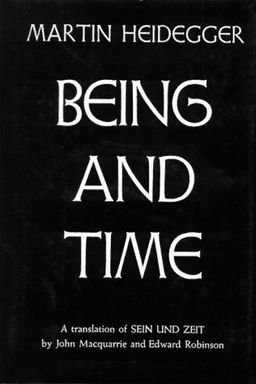
Being and Time cover

Being and Time

by Martin Heidegger

Martin Heidegger''s ''Being and Time'' is a groundbreaking philosophical work that challenges traditional thought, exploring the essence of human existence by redefining the relationship between being, time, and our environment. It inspires readers to live authentically by embracing individuality, anxiety, and mortality.

Reawakening the Question of Being

What does it truly mean to be? That question, simple yet foundational, shapes the entire path of Heidegger’s Being and Time. He believes philosophy has forgotten its very core: the question of Being. From Plato onward, metaphysics treated 'Being' as the most general and self-evident concept—so familiar that no one bothered to ask what it meant. Heidegger calls you to reawaken the question, to make it explicit again, and to trace how earlier philosophy revealed and concealed it.

Why the question matters

Heidegger insists that 'Being' cannot be defined by genus or difference like ordinary concepts. Its universality obscures rather than clarifies. Everyday language uses 'is' constantly, masking any wonder about what 'being' actually means. You must therefore treat its familiarity as a form of concealment. The task is not to add another definition to the list but to renew the question: from what horizon does 'Being' make itself known?

The method: phenomenology as disclosure

To approach the question of Being, Heidegger redefines phenomenology: less a school, more a disciplined way of letting things show themselves. He draws on the Greek roots phainomenon ('that which shows itself') and logos ('letting be said'). Phenomenology must disclose the phenomenon rather than impose theories. Logos is not empty argument: it is speech that uncovers, making truth appear as aletheia—uncovering, not correspondence. (Compare Husserl’s motto “to the things themselves,” which Heidegger deepens into a hermeneutic disclosure rather than neutral reporting.)

Dasein as starting point

But where does Being show itself most clearly? Heidegger turns to you, the one who asks—the being for whom Being is an issue. He coins Dasein ('being-there') to mark the unique mode of existence peculiar to humans. Dasein is not a subject or object; its essence is existence: the fact that each of us has our Being as a question. Your Being is always yours ('mineness'). Studying Dasein is not anthropology or psychology; it is an ontological inquiry into the very conditions that make science and theory possible.

The structure of questioning

Heidegger analyzes any question as having what is asked about, what is interrogated, and what is sought. For the question of Being, you ask about entities but seek Being itself. You must therefore avoid turning Being into another thing to study. Instead, you interpret entities in terms of their Being, bringing to light the tacit understanding we already live by. This move prepares the passage toward temporality as the horizon where Being will later be understood.

Implications of reawakening

To reawaken the question of Being means learning to interpret the conditions that make existence intelligible. You will see how phenomenology becomes hermeneutic; how Dasein’s world, moods, and care shape all understanding; and how time underlies them all. Heidegger’s challenge is not merely theoretical: he asks you to experience how you already operate within the disclosure of Being—and to make that implicit horizon explicit again. (Note: the later analysis of temporality fulfills what the opening promise merely declares.)


Dasein and Being-in-the-World

Dasein, the being who asks about Being, is never merely an isolated self looking out at a world of objects. Heidegger's decisive insight is that Being-in-the-world is a unitary structure, not a combination of subject and object. You always already find yourself absorbed in meaningful activities, places, and relations. Your 'world' is not a fixed collection of things but a web of significance in which tools, people, and tasks obtain their sense.

Worldhood and equipment

Heidegger defines worldhood through readiness-to-hand (Zuhandenheit) rather than presence-at-hand (Vorhandenheit). Tools are not first objects; they show their Being through practical use. A hammer’s essence is not its weight or shape but its 'in-order-to'—its role in hammering. You understand equipment through concernful involvement, not detached observation. When equipment breaks, its 'readiness' vanishes, revealing the hidden network of tasks. That breakdown displays how even detached knowledge depends on prior involvement.

Significance and the critique of Cartesianism

Worldhood depends on a totality of references Heidegger calls significance (Bedeutsamkeit): a system of 'for-the-sake-of-which' relations that create meaning. Descartes’ concept of res extensa—the world as spatial extension—misses this deeper structure. Extension makes sense only because Dasein already encounters the world through care and significance. Even scientific space presupposes the practical space of the workshop. (Note: Heidegger’s critique anticipates later phenomenologists and philosophers of technology.)

Being-with and everydayness

Your world is populated by Others, not as external additions but as part of the very structure of Being-in. Being-with (Mitsein) means every experience is co-determined by social practices and shared meanings. The public dimension—Heidegger’s das Man, the ‘they’—defines everyday life: what 'one' says, does, values. You fall into publicness when you stop owning your possibilities. Authentic existence begins when you step out of the anonymous ‘they’ and reclaim your own Being. Solicitude (Fursorge) thus becomes concrete: to ‘leap ahead’ rather than ‘leap in’ for others is to help them own their existence.

Insight

Being-in-the-world transforms how you view yourself: no longer a spectator observing nature, but a participant in a web of relations. Worldhood, equipment, and Being-with all stem from Dasein’s existential structure. Recognizing this unity dissolves the classical subject-object divide and prepares you for Heidegger’s deeper analysis of disclosedness, mood, and care.


Disclosedness, Mood, and Understanding

Heidegger redefines how the world appears: it is not first a set of facts but a field of disclosedness (Erschlossenheit). Dasein is the clearing where reality shows up. You do not peer out from an inner box toward an outer world; you are already immersed in openness shaped by mood, understanding, and discourse. These are equiprimordial ways of disclosure: together they reveal how the world matters.

Mood as existential disclosure

Moods are not inner feelings but primary ways the world is revealed. Fear shows the world as threatening; joy shows it as inviting; boredom shows it as empty. Heidegger’s analysis of fear demonstrates how moods organize space and time: the fearsome is ‘drawing near,’ the fearing self is exposed, and the feared-about is endangered. Anxiety (Angst) even deeper, discloses the world as nothing familiar, stripping away all specific threats to expose the raw fact that you exist.

Understanding as projection

Understanding is Dasein’s way of Being—a constant projection toward possibilities. You always exist “ahead of yourself,” capable of becoming differently. Heidegger calls this projective structure Entwurf. Alongside projection operate the fore-structures: fore-having, fore-sight, and fore-conception. These are the preconditions that guide any interpretation—your background, your focus, and your conceptual scheme. All interpretation is circular because it emerges from these fore-structures, yet that circle is what makes understanding possible.

Discourse and everyday language

Discourse is the articulation of this openness; speech is not mere communication but the way Being becomes manifest. Language grows out of disclosedness—it does not simply describe a preexisting world. But everyday talk often degenerates into idle talk (Gerede), curiosity, and ambiguity, flattening meaning into clichés. When you simply repeat what ‘one says,’ truth becomes hidden; authentic discourse requires reticence—a silence that keeps openness clear.

Together, these structures show

You uncover the world not by intellect alone but through the existential interplay of mood, understanding, and speech. Dasein is the place where the light of Being shines—the clearing that enables all sense-making. Grasping this helps you read Heidegger’s later insight: care and temporality are nothing other than structured disclosedness over time.


Care as the Structure of Existence

Having shown Dasein’s disclosedness, Heidegger condenses his insights into one formula: Dasein’s Being is care (Sorge). Care is not emotional concern; it is the integrated structure through which existence, thrownness, and involvement cohere. You are always ahead of yourself (projection), already in a world (facticity), and alongside entities (concern). These elements are not additive; together they constitute your Being.

Dissecting the formula

“Being-ahead-of-itself” refers to your future-oriented projection. “Already-being-in” marks how you are thrown into conditions—a body, history, language—you did not choose. “Being-alongside” describes practical involvement with tools and others. In sum, care means you are a temporal, situated openness toward possibilities. Heidegger’s ancient fable of Cura, a mythic figure who fashions humanity and keeps them while they live, symbolizes how care is the very essence of human life.

Truth and reality revisited

This wholeness grounds Heidegger’s shift in epistemology. Truth (aletheia) is uncovering, not correspondence. Entities show up as real only within care’s horizon. Even the sciences rely on Dasein’s existential disclosure: Reality (Vorhandenheit) is secondary to concernful involvement. Understanding this reverses centuries of metaphysics that privileged detached presence over lived engagement.

Practical takeaway

You exist as a dynamic totality, not a static subject. Whenever you think, work, love, or fear, you enact care—a unified temporal process of projecting and accepting. Seeing yourself through care invites you to read the next stage of Heidegger’s book: how temporality explains this unity and how authenticity and death bring care to its limit.


Death and Authenticity

Care’s structure drives Dasein toward its limit: death. Heidegger’s analysis of Being-towards-death is not a meditation on mortality as event but an existential insight into finitude. Death is Dasein’s ownmost possibility—non-relational, certain yet indefinite, not to be outstripped. Facing death discloses Dasein’s totality: here your existence appears as a finite whole, not an endless series of tasks.

Anxiety and anticipation

The mood that unveils this possibility is anxiety (Angst). It strips away all everyday concerns, revealing your uncanniness—the fact that you are thrown yet free. Through anticipation (Vor-laufen) you project yourself toward death, not as grim expectation but as openness to finitude. Authentic anticipation lets every possibility become transparently your own. You stop hiding behind ‘one dies,’ the they’s comforting phrase, and own your mortality.

Conscience and Being-guilty

From this limit arises conscience (Gewissen). The call of conscience summons you from the noise of the they into silent responsibility. It is not moral reproach but existential reminder: you are Being-guilty, meaning you are the ground of possibilities that always exclude others. Guilt here means finitude—the null basis of choice. Ordinary psychology misses this depth, treating conscience as memory of wrongdoing; Heidegger reclaims it as the way authenticity speaks.

Resoluteness and authenticity

Answering the call is resoluteness (Entschlossenheit): reticent openness where you own your thrown existence and act. Resoluteness is not withdrawal from the world but renewed engagement made clear by the call. Anticipatory resoluteness fuses conscience and death awareness, liberating authentic freedom within finitude. You become Self without becoming a detached subject: open, silent, and historical. (Note: later existentialists—Sartre, de Beauvoir—echo this structure though often moralize it.)


Temporality and Historicity

Heidegger’s final synthesis reveals that temporality is the meaning of care. Existence, thrownness, and involvement are temporal ecstases: future, having-been, and present. Time here is not a chain of nows but an ecstatical unity that lets Dasein stretch along from birth to death. You do not 'have time'; you are time. Temporality grounds disclosedness and makes truth possible.

The three ecstases

Future dominates because Dasein is always ahead-of-itself in projection. Having-been expresses thrownness—the past that lives in your situation. The present is making-present, the active bringing of things into concern. Authentic existence temporalizes all three as a unity: anticipation (future) draws on heritage (past) to act meaningfully now (present). The ‘moment of vision’ captures that authentic present.

Everyday time and within-time-ness

In everyday life time flattens into public 'nows': clock time and schedules. Making-present without awareness becomes distraction, dominated by curiosity and the they. Heidegger contrasts this with authentic temporality, where you hold a moment of vision—acting in clarity of finitude. Even clocks depend on this deeper temporality: world-time arises because Dasein dates and reckons events according to its concerns.

Historicity and destiny

Temporality makes you historical. You inherit possibilities and repeat them meaningfully, a process Heidegger calls fate. As Being-with others, this becomes destiny—shared resoluteness that shapes communities. Historicity is not chronology but existential repetition: taking up the past as source of authentic action. Historiology—the study of history—thus rests on Dasein’s own historicity.

Finitude, temporality, and care converge: to exist is to be temporal, finite, and responsible. Once you see this, Heidegger’s program is complete: the question of Being finds its horizon in time, and philosophy must now begin from the lived temporality that conditions all understanding.

Dig Deeper

Get personalized prompts to apply these lessons to your life and deepen your understanding.

Go Deeper

Get the Full Experience

Download Insight Books for AI-powered reflections, quizzes, and more.