
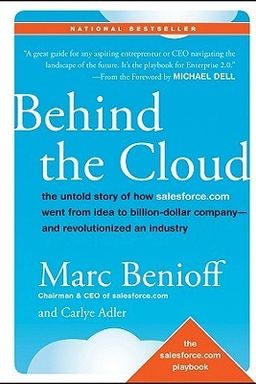
Behind the Cloud cover

Behind the Cloud

by Marc R Benioff and Carlye Adler

Behind the Cloud reveals the captivating story of Salesforce''s rise from a small startup to a billion-dollar giant. Marc Benioff shares bold strategies and customer-focused innovations that disrupted the software industry and set new standards for success. Discover how to apply these groundbreaking insights to your own business journey.

Building a Business that Changes Everything

What if your next idea didn’t just make money—but changed how an entire industry worked? That’s the central question of Marc Benioff’s Behind the Cloud, a book that reveals how one small start-up—Salesforce.com—revolutionized software, sales, and corporate philanthropy from a cramped San Francisco apartment into a billion-dollar force. Benioff argues that any business, no matter how small, can disrupt giants by combining bold innovation with deep social purpose. He contends that to do so, you must not only create great technology, but also craft a great culture, build with speed, and treat customers like co-creators rather than buyers.

The Central Promise: From Software to Service

Benioff introduces a radical idea: software shouldn’t be installed or owned—it should simply be used. This concept, now known as Software-as-a-Service (SaaS), was revolutionary in the late 1990s. Rather than selling million-dollar packages of enterprise software that took years to implement and even longer to maintain, Salesforce allowed companies to log onto a simple, elegant website to manage their customer relationships instantly. With this single shift, Benioff predicted the end of the era of bloated, on-premise systems—and the birth of cloud computing.

Yet Behind the Cloud is more than a technical manifesto. It’s a playbook for anyone who wants to align profit with purpose. Benioff’s “1-1-1 Model”—devoting 1% of equity, 1% of product, and 1% of employee time to philanthropy—redefined corporate giving. This integration of social impact into daily business operations turned Salesforce from a company into a movement, inspiring thousands of other firms (including Google.org) to follow suit.

The Structure of Innovation: 111 Plays for Success

The book itself reads like a field manual, divided into nine major playbooks—from startup and marketing to technology, global growth, finance, and leadership—each packed with practical tactics that made Salesforce a trillion-dollar industry pioneer. Benioff shares not only what worked but what failed. He invites readers into moments of fear (when he nearly lost the company during the dot-com crash) and triumph (when he rang the NYSE bell as Salesforce became the first billion-dollar SaaS firm).

Each section introduces “plays”—specific strategic actions that encapsulate a guiding principle. You learn to build culture first, hire for attitude before experience, use events to create buzz, and replace competition with collaboration. Benioff shows that marketing, sales, and technology are not separate silos but an interconnected web driven by courage, creativity, and customer obsession.

Why These Ideas Matter

Benioff’s story feels even more relevant today, when cloud computing, remote collaboration, and social entrepreneurship define modern business. His insights speak to founders, innovators, and leaders who want to build something lasting. He insists that you can’t rely on conventional wisdom—the most transformative ideas come from extending empathy and imagination to customers and communities. The companies that disrupt industries don’t just outspend others; they outthink and outcare them.

“Innovation is not only about doing something new—it’s about doing something good.”

Across its pages, Behind the Cloud urges you to imagine business not as a competition, but as a creative force for progress. You’ll discover how Benioff used a sabbatical in Hawaii to conceive Salesforce; how Einstein’s three rules of work—simplicity, harmony, and opportunity—guided him; and how every obstacle became a chance to rethink what was possible. By the end, Benioff leaves you with a clear challenge: combine profits and purpose, innovate wildly, and measure success not just in dollars, but in difference. That’s the cloud revolution he invites you to join.


The Start-Up Mindset: Dream Big, Act Bold

Marc Benioff begins Behind the Cloud with a deeply personal story about stepping away from success to rediscover purpose. After ten years at Oracle, he realized he had become what he feared most—a corporate lifer. Seeking clarity, he took a sabbatical to Hawaii, where swimming with dolphins inspired an idea: what if enterprise software could be simple, democratic, and delivered over the Internet like Amazon’s shopping platform? That meditation led to Salesforce’s founding principle—the End of Software.

Recharge Before You Create

His sabbatical wasn’t just rest—it was reflection. Benioff learned the value of stepping back to step forward. By removing himself from Oracle’s intense environment and immersing in nature and spirituality, he reconnected with creativity. Encounters with spiritual leaders like the Dalai Lama, Sri Sri Ravi Shankar, and the Indian humanitarian Ammachi encouraged him to align ambition with altruism. Ammachi’s advice—“Not yet”—became a lesson in patience and purpose. He returned believing business could serve humanity as well as shareholders.

Believe First, Evidence Later

Benioff’s idea of delivering CRM software through the Internet faced skepticism, even ridicule. But as Clayton Christensen argued in The Innovator’s Dilemma, disruptive models always look foolish before they look brilliant. Traditional software firms like Siebel were selling million-dollar licenses—Benioff was selling $50-per-user subscriptions. Yet his faith and responsiveness to early feedback made the improbable possible. He focused on recruiting three exceptional developers—Parker Harris, Dave Moellenhoff, and Frank Dominguez—and built the first prototype in just one month.

Culture over Comfort

Salesforce’s first "office" was a rented one-bedroom apartment where card tables replaced desks and the closet became the server room. Dogs roamed freely, Hawaiian shirts symbolized optimism, and Einstein’s portrait reminded them to “Think Different.” Benioff learned leadership wasn’t about hierarchy—it was about inspiration. He established values early: simplicity, happiness, and courage. His mantra: “Do it fast, simple, and right the first time.”

Why It Works

Benioff’s startup journey teaches that every revolution begins with recharging your mind and believing in something no one else sees. He refused to hedge his bets—leaving Oracle fully rather than splitting focus—and pursued talent with missionary zeal. His approach mirrors the philosophies of Steve Jobs (focus on simplicity) and Richard Branson (make work fun). For entrepreneurs, this chapter offers a blueprint: step away, dream wildly, and build with joy. The next big idea begins in silence—and ends in impact.


Marketing as Revolution: The End of Software

In Salesforce’s early days, marketing was warfare. Benioff understood that to overturn industry conventions, he had to declare them obsolete. His iconic End of Software campaign shouted what every frustrated customer felt but every vendor ignored: the old model was broken. This wasn’t cautious branding—it was rebellion.

Creating a Persona and a Movement

Salesforce launched with theatrical flair: a party featuring the B-52s, cages of actors playing captive salespeople, and games called “Pitch CDs in the Toilet.” Heaven was Salesforce; hell was traditional enterprise software. Benioff donned fatigues to play “the revolutionary.” He embodied the brand. Like Steve Jobs, he understood the power of story—turning technology into myth. The strategy was simple: position Salesforce as hero, Siebel Systems as villain, and customers as rescued citizens.

Differentiate or Disappear

With branding expert Bruce Campbell, Benioff created the No Software logo—a red circle with a line through “Software.” Critics said the negative message violated marketing logic. But it worked because it was visceral, easy, and contrarian. The same principle guided outrageous stunts: fake protests outside Siebel conferences, rickshaw coffee giveaways, even renting all taxis at competitor events. Each action reminded the world that Salesforce wasn’t just selling software—it was selling freedom.

Tell Reporters a Story, Not Stats

Benioff treated journalists as partners, not obstacles. His relationships with reporters like Don Clark of the Wall Street Journal turned stories into megaphones. He learned to offer metaphors (“Salesforce is Amazon.com meets Siebel”) and respond to competitor moves with wit (“Microsoft’s Great Plains will cause Great Pains”). This approach made Salesforce ubiquitous in press cycles—and shaped SaaS as an industry narrative.

Marketing, Benioff argues, isn’t about noise—it’s about meaning. If your story makes people feel part of something bigger, you’ve already won.

For readers, this playbook offers a stark truth: if you want attention, go after Goliath. Rebellion creates resonance. Position yourself as the alternative, tell your story through emotion, and never stop reminding the market why you exist. As Benioff proved, the best PR is purpose.


Turning Customers into Evangelists

Benioff’s most enduring innovation wasn’t technical—it was social. He transformed customers from consumers into collaborators. Whereas traditional enterprise companies treated clients as captives, Salesforce made them partners in creation. The mantra was simple: customer success is company success.

Give It Away to Grow

Salesforce’s seed strategy relied on generosity—a free one-year trial for five users. Skeptics called it suicidal; Benioff knew it would spark adoption through experience. Early customers like Blue Martini and iSyndicate loved the simplicity and stayed. Free trials turned users into advocates and critics into believers. The company built “bugforce,” a feedback system that allowed users to report and rank issues—creating a real-time innovation loop.

Sales as Science, Not Art

Benioff reinvented B2B sales by replacing expensive armies of field reps with efficient telesales teams—an idea once dismissed as impossible. He proved that smart, trained phone reps could close enterprise deals three times faster and cheaper than traditional methods. By rejecting discounts (even for his grandmother) and maintaining universal pricing, he made Salesforce democratic and dependable. The shift from persuasion to partnership defined a new kind of sales culture.

Land and Expand

The company’s “land and expand” strategy was revolutionary: start small within an organization, prove value, then grow internally. Once SunGard adopted Salesforce for 80 users, it expanded to 1,000—validating SaaS scalability. Salesforce turned satisfied customers into evangelists who drove exponential growth. As one executive put it, “Inside every customer, there’s a salesperson waiting to be unleashed.”

Benioff’s approach echoes Seth Godin’s concept of “tribes” in marketing: empower customers to spread your mission. In Behind the Cloud, evangelism isn’t accidental—it’s designed. When you create something people love, trust, and want to share, community becomes your strongest sales force.


Innovation Through Intelligent Reaction

How do you keep innovating once you’ve dominated your market? For Salesforce, the answer was continuous evolution by listening intelligently. Benioff borrowed what he called “intelligent reaction” from engineer Adam Bosworth: learn from users, adapt fast, and never fear iteration.

From Tabs to Platforms

At first, Salesforce had five simple tabs—Accounts, Contacts, Opportunities, Forecasts, and Reports. One customer, Marty Howard, complained they didn’t fit his industry. Instead of dismissing him, Benioff let users rename the tabs and fields. This customization feature became the seed for the Force.com platform, which let developers build entirely new applications inside Salesforce’s ecosystem.

Transparency Builds Trust

When technical outages threatened Salesforce’s credibility, Benioff didn’t hide—he opened the kimono. The trust.salesforce.com site showed real-time system status to anyone. Competitors mocked it—then copied it. Transparency turned vulnerability into strength and redefined corporate communication. Customers came to trust Salesforce because they could see its honesty.

Platforms Create Ecosystems

Launching AppExchange—the “eBay of enterprise software”—expanded innovation beyond internal teams. Start-ups could upload SaaS apps, customers could review and download them, and Salesforce could grow through collaboration instead of control. Later, IdeaExchange crowd-sourced product development from users themselves. Dell’s IdeaStorm and Starbucks’ MyStarbucksIdea copied this model to co-create with customers globally.

Innovation, Benioff suggests, isn’t predicting the future—it’s paying attention to the present.

By the time Salesforce reached $1 billion in revenue, its adaptability had become its DNA. In a world accelerating by the minute, Benioff’s message remains timeless: innovate not by planning in isolation, but by reacting intelligently to the people who use and love what you build.


Philanthropy as Corporate Strategy

Benioff believed business could be a force for good—and proved it. In Behind the Cloud, his 1-1-1 model redefined corporate social responsibility. Instead of writing occasional checks, Salesforce wove philanthropy directly into its business fabric: 1% of equity, 1% of time, and 1% of product dedicated to changing the world.

Integrate, Don’t Add On

Benioff had witnessed Oracle’s failed philanthropic effort—where employees ignored volunteer projects to chase quarterly quotas. He realized that doing good couldn’t be optional; it had to be cultural. Salesforce filed its foundation the same day as its incorporation. Suzanne DiBianca and Julie Trell built programs connecting employees to causes like Project Homeless Connect, youth media centers, and BizAcademy.

Scaling Impact Through Networks

The 1-1-1 model went viral. Partner companies like Bluewolf and Google.org adopted it, creating an ecosystem of shared giving. Salesforce’s foundation began donating software to nonprofits—over 6,000 by 2008—and empowered local offices to lead community programs. Even disaster response became internal innovation: during Hurricane Katrina, employees built PeopleFinder in three days, reuniting families through technology.

Profit Meets Purpose

The integrated model proved financially smart. Philanthropy improved employee retention, brand value, and customer loyalty. Every foundation milestone—like the 2004 IPO, which added $12 million to its grants—reinforced that doing good is good business. Benioff calls this compassionate capitalism, a vision later echoed by conscious business advocates such as John Mackey (Whole Foods) and Blake Mycoskie (TOMS).

For readers, the lesson is clear: philanthropy isn’t a donation; it’s a strategy. When your company’s success lifts communities, your mission gains longevity. Benioff’s model invites every leader to make giving not a side project, but a structural advantage—a key to happiness, innovation, and sustained growth.


Leading with Vision and Alignment

By the time Salesforce scaled globally, Benioff faced a leadership challenge: how to keep thousands of employees aligned around the same vision. His answer became the company’s secret weapon—the V2MOM model: Vision, Values, Methods, Obstacles, and Measures. This five-part framework clarified priorities, built accountability, and kept everyone rowing in the same direction.

Mapping Vision to Action

Each V2MOM starts by defining what you want (Vision) and what matters most (Values), then outlines how to achieve it (Methods), the barriers ahead (Obstacles), and the numeric results you seek (Measures). Benioff wrote Salesforce’s first V2MOM on an envelope in 1999—it ended with “We are all rich.” Every six months, he rewrites it collaboratively with executives and employees. The framework scales from corporate strategy to personal goals.

Recruitment and Culture

V2MOM instilled focus that extended into hiring. Benioff’s mantra: “Recruiting is sales”. He pursued talent relentlessly, valuing attitude over credentials. Each candidate passed exhaustive “all-yes” interviews; one dissent meant no hire. Once onboard, employees received orientation and cultural training emphasizing gratitude (the Hawaiian spirit of Mahalo) and philanthropy. Recognition—from personalized posters to tropical celebrations—built loyalty and joy.

Leadership Through Listening

Benioff believed great CEOs balance vision with humility. Through anonymous employee surveys (“Are you doing the best work of your career?”), he identified pain points—like career growth—and addressed them by creating mentorship programs and executive-taught “black belt” courses. Leaders, he says, should measure success by helping others grow.

Salesforce’s alignment strategy proves that structure doesn’t kill creativity—it enables it. Like Jim Collins’s concept of disciplined thought in Good to Great, V2MOM turns ambition into measurable progress. For any organization wrestling with scaling culture, Benioff’s playbook is a masterclass in keeping vision human and shared.


Profits and Purpose: The Final Play

Benioff closes Behind the Cloud with an expansive reflection: success isn’t about making money—it’s about making meaning. His final play, Make Everyone Successful, encapsulates a decade of lessons into one philosophy. By helping employees, customers, and communities thrive, Salesforce found its own greatness.

The Long View of Disruption

Benioff reminds readers that founders often overestimate what can be done in one year and underestimate what can be achieved in ten. From a closet server powering a prototype to a billion-dollar company anchoring a $46 billion industry, Salesforce’s journey proves exponential growth comes from patience and purpose. Gartner’s forecast of cloud computing’s rise validated the dream once dismissed as naïve.

Innovation Meets Altruism

Economic crises became creative catalysts. “The storm is the time to fish,” he quotes an Eskimo proverb, arguing that downturns are opportunities to build. Great companies—GE, Cisco, Southwest Airlines—were born in recessions. The world’s problems, from climate to inequality, demand entrepreneurs “wildly innovative, profitable, scalable, and sustainable.”

Profits + Purpose = Longevity

Benioff’s closing message echoes Einstein’s three rules of work: simplicity, harmony, and opportunity. By imagining a future of clean energy, reduced poverty, and global cooperation, he positions business as a creative instrument for hope. His farewell—“Imagine. Invent. Disrupt. Do good.”—feels less like advice and more like invitation.

“Life grows relative to one’s investment in it.”

For readers and entrepreneurs alike, Benioff’s final challenge is enduring: build companies that reflect your soul. The cloud revolution wasn’t just technical—it was ethical. In aligning money with meaning, Behind the Cloud becomes more than a business story. It becomes a manifesto for imaginative, compassionate capitalism.

Dig Deeper

Get personalized prompts to apply these lessons to your life and deepen your understanding.

Go Deeper

Get the Full Experience

Download Insight Books for AI-powered reflections, quizzes, and more.