
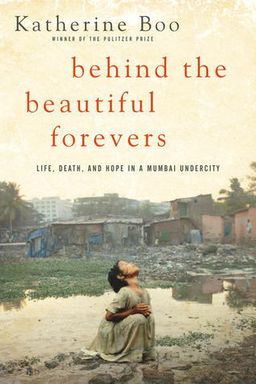
Behind the Beautiful Forevers cover

Behind the Beautiful Forevers

by Katherine Boo

Behind the Beautiful Forevers by Katherine Boo immerses readers in the vibrant yet harrowing world of Annawadi, a slum in Mumbai. Through the eyes of its resilient inhabitants, the narrative explores the intersection of hope, corruption, and survival in a society riddled with inequality and injustice.

Life, Hope, and Inequality in Mumbai’s Undercity

What does hope look like when it lives beside desperation? Katherine Boo’s Behind the Beautiful Forevers invites you into the vividly real slum of Annawadi, a settlement of tin shacks and sewage lakes that clings to Mumbai’s international airport. Through the lives of its residents—scrap dealer Abdul, aspiring slumlord Asha, her idealistic daughter Manju, scavenger Sunil, and the tragic Fatima—Boo reveals a world where dreams are as fragile as recycled plastic yet as resilient as the human will itself.

At its heart, Boo’s book asks: how do poor citizens of one of the world’s fastest-growing economies find meaning, dignity, and progress amid violence, corruption, and inequality? Her answer is as haunting as it is hopeful. She argues that the global prosperity surrounding India’s new modernity hasn’t erased poverty—it has simply changed its shape. In the shadow of glass skyscrapers and luxury hotels, Annawadians labor to recycle the affluent world’s trash and imagine possibilities that rarely materialize. Yet, Boo contends that inside this undercity, you can discover the moral texture of globalization itself—the ingenuity, desperation, and moral compromises that poverty breeds.

India’s Two Worlds: Beautiful and Broken

Boo opens with irony and truth: the slum sits behind a billboard for luxury tiles emblazoned with the slogan “Beautiful Forever.” It’s a literal and figurative divide between the rich and poor, between corporate wealth and human fragility. The wall hides Annawadi from view, yet its people are intimately connected to the global economy. They scavenge, sort, and sell the material remnants of prosperity from the airport and hotels—symbolic labor that keeps modern India glittering while its workers remain invisible.

Through Abdul’s family, Boo demonstrates how hard work doesn’t guarantee safety or progress. When their neighbor Fatima, a disabled woman longing for respect, sets herself on fire after a petty dispute, the event triggers a legal catastrophe for the Husains. Innocence cannot shield them from police extortion or the twisted justice system that thrives on bribes and corruption. This is Boo’s central claim: the poor in Mumbai are trapped not because they lack ambition, but because the system devours their integrity and punishes their dignity.

Cracks in Progress: Globalization’s Underbelly

As India’s economy booms, Annawadi lives in its shadow. Boo situates the slum amid a landscape of rapid urban development—hotels rising, airports expanding, middle-class dreams selling. Yet progress for some means displacement for others. While new shopping malls and airports proclaim India’s ascent, slum residents face demolition threats. This contrast infuses Boo’s narrative with deep irony: the people closest to the engines of modernity remain its most expendable.

By telling the story through individuals, especially women such as Asha and Manju, Boo counters the abstract narratives of economic growth with tangible human experience. Asha’s moral climb—from village farmer’s daughter to aspiring politician and corrupt power broker—shows how upward mobility in the slum requires partaking in the same corruption that sustains inequality. Her daughter Manju, idealistic and kind, dreams of becoming the first female college graduate in Annawadi through education, even as she sees how decency is punished and bribery is rewarded. Theirs is a moral drama of ambition colliding with compromise.

Between Survival and Moral Choice

Boo doesn’t romanticize the poor nor demonize the rich. Instead, she uses their interactions to expose the vicious cycle of survival. The police, courts, hospitals, and political networks that should alleviate suffering instead exploit it. The line between legal and illegal living blurs; morality bends with necessity. Abdul’s quiet reflections while imprisoned reveal this existential paradox: “I tell Allah I love Him immensely... But I tell Him I cannot be better, because of how the world is.” Boo’s empathy lies in recognizing that the undercity’s failures are systemic, not personal.

Her reporting—painstakingly detailed, immersive, documented over years—illuminates how people don’t just suffer; they adapt. They compete. They dream in micro-bursts. As in the social critiques of George Orwell’s Down and Out in Paris and London or Barbara Ehrenreich’s Nickel and Dimed, Boo’s analysis merges gritty observation with moral inquiry. The result is both literature and journalism—a nearly novelistic account of inequality that forces you to question your own comforts.

Why This Story Matters

Boo invites you to see Annawadi not as an anomaly of Indian poverty but as a microcosm of urban global inequality. Her characters could live in any of the world’s megacities where billion-dollar enterprises rest beside people sleeping on cardboard. The book’s power lies in dismantling the myth that development automatically lifts all boats; in fact, modernization often sinks the most fragile ones. These stories matter because they reveal human resilience within bureaucratic cruelty, hope within chaos, and morality in the grayest of places.

Key Takeaway

Boo’s central message is not that poverty is unending, but that human dignity persists even within systems designed to crush it. To truly see the undercity—and the inequality it mirrors—you must stand beside its people, behind the beautiful forevers, and listen.


The Moral Architecture of Poverty

Katherine Boo reveals that poverty is not just an economic condition—it is a moral environment shaped by corruption, competition, and survival. In Annawadi, virtue is dangerous. To be honest means losing money; to be cautious means being forgotten. The slum’s residents live in constant negotiation with morality, because right action rarely leads to food or safety.

Corruption as a Survival System

From police extortion to bureaucratic scams, Boo’s narrative shows how corruption becomes the daily language of survival. Zehrunisa and Karam Husain, accused of an impossible crime, discover that even innocence has a price. They pay bribes to officers to keep their children out of jail; they pay to retrieve truth itself. Through Asha—a woman who manipulates political connections to rise from poverty—Boo illustrates how corruption is not an aberration but a structure that rewards cunning and punishes honesty. Asha’s transformation echoes Orwell’s observation that poverty “annihilates morality.”

The Weight of Small Choices

Abdul’s reflections after enduring police beatings capture the moral torment of the poor. He wants to be good—“to keep the ice inside me from melting”—yet realizes that the world offers no space for purity. In a community of scarcity, the ethical spectrum compresses: stealing from a trash pile, taking a bribe, lying to survive—all become normalized acts. Boo reframes the idea of poverty from failure of character to collapse of moral infrastructure. When systems reward exploitation, compassion becomes irrational.

When Hope Is Moral Resistance

Still, Boo doesn’t portray Annawadians as lost souls. Small acts of kindness—Manju teaching barefoot children English, Zehrunisa washing her dead neighbor to cleanse sins—become quiet revolutions. Hope, in this environment, is a moral stance against cynicism. Like Viktor Frankl in Man’s Search for Meaning, Boo suggests that retaining integrity amid decay is the deepest human triumph. Even when justice is corrupt, morality endures as defiance.

In Short

Where there is no fair system, morality shifts from universal law to personal adaptation. The truly moral citizens are not those devoid of corruption but those who cling to decency in its midst.


Women at the Center of Survival

Women in Boo’s narrative bear the ethical and emotional weight of Annawadi’s contradictions. They embody both power and subjugation, navigating a system that trusts them least but depends on them most. Through Asha, Manju, and Fatima, Boo captures how gender shapes survival and ambition amid urban poverty.

Asha: Ambition in a Corrupt World

Asha Waghekar’s rise from agricultural servitude to political fixer defines Boo’s insight into feminine ambition under patriarchy. “Corruption is how things work here,” Asha tells her daughter. Unlike Western feminist heroines who seek liberation through ideology, Asha’s feminism is pragmatic—she wields manipulation and charm as armor in a male-dominated political order. She climbs by exploiting others but frames it as survival, showing how empowerment in unequal systems may require ethical compromise. (In contrast, Sheryl Sandberg’s Lean In champions assertiveness within fair institutions; Asha must weaponize corruption to exist.)

Manju: The Desire to Be Good

Manju, Annawadi’s first female college student, represents moral purity striving against social rot. Teaching slum children English, she believes education can redeem the slum’s cruelty. Yet, when her mother’s political dealings implicate her in dishonesty, Manju realizes that striving for goodness may require isolation. Her friendship with Meena, who commits suicide, exposes how domestic repression silences women’s hopes. Boo presents Manju’s grief as symbolic: in societies where morality erodes, the intellectually and emotionally upright women suffer most.

Fatima: The Demand to Matter

Fatima’s tragic suicide—an attempt to reclaim dignity—is the book’s moral axis. Mocked for her disability and sexuality, she burns herself out of rage and longing, not madness. Boo reframes her death as protest against invisibility. Fatima represents every marginalized woman whose existence is denied until her destruction makes her visible.

Bottom Line

Boo’s women show that female agency, in corrupt societies, often takes the form of endurance. They are strategists of survival, architects of morality, and silent resistors in a city built to forget them.


The Machinery of Injustice

The legal system in Boo’s account mirrors India’s contradictions: spectacular modern institutions run by human neglect. Abdul’s false imprisonment reveals how justice in Mumbai functions as a commodity sold to the highest bidder. Boo dissects this machinery with journalistic precision.

Police as Predators

In Annawadi, the police aren’t arbiters of law—they’re entrepreneurs of desperation. Abdul learns this the hard way. After Fatima accuses his family of burning her, officers demand bribes to “keep the case fair.” Honesty becomes a liability, as refusing payment leads to torture. Boo portrays the police station as a “bazaar of justice,” echoing Kafka’s absurd bureaucracies but rooted in real consequences. Every slap, every fabricated file, is profit.

Courts Without Truth

The fast-track courtroom that tries Abdul’s family reveals the hollowness of reform. Witnesses lie under pressure; stenographers mistranslate; judges hurry toward quotas instead of truth. Boo’s description of the chaotic, trash-strewn courtroom underscores her thesis: bureaucracy destroys empathy. The law’s architecture—like the airport’s glass—reflects modern progress but obscures moral collapse.

The Cost of Innocence

Abdul’s reflections after trial redefine justice. “To be innocent is not a living,” he realizes. Legal exoneration doesn’t heal humiliation or loss. Boo parallels Dostoevsky’s moral idea: suffering teaches righteousness, but in Mumbai, it teaches survival. The courts confirm not guilt or innocence but endurance—a psychological victory measured not by fairness but by survival through legal cruelty.

Takeaway

Justice here is not blind; it is hungry. Boo challenges you to ask not why the poor break the law, but how the law first breaks them.


Youth, Education, and the Limits of Aspiration

If hope had a curriculum, it would begin in Annawadi’s tiny hut schools. Boo frames education as the poor’s imagined escape route—a secular faith in progress. Yet, through Manju and Sunil, she reveals its limitations when opportunity itself is skewed.

Manju’s Classroom of Dreams

Manju’s informal school, crammed beside the sewage lake, symbolizes education’s double edge. She teaches English and Shakespeare’s Mrs. Dalloway but lacks resources, acknowledgment, or institutional support. Boo contrasts Manju’s idealism with the cynicism of politicians who exploit education funds through fake NGOs. The revelation that Asha fictitiously manages government schools underscores systemic rot—learning is reduced to a ledger entry. Still, Manju’s effort reflects the global poor’s instinct to teach even when systems refuse to listen.

Sunil’s Education of Survival

Sunil, the undersized scavenger boy, learns from the street instead of school. His apprenticeship in garbage—reading market value by smell and weight—becomes his curriculum. Boo transforms his growth story into a metaphor for adaptive intelligence: he might never recite Shakespeare, but he decodes economic systems intuitively. When he shifts from scavenging to stealing and back, Boo shows how poverty breeds risk-taking and self-education through necessity.

Knowledge Versus Systemic Ignorance

Education, Boo suggests, is moral rather than institutional. Real learning is learning to continue living. The juxtaposition of Manju’s and Sunil’s minds raises a question you can apply anywhere: what good is schooling without mobility? Knowledge can’t cure hunger when meritocracy is fake. Boo’s insight echoes Paulo Freire’s Pedagogy of the Oppressed: empowerment begins when the learner understands the forces that oppress him.

Final Thought

For the poor, learning is its own act of rebellion—a declaration that their minds exist even when their future does not.


Globalization and the Consolation of Hope

In her closing chapters, Boo moves from local tragedy to global insight. Annawadi becomes a symbol of globalization’s paradox—the simultaneous expansion of wealth and contraction of compassion. Yet, amid collapse, Boo insists on hope as the most rational survival strategy.

Progress and Displacement

As bulldozers raze Annawadi to make way for luxury developments, Boo juxtaposes destruction and optimism. Children scour the rubble for recyclable metal, turning demolition into opportunity. They remind readers that progress is built not on pure creation but on the repurposing of ruins. In Boo’s world, globalization’s winners call this innovation; its losers call it endurance.

The Economy of Dreams

Every dream in the slum—Abdul’s desire for a lawful business, Asha’s ambition for power, Manju’s hope for education—is an investment strategy in survival. When Boo describes Sunil celebrating finding cans after Kalu’s death, she transforms economic activity into emotional resilience. In the global market’s moral arithmetic, poverty isn’t just lack of money; it’s absence of predictability. Annawadians dream precisely because certainty is the one luxury they can’t afford.

The Hope That Refuses to Die

By the end, Boo argues that hope is not naïve—it’s infrastructure. It binds the undercity together when systems fail. The poor’s ability to imagine beyond the facts of their suffering is the most subversive act of all. Abdul’s “ice” metaphor—the wish to stay good despite global heat—becomes Boo’s parting image. It’s a reminder that morality, like water, survives transformation.

Essential Lesson

Behind the Beautiful Forevers exposes the cost of globalization but also its unexpected gift: the persistence of human imagination. Hope, within Boo’s Mumbai, is not optimism—it is rebellion.

Dig Deeper

Get personalized prompts to apply these lessons to your life and deepen your understanding.

Go Deeper

Get the Full Experience

Download Insight Books for AI-powered reflections, quizzes, and more.