
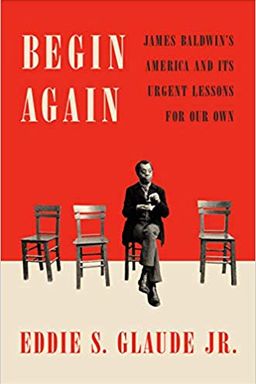
Begin Again cover

Begin Again

by Eddie S Glaude, Jr

Begin Again delves into James Baldwin''s incisive exploration of America''s racial issues, offering timeless insights into systemic racism. Eddie S. Glaude Jr. reflects on Baldwin''s legacy, urging us to apply his wisdom to today''s societal challenges and envision a more just future.

Facing the Lie at the Heart of America

What happens to a nation when its defining story is built on a lie? Eddie S. Glaude Jr.’s Begin Again: James Baldwin's America and Its Urgent Lessons for Our Own takes this question head-on. Glaude argues that America’s ongoing racial crisis cannot be solved without confronting what he calls “the lie”—the foundational falsehood that white lives are inherently more valuable than others and that the nation’s cruel history does not define its present. The book uses the life and thought of James Baldwin to probe what happens when a society denies its deepest moral failures and chooses safety and innocence over truth.

Glaude’s central claim is startlingly simple yet devastating: until America faces its history honestly, it will keep repeating cycles of hope and betrayal—what he calls “the after times.” He takes Baldwin’s prophetic witness and applies it to our current moment, especially the rise of Trumpism as proof that the country has once again recoiled from transformational change. The book is an invitation for each reader to ask: what lies do I live by, and what would it mean to tell the truth about who we are?

The Architecture of the Lie

According to Glaude, Baldwin saw America as enslaved by a moral disease. The lie operates in two layers: first, by defining white people as more valuable, and second, by rewriting history to protect that hierarchy. From the genocide of Indigenous peoples to slavery and segregation, the nation has reimagined itself as innocent—as a beacon of freedom rather than a perpetrator of cruelty. This distortion shapes how America remembers events like the Civil Rights Movement or the election of Obama, twisting them into self-congratulatory myths of progress (“a more perfect union”) rather than painful reckonings.

For Baldwin, and for Glaude, the lie is not merely political—it’s spiritual. It infects personal relationships and self-concepts. David Baldwin, James’s stepfather, embodied the lie’s psychological toll: hatred of white people and self-hatred intertwined. The result was a kind of madness, which Baldwin feared could consume him too. In Paris, Baldwin discovered that escaping the lie physically was impossible. He had “dragged it across the ocean.” America’s racism had shaped his identity from within. (This mirrors Toni Morrison’s insight in Playing in the Dark that race is both internal and systemic.)

The After Times: Repetition of Betrayal

Glaude insists that America moves in tragic cycles. After Reconstruction came Jim Crow. After the civil rights movement came Nixon’s “law and order” and Reagan’s “morning in America.” After Obama came Trump. Baldwin called these repetitions “after times”—moments after great moral awakenings when the country retreats from change. For Baldwin, King’s death marked one such collapse. The “New South” was born under monuments to old lies. For Glaude, Trumpism is the latest manifestation, an American regression fueled by fear of a multiracial democracy.

Through vivid episodes—from Dorothy Counts walking to school through a mob’s hatred to Baldwin’s despair after King’s assassination—Glaude shows that Black America’s suffering and resilience expose what the nation refuses to see: a trauma so deep that history itself becomes fractured. Baldwin’s fragmented memory (“My memory stammers, but my soul is a witness”) becomes a metaphor for the country’s own selective recall.

Begin Again: Choosing Responsibility Over Innocence

Glaude’s title phrase, taken from Baldwin’s later work, is more than an exhortation—it’s a moral method. “We must do our first works over,” Baldwin wrote. To begin again means to revisit the foundations, tell the truth about our history, and reconstruct our moral and political life free of whiteness as a category of value. The book closes by calling for a “third founding” of America, one that abolishes the value gap and centers the sacredness of all human life.

Why does this matter to you? Because Baldwin and Glaude both insist that the nation’s failure is not abstract. It’s personal. The lie lives in how we protect our comfort, rationalize injustice, or stay silent. To begin again is to reckon with the trauma of a country that has repeatedly chosen safety over love—and to imagine, even in the ruins, the possibility of a New America.

“Not everything is lost,” Baldwin wrote. “Responsibility cannot be lost, it can only be abdicated. If one refuses abdication, one begins again.”


James Baldwin’s Moral Witness

Eddie Glaude places James Baldwin at the center of his analysis because Baldwin’s life embodied moral clarity and ongoing struggle. Baldwin was not a traditional civil rights leader or politician—he was a poet-prophet. His task, as he said, was “to bear witness.” He aimed to force society to see what it refused to see and to tell the truth even when it shattered illusions of innocence.

Bearing Witness Through Art and Truth

Baldwin believed writing was a moral act. The writer must “mount an unending attack on all that Americans believe themselves to hold sacred.” From Notes of a Native Son to The Fire Next Time, he told stories that exposed how racism deformed American identity and the souls of both the oppressed and the oppressor. Baldwin’s famous meeting with Howard students in 1963 reflected this calling. He promised them, “If you will never accept the definitions this society gives you, then I will never betray you.” His witness was a vow—a personal covenant to tell painful truths.

Witness Amid Trauma and Memory

Baldwin’s life was marked by trauma: his father’s madness, police violence, homophobia, and the murders of friends like Medgar Evers, Malcolm X, and Martin Luther King Jr. Glaude connects Baldwin’s fragmented memories to how trauma distorts national history. In No Name in the Street, Baldwin warns that what we forget becomes the “serpent in the garden” of our dreams. America’s refusal to remember its sins—especially slavery and racial terror—keeps it trapped in cycles of denial. The writer’s duty, then, is to remember truthfully.

The Witness We Need Today

Glaude argues that Baldwin’s witness matters more now than ever. Smartphone cameras are modern versions of Don Sturkey’s photograph of Dorothy Counts: acts of public witnessing. Yet, as Glaude notes, video evidence rarely brings justice. Baldwin would not be surprised. “We are the ones dying fastest,” he said in 1968, refusing the easy demand to “cool it.” Bearing witness in our times means refusing numbness—refusing to forget George Floyd, Breonna Taylor, or the children in cages at the border.

To bear witness, Baldwin taught, is not to shout from moral superiority—it is to love enough to risk truth. The witness reminds society of the cost of its denial and invites each of us to see the human beings we have refused to see.


The Dangerous Road of Hope

When Baldwin introduced Dr. King in Anaheim in 1968, he spoke of betrayal rather than progress. The civil rights movement had reached a dangerous crossroads—what Glaude calls “the dangerous road.” King and Baldwin both faced the moral exhaustion of a nation that had turned away from its promises. Their conversation captures the tension between idealism and disillusionment that defines every reform movement.

King’s Moral Vision and Baldwin’s Skepticism

King’s advocacy of nonviolence rested on faith in America’s conscience. Baldwin feared that conscience was dead. The “Poor People’s Campaign” faced dwindling support; white liberals recoiled from demands that justice cost money. Both men, addressing audiences that preferred sentimental stories of progress, insisted that America remained morally sick. King confessed, “There aren’t enough white persons who cherish democratic principles over privilege.” Baldwin saw prophetic power in King’s words yet knew that appeals to morality would fail unless America changed its sense of identity.

History as Poison—and Possibility

Glaude draws parallels between Baldwin’s reflections and current debates over Confederate monuments and national memory. Like King and W.E.B. Du Bois, Baldwin argued that America’s version of history was propaganda meant to protect white innocence. In the wake of Charlottesville, Glaude reactivates Baldwin’s warning: without an honest reckoning, monuments become idols that imprison us in myth. History must be used, not worshiped. (This echoes Howard Zinn’s view in A People’s History of the United States that honest history liberates rather than flatters.)

Confronting Our Own Dangerous Road

Our times mirror 1968. Trump voters cling to nostalgia just as segregationists clung to Jim Crow’s “normalcy.” Glaude warns against compromising with hate, recalling Baldwin’s fury at appeals for gradualism. The dangerous road is moral, not political: a test of whether America can relinquish its innocence. To move forward, we must be like Baldwin in that moment—acknowledging despair yet daring to hope. “Hope is invented every day,” he said. It is not optimism; it is commitment to struggle even when the road ahead looks doomed.


Black Power and Moral Complexity

Baldwin’s relationship to Black Power, as Glaude explains, was full of tension. He understood the rage that birthed it—the demand for dignity after the nation’s refusal to change—but worried about its turn toward separatism and hypermasculinity. His debates with figures like Eldridge Cleaver exposed deeper questions about identity, love, and revolution.

Understanding Black Power’s Origins

The rise of the Black Panther Party and Stokely Carmichael’s call for “Black Power” in 1966 emerged from a history of broken promises. Police brutality in Oakland, chronic poverty, and the murders of civil rights leaders convinced young militants that reform was futile. Baldwin recognized their anger as justified. “White America’s choice to remain racist made Black Power necessary,” he wrote. Yet he cautioned against replacing one trap (white supremacy) with another (mystical essentialism).

Masculinity and the Trap of Identity

Eldridge Cleaver’s attack on Baldwin as “a self-hating Negro” spotlighted the movement’s fixation on virile black masculinity. Cleaver saw Baldwin’s queer identity and his emphasis on love as weakness. Baldwin, by contrast, understood that patriarchy itself was part of the disease. When politics becomes a competition for male power, liberation turns into domination. He refused to define freedom by manhood or race alone, declaring, “Color is not a human reality—it is a political reality.” This view resonates with today’s intersectional approaches to justice (as voiced by Kimberlé Crenshaw).

Love as the Revolutionary Act

Even amid radicalism, Baldwin’s message returned to love. In a 1969 interview in Istanbul, he said, “Love is the most frightful thing…and yet the most necessary.” For him, true revolution begins when we create ourselves without creating enemies. Glaude frames this as Baldwin’s enduring lesson: moral transformation must accompany political struggle. Without it, even righteous anger risks becoming hatred that corrodes the soul. Reform must be rooted in empathy and complexity, not purity or vengeance.


The Ruins of the After Times

In one of the book’s most vivid sections, Glaude recounts Baldwin’s return to the American South in the late 1970s, captured in the documentary I Heard It Through the Grapevine. By then, Baldwin had become a “despairing witness.” The promises of the civil rights era lay in ruins, replaced by Reagan’s cheerful conservatism and America’s “forgetfulness.” The documentary and Glaude’s analysis show Baldwin walking among the literal and moral debris of the nation.

The Politics of Forgetting

Baldwin begins by looking at old photographs of freedom marches and realizes that time has turned struggle into nostalgia. “Each picture,” Glaude writes, “makes history usable for innocence.” Monuments to Martin Luther King Jr., like the Confederate statues Baldwin despised, can anesthetize conscience. By turning suffering into heritage, America evades responsibility. “There is nothing you can do with that monument,” Baldwin said. The ruins remind him—and us—that progress without memory is a lie.

Reagan’s “Morning in America”

Reagan’s presidency represented, for Baldwin, the rise of genteel racism. His call for “states’ rights” in Mississippi, near the site of civil rights murders, disguised racial hatred as civility. His smile allowed white America to be sincere in its denial. Baldwin, who had witnessed earlier betrayals, saw Reagan as proof that America would repeat its sins until it faced the ruins honestly. Glaude parallels this with Trump’s manipulation of nostalgia—both men telling white voters that innocence could be restored.

Hope in the Rubble

Baldwin and Glaude agree that amid devastation lies possibility. “Hope not hopeless but unhopeful,” Du Bois once wrote. Baldwin’s version is grim but resolute: salvation demands confronting the ruins rather than hiding among monuments. As Glaude walks through modern America’s ruins—failing schools, prisons, and inequality—he echoes Baldwin’s voice: beauty and freedom can emerge only when we tell the truth about the debris at our feet.


Elsewhere and the Power of Love

How do you survive despair? Baldwin’s answer, as Glaude explores in “Elsewhere,” was to find peace outside of America—and within himself. After King’s death, Baldwin fled to Istanbul. He called it a place where he could “stop and do nothing in order to start again.” Glaude translates Baldwin’s exile into a metaphor for resistance: we all need an elsewhere—a space of love and rest—to endure the fight for truth.

Istanbul as Healing Ground

In Turkey, Baldwin was far from fame and American racism. There, amid friends who cooked for him and laughed with him, he rediscovered hope. Sedat Pakay’s film From Another Place shows Baldwin praying with Muslim beads, writing beside the Bosphorus, and speaking about love and freedom. He realized that escape was impossible—“American power follows you”—but the distance gave him clarity. For him, exile was creative resistance: a chance to rebuild integrity away from the lie.

Elsewhere as Inner Space

Glaude uses Baldwin’s Istanbul years to ask how we can rest without surrender. “He who finds no way to rest cannot survive the battle,” Baldwin said. Elsewhere isn’t escapism; it’s necessary renewal. In an era of nonstop outrage and distraction, Glaude urges you to cultivate inner elsewhere—love, community, laughter—that fortifies moral stamina. Baldwin’s lesson: to fight for justice is to love enough to stay alive.

Love as Democracy’s Foundation

In the end, Baldwin’s retreat to Istanbul embodies his enduring faith: love liberates. His vision of democracy is not procedural but relational—a mutuality of souls. “Salvation does not divide,” he later wrote. “It connects.” Glaude transforms that line into a political ethic for our after times: only love strong enough to face truth can birth a new America.


Reimagining America Anew

The book concludes with Baldwin’s and Glaude’s shared call to “begin again.” Facing the ruins is not an end—it’s the first step toward reimagining America. Glaude proposes a third founding: a moral reconstruction that abolishes the idea that to be American means to be white. He sketches a blueprint grounded in truth-telling, memory, and love.

Telling a Different Story

We must rewrite our national narrative, Glaude says, without myths of perfection. America’s “shining city on a hill” must give way to a mosaic story beginning with 1619, not Plymouth Rock. Repair begins when we teach history as shared reckoning, not self-flattery. He praises Bryan Stevenson’s Equal Justice Initiative and its Lynching Memorial as examples of such truth in public space.

Changing the Symbols

Physical monuments shape moral imagination. Confederate statues, racist urban design, and segregated schools all represent the value gap in stone and asphalt. They must fall, replaced by symbols that honor collective humanity. Rebuilding cities so everyone can walk freely through them is an act of moral architecture.

Policies of Repair

Glaude proposes truth-and-reconciliation-style efforts: hearings, reparations commissions, and civic education. Law alone cannot redeem America; only sustained moral labor can. “Liberation from the vocabulary that cannot bear reality,” Baldwin said, is essential. Begin again means transforming values and institutions simultaneously. It means risking everything for a just future.

Glaude closes with Baldwin’s humility at his grave: “Responsibility cannot be lost.” That truth, he writes, is our inheritance. We must pick up Baldwin’s torch, walk toward our fear, and choose life—and love—as the foundation of a new America.

Dig Deeper

Get personalized prompts to apply these lessons to your life and deepen your understanding.

Go Deeper

Get the Full Experience

Download Insight Books for AI-powered reflections, quizzes, and more.