
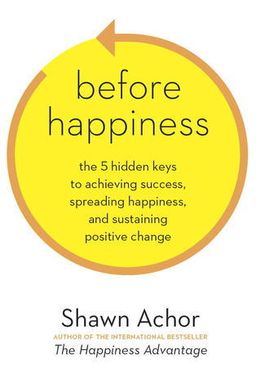
Before Happiness cover

Before Happiness

by Shawn Achor

Before Happiness by Shawn Achor reveals the transformative power of perception in achieving happiness and success. By teaching you how to reframe your view of reality, this insightful guide offers practical strategies to overcome challenges and unlock hidden opportunities for positive change.

Before Happiness: The Power of Positive Reality

How can you change your life before you even feel happy? That’s the question Shawn Achor opens with in Before Happiness—a companion to his bestselling The Happiness Advantage. In his earlier work, Achor argued that happiness fuels success. In this book, he takes a philosophical step back to ask what comes before both: the perception of reality itself. Achor contends that your ability to create lasting positive change depends not merely on your mood or circumstances, but on the reality you choose to see. Reality isn’t fixed, he argues—it’s filtered through the selective lens of the brain, which processes only forty pieces of information out of the eleven million bits it receives every second. In that unseen dynamic lies the power to reframe the world around you and spark transformation.

Through stories from his global research—whether consulting leaders in bulletproof cars in Venezuela, watching children in Tanzanian villages play optimistically with string and sticks, or advising doctors treating incurably ill children—Achor reveals that success and happiness begin when people first perceive that success is possible. The same conditions can lead one person to hopelessness and another to motivation. What makes the difference? Their reality. He introduces the concept of positive genius: the ability to construct a reality in which challenge can be overcome and change is achievable. This mental framing doesn’t ignore obstacles; it integrates them into a broader, empowering vision of what’s true.

Creating Positive Reality

The heart of Achor’s argument is startling but pragmatic—your interpretation of the world creates your reality, and that perception can be trained. While objective facts exist, your meaning-making is what gives those facts emotional charge and determines behavior. A poor farmer in Kenya who believes her daughter can go to Harvard inhabits a different world than one who cannot imagine it. In turn, the first mother’s reality activates possibilities and actions that the second never sees. In other words, belief precedes action. The challenge is learning to see the world through a lens that reveals possibility, not limitation.

The Five Hidden Keys

To help you construct that lens, Achor outlines five essential skills of positive genius:

  • Reality Architecture: Recognize that multiple realities exist and choose the most valuable one—the perspective that’s both true and leads to growth.
  • Mental Cartography: Map routes to success by identifying and following meaningful markers instead of fear-based escape routes.
  • The X-Spot: Find success accelerants—mental triggers that speed you toward goals by focusing on proximity, likelihood, and energy.
  • Noise Cancelling: Drown out negative, irrelevant, or distracting information so the real signal of progress can shine through.
  • Positive Inception: Transfer your positive reality to others so teams, organizations, and relationships become cooperative engines of success.

Beyond Optimism: Seeing the Full Pitcher

Achor differentiates true positive genius from mere optimism. Optimists see the glass as half full; pessimists see it as half empty. Positive geniuses, however, notice the pitcher of water sitting nearby. They recognize that good and bad coexist, but they focus on what can replenish the glass—the resources, relationships, and choices available to them. This mindset, grounded in possibility and practical realism, helps them act creatively rather than passively wishing problems away. (Unlike blind optimism, this perspective aligns with research from Yale’s Peter Salovey and Martin Seligman on realistic positivity.)

Why This Matters

In an era of overwork, distraction, and cynicism, Achor’s message is both scientific and deeply human: your success and happiness depend on mastering the lens that shapes your experience. The book doesn’t ask you to deny hardship; it teaches you to architect meaning out of it. Once you learn to select, map, accelerate, and share positive realities, you’ll not only change your own trajectory but amplify that effect across families, workplaces, and communities. The result isn’t naïve cheerfulness—it’s empowered clarity. As Achor’s research shows, the people who thrive are not those born lucky or happy, but those who construct a reality where happiness is possible and success becomes inevitable.


Reality Architecture: Choosing What’s True

Achor begins his five-step model with what he calls Reality Architecture—the ability to design your own version of reality. If your brain receives millions of sensory details but processes only a handful, then what you focus on effectively becomes your world. The skill isn’t about inventing fairy tales; it’s about selecting the reality that’s both factual and growth-producing. This principle is illustrated through his humorous but vivid submarine story, where the “floor” suddenly tilts sixty degrees, teaching him that perception—even of up and down—changes with context.

Seeing Multiple Realities

We naturally cling to one version of reality—our habitual worldview. At work, that might mean seeing stress as destructive, setbacks as personal, or bosses as obstacles. But Achor’s research at Yale and UBS proved otherwise: changing the lens from “stress is debilitating” to “stress is enhancing” reduced fatigue symptoms by 23 percent. Employees who saw stress as useful felt more energized and performed better. This reframing doesn’t deny pressure—it chooses a worldview in which pressure awakens potential rather than drains it.

Adding Vantage Points

Seeing from one angle gives a warped image. Achor urges you to add vantage points: new perspectives that expand understanding. He cites Yale medical students who improved diagnosis accuracy by 10 percent after art observation classes that trained them to notice unfamiliar details in paintings—a metaphor for life and leadership. Similarly, executives who view financial losses from multiple perspectives often realize hidden positives, like freed resources or team promotions. The more vantage points you add, the richer and more multidimensional your reality becomes.

Pursuing the Most Valuable Reality

Of all possible perceptions, some lead to growth, and others lead to stagnation. The goal is to choose the one that’s true, positive, and useful—the most valuable reality. Achor introduces the positivity ratio (originally proposed by Marcial Losada and Barbara Fredrickson): flourishing teams maintain at least three positive interactions for every negative one, while struggling teams fall below that threshold. At work and at home, you can raise this ratio not by ignoring negatives but by increasing constructive and meaningful positives. This keeps your perception resilient and adaptive even under pressure.

Core Idea

Reality Architecture teaches you that you always live in one of several potential worlds. The question isn’t whether reality is positive or negative—it’s which version of reality you choose to inhabit and reinforce through attention. Your focus determines your world.

By mastering Reality Architecture, you begin to see life as flexible, not fixed. You can perceive multiple truths and consciously select ones that amplify meaning and motivation. This shift—from reacting to designing your world—becomes the bedrock for every other skill in Before Happiness.


Mental Cartography: Mapping Meaning

If Reality Architecture is about choosing your lens, Mental Cartography is about drawing the map. Achor argues that many people wander without purpose because their mental maps lack clear meaning markers—signposts of what truly matters. He tells a funny childhood story about running away from home at age seven, trekking seven miles to a fishing pier. Though naïve, he made it because his brain had mapped the route anchored to one deeply meaningful memory: fishing with his father. That emotional connection provided motivation and direction, proving that meaning guides navigation.

Finding True Meaning Markers

Achor defines “meaning markers” as the emotional coordinates that orient you in life—relationships, goals, passions, contributions. They can be big (your family’s wellbeing) or small (enjoying problem-solving at work). At Harvard, Achor observed many brilliant students trapped in depression because their academic maps lacked meaning beyond grades or competition. To change direction, he helped them identify genuine fulfillment sources—community, creativity, teaching—and reorient their focus around those. When meaning replaced performance pressure, engagement and wellbeing soared.

Reorienting Around Meaning

Once you have markers, you must reorganize your mental map around them. Achor warns against “map hijackers”—false goals that mimic meaning but drain energy, such as chasing status or reacting to fear. In business, employees obsessed with promotions often feel miserable once they achieve them because their path lacked deeper purpose. Reorientation means replacing those false landmarks with authentic motives: learning, service, creativity, family connection. Every goal should connect to a marker of meaning, not a metric of ego.

Mapping Success Before Escape

We often plan escape routes instead of success routes. Anticipating failure—“What if I lose my job?” “What if my project flops?”—burns cognitive fuel that could chart growth paths. In a study of corporate managers during restructuring, Achor found that teams who mapped for success before planning contingency safety nets performed dramatically better. They viewed stress as challenge, not threat. The old Cartesian model of fear-based mapping was replaced by mental geography guided by purpose.

Core Idea

Meaning is your brain’s GPS. Without emotional coordinates to define direction, motivation falters. Every powerful achievement starts with a map anchored to what matters most.

Achor’s Mental Cartography echoes Viktor Frankl’s theory in Man’s Search for Meaning: the will to meaning is the primary human drive. When you align goals to meaning markers, obstacles become waypoints instead of dead ends. You don’t just survive the journey—you progress with purpose.


The X-Spot: Activating Success Accelerants

The third skill, The X-Spot, explores how to mentally accelerate progress once you’ve mapped your route. Achor borrows from neuroscience and sports psychology: when runners see the finish line, their brains release endorphins and adrenaline that propel a final sprint. This same mental event can be triggered earlier, transforming distant goals into near victories. The X-Spot is that moment of perceived possibility when “I might succeed” becomes “I’m close to succeeding.”

Zooming In: Perceived Proximity

Achor revisits Clark Hull’s goal-gradient theory—humans (and even rats in experiments) move faster as they near their goal. But he refines it: proximity is psychological, not just physical. When customers were given coffee punch cards with two stamps already marked, they bought more often—their reward felt closer. At work, you can harness this by setting visible milestones. Highlight the 70% completion mark of projects to cue your brain’s success accelerants. Small wins create perceived closeness to big goals, sustaining momentum.

Magnifying Target Size

The brain not only measures distance but also estimates likelihood. The larger the perceived target, the greater confidence. In golf studies using the Ebbinghaus illusion, players putted better when the hole appeared larger. Likewise, calling up your “champion moments”—past instances of success—magnifies your mental target and lowers fear. Achor references baseball players hitting more home runs in friendly stadiums because their perceived fence feels closer. Move the fences of your own goals inward by choosing realistic yet challenging targets—those with a 70% success probability.

Recalculating Thrust

Effort is expensive. When we perceive a project as harder or longer, motivation drops. Achor’s “20-second rule,” popularized in The Happiness Advantage, shows how small changes—like placing the remote farther away—increase positive habits by reducing mental thrust. He also teaches you to translate vague tasks into objective units: instead of “clean my inbox,” think “reply to 15 e-mails.” Time perception and energy use are mental constructs; reframing them recalibrates endurance. (Psychologist Roy Baumeister’s research on willpower supports this “energy budgeting” principle.)

Core Idea

Acceleration isn’t about working harder; it’s about triggering belief. When your brain perceives goals as closer, more likely, and manageable, it releases neurochemical fuel that transforms persistence into speed.

The X-Spot shifts motivation from endurance to momentum. Once you learn to paint goals closer, make targets larger, and reduce perceived effort, your actions become self-sustaining. Achievement ceases to be a marathon—it becomes a sprint powered by belief.


Noise Cancelling: Hearing the Signal of Success

In a world flooded by information, Achor warns that our minds overdose on noise—negative, irrelevant, or distracting data that drowns out the true signal of progress. Borrowing from audio technology, he introduces Noise Cancelling as a success skill: learning to filter what’s meaningful from the chaos. Just as Bose headphones emit counterwaves to silence unwanted sound, you can amplify focus by emitting positive mental waves that neutralize worry, fear, and negativity.

Recognizing the Signal

Signal is any information that’s true, timely, and useful. Noise fails one of four tests: it’s unusable, untimely, hypothetical, or distracting. Reading endless predictions about stocks or fears of disaster provides anxiety, not insight. Achor contrasts economist John Paulson—who correctly saw the 2008 financial crash—with Irving Fisher, who missed the real signs amid optimism. The difference wasn’t intelligence but attention: Paulson listened to signal, Fisher to noise. You must learn that attention is selective—and selective attention determines destiny.

Stopping the Addiction to Noise

Humans evolved to be alert for threats (Achor calls it the “rabbit brain”), but in modern life this instinct creates a bias toward negative information. We click more on bad headlines, remember criticism over praise, and surround ourselves with mental clutter. Achor recommends cutting just 5% of incoming data—turning off the car radio for five minutes, skipping one news alert, muting commercials. That small pause creates measurable increases in calm and clarity. The brain thrives not on quantity of data but on the quality of meaning.

Cancelling Internal Noise

External clutter is only half the problem; internal chatter—fear, guilt, worry—can be louder. Achor prescribes three mental counterwaves: 1) keep worry proportional to actual likelihood, 2) don’t ruin ten thousand days to be right once, and 3) never equate worrying with being loving or responsible. For example, parents who worry daily about rare dangers expend emotional energy that could foster real connection. Replace mental noise with gratitude journaling, exercise, or two minutes of writing about what’s going well—habits shown to improve performance by 10–15%.

Core Idea

The less noise you absorb, the clearer your signal. Trimming 5% of distraction—externally or internally—can boost focus, emotional equilibrium, and decision quality exponentially. Attention is your ultimate productivity resource.

Noise Cancelling is Achor’s antidote to modern overwhelm. When you tune out destructive frequencies and amplify signal, you regain bandwidth for creativity, empathy, and action. Productivity isn’t about doing more—it’s about hearing what matters most.


Positive Inception: Making Positivity Contagious

Finally, Achor presents his most outward-looking skill: Positive Inception, inspired by the film Inception. Just as ideas can be planted in dreams, positive realities can be transferred across people, teams, and organizations. The result is exponential growth in collective intelligence and engagement. Success multiplies because optimism spreads through mirror neurons and shared narratives.

Franchising Success

Positive behaviors are contagious. Achor’s work with Ochsner Health System shows this vividly: by adopting the Ritz-Carlton’s “10/5 Way” (smile within ten feet, greet within five), eleven thousand hospital employees transformed their culture. Patient satisfaction rose, revenues improved, and even skeptical doctors began smiling. The lesson: replicate small, emotional behaviors that trigger connection. Simplicity breeds scalability. Like viral code, positivity spreads through repetition—not force.

Rewriting Social Scripts

Workplaces are governed by silent social scripts—unspoken rules about what emotions or ideas are “appropriate.” Negative scripts, such as “we shouldn’t be cheerful during layoffs,” depress engagement. Drawing on research by Columbia psychologist Bibb Latané, Achor shows that social influence depends on strength, immediacy, and numbers. You can rewrite scripts by using positivity in multiple voices. Start with the “power lead”—speak first, and set a constructive tone before cynicism takes over. Facial expressions, humor, and laughter accelerate acceptance, signaling cognitive fitness and emotional safety (as also noted by researcher Daniel Goleman).

Creating Shared Narratives

Storytelling is the ultimate inception tool. Through emotional narratives, teams make meaning together. Achor’s collaboration with the National MS Society used real people’s stories of perseverance to spread hope among patients. In Walmart’s “Zip Challenge,” peer storytelling helped employees cultivate gratitude and health habits. Similarly, companies like Adobe and Zappos use shared stories of overcoming difficulty to bind teams. When adversity becomes a communal victory, stress turns into glue instead of poison.

Core Idea

Positivity multiplies by design, not accident. When you model optimism, rewrite the social script, and help others find meaning in their challenges, you transform individual wellbeing into collective success. Emotion spreads faster than logic—use it wisely.

Positive Inception turns happiness into cultural architecture. By franchising good habits, rewriting scripts through humor and empathy, and building shared emotional stories, you create environments where positivity sustains itself. As Achor concludes, an isolated positive reality fades; a shared one becomes genius.


Positive Inspiration: The Spark of Genius

In the final section, Achor returns to the deeper essence of his message: Positive Inspiration—the spontaneous insight that arises when your mind quiets and a new possibility appears. He draws on historical geniuses like Henri Poincaré and Albert Einstein, who made breakthroughs only after stepping away from their problems. Positivity primes the unconscious to keep working while the conscious mind rests. The greatest ideas emerge not during strain but during flow and openness.

The Unconscious Mind at Work

Achor cites Yale psychologist Scott Barry Kaufman’s research showing that insight often arises from System 1 thinking—the intuitive, non-linear mode. When you stop forcing solutions and create space—walking, relaxing, or sleeping—the unconscious connects ideas you didn’t consciously link. Einstein imagined riding a streetcar at light speed and realized time wasn’t absolute. Poincaré’s “black coffee night” of sleepless thoughts produced new mathematical functions. Both men displayed positive genius: confidence that answers exist even when unseen.

Letting Reality Work Through You

According to Achor, inspiration requires both discipline and surrender. You set up the mental architecture—meaning, signal, maps—but then let go, trusting your subconscious to integrate them. In practice, that means scheduling time for genuine disconnection: walking without devices, daydreaming, or mindful rest. Positivity creates cognitive spaciousness, allowing innovation to surface naturally. (This parallels Mihaly Csikszentmihalyi’s “flow” concept: full engagement without self-conscious control.)

Living as a Positive Genius

To become a positive genius is not to eliminate difficulty; it’s to integrate it into creative evolution. When you view challenges through a positive reality, your unconscious mind keeps solving, even when you’re unaware. Therefore, success is not merely cognitive—it’s perceptual and emotional. The call to action at the book’s end is simple: apply just one strategy at a time, embed it into habit, and let growth compound. Reality will adjust accordingly.

Core Idea

Inspiration is the fruit of a positive lens. When you believe positive change is possible, your unconscious aligns to create it. The happiest and most successful minds aren’t those that see less reality—they see more possibilities within it.

Achor closes with a plea for modern renaissance: a world led by individuals who use positivity not for escapism but for evolution. Like Poincaré’s seaside epiphany or Einstein’s tram ride, genius begins when you stop seeing limits and start seeing light. Happiness is not the absence of struggle—it’s the awareness that transformation is always within reach.

Dig Deeper

Get personalized prompts to apply these lessons to your life and deepen your understanding.

Go Deeper

Get the Full Experience

Download Insight Books for AI-powered reflections, quizzes, and more.