
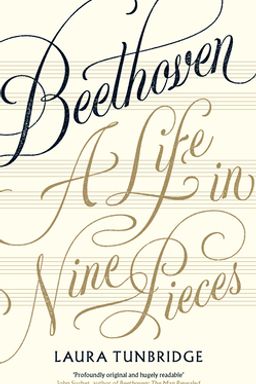
Beethoven cover

Beethoven

by Laura Tunbridge

Explore Beethoven''s life through the lens of nine pivotal compositions, challenging the myth of the reclusive genius. Discover the artist''s friendships, ambitions, and the innovative spirit that transformed music forever.

Beethoven: A Life in Nine Pieces

What does it mean to create art that transcends time, politics, and personal struggle? Laura Tunbridge’s Beethoven: A Life in Nine Pieces invites you to rethink the image of Ludwig van Beethoven—not simply as the irascible genius we’ve come to mythologize, but as a profoundly human artist whose music emerged through collaboration, circumstance, and reinvention.

Tunbridge contends that Beethoven’s greatness was not born from divine inspiration alone, but from an unrelenting combination of ambition, hard work, and adaptation to a changing world. His genius was shaped by patrons, publishers, technologies, wars, and audiences. Through nine central works—from his gentle Septet to his revolutionary Eroica Symphony—she redefines him as both product and creator of a chaotic, transformative era.

A Human Behind the Myth

We often encounter Beethoven as the isolated genius: the man who shook his fist at fate while composing deaf—to the world and its noise. Tunbridge dismantles this romantic caricature. She shows that Beethoven’s life was built on deep connections—with mentors like Haydn, friends such as Stephan von Breuning, and musicians like Ignaz Schuppanzigh and Anna Milder. These relationships sustained him, even as his temper and deafness strained them. You see him not as a solitary mountain of creation, but as a figure enmeshed in networks of support, rivalry, and everyday dependence.

Nine Masterpieces, Nine Lenses

Each chapter focuses on one defining composition to explore a different facet of Beethoven's life and art. The Septet reveals his first taste of success—a piece loved by audiences but later loathed by the composer for its popularity. The Kreutzer Sonata highlights friendship and collaboration through Beethoven’s volatile partnership with violinist George Bridgetower. The Eroica Symphony becomes emblematic of heroism amid revolutionary turmoil, initially dedicated to Napoleon before that faith curdled. Later works like Fidelio and Missa solemnis demonstrate Beethoven’s moral and spiritual concerns, while the late quartets expose his introspection during illness and isolation.

Beyond Genius: The Practical Craftsman

Tunbridge reframes Beethoven as a professional navigating an unstable economy. During the Napoleonic Wars, inflation ravaged Austria’s currency; princely stipends shrank; and yet Beethoven negotiated fiercely with publishers and patrons. His letters—at once poetic and exasperated—show his frustration with “being half a businessman,” even as he dreamed of a centralized “magazine of art” where composers could trade creation for sustenance. To survive, he adapted, taught, performed, and reworked his works for smaller ensembles to broaden their reach. In this way, Beethoven’s story mirrors that of every modern artist striving to reconcile integrity with income.

War, Revolution, and Liberty

Set against the backdrop of revolutions and empires, Beethoven’s music echoed the political rhythms of his age. He admired Napoleon’s republican ideals—liberté, égalité, fraternité—but recoiled at the emperor’s tyranny. The transformation of the Eroica from a dedication to Bonaparte to an abstract celebration of heroism reflects this disillusionment. Later, during the Congress of Vienna, his patriotic compositions like Wellington’s Victory and the celebratory Fidelio aligned with the restoration of order. Tunbridge reveals how Beethoven moved fluidly between rebellion and reverence, embracing both the artist’s freedom and the citizen’s duty.

Deafness and the Sound of the Soul

Perhaps the most haunting theme is Beethoven’s progressive hearing loss—what Tunbridge calls the fusion of isolation and transcendence. His 1802 “Heiligenstadt Testament” shows despair and defiance: he nearly ended his life but chose to live for his art. Deafness transformed not just his social world but his sonic imagination. Through sketches and devices like the “hearing machine” and resonating pianos, he composed by feeling vibration and envisioning sound. The music became inward—spiritual language beyond words, culminating in the ethereal late quartets where mortality itself seems to hum through the strings.

Beethoven as Legacy and Mirror

Tunbridge ends by asking what Beethoven means today. His myth has been reshaped—from Wagner’s nationalistic giant to Stockhausen’s avant-garde muse. Every era chisels a new Beethoven. For Tunbridge, what endures is not the monument but the man: a worker, negotiator, friend, and fighter whose music bridged intellect and emotion, structure and freedom, personal grief and universal joy. His “Ode to Joy” lives on not as a celebration of Europe alone but as a reminder of the enduring human drive toward connection and creation.

Essential Message

Beethoven’s life was not a solitary miracle but a networked struggle; his art was not divine but deeply human. Tunbridge’s nine pieces trace how music becomes biography—and how genius, forged in adversity, continues to speak to the creative spirit within us all.


Early Success and the Septet

How does an artist handle early success when it threatens future greatness? Beethoven’s Septet in E-flat major, Op. 20 was a triumph in 1800—an exuberant piece that charmed audiences and defined Viennese taste at the turn of the century. Yet the same piece later became Beethoven’s bane; he grew angry that it overshadowed his more serious works. Laura Tunbridge uses the Septet to explore the tension between commerce and art, popularity and profundity.

Making a Name in Vienna

At twenty-nine, Beethoven gave his first public Akademie at Vienna’s Burgtheater—a marathon concert where he presented the Septet alongside symphonies and concertos. It was part of a vibrant but precarious concert economy. Musicians had to rent theatres, handle permits, hire orchestras, and shoulder financial risk. Beethoven’s respectable patrons—Baron Braun, Prince Lichnowsky, and Empress Maria Theresa—helped open doors, but the artist still needed ticket sales to survive. The Septet’s charm made that possible: its melodic freshness, alternating winds and strings, and its blend of seriousness and entertainment seduced both aristocrats and commoners.

Music for All Spaces

The Septet’s instrumentation—clarinet, horn, bassoon, and strings—meant it could flourish in multiple venues: salons, taverns, gardens, or small theatres. Unlike Beethoven’s symphonies, which demanded large ensembles, the Septet was portable. Tunbridge calls it “the bridge between the string quartet and the orchestra.” Its success derived partly from its adaptability: it could be arranged for piano or flute, expanding its domestic market (similar to adaptations later made by his student Carl Czerny).

Art versus Commerce

Despite acclaim, Beethoven bristled. Critics praised its “taste and feeling,” but he called them “asses,” claiming immortality comes from Apollo, not from chatter. He wanted to be measured against Haydn and Mozart—not as a pleasant entertainer but as a bold innovator. His later bitterness about the Septet’s enduring fame underscores his anxiety about becoming merely popular. “In those days,” he told Cipriani Potter, “I did not know how to compose.” He yearned to be “interesting” in Kant’s sense—inviting contemplation, not consumption.

Shaping Genius Through Paper

Tunbridge reveals how the Septet marked Beethoven’s professional evolution. Around this time, he began keeping systematic sketchbooks, replacing loose sheets with bound volumes. These notebooks, meticulously studied by scholars today, clarify that Beethoven’s compositions arose from constant revision and experimentation, not divine spontaneity. They signify a shift from music as ephemeral entertainment to music as enduring work—what philosopher Lydia Goehr calls the birth of the “imaginary museum” of musical works.

Through the Septet, Beethoven tasted fame, mastered publication, and confronted the artist’s eternal dilemma: how to balance craft, creativity, and commercial survival. It was his first step from popularity to posterity.


Friendship and Collaboration

Beethoven is often imagined as solitary, but Friendship, Tunbridge’s second movement in his life symphony, proves he was deeply entwined with others. The Violin Sonata No. 9, Op. 47—later known as the ‘Kreutzer’ Sonata—embodies music born of connection and conflict. It emerged from a collaboration with violinist George Bridgetower, a charismatic Afro-European virtuoso. Their story reveals Beethoven’s dependence on—and defiance of—the community around him.

No Man Is an Island

Tunbridge paints Beethoven not as a hermit but as a man anchored in networks of musicians, friends, and patrons. His youthful bonds with Franz Wegeler and Stephan von Breuning fostered loyalty and lifelong affection. Social gatherings in Vienna’s cafés were crucial to artistic exchange—Beethoven’s meticulous habit of counting out sixty coffee beans for his morning brew became metaphor for his precision. These spaces fueled creative camaraderie.

The Bridgetower Episode

When Bridgetower arrived in Vienna in 1803, Beethoven was impressed. He wrote a sonata for their concert at the Augarten—completed overnight, barely rehearsed, yet electrifying. Bridgetower improvised an audacious flourish during the performance, prompting Beethoven to exclaim, “Encore, my dear boy!” After a drunken quarrel—allegedly over a woman—Beethoven withdrew the dedication and later gave it to Parisian virtuoso Rodolphe Kreutzer, who never performed it. Thus the work’s very name conceals the friendship that inspired it.

Music as Conversation

The Sonata’s structure mirrors collaboration itself: piano and violin engage in “dialogue relentlessly driven forward.” Instead of accompaniment, they debate as equals. Tunbridge notes this interplay marked a revolution in chamber music—as though each instrument were a living interlocutor. The work’s fiery tension and its blurred lines between sonata and concerto testify to Beethoven’s evolving musical equality, mirroring Enlightenment ideals of partnership and reciprocity.

Friendship and Friction

Beethoven’s humor and brutality coexisted with tenderness. He called Schuppanzigh, his loyal violinist, “Falstaff” and composed playful canons mocking his weight. These jesting exchanges reveal affection cloaked in sarcasm—the human side of greatness. Yet friendship also exposed his volatility: he could shift from camaraderie to feud in minutes. Tunbridge asks whether Beethoven’s creative energy thrived on this conflict, turning personal relationships into musical drama.

Beethoven’s friendships were performances—acts of creation as complex and contradictory as his music. In the ‘Kreutzer’ Sonata, we hear the conversation between two souls: harmonious, contentious, unforgettable.


Heroism and Revolution

Heroism—and its disillusion—is the heartbeat of Beethoven’s life. Tunbridge’s chapter on the Eroica Symphony (Symphony No. 3) dissects how Beethoven embedded revolutionary ideals into sound. Originally dedicated to Napoleon Bonaparte, the symphony transformed when Beethoven tore the title page upon learning of Napoleon’s coronation. It was now a tribute not to a man, but to the idea of heroism itself.

Revolution in Sound

The Eroica broke every rule. Its opening chords announce a new world—bold, dissonant, and massive for its time. Cellos, not violins, begin the main theme, grounding heroic aspiration in the earthly. Unexpected sharp notes and sudden meters make listeners lose footing; this, Tunbridge argues, is musical revolution. Beethoven fused struggle and triumph, folding the personal fight against deafness into a political language of hope and defiance.

From Napoleon to Prometheus

Tunbridge connects Beethoven’s changing hero to myth. He likened himself to Prometheus—the bringer of fire and enlightenment—punished for sharing divine gifts with humanity. Prometheus mirrored both Napoleon’s early republican vigor and Beethoven’s artistic rebellion. The symphony’s finale draws on music from Beethoven’s earlier ballet, The Creatures of Prometheus, merging myth and modernity to portray humanity’s ascent through art and struggle.

Trials of Fame and Reception

Its 1805 premiere divided audiences. Admirers hailed it as “most sublime,” while detractors found it “shrill and too long.” Critics feared Beethoven’s innovations would alienate the public, yet within decades the Eroica was revered as a cornerstone of symphonic art. Tunbridge juxtaposes early confusion with later canonization—how radical sound becomes timeless monument. (Compare this to Wagner’s similar reception a century later: initial chaos, later cult.)

Personal Heroism

At the same time Beethoven confronted his own physical and creative battle. His “Heiligenstadt Testament,” written around the symphony’s composition, confesses despair over his hearing loss—“Oh, how could I admit an infirmity in the one sense that should be perfect in me?”—and his decision to live for art. Tunbridge suggests that the symphony’s journey from turmoil to triumph mirrors this moral victory: Beethoven becomes his own hero, transforming suffering into glory.

Through the Eroica, Beethoven turns revolution into expression—political ambition into personal revelation. Heroism, for him, wasn’t conquest but persistence.


Ambition and Experimentation

Tunbridge’s chapter on the Choral Fantasy, Op. 80 captures Beethoven’s audacious ambition. Imagine a freezing December night in 1808: Vienna’s Theater an der Wien, packed yet shivering, witnessing one of music’s longest concerts. Beethoven premiered two symphonies (the Fifth and Sixth), a piano concerto, a mass, and ended with a new hybrid work combining improvisation, piano, orchestra, and chorus—the Choral Fantasy. It was chaos, genius, and failure all at once.

Defying Structure

The performance collapsed mid-piece, musicians lost their place, and Beethoven stopped everything shouting, “Wrong! Again!” Yet Tunbridge sees this fiasco as pivotal. The Choral Fantasy bridges Beethoven’s middle and late style—his prototype for the Ninth Symphony’s “Ode to Joy.” Both works unite individual voices in a communal triumph. The Fantasy’s lyrical line “When love and strength are wedded” becomes a precursor to universal brotherhood.

Improvisation as Creation

The Fantasy began as a piano improvisation—Beethoven’s natural habitat. He believed real creativity flowed only when unselfconscious, “when we are unconcerned with what we play.” He built the orchestral and choral parts around these spontaneous expressions, turning performance anxiety into art. Tunbridge highlights improvisation not as rough draft but as revelation—Beethoven’s ability to translate fleeting emotion into enduring form.

Professional Risks

Behind the artistic experiment was commercial peril. Vienna’s concert system demanded self-financing; Beethoven navigated permits, printing delays, and fuming musicians. While Haydn’s oratorios drew high society, Beethoven’s avant-garde experiments bewildered audiences. Yet this very combination—public chaos, private endurance—led him to financial independence. His patrons guaranteed an annuity after he threatened to leave for Kassel, ensuring he could “work without embarrassment or the clog of necessity.”

A Turning Point in Identity

The Choral Fantasy situates Beethoven at the fulcrum of Romantic transformation: from composer-as-servant to composer-as-visionary. Like Kant’s call for disinterested contemplation, Beethoven raised instrumental music from mere entertainment to philosophical art. Tunbridge suggests that the tumult of that long, cold night symbolized the struggle between old patronage and new independence—the moment Beethoven truly became Beethoven.

Ambition requires risk. Beethoven’s disastrous concert birthed his most daring idea: that music could unite humanity—not by perfection, but through collective striving.


Love and Isolation

Beethoven was a man of passion, yet love eluded him. Tunbridge’s chapter on “An die Geliebte” and his mysterious “Immortal Beloved” explores how yearning shaped his music and myth. The song, written in 1811, and the unsent letter to his “angel, my all, my very self” express an artist’s desperate attempt to connect amid solitude.

A Musical Confession

In “An die Geliebte”, Beethoven sets Joseph Ludwig Stoll’s tender poem to music that swells like intimacy itself: the lover longs to “kiss the tears from the beloved’s cheek.” Tunbridge reads it as more than romantic sentiment—it’s Beethoven’s metaphoric act of communion. Each repetition, each lingering pause, conveys hunger for union, mirrored later in An die ferne Geliebte (“To the Distant Beloved”), the first true song cycle in music history.

The Immortal Beloved

In July 1812, Beethoven wrote an unsent letter to a woman whose identity remains debated—Antonina Brentano, Theresa Brunsvik, or Josephine Deym. “Ever thine, ever mine, ever ours,” he penned. Tunbridge examines this mystery less as gossip than as psychological portrait: the letter reflects Beethoven’s yearning for impossible intimacy, blending the Wertherian pathos of Goethe’s age with his own defiance of social hierarchies that barred marriage to noblewomen.

Art Through Absence

His music for voice, from An die Hoffnung to An die ferne Geliebte, channels love through distance. For Beethoven, longing became form: cyclical melodies mirror eternal separation yet promise reunion in art. Tunbridge calls this “romantic isolation transformed into aesthetic immortality.” Love lived not through touch but through tone.

The Artist’s Vulnerability

Tunbridge portrays Beethoven as both proud and fragile—seeking devotion yet rejecting dependence. His bachelorhood, deafness, and volatile nature intertwined to form what scholar Mark Evan Bonds calls “the Beethoven syndrome,” the idea that crisis fuels creativity. Through his songs and letters, Beethoven crafted a new kind of love story: one between art and solitude.

Beethoven’s real romance was with sound itself. His music reached where words failed—toward the eternal beloved within every act of creation.


Liberty and Moral Courage

Freedom was Beethoven’s moral compass. In 1814, as Europe celebrated Napoleon’s defeat, his opera Fidelio triumphantly returned to Vienna. Tunbridge shows how the work’s evolution from its 1805 version to the revised “liberation opera” mirrored political shifts—from revolutionary daring to restoration-era order—and Beethoven’s own ethical struggle.

An Opera of Courage

Fidelio tells of Leonore, disguised as a male jailer, who rescues her husband from tyranny. Its finale celebrates light, truth, and freedom. Tunbridge connects this to Beethoven’s heroism in private—his fight with deafness—and public, during the Congress of Vienna. The opera’s moral victory resonated with a city rejoicing in liberation yet cautiously rebuilding hierarchy.

The Politics of Sound

Originally titled Leonore, the opera’s censorship battles showed Vienna’s political caution. Its revised form, guided by librettist Georg Friedrich Treitschke, softened its revolutionary edge, replacing rebellion with forgiveness. Still, Beethoven’s music holds subversive undertones—choruses of prisoners yearning for daylight echo Enlightenment ideals of inner liberty. Leonore’s defiance—“First kill his wife!”—remains, as Wilhelmine Schröder-Devrient’s 1822 performance proved, an unforgettable moment of female heroism.

Art as Moral Resistance

Tunbridge sets Fidelio against its historical backdrop: the Congress of Vienna’s opulent peace festivals and Metternich’s tightening censorship. Beethoven’s opera offered audiences a safe catharsis—resistance framed as virtue. Its tableau of freedom, repeated choruses, and radiant key changes symbolized moral restoration. Through Leonore, Beethoven championed compassion over conquest.

You can hear liberty not as politics but as personal conviction. Fidelio is Beethoven’s declaration that truth and love, not power, are the highest freedoms.


Family and the Hammerklavier

Family ties were Beethoven’s deepest torment. Tunbridge uses the Piano Sonata No. 29 in B-flat major, Op. 106—the ‘Hammerklavier’—to examine how creativity and control converged in his turbulent guardianship of his nephew Karl. Beethoven’s obsessive desire to shape Karl’s future mirrored his musical perfectionism: exacting, visionary, and destructive.

Guardianship and Guilt

After his brother’s death, Beethoven waged a five-year court battle to gain custody of Karl, denouncing the boy’s mother, Johanna, as immoral. Tunbridge recounts the painful saga—the accusations, appeals, and emotional estrangement. While Beethoven saw himself as fatherly, his severity alienated the child. Karl’s eventual suicide attempt in 1826 shattered him, forcing reflection on his own tyranny, both as parent and artist.

Music as Structure and Struggle

The Hammerklavier embodies this conflict. Towering, intricate, and nearly unplayable, it was his act of control over chaos. Its frenetic fugue—marked “con alcune licenze” (“with certain liberties”)—shows Beethoven bending rules yet maintaining mastery. The piece’s title, emphasizing the German “Hammer” piano, asserted independence from Italian convention and strengthened national identity through sound.

Hearing Without Hearing

Composed in near-total deafness, the sonata’s vast dynamic range exploited his new Broadwood piano. Tunbridge explains how Beethoven felt vibration instead of tone, designing sound through imagination and memory. Beneath its technical extremity runs an emotional theme—discipline born from loss. As his family unraveled, his music became his order.

Work Beyond Mortality

Rising thirds and descending harmonies suggest resilience beyond despair—a pattern Tunbridge sees as Beethoven’s symbolic confrontation with fate. “What is difficult,” he wrote, “is beautiful.” The Hammerklavier turned hardship into architecture, redefining what piano music could express: not easy brilliance but existential endurance.

Through family turmoil, Beethoven refined his deepest theme: mastery through struggle. The Hammerklavier is both monument and confession—his son’s future and his own legacy hammering at heaven’s door.


Spirit and Late Transcendence

Religion and reflection converge in Beethoven’s Missa solemnis (1819–1823), which Tunbridge calls “his most ambitious act of faith.” Written for his patron Archduke Rudolph’s installation as Bishop of Olmütz, the Mass grew beyond church service into monumental art. Its motto—“From the heart—may it go to the heart”—encapsulates Beethoven’s belief that music communicates divine truth through human emotion.

Faith Beyond the Church

Though raised Catholic, Beethoven was a spiritual eclectic, reading Hindu scriptures and Enlightenment philosophy. Tunbridge describes his fascination with universal deities: Brahmanic silence, Buddhist compassion, Christian mercy. This fusion appears musically in the Missa solemnis, where ecstatic fugues and trembling supplications meld sacred faith with secular yearning.

Human Drama in Sacred Form

In the Agnus Dei, gentle prayer erupts into warlike thunder; Beethoven marks “anguished” entries in the score. Drums disrupt peace, reflecting the turmoil of Europe and his inner conflict. These dissonances give spiritual realism to the music—grace achieved through struggle, redemption through resistance.

From Patronage to Posterity

Tunbridge recounts Beethoven’s audacious negotiations: he sold rights to multiple publishers simultaneously, even to kings via handwritten subscriptions. His Mass was performed as an oratorio rather than liturgy—a secular halo placed on a sacred form. Its Russian premiere was hailed as “so sublime none could fully grasp it.” Like the Ninth Symphony that followed, it blurred the boundary between human and divine art.

In the Missa solemnis, Beethoven’s spirituality transcends religion. Devotion becomes creation; faith becomes sound. He sings not to heaven, but through it.


Endings and Legacy

Tunbridge closes with Beethoven’s late quartets and final days, transforming death into art. The String Quartet Op. 130 and its original finale, the Grosse Fuge, represent Beethoven’s farewell to earthly form. He asked, “Must it be?” and answered, “It must be.” In those words, existence and music converge.

Late Style and Mortality

The late quartets shattered convention: seven movements, shifting keys, whispered “cavatinas.” After losing his nephew to despair and his own health to illness, Beethoven turned inward. Tunbridge sees these works as meditations on acceptance—complex, fragmented, yet serene. The Grosse Fuge, massive and dissonant, became too much for audiences who dubbed it “incomprehensible.” Yet for Beethoven, incomprehension was transcendence—art reaching where words or reason end.

Must It Be? It Must Be.

That phrase—“Muss es sein?”—originated in a mundane quarrel over payment, yet Tunbridge shows how Beethoven turned triviality into metaphysics. Life demanded surrender; music offered solace. His death in March 1827, under thunder and lightning, became legend. Grillparzer’s funeral oration crowned him “the last master of resounding song.” In death, as in art, he defied silence.

The Afterlife of Genius

Tunbridge traces his posthumous fame—from Liszt’s cultic Beethovenfest to Wagner’s nationalist essays to modern reinventions by Kagel and Stockhausen. Every generation sculpts a new monument. Yet Beethoven’s enduring message lies not in marble but in motion. His music lives as empathy in sound—human struggle translated into harmony. It reminds you that endings are beginnings in disguise.

For Beethoven, death was not silence but resonance. His final notes echo the truth Tunbridge’s book reaffirms: that creation, even amid suffering, is the purest form of freedom.

Dig Deeper

Get personalized prompts to apply these lessons to your life and deepen your understanding.

Go Deeper

Get the Full Experience

Download Insight Books for AI-powered reflections, quizzes, and more.