
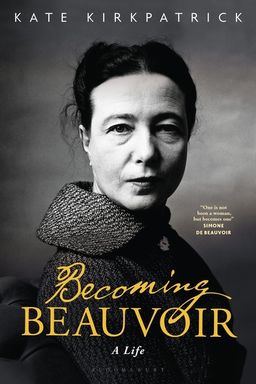
Becoming Beauvoir cover

Becoming Beauvoir

by Kate Kirkpatrick

Becoming Beauvoir offers a fresh perspective on Simone de Beauvoir''s life and philosophy, uncovering her pioneering thoughts on feminism, ethics, and existentialism. Through newly revealed letters and diaries, discover how Beauvoir''s groundbreaking ideas forged her legacy as a feminist icon.

Living Philosophy: Simone de Beauvoir’s Central Claim

How do you live an authentic life when every choice shapes not only who you are but also how others can be free? In the life and writings of Simone de Beauvoir, philosophy and biography are inseparable. Her central thesis, unfolding from her earliest diaries through her late memoirs, is that every action—with its joys, contradictions, and failures—is a philosophical choice. She refuses the divide between thinker and life-liver, turning her existence into a continuous experiment in ethics, freedom, and responsibility.

Philosophy Lived, Not Theorized

From teenage quarrels about love with her father, Georges, to the mature statement that "there is no divorce between philosophy and life," Beauvoir views thinking as something practiced in relationships and revised through experience. Her Sorbonne years (1926–29) show philosophy as autobiography: she tests ideas about devotion, freedom, and authenticity in diaries before publishing essays like Pyrrhus and Cinéas. Knowledge is not abstract—it grows from daily contradictions: the pious soul versus the thinking woman, the dutiful daughter against the free subject.

From Situation to Self-Making

Beauvoir’s dictum that “one is not born, but becomes, a woman” anchors her broader claim that the self is not an essence but a situation: constructed through time, social structures, and choices. Her own girlhood at the Cours Désir reveals how gender identity is taught and enforced. Books such as George Eliot’s The Mill on the Floss and Louisa May Alcott’s Little Women become early laboratories for revolt, modeling women who contest passive femininity. She learns that to live philosophically is to act consciously within the myths that shape you.

Freedom Entangled with Others

Freedom, for Beauvoir, is never solitary. Borrowing from existentialism but correcting Sartre’s abstract autonomy, she insists that your freedom carries moral weight only when it aids the freedom of others. Her mature works—the essays The Ethics of Ambiguity and novels like The Blood of Others—show that freedom without responsibility is hollow. The real challenge is ethical: how to live one’s project without converting others into objects. This moral reciprocity will later shape her theory of love and her lifelong partnerships.

Love, Power, and Ethical Experiment

The so‑called “pact” between Beauvoir and Sartre in 1929—the agreement to be each other’s essential love while allowing contingent loves—translates philosophy into daily risk. It attempts to combine autonomy and devotion but exposes asymmetries of gender and power. Sartre held greater institutional prestige, and their mutual liaisons with younger women revealed unresolved inequalities. For Beauvoir, these scandals were existential laboratories for exploring how ideals of freedom falter under emotional and social constraint (a tension dramatized later in She Came to Stay).

From Personal Crisis to Public Commitment

World War II, Sartre’s imprisonment, and her own ethical disillusion transform Beauvoir into a public intellectual. Out of wartime solitude emerge her first major novels and essays, and with Sartre she launches Les Temps Modernes (1945). Yet fame brings simplification—press and public cast her as Sartre’s disciple rather than as an original thinker. Still, she persists, writing across forms—fiction, travelogue, philosophy, and political reportage—to tie moral reflection to lived injustice.

From Woman to World: Expanding the Lens

Her 1947 trip to the United States marks a methodological turning point. Observing segregation, commercialized femininity, and racial inequality, she realizes that freedom must be analyzed across national and cultural boundaries. Out of these notes grows The Second Sex (1949), a monumental study proving that woman is a historical product of institutions, myths, and economic dependency. The claim “biology is not destiny” becomes a rallying cry for generations of feminists and intellectuals.

Later Works and Last Battles

In her later decades, Beauvoir turns to memoirs to democratize philosophy—rendering her life as a form of invitation to examine one’s own. She mobilizes her fame toward activism: defending Algerian independence, abortion rights, and anti-ageism. In Old Age (1970), she gives ageing the same analytic depth earlier reserved for womanhood, exposing how societies convert natural decline into social exclusion. Until her death in 1986, she refuses honors and celebrity myths, insisting that ethical life is not self-satisfaction but fidelity to freedom and justice.

Core Takeaway

Beauvoir’s story is a philosophical continuum: the lived search for ethical authenticity within the constraints of history, gender, and power. To read her is to accept a challenge: test your ideas in action, revise them in love, and live your philosophy as an unfinished project.


Freedom and Responsibility

Freedom, for Beauvoir, is never given—it’s created through action. In her notebooks, she struggles with the question: if freedom is absolute, how can it be ethical? She ultimately argues that freedom only gains moral depth when exercised in ways that enlarge the possibilities of others. This redefines autonomy as relational: your self‑making is legitimate only if others can still make themselves around you.

From Sartre to Beauvoir’s Correction

While Sartre’s existentialism marks freedom as pure self‑definition, Beauvoir adds context and compassion. She insists existence is situated: historical, embodied, and gendered. A woman under patriarchy or a worker under capitalism faces constraints that complicate free choice. This insight, grounded in her diaries and wartime reflections, leads to The Ethics of Ambiguity (1947). There she defines ethical action as living one’s freedom without denying others’ agency—a principle she dramatizes in fiction through moral dilemmas that demand costly decisions.

Freedom Tested in Crisis

The Second World War places Beauvoir’s ideal to the test. While Sartre is imprisoned and Bost wounded, she navigates scarcity, censorship, and personal loss. The war reveals how easy it is to confuse complicity with survival. Her novels She Came to Stay and The Blood of Others expose ethical contradictions: can you love freely in an occupied world? Can resistance justify sacrifice? Through these questions, Beauvoir transforms philosophy into an account of concrete choice under pressure.

Ambiguity as Moral Compass

Her famous claim that human existence is ambiguous—both free and limited, subject and object—gives ethical life its texture. Moral maturity comes not from purity but from navigating contradiction honestly. For you as a reader, Beauvoir’s ethics invite self‑examination: act, reflect, and remain open to revising yourself. Freedom without empathy is arrogance; empathy without action is surrender.


Becoming a Woman

When Beauvoir writes that "one is not born, but becomes, a woman," she turns a personal revelation into a philosophical revolution. Her early life—caught between intellectual brilliance and social constraint—illustrates how femininity is manufactured through schooling, custom, and narrative. From her Catholic upbringing to the halls of the Sorbonne, she feels herself taught to be both childlike and exemplary, sacred yet secondary. The dissonance becomes her analytic tool: gender is not essence; it is a situation sustained by institutions and myths.

The Making of Situation

Beauvoir’s education at the Cours Désir shows the contradictions of being the ‘clever girl.’ Rewarded for brilliance yet warned against ambition, she experiences the binary logic that makes women anomalies in intellectual spaces. Reading George Eliot and Bergson gives her vocabulary for process and becoming. She begins to link the timeless ‘feminine nature’ preached by religion to historically-specific practices—dress codes, domestic labor, moral instruction—that form a manufactured essence. This insight, made explicit later in The Second Sex, grounds feminist existentialism.

Friendships that Form Philosophy

Her friendship with Zaza Lacoin (who dies under familial pressure to conform) epitomizes the cost of social obedience. Zaza’s tragedy becomes Beauvoir’s lifelong proof that social myths—purity, duty, marriage—can kill individual freedom. By exploring her own adolescence through this loss, Beauvoir exposes how gender expectations are lethal moral systems, not natural facts.

From Personal Struggle to Political Insight

By 1946, Beauvoir plans The Second Sex as an inquiry into myths and institutions that turn women into “the Other.” She draws from anthropology, biology, and literature to argue that culture constructs subordination. Her transition from biography to philosophy, then, reveals method: start from lived contradiction and end with systemic critique. You are invited to read your own “situations” in the same light—to see history in the mirror of private experience.


Love, Power, and Truth

Beauvoir’s famous “pact” with Sartre—essential love plus contingent loves—becomes one of philosophy’s boldest attempts to live freedom honestly. It sought to reconcile passion with autonomy, yet its story reveals recurring asymmetries: institutional inequality, gendered power, and emotional cost. Through this experiment, Beauvoir exposes how ideals of openness often collide with real human frailty.

The Pact and Its Contradictions

Their 1929 agreement, made after passing the agrégation, was radical for its time. They maintained intellectual companionship as primary while allowing secondary liaisons. But perfect honesty proved impossible: they concealed details, rationalized hurts, and left later critics debating whether freedom can exist inside emotional inequality. Beauvoir’s diaries reveal both agency and pain—envy, guilt, and the weight of moral failure.

Sexuality and Ethical Reckoning

Her later scandals—with former students like Olga Kosakiewicz and Bianca Bienenfeld—force confrontation with ethical limits. Teacher–student hierarchies complicate freedom with power. Beauvoir’s reflections on desire thus foreshadow her ethical writings: acts of freedom must be judged by their effects on others’ autonomy. The Sorokine complaint of 1941 and her dismissal under Vichy expose how moral and legal standards intertwine with gender politics.

Ethics of Reciprocity

By midlife, Beauvoir refines love as reciprocal generosity rather than fusion or dominance. Her relationships with Nelson Algren and Claude Lanzmann test this belief: both men want stability; she seeks fidelity to vocation. The resulting heartbreaks lead her to recognize that freedom is meaningful only when balanced with care. Love, she concludes, is an ethical art—seeing another as a subject who opens your world, not as a mirror of yourself.


Witness, History, and Activism

Beauvoir translates existential ethics into activism by insisting that thought must act in history. Her postwar years at Les Temps Modernes see a transition from philosophical reflection to direct political engagement—defending Algerian rebels, advocating for reproductive rights, and confronting the structures of law and media that perpetuate oppression.

Algeria and Moral Courage

As France conducts brutal suppression in Algeria, Beauvoir and Sartre use their journal and public essays to condemn torture and racism. Her role in defending Djamila Boupacha—a young woman tortured by French forces—demonstrates how writing can be legal intervention. For Beauvoir, witnessing is moral obligation: to name injustice is part of living ethically.

Feminism in Action

Her activism for contraception and abortion brings private suffering into public discourse. She helps launch the Manifesto of the 343 (1971), where French women publicly declared illegal abortions, and supports the 1972 Bobigny trial that changes French law. Her methods—collective visibility, naming shame aloud—extend the existential task of truth-telling into civic space. Freedom, now, is political practice.

The Broader Vision

Beauvoir’s politics link every earlier insight—situation, reciprocity, ambiguity—to law and collective action. By combining personal testimony with civic courage, she demonstrates that philosophy can be militant compassion. You see in her example how words and choices can build the conditions for others to live freely.


Memoir, Mortality, and Legacy

In her final decades, Beauvoir transforms autobiography into a moral instrument. Works like Memoirs of a Dutiful Daughter, The Prime of Life, and Old Age reframe self-narration as shared inquiry: how to remain responsible to truth, to love, and to one’s readers. By choosing the memoir form, she translates abstract philosophy into human texture—turning theory into empathy and testimony.

Writing as Redemption

The memoirs are not confessions but acts of interpretation. They show her selective silences—omitting some affairs, minimizing scandal—to protect others and manage her public image. Yet they also democratize existential inquiry. Ordinary women read her life and recognize themselves. Letters pour in, making her a surrogate confidant for readers questioning duty, marriage, and choice.

Ageing and Ethical Visibility

In Old Age (1970), Beauvoir extends her philosophy to the final stage of life, arguing that ageing is not biological loss but social marginalization. She shows how Western societies erase the elderly, particularly women, converting decline into invisibility. To combat this, she calls for solidarity across generations: to treat age as another lived situation demanding justice.

Final Years and Continuing Relevance

After Sartre’s death in 1980, Beauvoir writes Adieux, a searing farewell blending love with anger at mortality. She refuses honors like the Legion of Honour, preferring integrity to recognition. When she dies in 1986, obituaries still call her Sartre’s companion, yet the archives—letters, notebooks, philosophical essays—prove otherwise: she built one of the twentieth century’s most profound bridges between thought and life. To follow her legacy is to make thinking itself an ethic of engagement.

Dig Deeper

Get personalized prompts to apply these lessons to your life and deepen your understanding.

Go Deeper

Get the Full Experience

Download Insight Books for AI-powered reflections, quizzes, and more.