
Idea 1
The Beautiful Game as Economic Laboratory
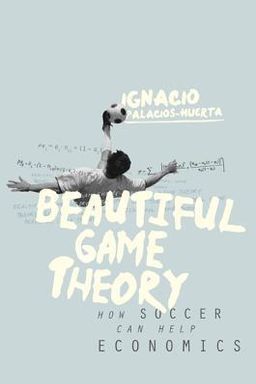
What if the key to understanding human behavior in markets, politics, or society could be found not in a lab or a financial exchange, but on a soccer field? In Beautiful Game Theory: How Soccer Can Help Economics, economist Ignacio Palacios-Huerta argues that the world’s most watched sport is more than spectacle—it’s a laboratory of human decision-making. Just as Galileo used falling stones and Newton used apples to test theories of physics, Palacios-Huerta uses soccer to test ideas in economics and game theory.
He flips the usual relationship between economics and sports: instead of asking what economics can do for soccer, he asks what soccer can do for economics. The sport’s abundance of data, competitive incentives, and clearly defined outcomes create a rare natural experiment where abstract theories about strategy, fairness, pressure, emotion, and discrimination can be observed in real time. Through penalty kicks, referee decisions, betting markets, and even fan behavior, Palacios-Huerta reveals the deep economic logic hidden inside the world’s game.
Soccer as a Testing Ground for Game Theory
At its core, this book demonstrates how game theory—the study of strategic interaction between rational actors—can be validated in real-life situations. In soccer, each penalty kick, referee call, and team lineup involves measurable, high-stakes decisions. Palacios-Huerta’s research verifies long-unproven theorems, such as John von Neumann’s minimax theorem, using thousands of professional penalty kicks across major European leagues. Where decades of lab-based experiments failed to perfectly replicate human unpredictability, soccer players on the field naturally do.
The book also shows how the strategies used by players mirror the equations of economists. When a kicker randomizes between aiming left or right to keep the goalkeeper guessing, they are unconsciously performing the same equilibrium reasoning that earns PhDs their tenure. Yet these patterns aren’t learned in a classroom—they evolve through experience, competition, and stakes. Soccer, Palacios-Huerta suggests, is where Homo economicus trains without knowing it.
From the Field to the Laboratory and Back
After documenting game-theoretic perfection on the field, Palacios-Huerta brings the same professionals into laboratory settings to see whether their strategic rationality holds under controlled conditions. It does. The same players who make instantaneous decisions on the pitch perform with statistical consistency against theoretical predictions when faced with experimental games. This not only reaffirms the validity of lab studies but also suggests that professional training can sharpen human rationality—an idea that bridges economics with neuroscience and psychology.
The subsequent chapters expand beyond strategy. Halftime betting markets test market efficiency. Referees’ injury-time decisions explore corruption driven by social pressure. The introduction of the three-point rule for wins enables a study of incentives and sabotage. The brains of players making random decisions are scanned in MRI machines to map strategy in neural circuits. Each chapter translates a topic central to economics—efficiency, incentives, fairness, discrimination—into soccer’s language of kicks, calls, and competitions.
Why It Matters: Humanity in Motion
Palacios-Huerta’s central argument is that economics, often accused of abstraction, gains empirical power by studying the emotional, strategic, and social reality of sports. Soccer’s simplicity—two teams pursuing one goal under transparent rules—lets economists observe how rational and irrational forces coexist. It reveals how people respond under pressure, when to trust markets, and how fairness can emerge (or fail) amid competition.
By reading this book, you learn how elite players unknowingly embody optimal strategies and how real-world biases—social pressure, fear, discrimination—distort rational behavior. Soccer’s global popularity makes it a universal mirror for human decision-making. Whether you’re a fan, economist, or leader, Palacios-Huerta’s message is the same: to understand how people play life’s biggest games, look closely at how they play the beautiful game.