
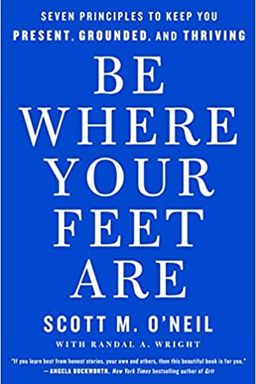
Be Where Your Feet Are cover

Be Where Your Feet Are

by Scott O''Neil

Be Where Your Feet Are offers transformative insights from Scott O''Neil, a leading sports executive, on living a richer life. Learn to be present, embrace failure, focus on priorities, and foster teamwork through engaging stories and practical advice.

Be Where Your Feet Are: Living with Presence, Purpose, and Teamwork

How often do you find yourself racing through life, half-present in the moment while already worrying about the next meeting, next email, or next milestone? In Be Where Your Feet Are, sports executive Scott M. O’Neil argues that the antidote to modern restlessness and distraction lies in learning to be truly present — to root yourself where you stand, even amid chaos.

Drawing from his career leading professional sports organizations like the NBA’s Philadelphia 76ers and New Jersey Devils, O’Neil contends that success, meaning, and emotional resilience come not from chasing constant balance, but from deliberately grounding yourself in the moment. He shows that leadership, family, faith, and teamwork all thrive when you learn to stop sprinting ahead and instead plant both feet — and your full attention — firmly in the present.

The Problem of Perpetual Distraction

O’Neil begins with the reality we all feel: our world rewards speed and overconnection. Between 24/7 news cycles, endless emails, and social media’s constant pull, most of us live tense, distracted, and fragmented lives. As he puts it, people curate their lives for likes rather than living authentically. He calls out the myth of work-life balance as a flawed pursuit — not because balance is undesirable, but because it’s impossible in a world that never stops moving. The better question is not “how do I balance?” but “how do I stay grounded and fully engaged wherever I am?”

Presence as a Leadership and Life Strategy

O’Neil’s central argument is that being where your feet are — fully present both at home and at work — transforms the way you lead, love, and live. When you’re buried in your phone during dinner, multitasking through conversations, or obsessing over past mistakes, you shortchange the people around you. Presence, by contrast, creates connection, empathy, and performance. The principle applies equally to the boardroom and the living room.

He demonstrates this through deeply personal and professional stories: losing his dream job at Madison Square Garden and rediscovering purpose through stillness; rebuilding teams by cultivating culture rather than control; and turning pain, loss, and failure into wisdom. O’Neil insists that presence isn’t passivity — it’s an active discipline that fuels resilience and focus when life turns unpredictable.

Grounding Principles That Shape a Meaningful Life

Across seven chapters, O’Neil builds his philosophy through what he calls “grounding principles,” lessons drawn from his experiences in leadership, family, and faith. Each principle serves as both a story and a challenge: to change your perspective, act with integrity, assume positive intent, and trust long-term growth. The ideas combine the urgency of a business playbook with the humility and vulnerability of a spiritual memoir.

  • In “Change the Race,” he shows how hardship, grief, and even depression can become engines for renewal if you confront — rather than flee — life’s storms.
  • In “Fail Forward,” he argues that every failure, from early career rejections to losing multimillion-dollar opportunities, becomes a lesson that builds character if you choose reflection over shame.
  • “Be the Purple Water Buffalo” transforms a viral wildlife video into a metaphor for teamwork, courage, and loyalty — a rallying cry for work cultures rooted in trust.
  • “Assume Positive Intent” explores empathy as the secret to stronger relationships and inclusive leadership, encouraging readers to approach others with curiosity, not judgment.
  • And “Trust the Process,” famous from his 76ers leadership, becomes a universal metaphor for patience, perseverance, and faith during uncertainty.

Why This Matters Now

O’Neil’s book blends business wisdom with heartfelt storytelling, showing that personal and professional leadership are inseparable. In an era of burnout, polarization, and surface-level communication, Be Where Your Feet Are offers a refreshing reminder that the core of success — whether in sports, business, or family — isn’t speed or status but connection, service, and purpose. Instead of chasing the next big thing, O’Neil invites you to slow down, pick up the proverbial paper on the floor, and make the space around you better right now.

Grounding Principle: “How you live is a choice. What you do and who you choose to do it with are the levers of a well-lived life.” This, O’Neil says, is what it truly means to be where your feet are.


Run Toward the Storm: Change the Race

What do you do when life hits you with grief, failure, or loss? O’Neil’s principle of “changing the race” teaches that when you face hardship, you can’t outrun the storm—you have to run toward it. This chapter explores resilience through emotional honesty and connection, built around O’Neil’s own journey through personal loss and depression following the suicide of his close friend Wil Cardon.

Facing Grief and Choosing Life

When his best friend Wil took his own life, O’Neil was devastated. He describes his paralysis in the aftermath—unable to feel joy, burdened by guilt, and drowning in sadness. Speaking at Wil’s funeral, in the presence of religious leaders and family, forced him to confront his emotions fully. The experience became a turning point: acknowledging pain and vulnerability openly is the first step toward healing.

Isolation Is Kryptonite

Through conversations with others who had suffered loss, O’Neil discovered that isolation is “today’s kryptonite.” Healing requires connection—with family, colleagues, community, and faith. This resonates with the work of psychologists like Brené Brown, who emphasize vulnerability as strength. When O’Neil began to open up, he found light returning gradually, “like a dimmer switch brightening over time.”

Resilience Through Action

He illustrates “running toward the storm” with stories of colleagues like Lara Toscani Weems, who faced her son’s life-threatening liver disease with courage. Instead of retreating into despair, she confronted uncertainty directly, choosing faith and purpose. Similarly, O’Neil recalls being fired from his Madison Square Garden role as another storm he had to face head-on: decompressing, reflecting, then rebuilding his career with deeper purpose at the 76ers. These moments show resilience not as toughness but as truthful surrender to reality, followed by action.

Grounding Principle: Don’t run away from pain—walk straight into it, with company. Only when you face the fire can you find clarity and compassion.


Fail Forward: Lessons from Falling

Failure, O’Neil insists, is not an obstacle but the gateway to growth. Drawing from formative setbacks—from college rejections to being fired from high-profile roles—he argues that success is built not on a string of wins but on your ability to fail forward. Failure refines self-awareness, humility, and adaptability — qualities far more enduring than a résumé line.

The Chip on the Shoulder

After being rejected from six of eight universities, including his dreams of Notre Dame and Georgetown, O’Neil learned early that failure stings — but it also motivates. At Villanova, he became obsessed with proving he was “smart enough.” Over time, that insecurity evolved into a genuine love of learning. The lesson: when setbacks fuel curiosity instead of resentment, they become stepping-stones to mastery.

Being Effective Is More Important Than Being Right

At the NBA, O’Neil’s early arrogance nearly derailed his career. A mentor, Jeff Robinson, challenged him to stop blaming others and start building relationships across departments. Being effective meant empathy, not ego—a principle mirrored in Dale Carnegie’s timeless advice: “Win people to your way of thinking by first seeing things their way.” O’Neil learned that influence grows not from control but connection.

Ego as the Great Deal Killer

The most haunting lesson came from his father’s downfall: a successful entrepreneur destroyed by pride, unable to compromise with a business partner. O’Neil saw firsthand that ego, not incompetence, kills more careers than failure ever could. His father’s story—and O’Neil’s own public firing—cemented the importance of humility. As he puts it, “Ego is the great deal killer,” in business, marriage, and leadership alike.

Grounding Principle: Failures are not endings but invitations—opportunities to re-center on growth, humility, and emotional honesty.


WMI: Keep What’s Most Important Main

O’Neil’s third principle, WMI—short for What’s Most Important—offers a compass for focus and meaning. Borrowed from NBA legend Stephen Covey’s maxim, “the main thing is to keep the main thing the main thing,” it’s a reminder that prioritization defines leadership. In a world of endless opportunity, clarity is power.

Faith, Family, and Service as Anchors

O’Neil’s WMI hierarchy shapes every decision: family, faith, and work—in that order. His decision to skip a Knicks-76ers game to attend his daughter’s play illustrates that building a life on present moments wins out over professional optics. Similarly, his conversion to the Church of Jesus Christ of Latter-day Saints at 47 shows that WMI evolves; faith became his grounding after decades of seeking meaning through achievement.

Examples of Living the Hierarchy

From NFL broadcaster Vai Sikahema’s parents selling their home siding to honor religious vows, to niece McCall’s survival through brain surgery, O’Neil uses vivid examples to show WMI in motion. In each case, the throughline is sacrifice—placing love, faith, or community above comfort. “You can’t do everything,” he writes, “so you better do the right things.”

Legacy of Leadership Through WMI

His friend Rahim Thompson, founder of Philadelphia’s Chosen League, exemplifies WMI through mentorship. Despite growing up homeless and deaf in one ear, Rahim focused his life on creating opportunities for youth. His north star—helping others—demonstrates that WMI is scalable: the same principle that guides family life can also transform cities and industries.

Grounding Principle: Clarity beats complexity. Define what matters, build routines around it, and cut what doesn’t serve it.


Be the Purple Water Buffalo

One of O’Neil’s most memorable metaphors—and perhaps the book’s beating heart—is the call to “Be the Purple Water Buffalo.” Inspired by a viral wildlife video, this principle reframes teamwork and community as acts of courage, loyalty, and shared responsibility. Whether in business, family, or crisis, success depends on moving forward together.

The Water Buffalo Metaphor

In the viral “Battle at Kruger” video, a herd of water buffalo rescues a young calf from lions and crocodiles by returning as a united front. O’Neil used the video to challenge staff at Madison Square Garden: “Who do you want to be—the tourist, the lion, the crocodile, or the water buffalo?” The tourist observes but never acts; the lion preys on weakness; the crocodile takes cheap shots. Only the water buffalo unites to protect its own. That became the company’s rallying cry and culture code.

Building Culture Through Symbolism

Employees who demonstrated extraordinary teamwork received buffalo nickels—small tokens of appreciation taped to their desks. The gesture created an ecosystem of recognition, shifting pride from individual success to collective contribution. O’Neil’s mantra for success—“Work unreasonably hard, be intellectually curious, and be an extraordinary teammate”—captures his belief that culture isn’t built by slogans but by visible gratitude.

Carrying It Into Life

O’Neil extends this lesson beyond the office to stories of solidarity: Sunny Sanyal and friends pooling scholarships to study in the U.S.; healthcare workers uniting during COVID; his brother Michael founding GetWellNetwork after surviving stomach cancer. Each example reveals a truth: when we choose “we over me,” we not only save the calf—we elevate the herd.

Grounding Principle: True leadership is collective courage—the daily decision to show up for your team, even when it’s hard.


Assume Positive Intent

In a world of quick judgment and digital outrage, O’Neil offers a radical mindset shift: assume positive intent. API means approaching others—at work and in life—with the assumption that their motives are good until proven otherwise. It is empathy in action, and it transforms relationships, culture, and communities.

Rewiring Reactions

When someone cuts you off in traffic, sends a curt email, or forgets a deadline, your instinct might be to assume laziness or hostility. API flips that instinct: maybe they’re overwhelmed, distracted, or hurting. Drawing from Indra Nooyi’s famed leadership philosophy (“Assume positive intent”), O’Neil expands the idea to all relationships. It’s not naivety—it’s discipline.

Stories of Empathy and Transformation

He illustrates API through moving stories: a Saudi prince challenging racial bias through art; adopted executive Jill Snodgrass reframing “abandonment” into gratitude for a birth mother’s courage; and a police chief in Camden, New Jersey rebuilding trust with citizens through community policing and free ice cream. Each story shows that assuming positive intent builds bridges faster than argument ever could.

Kindness as Strategy

O’Neil’s father’s advice—“Everybody’s having a tough day”—anchors this principle. Every interaction is a chance to choose generosity over suspicion. At home, API defuses family tension (“She didn’t steal your shirt—she needed it”). In leadership, it transforms mistakes into growth moments. Over time, this mindset turns organizations into communities and friction into trust.

Grounding Principle: When in doubt, choose curiosity over cynicism—your compassion might be the thing that changes someone’s story.


Trust the Process

O’Neil’s final principle, drawn from his Philadelphia 76ers years, transcends sports into a life philosophy: Trust the Process. In a culture fixated on instant success, it’s a call for patience—believing in long-term growth even when progress is invisible or painful.

From Losing Seasons to Lasting Legacy

“Trust the Process” began as a joke from a player but became a franchise’s battle cry during years of rebuilding. Fans mocked it. Critics derided it. Yet behind the slogan lay profound truth: sustainable greatness requires short-term sacrifice. O’Neil connects this to personal growth—you can’t skip the hard years. Like a team’s rebuild, transformation happens in unseen, unglamorous work.

Patience, Purpose, and People

O’Neil links the concept to mentors like NBA commissioner David Stern, who invested decades turning basketball global. Or Howie Roseman, NFL general manager, who bounced back from a demotion to eventually construct a Super Bowl–winning team—proving that trusting the process means investing in continual learning, not clinging to status.

Small Steps, Big Vision

Filmmaker M. Night Shyamalan’s story of rebuilding his broken confidence—one movie scene at a time, like solving a jigsaw puzzle—embodies this principle creatively. And psychologist Karyn Gordon’s journey from being told she’d never finish high school to earning a Ph.D. captures it academically. In both, incremental mastery becomes redemption.

Grounding Principle: Lasting greatness—on a team, in a career, or in a life—is built one intentional, disciplined act at a time. Trust small progress; the scoreboard will come.

Dig Deeper

Get personalized prompts to apply these lessons to your life and deepen your understanding.

Go Deeper

Get the Full Experience

Download Insight Books for AI-powered reflections, quizzes, and more.