
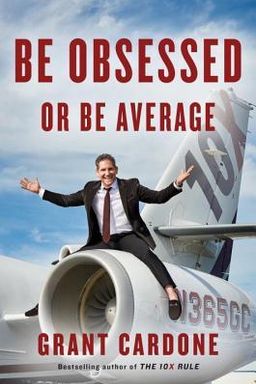
Be Obsessed or Be Average cover

Be Obsessed or Be Average

by Grant Cardone

In ''Be Obsessed or Be Average,'' Grant Cardone reveals how obsession is the secret to achieving extraordinary success. By transforming fear into fuel and setting audacious goals, you can unlock unparalleled energy, motivation, and balance. This book offers a blueprint for those who refuse to settle for mediocrity and are ready to reach their fullest potential.

Be Obsessed or Be Average: Turning Obsession into Power

What happens when the world tells you you're too intense, too driven, or too obsessed with success? In Be Obsessed or Be Average, Grant Cardone argues that obsession isn’t a flaw — it’s a superpower. The people who build empires, disrupt industries, and leave legacies aren’t balanced or moderate. They’re consumed by their passions. Cardone’s central message is disarmingly simple: in any area of life, you have two choices — be obsessed, or be average. There is no middle ground.

Cardone’s book builds on the foundation he introduced in The 10X Rule. There, he discussed the need to set goals ten times larger than you think possible and take ten times the action. But after readers of that book told him they were struggling to maintain intensity, Cardone realized they were missing one critical ingredient: a mindset of obsession. You can only sustain a 10X life, he writes, if you’re unapologetically consumed by your mission. Obsession, not balance, fuels extraordinary achievement.

The Power of Embracing Your Inner Obsessive

Cardone begins by recounting his own transformation from a drug-addicted young man to a self-made multimillionaire. After hitting rock bottom — beaten, broke, and directionless — he realized that denying his obsessive personality had ruined him. Instead of trying to kill his intensity, he redirected it into mastering sales, learning business, and building wealth. His obsession became his lifeline. “Obsession saved my life,” he says, “and it will save yours.”

By reframing obsession as a gift rather than an illness, Cardone challenges a culture that glorifies moderation. Society tells us to be patient, balanced, and satisfied with “good enough.” But, he insists, those rules were written by average people. Greatness requires single-minded focus. Bill Gates, Steve Jobs, Oprah Winfrey, and Muhammad Ali—none of them were “reasonable.” Like the great achievers he names, Cardone insists that to achieve an exceptional life, you must think and act unreasonably.

The Obsession Formula: From Purpose to Domination

The book functions as both a motivational manifesto and a practical system for channeling your energy. Cardone divides the path to productive obsession into several key disciplines:

  • Find What to Be Obsessed With: Identify your true purpose by writing down your goals every morning and night. Ask yourself questions like, “What would I do if I couldn’t fail?” and “What gives me energy?”
  • Feed the Beast and Starve the Doubt: Focus your energy on everything that drives your goals and ruthlessly eliminate distractions, self-doubt, and negative influences.
  • Dominate to Win: Take full control of your time, money, and brand. Don’t just compete — dominate your industry so fully that there’s no alternative to you.
  • Build an Obsessed Team: Surround yourself with people as driven as you are. “You can’t be the only maniac,” he jokes. Obsession must be the culture.
  • Practice Obsession Forever: Sustain your fire through constant learning, mentoring up, giving back, and continuously expanding your goals.

Each chapter is woven with practical advice (“You can’t grow a business without hiring people who share your obsession”) and memorable slogans that could hang on an office wall. Cardone’s voice is aggressive but infectious; he wants you to stop apologizing for your ambition and double down on it. Being normal, he warns, is far riskier than being extreme.

Why This Mindset Matters Now

Cardone’s message hits home in an era when “hustle culture” is both celebrated and criticized. He acknowledges that obsession is a double-edged sword—it can destroy you if misdirected—but insists the problem isn’t obsession itself, it’s what we obsess over. Drugs, gossip, and Netflix are obsessions too; they just don’t produce greatness. Learning to choose worthy obsessions and feed them with purpose turns an addictive tendency into a productive force.

At a deeper level, Be Obsessed or Be Average is about reclaiming control of your life. Modern culture, Cardone says, makes people spectators. We’re distracted by social media, numbed by entertainment, and paralyzed by fear of failure. Obsession cuts through the noise. When you have a massive goal and give it everything, doubts vanish. Purpose becomes your ultimate antidepressant.

By the end of the book, Cardone has dismantled the myth of balance and replaced it with the credo of total engagement. Whether you’re an entrepreneur, artist, or athlete, he argues, success is not about seeking comfort or moderation—it’s about living with relentless intensity, using obsession as the engine that drives you to create, contribute, and dominate in your chosen field. As he puts it, the obsessed “don't just make the world go around—they make the world worth living in.”


Obsession Is Your Only Option

Cardone opens the book by declaring war on mediocrity. You can live one of two ways, he says: obsessed or average. Anything in between—balanced, patient, moderate—is just disguised failure. This chapter directly attacks the cultural epidemic of “average thinking,” where people settle for comfort and call it happiness. For Cardone, complacency is a disease holding millions hostage.

Rejecting the Myth of Balance

Society’s moral code praises moderation: work steady hours, don’t stand out too much, be happy with what you have. But Cardone flips this script. “Average people think balance is success,” he writes, “but balance is compromise in disguise.” True freedom lies in full engagement. When you pursue something with total passion, life doesn’t need balancing—it becomes electrified by purpose.

One of Cardone’s examples is the middle class itself, which he calls a “trap disguised as safety.” Most Americans, he notes, live paycheck to paycheck, carry massive debt, and spend their lives “trying to look successful instead of being successful.” Their problem isn’t lack of opportunity, but lack of obsession. They aim too small and soothe themselves with clichés like “Money isn’t everything.”

The Case Against Average

Using data from sources such as Gallup and Forbes, Cardone shows that over two-thirds of workers are disengaged at their jobs. He calls this the “epidemic of average,” a global illness of low expectations and aimless existence. The cure, he argues, is to embrace your intense desires rather than dull them.

He points to visionaries like Martin Luther King Jr., Steve Jobs, and Muhammad Ali—all of whom were labeled unreasonable or fanatical. Their success came not from fitting in, but from doubling down on their uniqueness. “You’re not in trouble because you’re obsessed,” he reminds readers. “You’re in trouble because you’re not.”

The Responsibility to Want It All

For Cardone, it’s not selfish to want wealth, power, freedom, love, and impact—it’s moral. He quotes his uncle Vince: “If you can, you must.” To deny your potential is to waste the gift of your existence. He urges readers to stop apologizing for ambition. Desire, when aligned with purpose, is sacred fuel.

Ultimately, Cardone’s call is existential as much as economic. You were meant to contribute, create, and expand. Obsession is your natural state—the child’s curiosity, the artist’s muse, the entrepreneur’s fire. The tragedy of modern life, he argues, is that we’ve learned to suppress it. His first challenge to the reader is simple but radical: instead of labeling your intensity as a flaw, call it your greatest asset and start using it to build something extraordinary.


Find a Purpose Worth Obsessing Over

Once you accept that obsession is essential, the next question is: what should you obsess about? In Chapter 3, “What to Be Obsessed With,” Cardone guides readers to uncover their life’s purpose and transform it into relentless focus. He argues that you don’t have to love what you do to become obsessed with it—you just need to find meaning in it.

Purpose vs. Passion

Cardone differentiates between passion and purpose. Passion is emotional; purpose is directional. Passion comes and goes, but purpose endures. He illustrates this with a story about his father, who worked tirelessly at mundane tasks because he was obsessed with providing for his family. When young Grant asked if he enjoyed picking up trash in the yard, his father replied, “You don’t always have to like what you do to love what you do.”

Questions to Unlock Your Why

Cardone includes a powerful self-inquiry exercise containing dozens of questions across categories like personal interests, money motivation, skills, legacy, and lifestyle. For example: “What can I do better than anyone else?” “If I couldn’t fail, what would I do?” “What do I want to be remembered for?”

He instructs readers to answer these daily and without judgment. Repetition is critical: “Your purpose will evolve as you do,” he explains. This daily reflection reconnects you to your obsessions and prevents you from drifting through life without direction.

The Daily Goal Practice

Cardone’s signature tool for staying obsessed is writing down your goals every morning and night as if they’ve already happened. He avoids “I want” language, using present tense instead: “I have 4,000 apartments,” not “I want to own apartments.” When he began this practice in his twenties, he was broke, addicted, and directionless. Five years later, he owned multiple businesses.

(This exercise echoes Napoleon Hill’s autosuggestion from Think and Grow Rich, where consistent mental repetition transforms belief into reality.)

To Cardone, obsession isn’t mystical—it’s practical neuroscience. What you focus on expands. Writing your goals daily keeps your mind feeding on purpose rather than fear. “Purpose,” he declares, “keeps me from wandering Earth without direction.”


Feed the Beast, Starve the Doubt

Cardone devotes two central chapters to the twin disciplines of obsession: feeding the right things and starving the wrong ones. “What you pay attention to grows,” he writes, “and what you ignore dies.”

Feeding Your Productive Obsessions

Feeding the beast means giving energy, resources, and focus only to activities that move you closer to your goals. For Cardone, that includes daily sales training, leadership meetings, family time, and financial management. Anything that doesn’t feed your growth—gossip, negativity, fear—must be starved out.

He writes of establishing a company culture obsessed with success: daily meetings, motivational mottos on the walls, hourly progress updates. When everyone in your circle feeds the same beast, mediocrity has nowhere to hide.

Starving Doubt and Handling Haters

Doubt, Cardone warns in Chapter 5, is “the most dangerous form of mental terrorism.” His life nearly derailed when counselors told him he was powerless and destined to fail. He reclaimed control by rejecting those limiting narratives. From that moment on, he refused to associate with naysayers — even family members — who undermined his confidence.

He offers practical tactics for starving doubt: cut exposure to negative media, spend time only with achievers, and measure your life by effort, not excuses. When haters attack you, use them as free publicity: “Love me or hate me—at least you know me.” Obsession thrives under opposition because it confirms you’re doing something that matters.

Destroying Myths About Burnout and Balance

Cardone reverses conventional wisdom about burnout, vacations, and work-life balance. Burnout, he claims, happens not from overworking but from underpurposing. When you lose sight of your goals, your energy fades. The cure isn’t rest—it’s recommitment. Likewise, balance is a myth for those chasing greatness. “Obsessed people don’t choose between money and family,” he argues. “They demand both.” By feeding purpose and starving hesitation, you convert worry into relentless forward motion.


Dominate Every Area of Your Life

“If you can’t dominate yourself,” Cardone insists, “you’ll never dominate your market.” Obsession without control is chaos, so he teaches readers to channel their intensity strategically. Chapter 6, “Dominate to Win,” lays out a life philosophy where leadership begins internally and extends outward to money, time, and brand.

Mastering Self-Control

The first battlefield is your own behavior. Following a quasi-military approach, Cardone advocates discipline in every domain: rising early, dressing sharply, keeping promises, tracking performance hourly. “There is no domination without discipline,” he writes. You can’t inspire others unless you embody the standard yourself.

Taking Command of Time and Money

Time is your most valuable asset, yet most people treat it casually. Cardone’s antidote is rigorous scheduling—eliminating idle time (“If you want to meet the devil, leave white space on your calendar”). He and his wife Elena intertwine their marriage and business lives to maximize efficiency, proving love and ambition can coexist when both serve a unified mission.

Money receives equal focus. Cardone debunks the myth that “money isn’t everything,” calling it “oxygen for your dreams.” To dominate financially, he recommends controlling spending, expanding top-line revenue, and eliminating scarcity thinking. “Your battle cry,” he says, “should be, ‘Who’s got my money?’”

Owning Your Space and Brand

Finally, Cardone teaches that domination must become visible. He describes flooding social media with relentless content until he became “the Godfather of Sales.” His advice mirrors Gary Vaynerchuk’s in Crush It!: overcommunicate, outwork, and outpost your competition. “You can’t fill the ocean,” he says, “but throw enough rocks and people will see the waves.” To dominate is not arrogance—it’s leadership through example. When you show up endlessly, others follow your current.


Build an Obsessed Team and Culture

After mastering personal domination, Cardone turns outward: you can’t scale obsession alone. In Chapter 10, he dismantles the “one-man business” myth and demonstrates that exponential growth requires building an equally obsessed team. “You can’t be the only maniac,” he laughs—success demands an army of maniacs.

The Dangers of Staying Small

Cardone confesses that for ten years, he resisted hiring because he feared costs and mismanagement. The result? Burnout and stagnation. His turning point came when he realized every solo entrepreneur earns an average of only $44,000 per year. “That’s not freedom—that’s torture,” he writes. Scaling demands delegation.

Recruiting True Believers

Obsessed companies, Cardone argues, recruit like evangelists. He recounts billionaire Larry Van Tuyl greeting strangers with, “I want you to come work for me!” To attract such talent, leaders must radiate purpose and make their workplace a magnet. The best hires aren’t chasing a paycheck—they’re chasing opportunity. “Hire people who want to make money and make a difference,” he says.

Creating the Culture

Once you’ve found your team, indoctrinate them into an obsessed culture: daily meetings, motivational texts, visible success metrics, and clear standards. Cardone insists that work environments should reflect the leader’s personality. In his office, sticky notes are banned (“An $80,000 client doesn’t go on a yellow square!”). Uniforms, energy, and rituals all communicate excellence.

The key takeaway: culture beats management. Reward performance, not tenure; value initiative over permission; and be unafraid of turnover. “You’ll wreck your business not by losing people,” Cardone warns, “but by stopping recruiting.” Like professional sports teams, obsessed organizations must constantly scout, train, and replace players in pursuit of victory.


Persistence: The Final Ingredient of Obsession

In Chapter 12, “Obsessed with Persistence,” Cardone argues that persistence is obsession’s twin flame. Talent fades, markets shift, but persistence—the refusal to quit when others surrender—is what separates legends from the forgotten.

Stories of Relentless Endurance

Cardone reinforces his argument with examples: Walt Disney rejected 302 times, Stephen King’s Carrie tossed in the trash, Oprah fired from her first TV job. They persisted until “the miracle happened.” Cardone’s own “miracle moment” came in Houston when, desperate for direction, he saw a car with a Utah license plate and took it as a sign to fly to Salt Lake City. That leap sparked two of his most successful business deals. “Most people quit right before the miracle,” he writes. “The obsessed refuse to.”

Breaking the Perfection Trap

Cardone despises perfectionism, calling it “a fancy name for fear.” He wrote his first book, Sell or Be Sold, in three hours—complete with spelling errors—and sold thousands before revising. His mantra: “Get it done, then get it right.” Excellence grows from action, not hesitation. Quantity creates quality.

Turning Pain into Power

Persistence, he concludes, is less about toughness than purpose. When your goal matters deeply, quitting becomes unthinkable. “Stick and stay—it’s bound to pay,” his mother used to say. In a world quick to comfort failure, Cardone demands a harder truth: success belongs to those who persist when quitting feels smart. Obsession ensures you never stop showing up until the world has no choice but to take notice.

Dig Deeper

Get personalized prompts to apply these lessons to your life and deepen your understanding.

Go Deeper

Get the Full Experience

Download Insight Books for AI-powered reflections, quizzes, and more.