
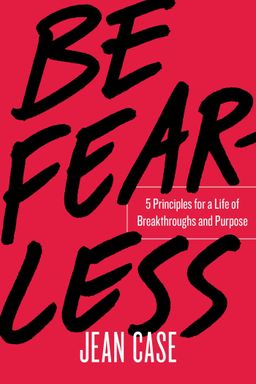
Be Fearless cover

Be Fearless

by Jean Case

In ''Be Fearless,'' Jean Case reveals five key principles that empower you to break through barriers and achieve a life of purpose. Through inspiring stories and practical insights, learn how to embrace audacity, learn from failures, and take bold actions that lead to meaningful change.

A Fearless Blueprint for Change and Purpose

What would you do if you weren’t afraid? It’s a deceptively simple question that Jean Case believes can change your life—and perhaps the world. In Be Fearless: 5 Principles for a Life of Breakthroughs and Purpose, Case argues that the people who achieve extraordinary things aren’t born more courageous or gifted than the rest of us—they simply act fearlessly in the face of uncertainty. Through stories of innovators, entrepreneurs, activists, and everyday changemakers, she insists that fearlessness is not the absence of fear but a learned response—a decision to move forward despite it.

Case contends that living fearlessly requires five specific principles: Make a Big Bet, Be Bold and Take Risks, Make Failure Matter, Reach Beyond Your Bubble, and Let Urgency Conquer Fear. These guiding ideas emerged from research by the Case Foundation into how great breakthroughs happen—whether in business, science, social causes, or art. Her thesis is that fearlessness is both a mindset and a process that anyone can adopt to break through limitations and lead a life of meaningful impact.

A Call to Leave Comfort Behind

The book opens with the reminder that transformative change doesn’t come from the comfort zone. Drawing on her own career—from growing up in working-class Normal, Illinois, to becoming a senior executive at AOL and later CEO of the Case Foundation—Case shares how every pivotal moment required her to take uncomfortable leaps. Fearlessness, she argues, is cultivated by leaning into discomfort and learning to see risk as research and development, not a dangerous gamble. Innovation, philanthropy, and personal growth all rely on the courage to experiment, fail, and adjust.

Her philosophy echoes thinkers like Brené Brown (Daring Greatly), who reframes vulnerability as strength, and Peter Drucker’s insistence that progress demands risk and purpose. Case extends these ideas into a practical model anyone can practice through everyday decisions, from business ventures to acts of compassion. Fearlessness isn’t reserved for adventurers or CEOs—it’s for anyone willing to take the first step.

The Five Principles That Fuel Breakthroughs

Case’s five principles form the scaffolding for fearless living. “Make a Big Bet” means aiming for audacious goals rather than incremental improvements—taking a page from President Kennedy’s moonshot challenge or Elon Musk’s dream to reach Mars. “Be Bold, Take Risks” encourages people to experiment constantly, like Einstein testing theories or entrepreneurs testing ideas. “Make Failure Matter” transforms mistakes into opportunities to learn and pivot. “Reach Beyond Your Bubble” emphasizes diversity and collaboration as the source of new thinking. Finally, “Let Urgency Conquer Fear” pushes action over paralysis—don’t overthink, just move with purpose.

Each principle comes alive through powerful stories: from Barbara Van Dahlen’s nationwide mental health network for veterans to Madam C.J. Walker’s journey from poverty to building a business empire that empowered women of color. From billionaire philanthropists like Warren Buffett taking the long view, to grassroots leaders like Marta Gabre‑Tsadick creating hospitals in Ethiopia, Case shows real-world models of courage across every field.

Why Fearlessness Matters Now

In a world marked by global crises, political division, and widespread uncertainty, Case’s call to “Be Fearless” feels urgent. Technology, inequality, and environmental change demand bold, inclusive problem-solving. Case argues that being fearless is not just about achievement—it’s an ethical imperative. Whether you’re a student, an entrepreneur, or a parent, acting fearlessly helps break barriers and create collective progress. She writes that humanity’s greatest advances—from vaccines to civil rights—were driven by people who refused to wait for perfect conditions or permission.

Ultimately, Be Fearless is both inspiration and manual: a guide to cultivating courage, embracing collaboration, and seeing failure not as a tombstone but as a stepping stone. By the end, Case urges you to ask yourself the question that started it all: what would you do if you weren’t afraid—and when will you start?


Make a Big Bet

Jean Case insists that small, safe actions rarely change the world. Every historic breakthrough—from the American Revolution to space exploration—began as a Big Bet. To “make a Big Bet,” she writes, is to set an audacious goal that challenges assumptions and invites others to dream bigger. It’s not about reckless gambling, but focused courage: defining a single, transformative goal and organizing all your effort toward it.

Learning from Moonshots and Mavericks

Case revisits President John F. Kennedy’s 1961 commitment to land a man on the moon—a promise made before the technology existed. That moonshot galvanized scientists, legislators, and citizens, producing not only the lunar landing but countless technologies that shape our lives today. Similarly, Elon Musk’s vision for colonizing Mars and electrifying transportation exemplifies modern-day Big Bets. Both leaders captured imagination and momentum by declaring a goal that seemed impossible but deeply worthwhile.

Everyday Audacity

Big Bets aren’t limited to billionaires or presidents. Case highlights grassroots trailblazers such as Jordyn Schara, who at fourteen founded an organization to collect prescription drugs and dispose of them safely after officials refused to act. Or Bernie Glassman, whose Greyston Bakery employs people often labeled “unemployable.” Each dared to reimagine what’s possible within their means and context. Their vision caught fire, multiplying their impact beyond expectations.

(In Bold, by Peter Diamandis and Steven Kotler, a similar idea appears: extraordinary leaps come when people stop thinking linearly and start thinking exponentially. Case echoes this but connects it directly to purpose and service.)

Case’s Big Bet Philosophy

Making a Big Bet requires conviction and clarity about your purpose. Case advises identifying a “true north” that guides decisions—something rooted in values rather than ego. Her own Big Bet emerged when she cofounded the Case Foundation to invest in people and ideas that could change the world. She frames Big Bets not as ego projects but as engines for inclusion and hope. “Define your mission,” she suggests, “then map every relationship, habit, and decision toward it.”

Chunking the Impossible

Case also reminds readers that moonshots are built one small step at a time. Like training for a marathon by running to the next mailbox, progress toward a Big Bet is cumulative. By “chunking down” audacious goals and celebrating milestones, you keep energy alive. When obstacles appear, remember JFK’s reasoning: we choose big goals not because they are easy, but because they are hard. That’s what makes them worth your life’s work.


Be Bold and Take Risks

Most people are wired to seek safety, but Jean Case argues that comfort kills creativity. To Be Fearless, you must embrace uncertainty and treat risk as research and development. Case writes, “We all can dip a toe in the water before jumping in the deep end.” She encourages small experiments that expand courage over time.

Turning Fear into Fuel

Case’s own turning point came atop a telephone pole during an Outward Bound–style challenge. Frozen by fear thirty feet in the air, she admitted she didn’t think she could move until the instructor replied, “But you can try.” That single phrase transformed her outlook. Every fear she has faced since—whether scuba diving under polar ice or taking leadership roles outside her comfort zone—has drawn power from that insight. Risk, she discovered, is the birthplace of resilience.

Risk as R&D

In business and innovation, Case reframes risk as R&D—a process of experimentation that generates insight even when outcomes fail. She quotes Steve Jobs: “Innovation has nothing to do with how many R&D dollars you have—it’s about people and leadership.” Jane Goodall’s fearless expedition to Africa, Jonas Salk’s self-testing of the polio vaccine, and Thomas Edison’s thousands of failed prototypes all illustrate risk as essential research. Each daring act was grounded in curiosity, not recklessness.

Everyday Boldness

Case encourages everyday daring—having the uncomfortable conversation, pitching a bold idea, or applying for the job that seems out of reach. Like muscle training, courage strengthens with repetition. Her motto: “Get uncomfortable.” When a situation feels too safe, that’s your cue to seek growth. Fearlessness, she writes, is merely “learning to keep moving when your knees are shaking.”

(Psychologists such as Carol Dweck in Mindset echo this philosophy—treating challenges as opportunities to grow abilities rather than prove worth. Case extends Dweck’s growth mindset into leadership, urging readers to act boldly in service of causes and ideas larger than themselves.)


Make Failure Matter

Failure, Jean Case insists, isn’t the opposite of success—it’s part of the process. Every great innovator has failed, but only those who harness those failures move forward stronger. Case draws on her own painful lessons, including the Case Foundation’s high‑profile PlayPumps initiative, which fell short of expectations. Instead of hiding the mistake, she published an open post titled “The Painful Acknowledgment of Coming Up Short.” The response, she recalls, was relief—others in philanthropy finally had permission to talk about failure honestly.

Fall Down Seven Times, Get Up Eight

Case quotes a Japanese proverb: “Fall down seven times; get up eight.” Her team institutionalized learning from failure through a red‑yellow‑green project rating system—red meaning likely to fail. For her, seeing some “reds” was a healthy sign of bold experimentation. Without risk of failure, organizations become stagnant. Those that “play not to lose” rarely win.

Learning from Giants

From Oprah Winfrey’s early firing to Steve Jobs’s ouster from Apple, failure is the hallmark of resilience. Edison framed it best after ten thousand attempts at the lightbulb: “I’ve just found ten thousand ways that won’t work.” Case illustrates this truth with Richard Branson’s many failed ventures and Kelly Clark’s Olympic comeback after a career‑ending injury. These models remind us that public missteps don’t define you—how you respond does.

(Similar concepts appear in Eric Ries’s The Lean Startup and Astro Teller’s work at Google X, where teams celebrate “killing” dead‑end projects early. Case sees this culture of fearless iteration as key to sustainability in any field.)

From Regret to Reinvention

The third principle of being fearless transforms failure into data. Ask, as Bill Gates did after early setbacks in eradicating polio, “What do we do next?” When you reframe defeat as tuition—a cost of your education—you turn setbacks into accelerators. By sharing your lessons publicly, as Case advocates, you not only strengthen your own practice but empower others to take bolder risks too.


Reach Beyond Your Bubble

Fearlessness isn’t a solo act; it thrives in diversity. Case argues that breakthroughs happen where different worlds meet. The fourth principle, “Reach Beyond Your Bubble,” calls you to dismantle blind spots and build unlikely partnerships. Real innovation rarely arises in echo chambers—it’s born of friction, empathy, and collaboration.

Eliminate Blind Spots

Case and her husband Steve’s cross‑country RV trips bring this lesson home. By visiting small towns like Mahanoy City, Pennsylvania, they confronted their biases as Washington insiders and discovered the resilience of overlooked communities. She cites entrepreneur Ross Baird’s book The Innovation Blind Spot: too often, capital and attention flow to the same people in the same few states, ignoring massive potential elsewhere. Reaching beyond your bubble means intentionally seeking perspectives far from your own social, economic, or cultural circles.

Build Unlikely Partnerships

Partnerships between opposites, Case notes, can fuel exponential impact. National Geographic’s collaboration with 21st Century Fox expanded its global reach to a billion people. NASA’s alliance with LEGO inspired a generation of young scientists. Even the White House’s PEPFAR coalition, uniting faith leaders and activists to fight AIDS under President George W. Bush, proves that progress is possible when moral urgency outweighs ideology.

Be Better Together

Internally, reaching beyond your bubble also means embracing workplace diversity. Citing McKinsey data, Case shows that gender‑ and race‑diverse teams outperform their peers in profitability and innovation. Through stories of Mellody Hobson, who promotes “color bravery,” and Steve Shirley, the refugee programmer who built a female‑led tech company in the 1960s, Case spotlights inclusion as strategy, not charity. Diversity isn’t a social nicety—it’s competitive advantage.

To truly reach beyond your bubble, Case concludes, ask in every project: “Who isn’t at the table?” Then invite them in. Innovation begins when you listen to the voices you’ve never heard before.


Let Urgency Conquer Fear

In the final principle, Jean Case urges readers to act now—before doubt drowns momentum. “Let Urgency Conquer Fear” means replacing hesitation with purposeful motion. Crises, she writes, often reveal our true capacity for courage, forcing action when time is short. The challenge is to summon that sense of urgency before disaster strikes.

Seize the Moment

Case illustrates this with examples from corporate and personal courage. After cyanide‑laced Tylenol capsules killed four people in 1982, Johnson & Johnson’s CEO immediately recalled every bottle nationwide—a costly but lifesaving move that rebuilt public trust. Years later, an internal crisis at AOL, when Apple canceled a partnership, similarly forced Case and her team to pivot from dependence to independence. The lesson: urgency clarifies priorities.

Be a First Responder

Fearless leaders don’t wait to be called. Walmart’s decentralized response after Hurricane Katrina—granting local store managers authority to distribute goods freely—saved lives. Chef José Andrés’s World Central Kitchen mobilized millions of meals in Puerto Rico after Hurricane Maria, showing that compassion and logistics can coexist. Paul Rieckhoff’s creation of Iraq and Afghanistan Veterans of America arose from the same impulse: “If those we rely on fail to act, we must.”

Act First, Fix Later

Case warns against “analysis paralysis.” Quoting Mel Robbins’s 5‑Second Rule, she notes that counting down and moving breaks the brain’s fear cycle. From the Holts’ urgent adoption of Korean War orphans to Ethiopian leader Marta Gabre‑Tsadick’s post‑war humanitarian efforts, decisive acts of compassion transcend bureaucracy. As Theodore Roosevelt said, “The credit belongs to the person in the arena.” Courage begins not with certainty but movement.

By combining urgency with generosity, you transform fear into energy. As Jeff Bezos told Princeton graduates, “We are what we choose.” The fearless choose action over safety, service over comfort, and the daring adventure of doing over the regret of waiting.

Dig Deeper

Get personalized prompts to apply these lessons to your life and deepen your understanding.

Go Deeper

Get the Full Experience

Download Insight Books for AI-powered reflections, quizzes, and more.