
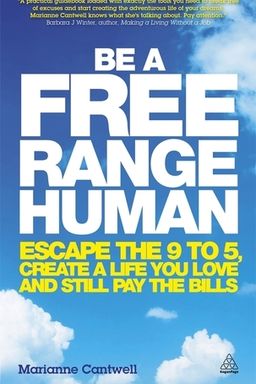
Be A Free Range Human cover

Be A Free Range Human

by Marianne Cantwell

Be a Free Range Human is your guide to escaping the conventional work life and crafting a career built around passion and fulfillment. Marianne Cantwell shows how to break free from the confines of traditional employment, harness your unique strengths, and create a sustainable income doing what you love.

Designing a Life You Love Beyond the 9–5

Have you ever caught yourself staring out the office window and thinking, Is this really all there is? In Be a Free Range Human, author Marianne Cantwell argues that you don’t have to trade your personality and passions for a paycheck. You can design a full-color life that generates income on your own terms. Cantwell contends that freedom and fulfillment aren’t luxuries to be saved for retirement or weekends—they are possibilities you can start living every day.

The book challenges the outdated “career-cage” model that teaches people to seek security through jobs they dislike. Cantwell shows how modern tools—especially online platforms, portable workspaces, and social networks—allow anyone to build meaningful work aligned with who they are. The emphasis isn’t on luck or overnight success but on strategic self-awareness: knowing your strengths, designing small experiments, and connecting authentically with others.

Escaping the Career Cage

Cantwell opens with a personal story. Once a high-performing corporate consultant trapped in fluorescent-lit offices, she experienced the stark contrast between how freedom felt and how confinement looked. The moment she coined the term Free Range Human—while wedged between commuters on the London Underground—she realized how many people live like battery-caged hens, restrained by fear and convention. Her transformation from consultant to “free ranger” models the book’s key claim: freedom begins when you stop waiting for permission.

The author warns against believing in the ‘safe job’ myth—a promise of stability that rarely exists in a world of layoffs, automation, and constant change. Instead of security, jobs often offer fragility disguised as comfort. Cantwell asks: why stay dependent on one employer (your only client) when you can diversify, express yourself fully, and create direct value in the world?

Freedom Through Simplicity and Action

A key part of Cantwell’s philosophy is learning by doing. Rather than spending months researching or writing elaborate business plans, she encourages small, playful projects to explore ideas. These “Play Projects” and “Test Projects” help you discover what fits, without risking financial ruin. The method echoes Tim Ferriss’s emphasis on lifestyle design in The 4-Hour Workweek, but with more soul and individuality—no cookie-cutter formula, just real experimentation to test your desires against reality.

Cantwell builds from the inside out: defrosting creativity, discovering your natural strengths (“superpowers”), overcoming fear of rejection, and crafting freedom through authenticity. These personal tools become business tools. The Free Range mindset relies less on flashy marketing and more on clarity—about what you love, what you offer, and who it helps.

Creating Income That Feels Like You

Cantwell’s world isn’t limited to entrepreneurs selling online. She lays out five flexible pathways: selling services, creating virtual products, hosting experiences, making physical goods, or mixing different strands in a “portfolio” career. Her examples—Melissa Morgan turning vegan cupcakes into a business, Benny Lewis selling language courses from his travels, and Charlie Haynes founding Urban Writers’ Retreats—illustrate how creative self-expression becomes a viable income source.

Underlying all these cases is a radical idea: you don’t need permission or perfection to start. You only need to begin. Using the principles of microtesting, authentic branding, and “Faststart” connections (collaborating with those who already have audiences), Cantwell proves that most progress comes from small steps taken consistently.

Living on Your Terms

The end goal of being a Free Range Human isn’t to escape work—it’s to make your life and work indistinguishable. This “life integration” means designing projects, communities, and rhythms around who you actually are. You might live in London, Bali, or your hometown, because the point isn’t travel—it’s authenticity. The book culminates in stories of people who replaced confusion and conformity with courage and creativity, including Cantwell’s own journey to living freely while managing depression and anxiety. Her honesty reinforces that freedom isn’t flawless—it’s human.

Be a Free Range Human reframes success not as climbing the corporate ladder but as designing a ladder that fits your height, reach, and purpose. You stop squeezing into boxes and start crafting your own shape for living and working.

By the end of the book, you see freedom less as a dream and more as a discipline—a daily choice to express who you are and create value your way. Cantwell’s invitation is clear: experiment boldly, take responsibility for your happiness, and make your living feel like life itself.


Break Free from the 'Safe Job' Myth

Cantwell opens with a challenge to one of the most entrenched beliefs the modern workforce holds: the idea that a traditional job guarantees safety. She calls this the 'career cage'—an illusion that keeps people locked in fear while technology and globalization erode the very stability they seek. A job might feel secure, but in reality, most workers are just like freelancers with one client: their employer.

The Risk of Staying Still

Cantwell recounts how automation and outsourcing have demolished old assumptions about job security. You can lose your income overnight from restructuring or automation. Meanwhile, entrepreneurs diversified their efforts and learned how to respond to change faster. “The question is not whether you can afford to leave your job,” she writes, “but whether you can afford to stay.” True stability comes from adaptability, not permanence.

Freedom as Practical Security

The author proposes a new definition of security: the ability to earn under your own control. Her “Free Range” model is designed to start small—with low overhead, no debt, and rapid testing—to build tangible financial autonomy. It’s not reckless; it’s pragmatic. Having multiple income sources and creative flexibility is safer than having one paycheck dependent on someone else’s decisions.

Like Richard Branson’s comment that business is “risk-free play when you start small,” Cantwell demonstrates that the modern economy rewards creativity and speed more than conformity. A “safe job” now often means stagnation, while free range independence rewards curiosity and action.

“Do you want to feel secure, or be secure?” Cantwell asks. Staying safe in a career cage may feel comfortable, but freedom builds real protection—because it teaches you to earn in any environment.

By reframing work as creative resilience, Cantwell dismantles the emotional dependence on employers. She shows that practical freedom begins with belief: if you stop waiting for external validation, you start building internal stability—the only security worth having.


Discover What You Really Want

Before you can build a life around your passions, you have to know what those passions are. Cantwell argues that many people are so “defrosted” by routine that they’ve lost touch with their inner desires. We make logical decisions about careers but forget that intuition is the best GPS for direction. Rediscovering your true wants means recalibrating what feels like a genuine yes and no.

Defrosting and Recalibration

Cantwell introduces an emotional exercise inspired by Martha Beck’s idea of the internal GPS—a sensation that physically signals alignment or resistance. Through journaling and self-reflection, readers identify when they feel light, relaxed, and energized versus drained or constricted. This process helps “defrost” creativity that responsibilities have frozen. Once you notice your emotional yes and no, choices about work and life become clearer.

Dreaming Without Limits

In her “Head in the Clouds” exercise, Cantwell asks readers to sketch a fantasy day in a life of total freedom. It’s not about finding a perfect job title; it’s about uncovering themes—like variety, creativity, community, or travel—that excite you. Melissa Morgan’s journey from educator to vegan cupcake entrepreneur began this way: she imagined spreading joy through fun food, then turned that idea into Ms Cupcake, a thriving London bakery and brand with her own cookbook.

Cantwell parallels Julia Cameron’s The Artist’s Way by reminding readers that creativity isn’t elitist—it’s instinctual. “Dreaming big,” she says, “isn’t naïve; it’s necessary.” The act of imagining possibilities resets ambition from survival to joy.

You don’t need to wait for inspiration to strike. You make it happen by paying attention to what feels alive—and by pursuing it before logic kills it.

Cantwell’s exercises reinstate emotional literacy in decision-making. They turn longing into practical direction so you can design a career that expresses who you are, not who you think you should be.


Turn Weaknesses into Superpowers

Cantwell’s chapter “Spot Your Superpowers” reframes weakness as misunderstood strength. Schools and corporations condition people to fix deficits and become generalists, leading to mediocrity. Free rangers, by contrast, identify what feels easy and energizing as core value. She argues, “Average is no longer an option.”

Breaking the All-Rounder Myth

Traditional career systems reward competence across every category, but Cantwell says mastery happens where joy meets natural skill. Strengths aren’t learned— they’re innate energies. For example, her client Alex thought his impulse to change systems was a weakness because bosses wanted compliance. When he moved into consultancy where innovation was valued, the same trait became his selling point.

This model mirrors Marcus Buckingham’s strength-based leadership theory: don’t paste on skills; amplify talent and work around weaknesses. Cantwell provides the “flip it” method: list five weaknesses, identify the hidden trait behind each (like adaptability or fast thinking), then find environments where that quality thrives.

Owning Your Strengths

Rachel Papworth’s story exemplifies this. She loved decluttering but saw it as trivial. After applying Cantwell’s methods, she turned her organizing hobby into a professional service, Green and Tidy, helping others reclaim order and joy. What she once hid became profitable purpose. Einstein’s quote—“If you judge a fish by its ability to climb a tree…”—frames Cantwell’s argument: success is simply a fish finding water.

Your natural flow is not laziness; it’s expertise. The work that feels effortless to you is what others perceive as genius.

By reinterpreting weakness as direction, Cantwell replaces self-criticism with momentum. You stop polishing your flaws and start shining where you’re already bright.


Start Small and Experiment

Cantwell dismantles the myth that you must have everything figured out before you begin. Her concept of “Play Projects” shows how small experiments reveal big truths. Thinking is helpful, but action is transformative. Just as John Williams in Screw Work, Let’s Play suggests starting mini-projects, Cantwell defines two project types: playful explorations and test projects that link joy to income.

Play Projects: Discover Joy Through Doing

Play Projects help you discover what you love by doing it, not thinking about it. Cantwell tells of Melanie Pearson, who founded a pop-up cinema after experimenting with one film night. That single act evolved into a long-term business. Whether baking cupcakes or hosting workshops, the point is to move from possibility to practice.

Test Projects: Turn Ideas into Income

Test Projects, by contrast, involve charging real money—even small amounts—to gauge interest. Amy Day’s waterproof phone case originated from observing tourists in Indonesia. She spent $100 on samples and pre-sold her first stock. Cantwell emphasizes this lean strategy: skip complex business plans, make a batch of cookies, and see if people buy them. It’s pragmatic creativity in motion.

Start before you’re ready, test before you’re perfect. Momentum matters more than mastery.

This philosophy transforms fear into curiosity. Every Free Range Human starts small, observing results, tweaking, and expanding. Mistakes stop being disasters—they become data. The result? Progress without paralysis.


Stand Out by Being More You

Cantwell’s approach to branding and positioning is radically human. Instead of gimmicks and trends, she centers authenticity. Standing out means amplifying what’s naturally different—not inventing something artificial. Her 1%/100% model shows how small, personal distinctions win loyal audiences.

Find Your 1% Difference

You don’t need to be revolutionary; you just need one meaningful difference that matters to your niche. Cantwell compares coffee chains: she prefers Caffè Nero because they serve real chocolate and offer free water—tiny details ignored by competitors. That unique 1% earns 100% of her loyalty. Translating this into business, your “1%” might be your communication style, tone, or service atmosphere.

Personal Branding Without Pretension

Cantwell warns against defining yourself by comparison. The real edge comes from magnifying traits others overlook—like her “smile” story, where she realized clients remembered her energy more than her credentials. Interior designer Zoe Hewett’s hand-drafted, colorful designs became her hallmark after she stopped apologizing for not using industry software. Her brand grew precisely because it mirrored her truth.

Authenticity isn’t noise—it’s clarity. The more visible your real self, the more clearly your people recognize you.

By embracing small differences rooted in personality, Cantwell turns branding from performance into generosity. You stop trying to be universally appealing and start resonating deeply with those meant for you.


The Three Free Range Styles

One of Cantwell’s most powerful contributions is the idea of Free Range Styles—three natural attraction models that explain how different personalities draw clients and income. This framework replaces one-size-fits-all advice with tailored approaches, showing that success depends on alignment with who you are.

Attractor: The Magnet

Attractors gain attention through visibility and storytelling. Cantwell herself is an Attractor, growing her community through writing, speaking, and online presence. For Attractors, clarity and communication are key; they turn ideas into narratives people want to follow. Visibility isn’t vanity—it’s connection.

Connector: The Relationship Builder

Connectors thrive on conversation and collaboration. Selina Barker built two successful coaching brands entirely through partnerships and relationships, not advertising. Her income flowed from chatting authentically about projects and creating alliances. Networking isn’t manipulation—it’s genuine curiosity about people.

Trusted Person: The Expert

Trusted People attract through reliability and depth. Jeanne Patti shifted from stalled online sales to thriving referral-based coaching by focusing on one-on-one trust. Her grounded expertise replaced flashy marketing. Cantwell stresses that Trusted People shouldn’t mimic Attractors; their strength lies in consistency and authenticity.

No style is superior. What matters is discovering yours and putting most of your energy there. Flow follows authenticity.

This flexible model resolves why identical strategies create unequal results among equally smart people. When you match your method to your Style, momentum replaces struggle. Know your magnet—and let it pull naturally.


Sell Without Losing Your Soul

For many new free rangers, sales is the scariest word. Cantwell humanizes it by reframing selling as sharing enthusiasm rather than pushing. Her “Four Es” model—Enthusiasm, Engagement, Equanimity, Ethics—turns fear into heart-centered communication.

Enthusiasm

Share what you love as if recommending it to a friend. When you communicate genuine passion, persuasion happens naturally. You’re not convincing; you’re inviting connection. This mirrors Daniel Pink’s idea in To Sell Is Human that authenticity is the new sales advantage.

Engagement

Sales succeed when you understand your client’s deeper benefits. Instead of listing features, describe the outcomes—like comfort, confidence, or relief. Think in their language, not industry jargon. Clarity sparks conversion.

Equanimity and Ethics

Equanimity means staying calm and confident without desperation. Scarcity vibes repel people. Ethics simply means treat others as you wish to be treated. Cantwell refuses to coerce or upsell debt-heavy clients. Selling from integrity builds trust, and trust builds income.

If selling feels wrong, you’re probably doing it someone else’s way. Your way can feel generous, confident, and kind.

Cantwell’s sales philosophy restores dignity to commerce. When you sell with soul, you aren’t manipulating buyers—you’re helping humans get what they genuinely need.


Create Real Freedom, Anywhere

In her final chapters, Cantwell proves that freedom isn’t just quitting a job—it’s designing how and where you live. Location independence, flexible scheduling, and self-created security define the Free Range lifestyle. The goal isn’t perpetual travel but total choice.

Freedom by Design

Cantwell shows readers how to structure work across borders using digital tools and portable systems. From Skype-based coaching to remote courses, free rangers can operate globally from anywhere. Her own laptop in Thailand or California proves it’s viable. Travel becomes a metaphor for autonomy.

Families and Real Lives

Free range living fits humans, not just wanderers. She profiles families like Jennie Harland-Khan, who moved to Bali for their children’s education, and others combining work with parenting or health needs. Freedom means reconfiguring daily reality to support wellbeing.

The Discipline of Design

Freedom isn’t escapism—it’s engineered through focus. Cantwell’s closing exercise, “10 Steps to Freedom,” turns ideals into plans: act as your own boss now, save strategically, build side income, set a quitting date, and say no to beige conformity. She reminds readers that courage is cumulative: small, clear steps multiply over time.

You’re not building a business; you’re creating a life. Freedom isn’t found—it’s crafted daily through intentional choices.

By the end, Cantwell redefines success as feeling whole—embracing quirks, autonomy, and the courage to color outside any prescribed lines. The Free Range Human doesn’t just escape the 9–5: they create a world of their own making.

Dig Deeper

Get personalized prompts to apply these lessons to your life and deepen your understanding.

Go Deeper

Get the Full Experience

Download Insight Books for AI-powered reflections, quizzes, and more.