
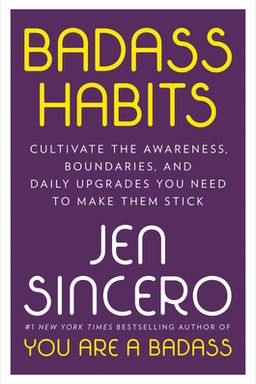
Badass Habits cover

Badass Habits

by Jen Sincero

Badass Habits by Jen Sincero is a lively guide to reshaping your life through positive habit formation. Discover how to break old patterns, set effective boundaries, and align new habits with your true desires for sustainable growth.

Transforming Identity Through the Power of Habits

Have you ever tried to change a habit—say, start exercising, stop procrastinating, or quit smoking—only to watch the old behavior creep back in? In Badass Habits, bestselling author and coach Jen Sincero argues that habit change isn’t just about what you do. It’s about who you are becoming. Lasting transformation comes not from discipline alone, but from reshaping your identity, your beliefs, and your energy to match the habits you desire.

Sincero builds on her earlier works like You Are a Badass and You Are a Badass at Making Money, blending science, storytelling, and humor to guide readers through a practical framework for upgrading the habits that shape their lives. Her central contention: you are already in the habit of being someone. Your thoughts, actions, and patterns define your reality—but because they’re learned, they can be reprogrammed. When you change your habits, you change who you’re being, and in turn, you transform what’s possible for your life.

The Core of Sincero’s Approach

Sincero combines mindset psychology and practical tools into a three-part strategy: awareness, alignment, and action. First, you must become aware of the habits—mental and physical—that shape your reality. Then, align your identity and environment with the version of yourself who already embodies the habit. Finally, take consistent, intentional action until the habit becomes second nature.

In doing so, you avoid the common trap of self-judgment and procrastination. Progress isn’t about perfection, Sincero reminds you—it’s about staying conscious. Habits form the scaffolding of your life, and mastery comes through humor, forgiveness, and repetition.

Why Habits Matter More Than Motivation

Motivation is fleeting. Habits are durable. Sincero opens with her own admission: even as a bestselling author, her habits are imperfect. But she demonstrates how recognizing and upgrading them intentionally creates ripple effects throughout every area of life. Whether in relationships, money, or self-care, your daily choices become rituals that embody your self-worth. This mirrors the ideas of other behavior-change experts like James Clear (Atomic Habits) and Charles Duhigg (The Power of Habit), but Sincero’s focus leans more spiritual and identity-driven than purely scientific.

The book divides its guidance into clear, conversational sections—covering the psychology of habit identity, the importance of boundaries, and a detailed 21-day process that acts like a self-coaching course. By the end, you’ll not just have added or dropped a habit; you’ll have redefined the kind of person you are in the process.

A Journey from Awareness to Celebration

The heart of Badass Habits lies in its experiential structure. Sincero walks readers through a daily progression: crafting a powerful mantra, setting up triggers, creating rituals, anticipating excuses, taming distractions, and celebrating growth. Each stage is backed with humor and real-world stories—from friends, clients, and her own life—reminding you that transformation is messy but possible.

Her tone is equal parts coach and comedian. For instance, she jokes that we all “fake-set our minds” to things, but insists that gentler, more intentional microshifts are what stick. She flips the guilt-heavy language of self-help into self-compassionate accountability. Rather than “fixing” yourself, you’re reclaiming your innate confidence and identity as a creator of your own life.

The Promise of Becoming Your “Badass” Self

What ultimately distinguishes Sincero’s philosophy is her insistence that personal growth should feel fun, not punishing. You cultivate “badass habits” by owning your desires, setting unapologetic boundaries, and acting as if your future self already exists. These aren’t just life hacks; they’re declarations of self-respect.

“Habits aren't about discipline. They’re about identity. To change your habits, you must change who you believe yourself to be.” —Jen Sincero

That’s the driving force of Badass Habits: you already possess the power and confidence to live fully; you just have to practice being the person who believes it. Across its chapters, you’ll learn how to decide who you want to be, align your language and rituals with that decision, maintain focus through setbacks, and—most importantly—celebrate your wins rather than downplaying them. For Sincero, habit-building isn’t a grind; it’s a spiritual rebellion against self-doubt.


The Psychology of Who You’re Being

Sincero opens the book with an insight that reframes traditional advice: habits aren’t just routines—they’re reflections of your identity. In Who You’re in the Habit of Being, she examines how your patterns of thought, speech, and action literally sculpt your reality. To change a habit, you don’t start with behavior; you start by redefining who you are.

Habits Begin as Identity Scripts

According to Sincero, almost half of your daily actions are habitual. These aren’t just physical routines—they’re repeated stories you tell yourself about what’s possible. If you’ve always identified as “bad with money,” “lazy,” or “unlucky in love,” your habits follow that script. The good news? You wrote the script—and you can rewrite it.

One of her examples is her brother Stephen, who became “the Patron Saint of Lost Shiny Things.” After years working as a diamond sorter, he developed the habit of spotting tiny objects everywhere—even lost earrings on sidewalks. His attention trained his identity. Whatever you repeatedly think, say, and do, you become.

The Habit Loop: Trigger, Action, Reward

Like Charles Duhigg’s “habit loop,” Sincero breaks down habits into three components: trigger, action, and reward. When you recognize your triggers (like anxiety or boredom), you can intercept the pattern before reacting unconsciously. Replace the old loop with a new one that serves your future identity.

For instance, instead of “Trigger: stress → Action: smoke → Reward: relief,” you can consciously choose “Trigger: stress → Action: meditate → Reward: peace.” Over time, your brain associates the new pattern with comfort, and your identity shifts from “stressed smoker” to “calm, grounded person.”

Becoming the Future Version of You

Sincero insists that sustainable change comes from embodying the identity of your desired self before you’ve fully “earned” it. In her words, “act as if.” Want to be a writer? Start thinking, dressing, and scheduling like one now. Want to stop overspending? Adopt the worldview of someone who manages wealth confidently. As she experienced when shifting from “broke” to financially prosperous, her outer world only changed after she stopped identifying as a victim of scarcity.

Identity precedes action. You won’t act differently until you see yourself differently—and you won’t see yourself differently until you start acting as if you already are.

This cyclical relationship between belief and behavior underpins every chapter in Badass Habits. By consciously deciding to believe something new, you retrain your subconscious to match your conscious desire. Over time, the “new you” becomes automatic, just as the old one once was.


Boundaries: The Unsung Heroes of Change

In Chapter 2, Sincero turns her attention to a less glamorous but essential skill: boundaries. She argues that most failed habits don’t collapse from weak willpower—they collapse because you didn’t protect the space required to maintain them. Healthy boundaries define what you’re available for and what you’re not.

Boundaries as Energy Management

Sincero uses vivid childhood anecdotes to illustrate how boundaries form. As a little girl, she recalls being too afraid to deliver bad news to adults—symbolizing how we often avoid setting limits for fear of rejection. In adulthood, this becomes chronic overcommitment, guilt, and burnout. Without boundaries, you spill your energy across everyone else’s needs and have nothing left for yourself.

Her core message: you are responsible to others, not for them. This distinction frees you from rescuing, fixing, and enabling others’ problems so you can focus on your own growth. That emotional clarity is what allows new habits to stick.

The Three Boundary Blunders

  • Too yessy – You agree to everything from guilt or fear of confrontation, diluting your commitments.
  • Too no-y – You shut everything down to avoid vulnerability, which isolates you from help and opportunity.
  • Too controlly – You micromanage others or over-involve yourself in their lives, draining both sides of autonomy.

Recognizing which pattern you lean toward is the first step to healthier balance. From there, Sincero offers tools like gentle no statements, time buffers, and emotional ownership to reinforce where your energy belongs.

Boundaries and Habit Freedom

Sincero links boundary work directly to habit transformation. If you’re building the habit of exercise, for example, you’ll need to set time boundaries (“No meetings before 9 a.m.”) and relational boundaries (“I’m unavailable for phone calls during workouts”). Setting limits is not selfish—it’s self-loyalty. It trains others (and yourself) to respect your goals.

Ultimately, the chapter reframes boundaries as self-trust in action. When you honor your time, space, and energy, you send your brain the message that your commitments matter. And once your subconscious believes that—you start showing up accordingly, automatically.


The 21-Day Badass Habit Method

The centerpiece of Sincero’s book is her 21-day guided program for locking in one habit at a time. Each day builds on the previous, gradually rewiring your mindset and routines. Instead of pushing willpower, she invites play, creativity, and relentless self-celebration.

Structure and Flow

Each daily exercise fuses psychology with practicality. You begin on Day 1 by creating your “Mantra of Mightiness”—a short, emotional statement that embodies your future self (“Money flows to me easily and freely”). Over the next three weeks, you add layers: environmental design, accountability, reward systems, rituals, focus practices, and emotional resilience.

Days like “Refuse to Participate in Negotiations” train your mind to shut down the mental chatter that tries to talk you out of your new habit. “Take Tiny Bites” teaches micro-focus, breaking overwhelming goals into manageable chunks. Every day ends with the same grounding instruction: repeat your mantra until it becomes your default programming.

Sincero’s 21-day plan mirrors behavior design systems from experts like BJ Fogg (Tiny Habits): small steps create exponential change when repeated with emotion and belief.

Building a Ritual of Success

From lighting a candle before meditating to celebrating each victory with homemade “Ta-da!” moments, Sincero shows that ritualization fosters pride and consistency. “Reward Yourself,” she insists, isn’t indulgence—it’s neural reinforcement. Dopamine bonds you to the behavior. Similarly, “Create a Ritual” activates ceremony and meaning so mundane actions feel sacred.

By Day 21, you’ve not only repeated an action but also become a new person. The repetition cements self-belief, and the ritual reminds you that growth deserves joy. Many readers return to this program repeatedly, refining habits layer by layer until their identity fully aligns with their higher selves.


Speaking and Thinking Your Reality

In “Speak It into Being,” Sincero shows how words are the anchors of identity. The statements you use daily (“I’m always late,” “I have no willpower”) are self-programming scripts. She challenges readers to become linguistic architects of their reality by upgrading their vocabulary.

Replacing Limiting Language

Sincero provides a simple but potent list of replacements: trade “I can’t” for “I can,” “I suck at” for “I excel at,” “I hate” for “I love.” These swaps may sound trite, but they retrain your focus toward agency. As she writes, “Your words anchor your reality. What you keep saying—so it shall be.”

Her humorous story about being talked into joining the basketball team by a persuasive coach underscores how external words shape self-perception. Language, whether internal or external, hypnotizes behavior. When you control that narration, you reclaim creative authority over your life.

Filtering Toxic Input

Just as your words shape thought, your environment’s words influence mood. Sincero urges you to curate your input—mute negativity, avoid gossip, stay clear of pessimistic media. When you encounter unavoidable toxicity, protect your mental space by internally repeating your mantra. It’s a mental noise-canceling device.

This mirrors the cognitive-behavioral principle that attention magnifies whatever it touches. Choose words that affirm who you’re becoming, and your subconscious works overtime to validate those declarations.

The exercise concludes with an invitation to write and use three empowering phrases every day—especially ones that contradict the “old you.” This deliberate repetition transforms language into proof of evolution.


Confidence and the Embodied Mindset

Sincero dedicates Day 15, “Cultivate Your Confidence,” to the inner posture of success. Her definition is refreshingly simple: confidence means “to confide in yourself.” It’s not about arrogance or fake positivity—it’s trusting that even when you don’t know how, you’ll figure it out. This inner trust makes or breaks habit transformation.

Your Body Leads Your Mind

One of Sincero’s signature methods is using your body as a feedback loop. “Walk tall, roll your shoulders back, breathe deeply,” she instructs. Confidence can start as a physical act; your brain catches up. This echoes social psychologist Amy Cuddy’s “power pose” research—posture changes state faster than thought alone.

By embodying assurance while practicing your new habit—like standing proudly before a presentation or jogging with purpose—you literally rewire your nervous system’s sense of safety and skill. Over time, this becomes your default setting.

From Comparison to Contribution

Sincero also redefines confidence as service. When anxiety creeps in (like her stage fright before speaking events), she shifts focus outward: “It’s not about me; it’s about who I can help.” By framing your actions as gifts rather than tests, you sidestep self-consciousness entirely.

She offers readers five specific tools for boosting confidence: adopt the posture, act “as if,” compile proof of past wins, practice in safe environments, and surround yourself with cheerleaders. Each builds evidence that you already have what it takes.

In the end, Sincero reminds us that everyone’s winging it—even the “popular kids.” So stop comparing, start practicing, and trust your momentum. Confidence, like every habit, is a muscle you strengthen by using it.


Surrender, Gratitude, and Celebration

The final days of Sincero’s program shift from action to integration. After you’ve done the work—established structure, language, and belief—you must also learn to let go. In “Surrender,” “Give Thanks,” and “Rinse, Review, Rejoice, Repeat,” she explores the spiritual dimension of habits: reconnection with trust and gratitude.

The Art of Letting Go

Surrender, for Sincero, is not passive resignation but releasing control. She shares the story of her client Carla, whose professional and personal life blossomed only after she finally stopped obsessing over her daughter’s behavior. The moment Carla surrendered her fixation, everything she desired began to flow. This echoes a common paradox in manifestation and stoic philosophy alike: loosen your grip, and the universe rushes to fill your open hands.

Gratitude as Momentum

In Day 17, “Give Thanks,” Sincero highlights that gratitude isn’t about ignoring struggle—it’s about remembering perspective. When you focus on what you appreciate, you raise your frequency and energize persistence. She offers a practical exercise: list ten reasons you’re grateful you get to do your habit (not have to). The simple linguistic flip shifts duty into devotion.

Rejoice and Repeat

In the closing chapter, Sincero insists you must celebrate your wins. Most people skip this step, but recognition cements identity. Whether it’s shouting “Ta-da!” after finishing 21 days or buying yourself flowers, celebration teaches your subconscious that growth feels good—and therefore, it’s worth repeating. As she jokes, “Be the kind of person who’s in the habit of forgiving failures and appreciating awesomeness.”

By combining surrender, gratitude, and joy, Badass Habits comes full circle: the goal isn’t perfection. It’s consistency with lightness. When you can show up, let go, give thanks, and rejoice—all while believing in the person you’re becoming—you’ve mastered the ultimate habit of all: self-love.

Dig Deeper

Get personalized prompts to apply these lessons to your life and deepen your understanding.

Go Deeper

Get the Full Experience

Download Insight Books for AI-powered reflections, quizzes, and more.