
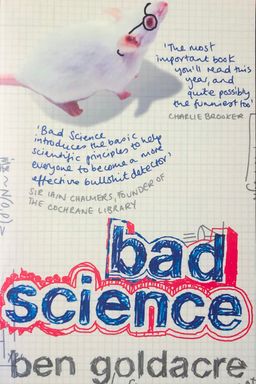
Bad Science cover

Bad Science

by Ben Goldacre

In ''Bad Science,'' Ben Goldacre peels back the curtain on the pervasive pseudoscience that influences our health decisions. From misleading media headlines to pharmaceutical company tactics, learn to spot and challenge false scientific claims to protect yourself from misinformation and make well-informed choices.

Inside the Machinery of Modern Misinformation

You live in a world where health and science claims are everywhere—on TV breakfast shows, school posters, beauty counters, and viral social media posts. In Bad Science, Ben Goldacre argues that the greatest danger of this flood of pseudoscientific claims is not just wasted money but the erosion of society’s shared understanding of evidence. He takes you on a tour through detox rituals, educational gimmicks, cosmetic marketing, nutritional myths, celebrity health empires, and even deadly political tragedies to show how scientific language can be twisted into theatre.

Goldacre’s central claim is simple and vital: when people lose the ability to tell good evidence from bad, they become easy prey—for advertisers, politicians, and even deadly ideologies. He doesn't attack individuals for their enthusiasm or faith; rather, he exposes the systemic incentives that reward nonsense and punish transparency. Each chapter teaches you how to think scientifically, not just how to mock bad examples.

From Footbaths to Big Pharma

The book starts with the most harmless spectacles—detox footbaths, ear candles, sticky foot patches. These products dramatize the idea of toxin removal through sensory theatre: bubbling brown water, melting wax, dramatic smells. When Goldacre replicates the effect using a doll or no feet at all, the same brown residue appears. The lesson: theatre can be convincing because it mimics the ceremonial aspect of medicine, not because it performs physiology.

From there, he moves into institutional pseudoscience, showing how programs like Brain Gym infiltrate real schools. Teachers often adopt these ideas not because they’re gullible but because the exercises sound plausible and carry a patina of neuroscience (“reticular formation,” “oxidation,” “brain buttons”). A similar pattern applies to cosmetics and nutrition: technical vocabulary and exotic molecules substitute for real data. Simple moisturizers are rebranded as “DNA delivery systems” and vitamin mythology drives multibillion-dollar supplement markets.

Why Evidence Matters

Goldacre uses homeopathy as the perfect demonstration of how evidence testing works. The pills themselves are inert; the apparent benefits arise from the context of compassionate care, not chemistry. That connects directly to the placebo chapters, where experiments show measurable biological effects from belief and ritual—dopamine release in Parkinson’s, endorphins in pain relief. The lesson is not that placebo is bad, but that meaning is powerful and must be used ethically—through communication and empathy, not deception.

How Denial Turns Deadly

Some pseudoscience becomes lethal when transplanted into policy. Goldacre’s account of Matthias Rath’s vitamin crusade in South Africa during the AIDS epidemic is the darkest part of the book. Rath’s claims, supported by political denialism, diverted trust and funding away from proven antiretroviral drugs—costing hundreds of thousands of lives. The episode reveals that evidence illiteracy is not merely academic; when political identities align with bad science, misinformation kills. (Note: Goldacre’s own libel battle with Rath shows how resistance to scrutiny can itself be weaponized.)

Bias, Industry and Journalism

Goldacre distinguishes between industry manipulation and everyday statistical incompetence. Drug companies manipulate trial designs, suppress negative data, and selectively publish promising results. Meanwhile, journalists amplify tiny p-values, relative-risk distortions, and anecdotal drama. The MMR vaccine panic demonstrates how the combination of a weak case series, poor media reporting, and emotional storytelling triggered real outbreaks of measles and mumps. Behind these patterns lies a consistent psychological weakness: humans prefer vivid stories, authoritative confidence, and short-term emotional logic.

Repairing the System

Goldacre ends optimistically. He proposes simple fixes: enforce public trial registries so negative results cannot vanish; teach statistics and critical-thinking skills early; and hold journalists to higher evidential standards. He also invites individuals to act: question sciencey language, ask for natural frequencies (“how many actual cases?”), prefer systematic reviews over anecdotes, and welcome empathetic but transparent clinical care. The ultimate goal is not cynicism but confidence—the ability to tell when someone is performing science and when they are actually doing it.

Core message

Science is not a set of facts but a process of questioning. The most dangerous bad science is not eccentric mistakes but the systemic erosion of skepticism. When you learn to demand evidence, you reclaim power—from marketers, politicians, and any narrative too polished to be tested.


Testing Claims Versus Theatre

Goldacre starts with playful experiments that reveal how easily theatrical rituals masquerade as evidence. Detox devices, ear candles, and foot patches promise purification but rely on dramatic visuals and unverifiable language. Simple tests—leaving feet out of a bath, burning a candle as a control—show that the brown residue or orange wax appear regardless of the human body. The result is mechanical rust or melted candle wax, not expelled toxins.

What Controls Reveal

You learn that the core scientific idea is the control experiment: isolate a variable to see if it matters. When detox patches turn brown overnight without feet, the claim collapses. When ear-candle residue matches that from an unburned control, the exit wax is theatrical. Goldacre labels such pseudo-laboratory spectacle “the hassle barrier”—enough pseudo-complexity to deter journalists from checking, yet no real transparency about method or outcome.

Detox as Culture

Beyond chemistry, Goldacre shows detox as cultural ritual: it meets needs for purification and renewal, echoing religious and social traditions worldwide. The harm comes when these rituals are sold as biomedical innovation—redefining spirituality as science, without measurable toxins to test or treat. This pattern recurs later in the book: whenever meaning is sold as mechanism, the result is persuasion without proof.

Essential lesson

Visual drama is not evidence. Controlled tests, even simple ones, often reveal that the theatre of detox and “energy cleansing” hides ordinary chemistry—rust, moisture, or sugar.


Brains, Beauty, and Pseudo‑Expertise

Goldacre turns to institutional and commercial pseudoscience—cases where nonsense gains credibility through jargon, authority, and branding. In schools, Brain Gym rebrands commonsense advice (“take breaks,” “drink water,” “move around”) as proprietary rituals with fake neuroscience. Teachers adopt it because it sounds professional and promises engaged children. Cosmetic companies play the same game, dressing emulsified oil and water with molecular diagrams and Latin-like names (“Tenseur Peptidique Végétal”).

The Seduction of Technical Language

Experiments prove that audiences rate bad explanations as more convincing when they include irrelevant neuroscience terminology (as shown in the Journal of Cognitive Neuroscience). Goldacre calls this the “science-sounding seduction.” These brand narratives exploit authority bias—consumers and educators both assume that long words equal expertise.

Privatizing Common Sense

The harm, Goldacre argues, lies in the “proprietorialization of common sense.” Practical advice about hydration and exercise becomes copyrighted routine, sold as if scientific discovery. This privatization disables critical thought and replaces accessible health literacy with dependence on branded guidance. Similarly, cosmetics advertising replaces biological facts with ritualistic consumption framed in lab imagery—making the public feel that science is incomprehensible and products are its only doorway.

Key principle

When you hear complex words in simple contexts, ask whether the scientific jargon adds explanatory power—or just sells ordinary ideas with a lab coat.


Evidence, Placebo, and Meaning

Homeopathy and placebo science together form Goldacre’s masterclass in critical appraisal. Since homeopathic pills contain nothing but sugar beyond 10⁻⁶⁰ dilutions, they serve as perfect controls for testing the placebo phenomenon. Systematic reviews and high-quality randomized trials (Shang et al., The Lancet) show that homeopathic remedies perform no better than placebo. But rather than ending the discussion, Goldacre digs deeper into what that means for people’s real experiences of healing.

Placebo as Meaning Response

Goldacre builds on Daniel Moerman’s concept of the meaning response: physiological changes produced by ritual, expectation, and trust. Sugar pills colored red may stimulate alertness; injections outperform pills in pain reduction, even when both are inert. Clinicians’ confidence, empathy, and clear diagnoses measurably increase recovery—showing that ritual and communication embody biological power. Dopamine release in Parkinson’s patients and endorphin activation in analgesia reveal physical correlates of belief.

Harnessing Meaning Without Deception

Goldacre urges ethical use of this insight: you can design caring, time-rich consultations that optimize meaning without lying to patients. Open-label placebo trials show benefit even when patients know they receive a placebo—evidence that ritual itself helps. What matters is clarity: offer real treatments first, use meaning honestly, and reject magical claims that mislead people into abandoning effective care.

Main takeaway

Placebo effects prove that meaning heals—but only when used transparently. Deception turns empathy into exploitation.


Nutrition Myths and Manufactured Miracles

Goldacre’s middle chapters dissect the lucrative pseudoscience of diet and supplements. He outlines four recurring methodological errors—missing data, mistaking correlation for causation, over‑extrapolating from lab work, and cherry‑picking studies. From pomegranate anti‑aging propaganda to turmeric cancer promises, nutritionism succeeds by ignoring these rules. Media nutritionists and celebrity experts (like Gillian McKeith) exemplify how charisma and commerce replace evidence.

The Economics of Hope

Goldacre traces the guru tradition back to Sylvester Graham and John Harvey Kellogg, showing that dietary crusades blend moralism, spectacle and salesmanship. McKeith’s televised persona updated the formula: confident lectures, fake credentials, and products backed by “clinical trials” with no controls. When challenged by scientists such as John Garrow, who proposed fair tests, she threatened legal action—proof that commercial pseudoscience fears transparency.

The Antioxidant Fallacy

Large randomized trials dismantled the simple antioxidant story. Beta‑carotene and vitamin E supplements not only failed to help but increased mortality (as shown in CARET and ATBC trials). Observational correlations were misleading; biological plausibility collapsed under real-world complexity. Food supplement industries responded by manufacturing doubt—financing public relations that blurred negative outcomes. The takeaway: appealing biochemical theories mean nothing without randomized evidence.

Application

Ask whether any nutrition claim comes from randomized trials or systematic reviews. If it rests on observations, petri dishes, or anecdotes, it is advertising, not science.


When Politics Meets Pseudoscience

At the book’s peak moral intensity, Goldacre documents Matthias Rath’s vitamin crusade during South Africa’s AIDS epidemic. Rath leveraged genuine research on malnourished populations—where vitamins modestly delay disease progression—into propaganda claiming vitamins outperform antiretrovirals. Supported by Health Minister Manto Tshabalala‑Msimang and President Thabo Mbeki’s AIDS denialism, Rath’s clinics dissuaded patients from proven drugs. The outcome was disaster: hundreds of thousands of preventable deaths.

How Denial Took Hold

Rath’s advertising portrayed pharmaceutical companies as genocidal villains and cited false endorsements from WHO and UNICEF. Government complicity turned fringe claims into national policy debate. Activists like Zackie Achmat and Médecins sans Frontières fought to restore evidence-based treatment, facing lawsuits and harassment. The episode mirrors Robert Proctor’s notion of “agnotology”—the deliberate manufacture of ignorance for profit or ideology.

Why Context Matters

Goldacre’s point is clear: pseudoscience becomes lethal when embedded in political power structures and amplified by distrust of institutions. Denialist rhetoric weaponizes identity and postcolonial resentment, making scientific correction seem elitist or oppressive. Public-health literacy is therefore a civic shield: when the ability to evaluate evidence is widespread, crises like this can be resisted before they scale.

Lesson

Fake science dressed as empowerment can kill. Political endorsement of pseudoscience turns moral comfort into mass harm.


Bias, Statistics, and Media Spin

Goldacre devotes substantial effort to teaching statistical literacy—the practical defense against bad reasoning. Misuse of relative risk, clustering, and p-values distorts truth in medicine and media alike. Headlines tout “50% increased risk” without stating baseline numbers, turning trivial findings into panic. Natural frequencies (“two extra heart attacks per 1000 people”) reveal the real scale. When readers understand this conversion, emotional manipulation loses power.

Common Statistical Traps

Goldacre explains regression to the mean and confirmation bias—how apparent successes follow extremes naturally and how people seek confirming examples, not falsifying ones. The Lucia de Berk and Sally Clark cases demonstrate courtroom tragedies born of statistical ignorance: multiplication errors and misunderstanding of conditional probabilities produced wrongful convictions. Multiple‑comparison fallacies and self‑selected samples plague media surveys and political polling, giving random variance the authority of pattern.

Corporate and Journalistic Bias

Big Pharma exploits similar weaknesses deliberately: selective publication (only positive trials appear), underdosing competitors, switching endpoints after results emerge, and duplicating positive findings to inflate apparent confirmation. Merck’s Vioxx and SSRI trials demonstrate how corporate bias shapes entire fields. Journalists then amplify partial results, creating self-reinforcing distortion loops between commerce and consumer belief.

Bottom line

Statistical literacy isn’t optional—it’s public armor. Whether you analyze research or read news, understanding frequencies, sampling, and bias means power.


Restoring Trust Through Transparency

Goldacre closes with actionable reforms—the antidotes to bad science. He insists on mandatory trial registries, where protocols and outcomes are logged publicly before data collection. This single measure curbs publication bias, endpoint switching, and data suppression. Transparency is cheap but transformative: once negative results can’t vanish, medicine’s evidence base becomes trustworthy again.

Better Journalism and Education

Goldacre calls on editors to trust specialist reporters rather than celebrity columnists. Proper science communication requires translating risk into natural frequencies, emphasizing replication over anecdote, and avoiding emotional shortcuts. Education is equally crucial: teaching students how to read a study, understand uncertainty, and appreciate randomness creates public immunity to hype. Resources like Testing Treatments and How to Read a Paper illustrate how non‑specialists can learn evidence literacy.

Individual Action

You too can practice resistance: ask for numbers, question jargon, favor systematic reviews, and communicate clearly. Clinicians can use empathy and ritual—meaningfully—to enhance real treatments. Academics can engage the public directly, correcting errors early. At heart, Goldacre reminds you that the greatest cost of bad science is distraction: energy spent chasing comforting myths rather than solving genuine problems.

Final insight

Transparency, education, and empathy are the real cures for misinformation. Once evidence becomes public and people understand it, pseudoscience loses its glamour and society regains its rational compass.

Dig Deeper

Get personalized prompts to apply these lessons to your life and deepen your understanding.

Go Deeper

Get the Full Experience

Download Insight Books for AI-powered reflections, quizzes, and more.