
Idea 1
Bad Laws Are Choices—Repeal Them
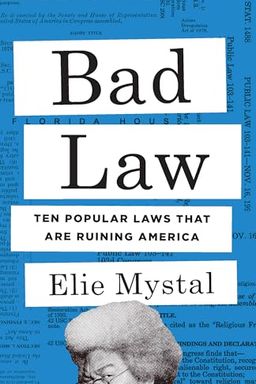
How can you tell when a law isn’t protecting you, but quietly scripting the worst parts of your daily life? In Bad Law, Elie Mystal argues that America’s biggest social wounds—voter suppression, mass incarceration, school shootings, immigration cruelty, and theocratic creep—aren’t accidental side effects. They are the intended consequences of specific, popular laws designed by powerful interests to keep wealth, control, and cultural dominance in the same hands. If the law is a plan, Mystal contends, then our problems aren’t glitches; they’re features—and the way forward isn’t timid reform but repeal.
At the core, Mystal flips a comfortable myth: that law is neutral and inevitable. He shows you that law is a series of choices we’ve made—often by unrepresentative (and, for centuries, legally exclusive) bodies—and that we’re still living inside those old choices. The book opens by locating the broken foundation: for most of U.S. history, Black people, women, and the poor were formally and then structurally excluded from making the rules. Even after 1965, the “rules of the game” (from gerrymandering to money in politics) preserved the same outcomes. So, when a rule—say, airline deregulation or felony murder—keeps producing avoidable harm, the right remedy isn’t tinkering at the margins; it’s taking the rule off the board.
What this book covers
You’ll travel through ten laws (and one amendment) that Mystal argues must go. He starts at the ballot box by attacking voter registration requirements as purposeful barriers to participation, then moves to immigration’s core criminal trap (illegal reentry) and the airline deregulation that became neoliberalism’s gateway drug. He dismantles the mandatory-minimum machine (from the 1984 Armed Career Criminal Act through the 1986 Anti-Drug Abuse Act to the 1994 Crime Bill), and exposes the gun industry’s liability shield (PLCAA) that blocks the very tort system we rely on to keep cars, toys, and medicine safe. He then examines felony murder (punishing people for deaths they didn’t cause or intend) and Stand Your Ground (converting fear into a license to kill—disproportionately Black people). An interlude on the Second Amendment shows how a slave-patrol militia clause was recast in 2008 (Heller) into an individual right, fueling a uniquely American arms race. Finally, he takes on the Hyde Amendment (which withholds federal abortion funding) and the Religious Freedom Restoration Act (RFRA), a tool that now lets majoritarian religion punch through neutral laws.
Why this matters right now
If you’ve ever wondered why your kid’s school drills for shooters; why your flight is chronically delayed while fees balloon; why a friend can’t vote after moving apartments; or why a battered woman goes to prison for a murder her boyfriend committed—this is the connective tissue. Mystal shows how laws like PLCAA and Stand Your Ground don’t merely respond to tragedy; they manufacture the conditions for more of it, while immunizing the most powerful players. Likewise, RFRA doesn’t protect minority faiths so much as it empowers the dominant one to carve holes in civil rights and health care (see Hobby Lobby). And Hyde isn’t a budget quirk—it’s a policy to stratify bodily autonomy by wealth.
What you’ll take away
You’ll leave with concrete repeal targets, the historical receipts to defend them, and a way to talk about law that resists technical fog. Mystal pairs gripping stories (Aurora theater, Sandy Hook, Breonna Taylor, Ralph Yarl) with legislative provenance (e.g., the Undesirable Aliens Act of 1929, pushed by eugenicist Harry Laughlin) so you can see both outcomes and origins. He also names live fixes: automatic voter registration; repealing INA §1326; reviving consumer protection via torts by ending PLCAA; scrapping ACCA and Stand Your Ground; codifying abortion access and nullifying Hyde; and repealing RFRA to restore the establishment/free-exercise balance. In the epilogue, he goes structural, urging you to expand the House (end the 1929 cap), crush gerrymandering, and, yes, still vote—because turnout shifts the cost-benefit calculus for the same politicians who keep choosing bad law.
Mystal’s blunt thesis
“The law is not an accident. It is a plan.” If the plan keeps hurting you, repeal the parts that do exactly what they were built to do.
The through line is liberating: you are not stuck with any of this. Laws are human-made, many are recent, and several were adopted by wide margins under bipartisan fog. Understanding their DNA—who asked for them, who profits, who pays—doesn’t make the fight easy. But it does make it winnable. And it restores something bracingly democratic: permission to say, out loud, that some laws are so harmful in purpose and effect that the only honest “reform” is repeal.