
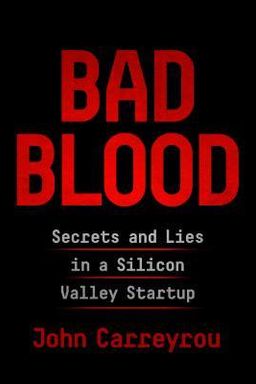
Bad Blood cover

Bad Blood

by John Carreyrou

Bad Blood delves into the shocking tale of Theranos, the Silicon Valley startup that deceived the world with its revolutionary blood-testing device. John Carreyrou meticulously uncovers how ambition, charisma, and deception led to a $9 billion scandal, risking lives and shaking the tech industry.

The Rise and Fall of a Biotech Illusion

How can a single idea inspire billion-dollar investments, captivate global media, and yet collapse into one of the most notorious scandals in medical technology? The Theranos story answers this, tracing how Elizabeth Holmes built and lost an empire on the promise of painless, one-drop blood testing. The book offers more than a cautionary tale—it reveals the anatomy of deception in innovation: how charisma, secrecy, technical shortcuts, and institutional trust combined to mask systemic failure.

Theranos began as a Silicon Valley dream: democratize healthcare by replacing vials of drawn blood with a finger-prick nanotainer. Holmes, inspired by Steve Jobs, embodied the archetype of the visionary founder. Yet what powered early enthusiasm—the founder’s charisma, disciplined aesthetic, and confidence—became the force that blinded investors, advisors, and employees to glaring warning signs. This book dissects those entanglements across corporate, technical, and ethical dimensions.

Charisma and the Founder’s Spell

At Theranos’s core stood its founder’s image. Holmes’s black turtlenecks, unwavering gaze, and hypnotic conviction charmed tech powerhouses like Larry Ellison and George Shultz. She framed Theranos as an inevitability—an Apple of healthcare. Her charisma became corporate currency, securing high-profile support and muting dissent. When CFO Henry Mosley raised ethical objections to staged demos, she dismissed him for being “not a team player.” In this framework, style didn’t just supplement substance—it suppressed it (similar to how charismatic founders in other tech firms have used devotion as a defense against scrutiny).

From Dream to Deception

Behind the aesthetic veneer were machines that didn’t work. Theranos cycled from microfluidic chips to glue-dispensing robots (the Edison) to the ill-fated miniLab. Each pivot tried to solve problems of chemistry and physics—too little blood, unstable reagents, temperature drift—but created new failures. Yet despite these setbacks, Holmes’s presentations never slowed. Investor demos used prerecorded data, and corporate slides projected billions in revenue from unverified “validation studies.” The dissonance between internal chaos and external perfection widened relentlessly.

Secrecy and Control

To maintain the illusion, Theranos turned inward. Employees signed punishing NDAs and were monitored by a technical security team that tracked USB inserts and logins. Colleagues called firings “disappearances”—a warning to those who asked too many questions. Inside the company, Sunny Balwani enforced obedience through intimidation and legal threats. Outsiders who inquired too deeply—consultants, partners, even lab techs—found themselves stonewalled or sued. This culture of fear preserved the myth at the cost of innovation and safety.

The Ecosystem That Enabled It

What made Theranos thrive for so long wasn’t just manipulation—it was complicity. Major institutions took the story at face value. Walgreens and Safeway, fearing to miss a revolution, committed tens of millions based on opaque demonstrations. The U.S. military considered deploying devices before the FDA had cleared them. Media profiles crowned Holmes as the next Jobs, and a board of generals and statesmen (Shultz, Mattis, Kissinger) lent unimpeachable credibility to exaggerated claims. Validation by status replaced validation by science.

Exposure and Collapse

What began to unravel the illusion wasn’t a rival or regulator but whistleblowers—young employees like Erika Cheung and Tyler Shultz, who risked career and family pressure to reveal misconduct. Working with Wall Street Journal reporter John Carreyrou, they unearthed documents showing hacked Siemens analyzers, falsified proficiency tests, and manipulated data. The resulting CMS and FDA investigations found Theranos in “immediate jeopardy to patient safety.” Within months, Walgreens severed ties, investors sued, and almost all test results were voided. Holmes’s empire crumbled not because of a dramatic failure but a steady accumulation of inconvenient truths that could no longer be hidden.

Core Lesson

Theranos is less a story of fraud than a parable about the peril of believing charisma over competence. It reveals how Silicon Valley’s 'fake it till you make it' ethos, applied to health care, becomes not innovation but endangerment.

By the final chapters, you understand that Theranos’s downfall was systemic: a product of culture, governance, and myth-making as much as technology. It urges you to look beyond the spectacle of visionary founders and ask for data, reproducibility, and transparency—because when narratives replace evidence, even well-meaning innovation can turn into deception with human consequences.


The Cult of the Founder

Theranos’s momentum began with one person’s charisma. Elizabeth Holmes didn’t just build a company; she built a myth. Colleagues described her presence as hypnotic—her low baritone, unwavering eye contact, and fanatical certainty projected inevitability. Like Steve Jobs, she used image as strategy: black turtlenecks, choreographed pauses, and mantras such as “one tiny drop.” This crafted identity became both armor and weapon.

Charisma as Capital

Holmes’s charisma translated into access. Don Lucas mentored her as family, Larry Ellison endorsed her, and Stanford’s Channing Robertson vouched for her credibility. The board became a validation loop: older, influential men deferring to a visionary youth who promised medical transcendence. Those relationships eroded governance—skeptics like Avie Tevanian were marginalized after questioning revenue claims. In this environment, dissent equaled betrayal.

Persuasion Over Proof

Investor meetings became performances. Rather than rigorous data, Holmes offered conviction. When demonstrations failed, staff patched displays with preloaded readings. Her rhetorical clarity—“the iPod of healthcare”—turned imagination into pseudo-fact. Those who doubted her vision were told they “didn’t get it.” You learn that charisma, when unchecked, can distort incentives and make skepticism socially costly within organizations.

Insight

When a founder’s personality becomes a company’s primary asset, governance collapses into faith. Charismatic leadership attracts capital but discourages truth-telling—the seed of future crises.

In essence, Theranos elevates the tension between inspiration and illusion: Holmes inspired a generation to believe science could be bent by willpower. The tragedy is that her charisma didn’t simply motivate—it mesmerized, making otherwise sensible people part of a collective suspension of disbelief.


Engineering the Impossible

Theranos’s promise hinged on a stunningly ambitious proposition: perform hundreds of lab tests using a single drop of blood. This goal forced engineers into a labyrinth of physical limits—sample volume, reagent stability, optical noise, and temperature control—that made each pivot more desperate than the last.

From Microfluidics to MiniLab

The company’s evolution from microfluidic chips to robotic pipettes to integrated miniLabs reveals a pattern of trade-offs. Early cartridges leaked and contaminated; the Edison robot worked only under narrow conditions. When miniaturization repeatedly failed, engineers scrounged existing technology—repurposing glue robots and hacking Siemens analyzers—to meet executive deadlines. Each workaround generated new reliability problems: pipette drift, overheating, and inconsistent assay results.

Deception by Dilution

Unable to process small samples reliably, the team began diluting blood to fit commercial analyzers designed for larger volumes. These “hacked” machines yielded erratic readings—especially for chemistry panels like potassium and sodium. Still, results were adjusted, averaged, and reported to patients. Engineers built six-way median calculations to mask variability, erasing outliers until performance appeared credible. The process substituted statistical maneuvering for validation.

The Laws of Physics Don’t Bend

Behind the rhetoric of disruption lay fundamental scientific oversight. Fluid mechanics, heat transfer, and optical sensitivity don’t obey ambition. MiniLabs suffered thermal cross-talk, low throughput, and constant recalibration. Prototypes rarely survived more than a few cycles without failure. Yet corporate timelines—driven by Walgreens contracts and investor promises—forced premature launches. As a result, patients’ health data became experiments in wishful engineering.

Engineering Lesson

Innovation must confront, not conceal, technical constraints. When a startup replaces iteration with illusion, mechanical errors evolve into moral ones.

Theranos’s “one drop” dream collapsed because the body’s chemistry refused to cooperate with its marketing. You grasp that technological revolution is not about imagination alone—it demands reproducibility, measurement, and honesty about what physics permits.


Secrecy and the Architecture of Fear

At Theranos, secrecy became structured into daily life. What began as protection against leaks morphed into surveillance and intimidation. The IT team tracked devices; HR monitored communication; and security guards escorted dismissed staff out without notice. Employees described the headquarters as a maze of locked corridors and silence.

A Culture that Punished Honesty

Raising legitimate lab concerns—like expired reagents or inconsistent readings—invited retaliation. When Diana Dupuy complained about conditions, she was fired. Legal threats followed: cease-and-desist letters from David Boies’s firm warned ex-employees against speaking to journalists or regulators. The result was emotional exhaustion and moral paralysis; engineers began hiding data rather than exposing defects.

Power, Loyalty, and Legal Muscle

Holmes demanded devotion; Sunny enforced it. He monitored attendance, berated staff publicly, and used immigration status as leverage over foreign hires. The company’s legal arm pursued both former employees and journalists with intimidation tactics. Whistleblowers like Erika Cheung received letters at private addresses—clear evidence of surveillance. Such enforcement created a false stability by converting fear into silence.

Moral Insight

Fear may preserve secrecy but destroys truth. In science-driven companies, that is self-sabotage—because every hidden problem multiplies risk.

Theranos’s fortress mentality reveals how startups can drift from confident secrecy into authoritarian control. What begins as IP protection ends as reputational suicide. Transparency isn’t a regulatory burden; it’s the foundation of scientific integrity.


The Theater of Deals and Demos

Theranos’s external narrative was a performance tuned for investors and partners. Staged demos, inflated forecasts, and selective data built an aura of inevitability that swept cautious corporations into alliance.

The Mirage of Validation

In Switzerland, Novartis executives marveled as a demo device produced test results—unaware the numbers were transmitted from Palo Alto in real time. Pfizer’s validation in Tennessee revealed inconsistent outcomes in cancer studies, yet the company’s name continued to appear in investor decks. What counted internally as pilot experiments became externally presented as “deployment.”

Retail Partners and Corporate FoMO

Walgreens and Safeway, fearing rivals would secure exclusivity, committed tens of millions before due diligence was complete. Walgreens prepaid for cartridges; Safeway remodeled stores for wellness centers. Their internal experts—Kevin Hunter and Kent Bradley—raised red flags but were marginalized by visionary leadership. This pattern exemplified corporate fear of missing out replacing rigorous verification.

Marketing Before Science

Chiat\Day’s elegant campaigns (“One tiny drop changes everything”) masked unresolved failures. Creative directors requested data to validate claims; Theranos supplied ambiguous summaries. The branding’s allure—nanotainers glinting in high-gloss promo shots—helped secure media worship but deepened the ethical divide between message and reality.

Cautionary Lesson

In innovation, premature storytelling can eclipse substance. A company shouldn’t sell transformation before testing truth.

Theranos’s retail and investor theater shows how narrative agencies, corporate partners, and press loyalty can normalize unverified science. The appearance of disruption became more valuable than its reality—until patients suffered the consequences.


Regulation, Ethics, and Public Harm

As Theranos’s devices entered clinical and military settings, legal and ethical missteps multiplied. The company’s regulatory argument—that remote analyzers were mere “data collectors”—attempted to sidestep FDA jurisdiction. Regulators resisted.

Defying Oversight

Army officials like David Shoemaker insisted field deployment required FDA and IRB approval. Holmes brushed aside concerns, invoking urgency and innovation. CMS inspectors later appeared unannounced, discovering that “proprietary” devices were absent—tests were being run on commercial machines. These findings provoked federal warnings and exposed improper patient testing at Safeway clinics.

Ethics in Clinical Studies

Theranos’s use of terminal cancer patients in Pfizer trials without adequate consent blurred humanitarian boundaries. Employees reported reused or expired tubes and discrepancies in PSA scores that prompted retesting. Each case illustrated a company willing to conflate experimentation with treatment. For regulators, the distinction wasn’t optional—it was moral.

Ethical Reminder

In health technology, rule-bending can equal harm. Transparency about approval paths and patient consent is not bureaucratic noise—it’s the line between innovation and exploitation.

Theranos’s attempt to outsmart regulators ended by proving why regulation exists: to protect the public from ambition unmoored from accountability.


Exposure, Collapse, and Aftermath

The fall of Theranos was both journalistic triumph and institutional reckoning. Internal disillusion met external scrutiny to unravel a myth sustained for a decade.

Whistleblowers as Catalysts

Alan Beam, Erika Cheung, and Tyler Shultz documented quality-control violations and falsified reports, risking livelihoods and family relationships. Their evidence—emails, test results, and regulatory complaints—tipped off journalist John Carreyrou, whose 2015 exposé triggered CMS and FDA actions. Without these individuals, illegal practices might have continued, harming countless patients.

Institutional Response

Regulators issued damning reports, federal agencies withdrew approvals, and retail partners terminated contracts. Investors sued for fraud. Walgreens alone sought hundreds of millions in damages. Within months, Theranos voided nearly one million tests and refunded patients. By 2018 the company was effectively defunct, its founder banned from lab operation.

After the Myth

What remained was narrative contrast: a visionary who promised to change the world and instead endangered it. The later publication of peer-reviewed results showed Venous-only testing—proof that the drop-of-blood claim never came true. Holmes’s empire reminds you that leadership without verification is performance, not progress.

Enduring Lesson

Theranos collapsed not because systems failed to detect lies but because too many professionals preferred belief to evidence. Transparency was available—courage was rare.

This closing arc reframes the scandal from technological hubris to institutional learning. In regulated industries, storytelling can’t replace science. The cost of confusing them is measured not just in dollars—but in trust lost and patients misled.

Dig Deeper

Get personalized prompts to apply these lessons to your life and deepen your understanding.

Go Deeper

Get the Full Experience

Download Insight Books for AI-powered reflections, quizzes, and more.