
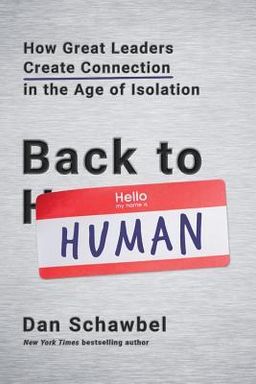
Back to Human cover

Back to Human

by Dan Schawbel

Back to Human provides a roadmap for leaders to cultivate a human-centric workplace in a technology-driven world. Dan Schawbel shows how fostering genuine relationships and empathy can lead to happier employees and better business outcomes.

Reconnecting Humanity in the Age of Technology

When was the last time you felt truly heard at work—without staring at a screen? In Back to Human: How Great Leaders Create Connection in the Age of Isolation, Dan Schawbel asks this haunting question of our times. He argues that our modern workplaces—dominated by smartphones, collaboration apps, and remote tools—have created an illusion of connection while feeding a crisis of loneliness, disconnection, and burnout. His core message is simple but urgent: technology should be the servant of human connection, not its master.

Schawbel contends that the spectacular connectivity offered by technology—instant messaging, 24/7 emails, digital meetings—has ironically stripped work of empathy, purpose, and human touch. Despite the ease of communication, employees around the globe report increasing isolation and disengagement. The author’s central mission is to help leaders replace digital overload with meaningful human engagement and transform managers into empathetic, present, and connected guides who bring teams back to human.

Technology’s Illusion of Connection

Schawbel opens with striking data: most employees spend five hours a day on mobile devices and touch their phones more than 2,600 times daily. These habits, he explains, activate dopamine-driven feedback loops, mirroring addictive patterns like gambling. We feel connected online but are emotionally detached in person. He draws on research from Gallup and Harvard showing that meaningful relationships—not compensation or convenience—predict well-being and long-term satisfaction. Yet workplaces are increasingly robotic, with artificial intelligence replacing not only tasks but the very interpersonal warmth that makes us human.

The book situates this cultural shift in a historical context: technology once promised freedom, collaboration, and innovation, but now demands constant availability, erases boundaries, and rewards surface-level engagement. The result is a global loneliness epidemic so severe that governments like those in the U.K. and Japan have appointed ministers for loneliness. Schawbel’s warning echoes psychologist Sherry Turkle’s concern from Reclaiming Conversation: we have lost the art of conversation itself, mistaking screens for relationships.

The Human Imperative for Leadership

Schawbel asserts that good leaders are “human connectors.” He urges leaders to cultivate empathy, purpose, belonging, and happiness rather than relying solely on productivity metrics. Through extensive global research with Future Workplace and Virgin Pulse, he finds that employee engagement hinges on four human factors—happiness, belonging, purpose, and trust—each eroded by excessive technology use. He positions leaders as orchestrators of emotional connection, not just administrators of workflow. His practical exercises—like face-to-face conversations, gratitude rituals, and collaborative learning—retrain teams toward emotional intelligence, mirroring Daniel Goleman’s work on social competence.

Three Levels of Connection

The book unfolds in three parts, each representing a deeper layer of connection. Part I (“Master Self-Connection”) helps readers rediscover personal fulfillment through mindfulness, time management, and learning. Part II (“Create Team Connection”) expands outward to the social realm—diversity of ideas, recognition, and collaboration—emphasizing relationships as the currency of success. Part III (“Build Organizational Connection”) moves to the systemic level, focusing on hiring for personality, empathetic leadership, and improving the employee experience across the life cycle. Schawbel blends psychological insight with pragmatic leadership guidance, showing that every link in this chain—self, team, and organization—relies on genuine human connection.

Why It Matters Now

In an era of automation and artificial intelligence, Schawbel’s vision feels prophetic. He echoes the warnings of Tim Cook, Elon Musk, and Stephen Hawking, who caution that technology’s unchecked expansion may dehumanize work itself. Yet Schawbel is not anti-technology; he’s pro-intention. He invites readers to use digital tools deliberately—to schedule more in-person interactions, share gratitude authentically, and design workplaces where empathy thrives. In short, human connection is not just emotionally fulfilling—it’s a competitive advantage.

“We need to use technology to foster deeper connections, not substitute them.” —Dan Schawbel

Throughout Back to Human, Schawbel challenges leaders to reclaim attention, presence, and empathy as the new revolutions of work. The result is a roadmap for balancing innovation with humanity—a leadership manifesto for anyone ready to trade isolation for authentic collaboration and meaning.


Focus on Fulfillment

Schawbel begins his journey with the idea of fulfillment—what it truly means to thrive in a hyperconnected, overstretched workplace. He observes that despite instant communication and inflated social feeds, workers are burning out, disconnected, and searching for meaning. Fulfillment, he argues, is not just happiness but the ongoing alignment between your values, relationships, and purpose.

Technology and Loneliness

The author cites research from the University of Pittsburgh showing that two hours of social media use doubles one’s sense of isolation. Instead of genuine social interaction, we compare our lives to curated online images, triggering envy and depression. In Schawbel’s interviews, leaders like Andrew Miele at Four Seasons and Dan Klamm at Nielsen confirm that virtual exchanges cannot replace the empathy and focus of face-to-face conversations. This “digital paradox” explains why employees feel lonelier despite constant connectivity.

Well-Being and Burnout

Burnout, according to Schawbel’s research with Kronos, fuels almost one-third of employee turnover. Workers labor longer hours for stagnant pay while neglecting mental and physical health. He highlights simple wellness routines—like Honeywell director Kiah Erlich’s boxing sessions or Adidas manager Vicki Ng deleting her email app during vacations—that restore energy and happiness. These personal boundaries create balance, countering the myth of “work-life balance” with the more realistic concept of “work-life integration.”

Five Paths to Fulfillment

Schawbel defines five dimensions of fulfillment: connection, values, purpose, openness, and accomplishment. Connection depends on relationships, echoing Maslow’s hierarchy where belonging precedes achievement. Values and purpose give your work deeper meaning, while openness fosters adaptability and empathy. Finally, accomplishment nurtures pride through completing meaningful goals. The higher you rise in these dimensions, the more aligned your inner world becomes with your actions.

Helping Your Team Find Meaning

Fulfilled leaders create fulfilled teams. Schawbel encourages managers to hold “purpose conversations”—asking team members what drives them and designing development plans accordingly. When leaders listen actively and remove technological distractions, they transform routine check-ins into moments of trust. Virgin Pulse’s Rajiv Kumar notes that close friends at work can lift morale after setbacks: “A bad day becomes bearable when you have someone who cares.” In essence, fulfillment is contagious.

Compare this to Viktor Frankl’s insight from Man’s Search for Meaning: happiness cannot be pursued; it must ensue from purpose. Schawbel brings that wisdom into modern corporate life—fulfillment isn’t about perks or promotions but about being seen, valued, and connected. Until you reclaim those human essentials, no amount of technology will make work worthwhile.


Optimize Your Productivity

Schawbel reframes productivity as a human-centered discipline rather than a race against devices. He begins with a startling observation: employees switch their attention every sixty seconds, bombarded by notifications, emails, and instant messages. The cure isn’t downloading more apps—it’s reclaiming focus, time, and intention.

Breaking the Cycle of Distraction

To identify digital addiction, Schawbel proposes a self-assessment, noting how our dopamine-driven habits make us check phones compulsively. He encourages leaders to model restraint by holding technology-free meetings. Stephanie Bixler of Scholastic declares email the “enemy of productivity” because it creates confusion and hides responsibility. Instead, face-to-face requests—found to be 34 times more effective—restore accountability and clarity.

Three Actions to Regain Focus

  • Procrastinate less: break daunting tasks into smaller milestones. This simple restructuring prevents burnout and delays.
  • Resist perfectionism: perfection, Schawbel warns, is a weakness disguised as strength. Leaders like Honeywell’s Kiah Erlich remind employees that “no answer found online” moments activate creativity, not failure.
  • Stop multitasking: neuroscientific research shows that multitasking fragments attention. Derek Baltuskonis at Intuit learned to prioritize and sequence work instead, completing 80 percent before seeking feedback.

Designing Human-Centered Work Habits

Schawbel introduces the idea of “flow” as the state of deep concentration where creativity flourishes. Flow, he explains, requires structure: defined goals, healthy breaks, and boundaries against interruptions. Leaders can optimize productivity through delegation and respect for team rhythms. Examples from MGM’s Chris Gumiela and Viacom’s Sarah Unger illustrate how managers empower teams by offloading design work or scheduling creative sessions strategically.

The Human Side of Efficiency

True productivity comes from balancing performance with wellness. Schawbel offers granular advice on sleep (7–9 hours), nutrition, and regular exercise—all proven to enhance attention and reduce absenteeism. Tools like Pomodoro timers or daily goal sheets support humans, not replace them. “If you don’t protect your calendar,” says Honeywell’s Kiah Erlich, “others will consume your sanity.” Productivity, then, is about mastery of energy, not technology.

Echoing Cal Newport’s Deep Work, Schawbel insists that digital minimalism is not deprivation but liberation. You aren’t competing with robots; you’re reclaiming what makes you human—focus, flow, and fulfillment.


Practice Shared Learning

Modern workplaces often reward individual expertise, but Schawbel argues that survival now depends on “shared learning”—the continual exchange of skills and insights across teams. In an era where the half-life of a skill is just five years, the ability to learn collaboratively is a leader’s greatest asset.

From Self-Learning to Team Learning

Instead of hoarding knowledge, leaders must circulate it. Shared learners proactively train teammates before being asked, building cultures of mutual growth. Heather Samp of American Airlines observes, “Sharing your knowledge allows you to move to new challenges.” When everyone teaches everyone else, silos dissolve and trust expands.

Overcoming Barriers to Sharing

Ego and complacency are the biggest obstacles. Leaders fear losing power by giving away knowledge. Schawbel counters that true expertise multiplies when shared. Understanding different learning styles—visual, kinesthetic, collaborative—makes knowledge transfer more effective. Videoconferencing and social tools can help distributed teams maintain contact, but human discussion remains irreplaceable.

Creating a Shared Learning Culture

Schawbel outlines actionable steps: give frequent feedback, track accomplishments, promote flexibility, and reward generosity. Recognize helpers publicly and customize training plans with individual career goals. At REI, Paolo Mottola hosts podcast discussions to share best practices, while Unilever’s Tracy Shepard-Rashkin created lunchtime “knowledge clubs” to spread new industry insights. These small gestures build ecosystems of continuous education.

Generational Exchange and Mutual Mentorship

Older workers contribute wisdom and emotional intelligence; younger workers bring technological fluency and optimism. Schawbel showcases leaders like Cisco’s Caroline Guenther, who learn supply-chain knowledge from veterans while teaching digital systems in return. This reciprocal mentorship bridges generational divides and creates belonging. Jessica Latimer’s effort to teach social media to older colleagues at Alex and Ani exemplifies shared learning’s potential as community building.

(Note: Peter Senge’s concept of “learning organizations” in The Fifth Discipline parallels Schawbel’s approach—continuous education is not an HR initiative but a cultural lifeline.) In connected workplaces, shared learning is survival through solidarity.


Promote Diverse Ideas

Diversity today extends far beyond demographics—it’s about the diversity of thought. Schawbel argues that teams stagnate when they fall into “groupthink,” the trap of unanimous agreement. Creativity flourishes only when multiple viewpoints challenge each other respectfully.

Groupthink: The Silent Killer of Innovation

Schawbel cites Volkswagen’s emissions scandal as an example of homogeneous thinking. Engineers sought unanimity, not questioning, and the lack of dissent led to deception and billions in losses. Pixar’s Ed Catmull provides the antidote: managers must make risk-taking safe. “It’s not a manager’s job to prevent risk—it’s to make it safe to take them.” Diverse ideas reduce risk by multiplying perspectives.

Building a Culture of Dialogue

Schawbel encourages leaders to hire unconventional candidates and commit to inclusion. Lauren Rivera’s Kellogg study on cultural matching shows that most firms hire “people like us,” narrowing creativity. Replacing this pattern with curiosity-driven recruitment builds innovation. Leaders such as Jenna Lebel at Liberty Mutual advocate for “get fired” ideas—audacious proposals that may fail but teach fast.

Managing Diversity in Practice

  • Hold anonymous brainstorming to encourage shy voices.
  • Create safe spaces where mistakes are viewed as learning.
  • Reward thoughtful dissent and curiosity through recognition.

Through examples like Amit Trivedi at Xerox bridging generational divides and Sjoerd Gehring at Johnson & Johnson transforming “Ideas over Titles” into office mantra, Schawbel shows practical pathways for inclusion that goes beyond slogans.

Beyond Demographics: The Psychology of Difference

Psychologist Steven Pressfield’s notion of “resistance” captures the fear of change. Schawbel reframes resistance as courage—choosing openness over comfort. He links diverse thought to psychological safety, echoing Google’s Project Aristotle findings that teams perform best when members feel safe to speak honestly. Diverse ideas make companies resilient, and empathy makes diversity thrive.

In essence, diversity is less about who you hire and more about what conversations you allow. True innovation emerges when leaders create cultures where difference is not tolerated—it’s celebrated.


Empathy: The Heart of Leadership

Empathy, Schawbel insists, is the ultimate leadership skill for the digital era. Where data governs decisions, empathy governs people. He defines it as “understanding others’ feelings as if they were your own.” Without empathy, cultures decay into harassment, greed, and distrust—the opposite of sustainable success.

The Cost of Empathy Deficit

Using examples like Uber’s harassment scandals and Wells Fargo’s fraudulent accounts, Schawbel demonstrates how empathy failures at leadership levels breed toxic workplaces. Pew Research shows 41% of people encounter harassment online, worsened by leaders who trivialize pain. These environments fuel turnover, lawsuits, and moral collapse. Empathy isn’t softness—it’s self-preservation.

Technology and Emotional Numbness

Technology dulls our emotional sensitivity. UCLA’s Gary Small found that overexposure to screens reduces teens’ ability to recognize emotion. MIT professor Sherry Turkle warns that texting robs apology of warmth. Schawbel corroborates with personal stories of digital breakup pain, illustrating how digital convenience erodes compassion. Leaders must re-practice being human—eye contact, listening, and personal gestures of care.

Empathy in Action

Empathetic leaders like Elon Musk and Satya Nadella model vulnerability. After Tesla injuries, Musk wrote an emotional letter pledging to meet every affected worker and perform their tasks himself. Nadella, shaped by parenting a disabled child, infused Microsoft’s culture with understanding over command. These examples prove that empathy increases loyalty and innovation—leaders who feel elevate those who follow.

Cultivating Empathy Daily

Schawbel offers actionable practices: ask “How are you feeling?” instead of “How are you doing?”; put phones away during conversations; summarize what you hear with emotional accuracy. He frames empathy as teachable through habits, similar to Brené Brown’s concept of vulnerability as courage. Studies from the Center for Creative Leadership confirm that empathy correlates with higher performance and ethics. Listening and care make teams thrive.

Empathy, Schawbel concludes, is the cure for our age of apathy. When leaders restore compassion, they restore humanity itself.


Improve Employee Experiences

Schawbel culminates his argument by redefining “employee experience” as the sum of every human interaction across the life cycle—from recruitment to departing farewell. Creating exceptional experiences, he says, isn’t about perks like ping-pong tables but about meaningful, consistent relationships, culture, and space.

The Five Rules of Experience Design

  • Be consistent—avoid favoritism and bias.
  • Build culture that sustains when you’re not present.
  • Understand each employee as an individual.
  • Empower employees to co-create their experience.
  • Rely less on devices—add human touch everywhere.

Three Dimensions of Experience

Employee experience spans culture, relationships, and space. A vibrant culture communicates belonging through rituals and shared language—like the “GSD” motto at Scholastic that transformed a team into a proud identity. Relationships make work family-like, as Porsche’s Peter Schutz proved by rebuilding culture through emotional connection rather than layoffs. Space, meanwhile, affects mood and creativity: workers allowed to decorate their offices showed 32% higher productivity and commitment.

Let Employees Define Their World

Empowered employees create meaningful experiences. Erin Yang at Workday invited teams to co-design their office space using Pinterest boards and snack polls, boosting both engagement and ownership. Caroline Guenther at Cisco showed how small gestures—like allowing dogs at work—foster joy and flexibility. These examples highlight that autonomy builds emotional investment far better than managerial mandates.

Beyond Perks: The Business Case

Data from Deloitte, IBM, and Globoforce back Schawbel’s claims: positive experiences drive retention, social connection, and performance. Over 80% of executives acknowledge its strategic importance, yet only 22% excel at it. He urges ongoing measurement and feedback—from onboarding to offboarding—to identify gaps. Listening and acting on feedback, as Viacom’s Sarah Unger did with office post-it suggestions, turns complaints into collaboration.

Ultimately, Schawbel reframes employee experience as a leadership mirror: how people feel about their work reflects how leaders treat them. When leaders choose empathy, trust, and inclusion, experience becomes not a perk—but a relationship that lasts.

Dig Deeper

Get personalized prompts to apply these lessons to your life and deepen your understanding.

Go Deeper

Get the Full Experience

Download Insight Books for AI-powered reflections, quizzes, and more.