
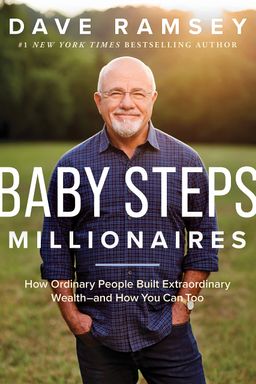
Baby Steps Millionaires cover

Baby Steps Millionaires

by Dave Ramsey

Baby Steps Millionaires by Dave Ramsey reveals a proven pathway for anyone to achieve millionaire status. Through practical steps and real-life success stories, this book transforms the daunting journey to wealth into an attainable reality for ordinary individuals.

Becoming a Baby Steps Millionaire: Hope, Discipline, and Proven Steps to Wealth

What if becoming a millionaire wasn’t about luck, privilege, or winning the lottery—but a clear, predictable journey open to anyone who’s willing to follow the right steps? In Baby Steps Millionaires, Dave Ramsey argues that ordinary people can achieve extraordinary wealth if they embrace disciplined habits, reject the lies of a debt-driven culture, and follow his seven Baby Steps. He contends that wealth creation isn’t about financial genius or insider information—it’s about financial behavior, patience, and belief.

Over the past three decades, through his radio show, classes, and millions of success stories, Ramsey has shown that lasting wealth is built not through schemes or shortcuts but through steady work and sound priorities. This book is both an inspiration and a road map, combining heartwarming real-life stories with statistical proof from the largest-ever study of U.S. millionaires—the Ramsey Solutions’ National Study of Millionaires.

The Core Premise: Anyone Can Build Wealth

Ramsey challenges one of the most toxic beliefs in modern culture: that only a privileged few—those born into money, those with elite degrees, or those who inherit wealth—can become millionaires. He argues that this myth benefits the financial industry, which profits by keeping people dependent on debt and short-term gratification. Instead, Ramsey presents the Baby Steps as a proven path that millions have used to build seven-figure net worths.

These steps are deceptively simple: start with a $1,000 emergency fund, pay off all consumer debt using the debt snowball, save three to six months of expenses, invest 15% of income into retirement, save for kids’ college, pay off your home early, and finally, build wealth and give generously. In Ramsey’s world, the formula for financial freedom is behavioral and spiritual—rooted in self-control, sacrifice, and gratitude.

Why It Matters: Hope Over Hopelessness

Ramsey frames this book as a “message of hope.” He insists that the average person is not trapped by their circumstances but by their beliefs. In his view, the cultural obsession with instant gratification, debt, and status has blinded people to the power of small, consistent progress. By showing the stories of real people—teachers, engineers, single moms, and couples who started in debt and ended as millionaires—Ramsey’s main point is that wealth is not random. It’s a harvest born of discipline over time.

Hope is not wishful thinking; it’s the byproduct of seeing that other people “just like you” have done it before. Ramsey weaves stories like Tiffany—the single mom who conquered debt and built a net worth of $1.8 million—and John and Maddi, who rebuilt their marriage and finances to become multimillionaires. His larger message: your background does not determine your destiny, your behavior does.

Faith, Belief, and the Battle Against Lies

A major theme throughout the book is belief—spiritual and practical. Ramsey argues that people fail to build wealth because they’ve been sold lies by what he calls a “toxic money culture”: that debt is normal, that financial success is impossible, and that wealth is immoral. Against this cultural backdrop, he presents wealth building as morally good and deeply biblical: wealth gained through diligence and service to others allows for generosity and legacy. Belief, he argues, is the foundation that sustains discipline when circumstances get hard.

The faith component underscores the book’s Christian context. Ramsey quotes Proverbs and Hebrews to remind readers that discipline and stewardship produce peace and blessings. But even secular readers will recognize the psychological principle: people with a growth mindset (as psychologist Carol Dweck describes) and internal locus of control are far more likely to achieve financial goals.

From Research to Real Life

To move beyond anecdote, Ramsey anchors his teachings in data. His National Study of Millionaires surveyed over 10,000 millionaires and found that 79% did not inherit their wealth; most worked in ordinary careers, attended public universities, and saved consistently over decades. The average millionaire, according to the study, took about 17 years from starting the Baby Steps to reach a net worth of $1 million. Ramsey uses this to underscore his claim that the Baby Steps aren’t a theory—they are statistically verified best practices.

These millionaires were not day traders or Silicon Valley founders; they were engineers, teachers, managers, and accountants. They lived below their means, avoided debt, and invested diligently in 401(k)s and IRAs. Most notably, two-thirds lived in neighborhoods where household incomes were under $75,000, and the average home size was a modest 2,600 square feet. Ramsey’s lesson: the true millionaire next door still exists.

A Journey of Character, Not Complexity

Despite its financial focus, Baby Steps Millionaires is a character development book as much as a money manual. Ramsey insists that wealth and wisdom grow together—you need the maturity to handle success without letting it ruin you. He weaves in his own rise, bankruptcy, and rebuilding process, arguing that humility, generosity, and stewardship protect both your wealth and your soul.

Ultimately, Ramsey’s thesis is simple but radical: you can become a millionaire by following a simple, moral, time-tested plan. This book exists to destroy the myth that money mastery is reserved for the privileged few. If you believe you can, follow the Baby Steps, and stay disciplined through setbacks, you will reach financial peace—and maybe more importantly, the freedom to live and give abundantly.


The Baby Steps: A Blueprint for Financial Freedom

Dave Ramsey’s seven Baby Steps form the core of his philosophy, a simple yet structured method that charts the fastest, most reliable path to financial independence. He presents these steps as universal “best practices” that work regardless of income, education, or background. Each step builds sequentially, creating behavioral muscle and spiritual grounding along the way.

Steps 1–3: The Sprint Out of Debt

The first three steps are an emotional and financial sprint. They focus on breaking the cycle of debt and creating financial stability. Step 1 is to save a $1,000 starter emergency fund—small but strategic. This protects you from falling deeper into debt when life inevitably “happens.” Step 2 uses the debt snowball, where you list debts from smallest to largest and pay them off in order, ignoring interest rates. This builds psychological momentum (similar to James Clear’s habit stacking in Atomic Habits).

Step 3 expands the emergency fund to cover 3–6 months of expenses, creating a safety net that allows you to breathe and plan. Completing this step gives you stability—no more panicking over car repairs or medical bills—and prepares you for the long haul of investing.

Steps 4–7: The Marathon to Wealth

Once debt-free, the race transforms into a marathon. Step 4 begins wealth building with 15% of your pre-tax income invested in retirement through good growth stock mutual funds. Ramsey divides investments into four equal categories: growth and income, growth, aggressive growth, and international. The goal is not speculation but consistency—because wealth comes from steady, ongoing investment, not timing the market.

Step 5 is saving for kids’ college through 529 plans or ESAs if applicable. Step 6 accelerates paying off your home early—Ramsey’s research confirms that 67% of millionaires have paid-off homes, typically within 10–12 years. Step 7 is the capstone: build wealth and be generous. Here, giving transitions from duty to joy. Ramsey reminds us that “people with no debt can do anything they want,” and the greatest freedom is the ability to give outrageously.

“The plan is simple, but it isn’t easy.”

Ramsey emphasizes that these steps demand sacrifice, focus, and resilience. Friends might mock you, budgets may strain, but the life that follows—peaceful, generous, and free—is worth the temporary discomfort.

When viewed as a behavioral system rather than a financial trick, the Baby Steps represent something radical: a return to intentional living. They shift you from consumer dependence to creator independence. Discipline replaces desperation, and generosity replaces greed. And as Ramsey’s data shows, this predictable path produces predictable results—a net worth of $1 million or more within two decades, achieved by everyday individuals who simply refused to quit.


Mindset and Belief: The Foundation of Wealth

At the heart of Ramsey’s teaching is a surprising insight: wealth is only partly about money; it’s primarily about mindset. In Chapter 5, “Belief versus Barriers,” he argues that the biggest obstacle to wealth isn’t poverty, racism, or education—it’s unbelief. To him, belief acts like an internal engine that fuels consistent, disciplined behavior even when circumstances are difficult.

The Power of Belief and the Lie of Victimhood

Ramsey introduces Jackie, who grew up in poverty, became a single mom, and still reached a net worth of $1.5 million. Her story, along with others, illustrates his thesis: belief creates behavior, and behavior creates results. Without belief, people succumb to a “victim mentality” and never act. He quotes Henry Ford: “Whether you think you can or you think you can’t—you’re right.”

Ramsey doesn’t deny that systemic barriers exist—he acknowledges racism, income inequality, and broken institutions—but he insists these barriers are not invincible. His research on immigrants supports this claim: despite starting behind, immigrants are statistically more likely to start businesses and build wealth because they believe America offers opportunity.

Controlling the Controllables

Belief alone isn’t magic—it fuels control. Ramsey teaches that those who succeed focus on what they can change. Among the over 10,000 millionaires surveyed, 97% said they believe they control their own destiny, compared to only 69% of the general public. That single mental shift—from life happening to you, to life responding to you—defines the difference between stagnation and success.

“Belief will cause you to be the hero of your own story.”

Ramsey argues that empowerment starts when you stop blaming systems or stereotypes and start taking ownership. You become the protagonist, not the victim.

Ultimately, Ramsey’s approach to mindset mirrors psychological research on grit and self-efficacy. Like Angela Duckworth’s Grit or Carol Dweck’s Mindset, he ties financial success to disciplined optimism—the belief that the finish line exists and effort matters. As faith meets perseverance, disbelief dissolves, and what once felt impossible becomes inevitable.


Slow Is Fast: The Power of Diligence Over Quick Riches

In Chapter 6, Ramsey dismantles the obsession with “getting rich quick.” He contrasts his early life—making millions through risky, debt-fueled real estate in his twenties and losing it all in bankruptcy—with the slow, steady wealth that followed once he embraced diligence. His message is both cautionary and redemptive: wealth built fast often vanishes faster.

Why Quick Money Fails

Ramsey recalls a misguided era of “nothing-down” real estate schemes and empty promises sold in hotel ballrooms. Virtually everyone he met in that world went broke, including the guru who wrote the book they followed. The lesson? You can’t outsmart time or character formation. Proverbs 13:11 captures his point: “Wealth gained hastily will dwindle, but whoever gathers little by little will increase it.”

The Tortoise Always Wins

To illustrate, Ramsey revisits Aesop’s fable The Tortoise and the Hare. Even billionaires he’s met cite the same principle: focus beats flash, patience beats pride. In building wealth, slow is the quickest right way. Millionaires from his study took an average of 17 years after starting the Baby Steps to reach $1 million—not overnight, but within a career span.

Ramsey likens disciplined wealth-building to athlete Simen Krueger’s Olympic story: after falling and starting last, he methodically caught up lap by lap to win gold. That’s the Baby Steps story in motion—persistence outperforming panic.

“The quickest way to get rich quick is to get rich slow.”

Ramsey reframes patience not as delay but as acceleration. In finance, the compounding effect of steady habits beats short-term gambles every time.

For Ramsey, time refines both wealth and the person accumulating it. As your money grows, so does your wisdom and faith—protecting you from the arrogance and collapse that often follow sudden success. Diligence, not dynamism, becomes the true superpower.


Millionaire, Not Billionaire: Redefining Success and Contentment

In Chapter 4, Ramsey corrects a cultural misconception: being a millionaire is not the same as being a billionaire. He spotlights Jeff Bezos and Elon Musk to demonstrate the difference—a billionaire has a thousand times more wealth than a millionaire. While billionaires live detached, extreme lives, most millionaires are ordinary Americans who live modestly, work diligently, and give generously.

Ramsey introduces Clint and Brittany, a couple who paid off student loans, lived simply, and reached a $1.3 million net worth by age 37. They own a modest home and drive Hondas—not yachts or jets. On paper, this seems average, but in reality, it’s extraordinary: freedom without extravagance.

Success Without Excess

By contrasting Mount Everest (billionaire wealth) with Clingmans Dome (millionaire wealth), Ramsey illustrates that the climb to seven figures is challenging but doable. Anyone can make it to the summit if they follow a plan, while trying to scale Everest without oxygen—i.e., chasing billionaire dreams without fundamentals—leads to collapse.

He cites the National Study of Millionaires data: 93% of millionaires didn’t inherit wealth, 62% graduated from public colleges, and half earned B averages or lower. Most live in 2,600 square foot homes and use shopping lists and coupons. Their habits—not their incomes—made them wealthy.

“A millionaire looks a lot like you.”

Ramsey argues that when you see yourself in their stories, you’re seeing possibility—not privilege.

Ramsey’s purpose in redefining “millionaire” is to make the dream feel human again. Financial independence is within reach for any disciplined household earning and investing consistently. The aim is not opulence—it’s freedom and generosity. You don’t need to be Jeff Bezos to be wealthy; you just need to be intentional and content.


Raising Responsible Kids: Wealth That Blesses, Not Curses

In Chapter 7, “Will Wealth Ruin My Kids?”, Ramsey turns his attention to one of parents’ deepest fears: that financial success might spoil their children. He reassures readers that wealth itself doesn’t ruin anyone—entitlement does—and the antidote is teaching stewardship and character.

He introduces five behaviors that inoculate kids against entitlement: Work, Give, Save, Spend, and Steward. Each one is a skill of both the wallet and the heart.

Work and Earn

Ramsey opposes allowances (handouts) and advocates commissions (pay tied to chores). Work builds dignity and cause-and-effect thinking. His example of Ben, who began mowing lawns at 14 and became a millionaire by 40, shows how discipline compounds like interest.

Give and Save

Children trained to give regular portions of their income learn gratitude and empathy. Ramsey’s envelope system—dividing money into Give, Save, and Spend categories—instills early budgeting habits. Kids who tithe or give learn joy, not loss, in generosity. Saving, meanwhile, trains patience in a culture obsessed with immediacy.

Steward and Spend Wisely

Finally, stewardship teaches kids to see ownership as temporary responsibility—a theme rooted in Ramsey’s faith. Sharing how his own children manage wealth ethically, he shows that parents who model integrity, consistency, and generosity raise kids who handle success well. Wealth, in this framework, becomes a tool for service, not status.

The underlying message is timeless: rather than fear wealth’s power, use it to plant strong values. Money doesn’t change your children—it magnifies who they already are. When parents model hard work, humility, and giving, prosperity becomes generational, not poisonous.


Wealth as a Moral Good: The Truth About Money and Character

In Chapter 8, Ramsey confronts one of the most persistent myths in both society and church: that money is evil. He reclaims wealth as morally neutral—its virtue rests in the user’s heart. Through scripture and logic, he dismantles guilt-based thinking about prosperity.

He recounts how, after rebuilding from bankruptcy, he bought a used Jaguar and instantly felt shame, fearing judgment. Yet he realized that wealth gained righteously—debt-free, with generosity—is nothing to apologize for. Quoting Ecclesiastes, he says enjoying the fruits of your labor is “the gift of God.”

Equal Doesn’t Mean Fair

Ramsey argues that fairness lies in opportunity, not equal outcomes. Equal wealth would be unjust because effort, talent, and service differ. He urges readers to abandon the scarcity mindset—the belief that one person’s success deprives another. Citing his mentor Rabbi Daniel Lapin, he calls wealth creation inherently moral when it serves others: business and generosity are both sacred acts.

Faith and Generosity

Ramsey highlights the Jewish tradition of the Havdalah—wine overflowing into a saucer as a symbol of abundance poured out for others. Likewise, he says Christians are called to fill their cup and let it overflow in giving. Wealth, in this worldview, multiplies goodness when stewarded responsibly.

“Money isn’t the root of evil—the love of money is.”

Ramsey insists that greed, not gain, is the problem. When money becomes a tool of service rather than identity, it blesses everyone it touches.

By reframing money as a moral resource, Ramsey liberates readers from guilt and fear. In place of shame, he offers stewardship. The wealthy aren’t villains—they’re potential vessels for impact. When handled God’s way, wealth becomes not a symbol of pride but of purpose.


A Millionaire Movement: Everyday Wealth for Every Neighborhood

Ramsey closes the book with a vision that extends beyond personal success: an America filled with “Baby Steps Millionaires in every neighborhood.” In Chapter 9, he profiles Rafael and JoBeth, an immigrant couple who rose from poverty to millionaire status by age 40 through persistence and the Baby Steps. Their story captures his dream—ordinary families transforming their communities by modeling hope, discipline, and abundance.

Rafael grew up in war-torn El Salvador and immigrated to the U.S. in poverty. Years later, after discovering Financial Peace University, he and his wife paid off all debt, saved, invested, and gave generously. Today they coach others to do the same. It’s a full-circle picture of stewardship and empowerment.

Hope as an Economic Catalyst

Ramsey calls hope “the secret fuel of transformation.” Without it, people stay trapped in fear and dependence. His dream neighborhoods overflow with homeowners, givers, small-business owners, and families free from debt. The ripple effect: reduced poverty, fewer predatory lenders, and stronger communities.

In his view, political ideologies can’t fix financial brokenness—personal responsibility can. A nation of financially free citizens creates resilience and generosity that no government program can replicate. Hope, multiplied across households, becomes systemic change.

Ramsey ends with spiritual encouragement. Quoting Jeremiah 29:11, he reminds readers that God’s plan includes prosperity—not as a guarantee of riches, but of purpose and hope. The final line is both rallying cry and invitation: take control, follow the steps, live intentionally, and then pass the light forward. The millionaire movement is not about numbers—it’s about hope changing lives.

Dig Deeper

Get personalized prompts to apply these lessons to your life and deepen your understanding.

Go Deeper

Get the Full Experience

Download Insight Books for AI-powered reflections, quizzes, and more.