
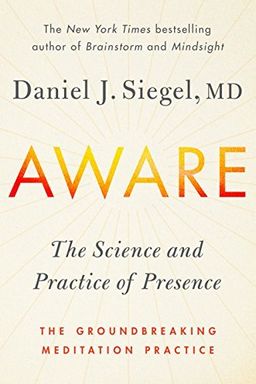
Aware cover

Aware

by Daniel J Siegel

Aware by Daniel J. Siegel reveals the transformative power of meditation, backed by neuroscience, to improve mental and physical health. Learn how mindfulness can make life more meaningful and joyous while fostering profound connections with the world and others.

Training Awareness and Integration

How can you deliberately train your mind to expand consciousness and live with more presence, connection, and compassion? In Aware, psychiatrist and neuroscientist Dr. Daniel J. Siegel offers a framework that unites brain science, contemplative practice, and a visionary model of consciousness. He argues that well-being and mental freedom come from integration—the balance of differentiation and linkage within the mind, body, and relationships. The book provides both a practical method—the Wheel of Awareness—and a scientific theory of how awareness itself may operate through energy and probability.

Siegel’s central claim is that the mind is not just the activity of the brain but an embodied and relational process that regulates the flow of energy and information. By learning to direct attention intentionally, open awareness spaciously, and cultivate kind intention, you reshape that flow toward harmony instead of chaos or rigidity. The Wheel of Awareness serves as both map and practice, helping you clarify what you’re aware of and who—or what—is the one being aware.

From Rim to Hub: Learning Mindful Awareness

You picture consciousness as a wheel: the rim holds everything you can know (from sensations and thoughts to relationships), the hub is pure awareness, and the spoke is your focus—your directed attention bridging the two. As you move the spoke through rim segments (five senses, internal sensations, mental activities, and relational connections), you practice noticing each element without being lost in it. Later, you bend the spoke inward to rest in awareness itself, experiencing what Siegel calls the “hub-in-hub” state—a wide, luminous sense of being that transcends ordinary self-definition.

This practice trains you to distinguish knowing from the known. Billy, a five-year-old, learned to use that distinction by saying, “I’m stuck on the rim, I need to get back to my hub.” His words embody Siegel’s purpose: to nurture a simple operational tool for awareness that children and adults alike can use to move from reaction to reflection.

Three Pillars That Rewire the Brain

The Wheel integrates three pillars of mind training: focused attention (moving the spoke with intention), open awareness (resting in the hub’s spaciousness), and kind intention (infusing practice with compassion). Focused attention builds clarity and regulatory strength; open awareness cultivates stability and peace; and kind intention transforms motivation into empathy and prosocial behavior. Together, they trigger neuroplastic change: “Where attention goes, neural firing flows, and neural connection grows.”

Clinical examples bring these pillars to life. Teresa, a trauma survivor, learned to reinterpret her panic as energy in the rim rather than identity in the hub. Zachary reduced chronic pain and found new meaning by practicing compassion phrases like “May all beings be happy.” These practices encode new, integrative traits through repeated experience, converting momentary states into enduring patterns of well-being.

Integration and Self-Organization

Integration is the book’s master concept. Health emerges when differentiated parts—body, emotion, memory, relationships—are linked into a coherent whole. Siegel describes this balance as a “fruit salad” rather than a smoothie: you maintain distinct flavors within an overall harmony. Integration yields flexibility, adaptability, coherence, energy, and stability (the FACES model). Without it, the system collapses into chaos (too loose) or rigidity (too tight). The Wheel’s process of differentiating rim points and linking them to the hub directly cultivates this integrative pattern, measurable both subjectively and neurologically.

Mind as Energy and Probability

Siegel expands beyond neuroscience to propose a unifying energy model—the “3‑P framework.” Energy becomes the movement from possibility to actuality. You live across three probability zones: the Plane of Possibility (total potential, felt as the hub’s spaciousness), Plateaus (mental filters that shape likely outcomes), and Peaks (specific thoughts or feelings actualized in awareness). Understanding this spectrum allows you to see how habitual plateaus like worry or shame predetermine what becomes real. Returning to the plane through hub practice opens new potential outcomes.

Siegel integrates evidence from connectome harmonics and 40‑Hz brain oscillations to propose how awareness physically functions as synchronized energy flow. These oscillatory sweeps link differentiated brain regions much like the Wheel links rim points to the hub. Practicing awareness stabilizes metastable networks—neural configurations that optimize flexibility between order and spontaneity.

Compassion and Relational Integration

Aware’s purpose is not personal serenity alone but relational health. Through kind intention you soften plateaus and expand empathy from “me” to “MWe”—an integrated Me+We. This stance of COAL (Curiosity, Openness, Acceptance, Love) transforms interactions and community life. Studies cited show that compassion practice improves cardiac and immune health while enriching emotional regulation and leadership. For parents, teachers, and leaders like Mona and Zachary, the Wheel becomes a social tool—promoting connection, repair, and collective integration.

Healing and Ethical Practice

Finally, Siegel emphasizes caution and clinical wisdom. Trauma survivors may need guided, gradual exposure to hub states. He distinguishes integration from spiritual bypass: you cannot use awareness to avoid pain. The Wheel’s ethics are grounded in care and realism—it’s better seen as a protocol for conscious presence than a shortcut to transcendence. Whether applied to children, families, or professionals, it’s the same lesson: awareness expands your container for pain and joy alike.

Core Argument

Consciousness is not a static state but a dynamic process of integration—shifting the movement of energy and information from possibility to actual experience. The Wheel of Awareness provides a reproducible practice to make that process visible, trainable, and transformative.

In essence, Aware gives you a scientific and experiential language for what contemplatives have long practiced: the deliberate cultivation of presence to heal, connect, and thrive. Through the Wheel, the 3-P model, and the principle of integration, Siegel invites you to realize awareness as both inner peace and interactive wholeness.


The Wheel of Awareness

Siegel’s Wheel of Awareness is both map and method—a visual meditation that lets you explore consciousness by moving attention deliberately. Its simplicity hides depth: the hub is awareness itself, the rim holds all experiences, and the spoke connects them. Every exercise revolves around learning to shift this spoke, so you can see your mind’s landscape instead of living lost inside it.

Structure and Practice

You start by grounding in breath, then move the spoke across four rim segments: the external senses (seeing, hearing, touching, tasting, smelling); interoception (internal sensations like heartbeat or tension); mental activities (thoughts, emotions, memories); and the relational sense (connection to others, nature, and meaning). After touring these segments, you bend the spoke inward for awareness of awareness—the hub-in-hub step.

This structure mirrors contemplative traditions but uses modern brain science. Each segment differentiates experiences; linking them to the hub integrates consciousness. Siegel likens the mind to water: the same tablespoon of salt—the pain or stress—tastes overwhelming in a small cup but barely noticeable in a vast reservoir of awareness.

Experiential Outcomes

Participants regularly describe spaciousness, timelessness, or deep calm. A child, Billy, used the image to stop an impulsive punch by remembering his hub. Jonathan, an adolescent, learned to regulate mood swings through repeated practice. Adults like Zachary found physical relief and new purpose. These examples demonstrate that expanding awareness changes both subjective experience and neural patterning.

Key Function

The Wheel operationalizes the difference between being aware and being swept away, enabling conscious regulation of attention and emotion. It transforms fleeting states into enduring traits through mindful repetition.

Applications and Adaptations

Siegel offers a 7-minute Compact Wheel for busy days and classroom-friendly versions for children. Whether the session lasts thirty minutes or five, the principle remains: differentiate experiences and link them through mindful attention. Over time, the Wheel strengthens regulation, emotional balance, and relational attunement—the hallmarks of integration.

Ultimately, the Wheel is less a meditation technique and more a representation of how mind functions. By practicing it, you learn that awareness itself—the hub—is the one constant among the changing rim. That realization is the beginning of freedom.


Attention and Awareness

Attention is the engine that drives consciousness. Siegel distinguishes focal attention—the spotlight you guide intentionally—from non-focal attention—the background monitoring that keeps you balanced and safe. Understanding both explains how you can steer your mind instead of being pulled by habits or distractions.

Focal vs. Non-Focal

Focal attention is the conscious beam that selects a rim point; non-focal attention regulates background systems (posture, balance, vigilance). Siegel’s hiking story illustrates this: your focal attention may follow a conversation while non-focal awareness keeps you from stumbling. Training the spoke in the Wheel amplifies focal control, allowing you to notice pulls—like worries or sudden noises—and redirect with kindness.

Guided vs. Pulled Attention

In practice, attention can be guided (intentional focusing) or pulled (reactive distraction). With repeated awareness training you learn to catch the pull, label it (“thinking, thinking”), and return. Even labeling simple distractions builds neurocircuits for monitoring and modulation—key parts of self-regulation.

Neuroscience Connection

Focused attention activates networks linking the insula, prefrontal cortex, and cingulate regions—systems vital for regulation and empathy. Open awareness expands connectivity, while kind intention modulates motivation circuits. The integration across these networks mirrors the spoke linking hub and rim. When Siegel says “energy and information flow where attention goes,” he captures this feedback between focus and neural mapping.

Training attention through breath and the Wheel enhances clarity, choice, and flexibility. Over time your mind becomes less pulled by peaks and more guided by awareness itself—the hallmark of maturity in consciousness.


Integration and Health

Integration—the coordinated balance of differentiation and linkage—is the cornerstone of Siegel’s vision of well-being. He defines a healthy mind as one that flows between chaos and rigidity, adapting flexibly to life’s challenges. The Wheel of Awareness mechanizes this process by encouraging you to separate experiences (differentiation) and connect them consciously (linkage).

Differentiation and Linkage

You differentiate rim segments—sights, bodily sensations, feelings—then link them to the stable hub of awareness. This movement refines your nervous regulation, integrating sensory, emotional, and cortical layers. Siegel’s “fruit salad” metaphor portrays integration as diversity maintained within unity. Neglecting that balance leads either to rigidity (too much control) or chaos (too little differentiation).

Clinical and Biological Effects

Research validates integration as health’s foundation: improved immune markers, reduced inflammation, enhanced regulation across prefrontal and hippocampal circuits. Trauma disrupts these systems, but practices like the Wheel restore cohesion. Teresa’s recovery illustrates this—her fragmented sensations gradually linked into coherent autobiographical memory. Integration turned survival reflex into conscious choice.

FACES Model

An integrated system displays Flexibility, Adaptability, Coherence, Energy, and Stability (FACES). These correspond to life quality markers—resilience, vitality, and emotional health. Practicing differentiation and linkage daily cultivates FACES both neurophysiologically and psychologically.

Integration transforms reactivity into response, isolation into connection, and rigidity into flow. For Siegel, this principle unites mind, brain, and relationships as a single self-organizing process guided by awareness.


Energy and the Plane of Possibility

Siegel’s most revolutionary idea is seeing consciousness through the lens of physics: energy as the movement from possibility to actuality. He builds a three-level model—the Plane of Possibility, Plateaus of Probability, and Peaks of Actuality—to map how thoughts and sensations arise.

Understanding the 3‑P Framework

The Plane of Possibility represents infinite potential—akin to the quantum vacuum or spacious awareness. Plateaus are learned mental filters—habits, moods, beliefs—that shape what’s likely. Peaks are the concrete experiences you perceive. A thought of fear or joy is a peak drawn from plateaus conditioned by experience. By resting in the hub, you access the Plane, loosening plateaus and allowing fresh outcomes.

Scientific and Practical Integration

Siegel links this model to neuroscience: the default mode network mirrors plateaus, sensory networks express peaks, and the hub aligns with the plane. Connecting consciously among these levels increases flexibility. He draws on thinkers like Arthur Zajonc and Jacob Biamonte to bridge quantum probability with subjective mental flow, illustrating that awareness moves energy from possibility into perception.

Everyday Implications

When you feel trapped in repetition—anger, rumination, fear—you’re stuck on certain plateaus. Accessing the Plane through hub practice widens probabilities and invites change. Over time, beliefs and identity soften, letting compassion and creativity emerge. The 3-P model thus connects the physics of possibility with psychological freedom.

Practicing awareness, then, is like tuning your mind between frequencies of probability—moving back to the Plane of open potential and choosing what becomes actual. Siegel presents this as both poetic and scientific: a language uniting neuroscience, physics, and contemplative insight.


Kind Intention and Compassion

Kind intention is the emotional and ethical heart of Siegel’s work. Beyond calm or clarity, he wants you to cultivate genuine compassion—toward yourself, others, and the larger world. This third pillar transforms awareness into empathy and supports connection as a biological and social necessity.

Training Compassion

You repeat phrases like “May all beings be happy, healthy, safe, and flourish,” directing them to others, yourself, and what Siegel calls MWe (Me + We). This verbal framing activates circuits of empathy and affiliation beyond cognitive networks. Studies show compassion training boosts immune health and brain integration. In clinical examples, Mona found less reactivity with her children; Teresa transformed fear into curiosity.

Empathy vs. Compassion

Siegel distinguishes empathy (feeling another’s state) from compassion (empathy plus caring response). Empathy alone may lead to distress; compassion sustains connection without burnout. Researchers like Tania Singer confirm this balance. Kind intention provides a neural buffer, promoting resilient altruism rather than emotional depletion.

Social and Global Integration

Cultivating COAL—Curiosity, Openness, Acceptance, Love—enlarges your awareness into relational presence. This emotional stance aligns with Siegel’s vision of an interconnected MWe consciousness, where compassion extends into policy, leadership, and collective well-being. In this view, awareness becomes a social technology for healing divisions and fostering belonging.

Kind intention thus completes the Wheel’s geometry: it links hub spaciousness with rim connection, transforming mindfulness from an inward act into an outward ethic of care.


Healing and Trauma Integration

For anyone recovering from adversity, Siegel offers a powerful message: trauma does not destroy the Plane of Possibility—it merely disconnects you from it. Integration restores that link. The Wheel provides a structured way to bring implicit sensations into explicit awareness safely, converting fragmented experiences into coherent memory.

Implicit and Explicit Memory

Trauma embeds as implicit memory—bodily feelings and impulses that activate automatically, feeling like the present. The hub allows secure access so you can tag them as past events, reducing their emotional grip. Teresa exemplifies this process: from panic to curiosity to peace, she learned to differentiate rim reactions from hub awareness.

Integration Pathway

Healing unfolds as implicit fragments are invited into awareness, contextualized, and woven with compassion. Each spoke movement from rim to hub reinforces safety and connection. Neuroscientifically, this reactivates the hippocampus and corpus callosum—systems damaged by trauma—while reestablishing prefrontal regulation.

Clinical Guidance

Siegel cautions against spiritual bypass—using hub spaciousness to avoid pain. He recommends gradual work, ideally supported by clinicians. Integration requires patience and kindness, not avoidance. The promise is resilience: the Plane itself remains intact and ready to be reclaimed whenever awareness returns.

Through trauma integration, the book demonstrates awareness’s capacity not just to calm but to repair—the mind’s natural ability to bring scattered parts back into harmony.


Living Integration Daily

The book concludes with practical integration. Awareness is not reserved for meditation cushions; it’s meant for meetings, meals, parenting, and pain. Siegel’s concept of sweep‑ratios lets you quantify states: 50/50 hub/rim for balanced awareness, 99/1 for deep absorption, and 100/0 for full hub spaciousness. Adjusting this ratio during daily life shifts perspective and emotion in real time.

Everyday Techniques

Try short sessions: a 5‑minute morning Wheel, or a breath focus before difficult conversations. The simple act of naming “I’m on the rim” interrupts autopilot and restores choice. Use the hub when pain spikes or stress rises—its spaciousness dilutes intensity. Even Siegel used the practice during a dental procedure to contextualize sensation and reduce fear.

Ethics and Safety

For trauma survivors, Siegel advocates gentle pacing and supportive environments. The Wheel is not a substitute for therapy but a supplement. Integration flourishes through balance, not force. Parents can teach the Wheel drawing to children; leaders can model hub awareness under pressure. Each use reinforces the same pattern: discern, link, rest, repeat.

Siegel’s final lesson is clear: conscious awareness is portable. Wherever you go, the hub travels with you—an inner refuge and a way to bring integration into every moment.

Dig Deeper

Get personalized prompts to apply these lessons to your life and deepen your understanding.

Go Deeper

Get the Full Experience

Download Insight Books for AI-powered reflections, quizzes, and more.