
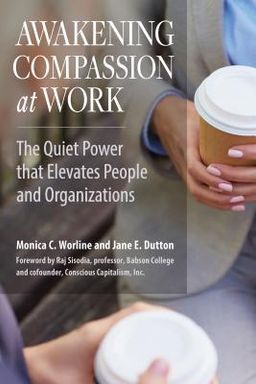
Awakening Compassion at Work cover

Awakening Compassion at Work

by Monica C Worline and Jane E Dutton

Awakening Compassion at Work explores how fostering empathy and compassion in the workplace can elevate both individuals and organizations. Through real-world examples and research, authors Monica C Worline and Jane E Dutton provide actionable insights on creating a supportive and innovative work culture.

The Quiet Power of Compassion at Work

Have you ever wondered why some workplaces feel uplifting—filled with energy, kindness, and creativity—while others crush the human spirit under pressure? In Awakening Compassion at Work, Monica Worline and Jane Dutton argue that the missing ingredient is compassion. Drawing on over fifteen years of research, they show that compassion isn’t just a moral virtue; it’s a strategic advantage that can transform organizations, improve performance, and renew people’s sense of meaning at work.

The authors contend that compassion—defined as the felt and enacted desire to alleviate suffering—is the hidden driver of innovation, engagement, and sustainable success. Wherever people work together, suffering inevitably occurs: through loss, stress, failure, illness, or change. Leaders often treat pain as irrelevant or inefficient to address. But Worline and Dutton demonstrate that noticing, interpreting, feeling, and acting compassionately turns these painful moments into opportunities for connection, learning, and growth.

Why Compassion Matters in Modern Work

The authors challenge traditional business beliefs that view compassion as “soft” or sentimental. Their research shows that compassion strengthens the bottom line. Kim Cameron’s studies on organizational “virtuousness” found that compassion correlates with higher profitability, productivity, and customer retention. When companies responded with care after periods of downsizing, employees stayed engaged rather than disengaged—and disengagement, as Gallup found after 9/11, can actively harm organizational performance. Compassion, they argue, is measurable, profitable, and essential to organizational excellence.

The Four-Part Process of Compassion

According to Worline and Dutton, compassion unfolds through four interrelated capacities: noticing suffering, interpreting its meaning in a generous way, feeling empathic concern, and acting to alleviate the pain. Understanding and cultivating each of these dimensions—in individuals, teams, and entire systems—creates what they call “compassion competence.” This competence can be learned, practiced, and designed into organizations.

In later chapters, the authors weave vivid stories showing how compassion functions across all levels of organizational life—from a manager who gives an employee time off to grieve, to an entire network of coworkers coordinating care for someone injured, to CEOs reimagining company culture to make compassion a norm rather than an exception.

From Personal Empathy to Organizational Strategy

Worline and Dutton move beyond personal kindness to explore compassion as a systemic capability. They introduce the concept of an organization’s “social architecture”—its networks, culture, roles, routines, and leadership stories—that shapes how empathy flows and action happens. A compassionate culture legitimizes emotions, encourages inquiry into suffering, and rewards caring behaviors. When these architectural elements align, compassion becomes part of how work gets done, not a side activity or crisis response.

The authors situate compassion alongside innovation and adaptability. They show that compassion fuels creativity by creating psychological safety (as Amy Edmondson’s research found) and energizes collaboration by building trust and respect. It motivates people through meaningful purpose rather than fear or competition. Thus, compassion isn’t a distraction from business—it’s the lifeblood of healthy human systems.

A Call to Awaken Courage and Care

Worline and Dutton’s book urges you to become a “compassion architect”—someone who designs conditions that enable people to notice and respond to suffering. They understand that workplaces can numb empathy through overload, fear, and incivility. But they also show how small acts—gentle inquiry, authentic listening, flexible time, respectful presence—can awaken compassion in everyday routines. Their message is not sentimental; it’s pragmatic and revolutionary.

“Compassion is not just a moral impulse; it is the quiet power that elevates people and organizations.”

The book concludes that compassion is humanity’s greatest untapped resource in work life. It is both a window of light in darkness and a strategic advantage in turbulent times. By awakening compassion—one act, team, and system at a time—you not only create better workplaces but also help heal the wider human community.


Noticing Suffering: The Portal of Awareness

You can’t respond to what you can’t see. The first step toward compassion is noticing suffering—a deceptively simple skill that turns out to be difficult in busy workplaces. Monica Worline and Jane Dutton describe noticing as a portal to compassion, because without this awareness, no empathetic or healing response can follow. Yet many organizations are structured to ignore suffering through policies, time pressure, and norms of emotional suppression.

Inquiry Work and the Courage to Ask

The authors introduce the idea of “inquiry work”—asking humble, curious questions that invite people to share what’s really happening. In one story, Sandeep, a manager, notices that Dorothy, a reliable employee, has been absent and distracted. Rather than reprimand her, he gently asks, “You haven’t been acting like yourself. What’s going on?” This question opens the door to the truth: Dorothy’s husband is dying of kidney failure. By noticing and asking with compassion, Sandeep prevents disciplinary action and helps Dorothy receive medical leave flexibility. Dorothy’s loyalty and commitment to work multiply in return.

Organizational Barriers to Noticing

Many organizations unintentionally blind us to others’ pain. Metrics, performance dashboards, and attendance policies turn people into data points. As philosopher Elaine Scarry observed, suffering is inherently inexpressible; those in pain often become silent. Employees may hide personal crises, fearing shame or punishment. Leaders, distracted by deadlines, overlook these human clues. The authors emphasize becoming a “first-class noticer” (a term borrowed from Max Bazerman)—learning to pick up small deviations in people’s energy or engagement as indicators of distress.

Spreading Attention in Networks

Compassion spreads through networks. When Sandeep gains permission to share Dorothy’s situation, coworkers rally to help—organizing coverage, providing emotional support, even raising funds for medical bills. This ripple effect shows what happens when attention expands from one interpersonal moment to an organizational pattern. Attention and care circulate when people talk openly about suffering rather than conceal it. Over time, noticing becomes a cultural norm instead of a rare act.

(In Amy Edmondson’s related research on psychological safety, openness about errors and vulnerability enables learning. Similarly, openness about suffering enables compassion.)

Practical Reflection

The authors encourage you to notice clues—changes in mood, energy, participation—and to ask gentle questions without judgment. When you grant others permission to share their experience, you help turn invisible pain into visible humanity. This simple act reconfigures power and connection in any workplace. By becoming better noticers, managers and peers create an environment where compassion can begin to flow naturally.


Interpreting Pain Generously

Once you notice suffering, the next step is how you interpret it. Do you view someone’s struggle as a weakness or a symptom of irresponsibility? Or do you see it through the lens of shared humanity? Worline and Dutton call this critical bridge “interpretation,” and they show that it determines whether compassion will open or close.

The Trap of Judgment

Interpretations can shut compassion down in three ways: by blaming the person for their suffering, deeming them undeserving, or believing you lack the capacity to help. When we think “They brought this on themselves” or “There’s nothing I can do,” empathy disappears. Research shows these appraisals happen unconsciously and quickly, shaped by culture, stereotypes, and organizational norms (psychologist Daniel Kahneman explained this in Thinking, Fast and Slow).

Philosopher Martha Nussbaum reminds us that institutions train our moral imagination—leaders can encourage seeing suffering as meaningful rather than shameful.

Generous Interpretations

Worline and Dutton propose three practices: withhold blame, imbue others with worth, and cultivate presence. Withholding blame means giving people the benefit of the doubt. Imbuing them with worth means recognizing their dignity regardless of status or mistakes. Cultivating presence means remaining steady and compassionate even when you can’t fix anything. These interpretations create psychological safety and open pathways for healing.

Fierce Compassion in Action

Sarah, a manager at Midwest Billing, embodies fierce compassion. When an employee exploded in a meeting—yelling and crying—Sarah resisted the urge to retaliate or fire her. She quietly waited, listened, and later discovered the woman was dealing with her husband’s infidelity and personal crisis. Sarah forgave her, turning conflict into healing. Compassion here isn’t sentimental; it’s courageous and disciplined. It calls you to act with humanity even when someone behaves badly.

“Making generous interpretations means extending dignity even when circumstances test your patience.”

The authors suggest practicing curiosity over judgment—asking, “What’s behind this person’s behavior?” instead of “What’s wrong with them?” This shift makes compassion practical and strong, grounded in reality and respect.


Feeling Empathy: The Bridge to Action

Compassion begins with emotion. Worline and Dutton call this stage “feeling”—the heart’s bridge between awareness and action. Drawing on neuroscience, they explain that empathy is both automatic and chosen: our brains mirror others’ pain, yet we can also decide to open or close our hearts. As Leslie Jamison wrote, empathy is “a choice to pay attention, an act of exertion.”

Four Skills to Deepen Empathy

  • Perceptive engagement—Seeing through another’s perspective and discerning what might help. Veronica, a manager, used this when coaching Rosita and Juana, whose conflict melted after she asked questions that explored both women’s viewpoints.
  • Attunement—Sensing others’ emotions while staying connected to your own. This skill, taught in nursing and therapy, lets you respond to pain without being overwhelmed.
  • Empathic listening—Listening beyond words to emotion. Rosita learned this when she stopped blaming her coworker and simply heard the anxiety behind her mistakes, healing their relationship.
  • Mindful attention—Being fully present, steady, and calm, even in distress. This awareness turns emotions into compassionate responses instead of reactions.

Identification and the Human Moment

Empathy grows through identification—those “human moments” Edward Hallowell described when we turn off distractions and focus on someone in pain. Ken, an entrepreneur, responded to a fellow investor battling depression, spending months helping him through crises. Their shared identity as professionals opened the door to compassion beyond work roles. Physical and psychological presence—sitting, listening, and sharing silence—transform ordinary connections into healing encounters.

Empathy as Energy

Worline and Dutton stress that empathy isn’t weakness—it’s energy. It fuels motivation, creativity, and commitment. When people feel cared for at work, they engage more deeply and become more willing to care for others. Cultivating empathy in teams makes compassion sustainable. The authors invite you to practice these four skills daily, remembering that the courage to feel is what transforms caring thoughts into compassionate deeds.


Acting with Compassion: The Moves That Heal

Compassion isn’t complete until it becomes action. In this stage, Worline and Dutton introduce “compassion moves”—improvised, skillful acts that alleviate suffering while keeping work going. These moves are flexible, contextual, and deeply human—more like jazz improvisation than strict procedure.

Common Compassion Moves

  • Flexible time: Giving people time to cope. When Nazima’s niece died, her manager Ed instantly told her, “Your sister needs you. I’ll handle everything.” That flexibility allowed her grief and family care without job anxiety.
  • Buffering from overload: Managers act as shields. Ed became Nazima’s communication buffer, filtering messages so she wasn’t overwhelmed while recovering.
  • Reassurance and safety: Offering job security and emotional stability. Nazima’s colleagues reassured her that her position was safe—a small act with enormous healing impact.
  • Rituals and memorials: Creating shared meaning. Ed’s team held a Hawaiian remembrance ceremony for Nazima’s family, transforming grief into community solidarity.

Navigating Dilemmas of Compassionate Action

Acting with compassion isn’t always easy. Sethi, a plant manager, faced a dilemma: laying off workers while caring about their well-being. His company’s legalistic downsizing ignored human suffering, showing how “necessary evils” can still be handled with dignity when managers meet personally, express empathy, and support both the fired and the remaining employees. The authors argue that compassion during painful processes increases morale and long-term resilience.

Sometimes compassion means protecting privacy. When Liam’s partner was dying, HR leader Krista created a silent ritual in the factory—workers gathered in a circle of silence to honor his suffering without exposing details. Respectful rituals can hold space for communal empathy without violating boundaries.

“Compassion moves are the quiet choreography that keeps humanity alive amid the machinery of work.”

Each compassionate act ripples through the system, inviting others to join. When actions are skillful, improvisational, and authentic, they transform ordinary routines into expressions of care that make work a healing space.


Building Compassion Competence in Organizations

How do entire organizations—not just individuals—learn to be compassionate? Worline and Dutton call this ability “compassion competence,” the coordinated capacity to notice, interpret, feel, and act collectively and effectively to alleviate suffering. They illustrate this through the luminous story of Zeke, a TechCo employee severely injured in a biking accident, whose company responded with extraordinary care.

The TechCo Story

Zeke’s coworkers visited him daily, covered his tasks, and rallied leaders across continents. Vice presidents called his family. HR activated donation policies allowing employees to transfer unused vacation time into cash for his treatment. Executives matched donations across divisions. Later, TechCo built Zeke a custom workstation and car so he could return to work. These coordinated actions across time and geography revealed not random kindness but systemic compassion competence.

Four Dimensions of Organizational Compassion

  • Speed: How fast the system responds, both immediately and over time. TechCo mobilized quickly, sustaining attention for months.
  • Scope: The breadth of resources—emotional, financial, logistical—brought to alleviate suffering.
  • Magnitude: The amount of resources mobilized and how well they match actual needs.
  • Customization: The degree to which responses are tailored to each person’s situation, from global donations to handmade gestures.

These dimensions create a measurable framework for assessing a system’s compassion competence.

Social Architecture of Compassion

Compassion competence depends on an organization’s social architecture: networks, culture, roles, routines, and leadership stories. TechCo’s culture emphasized “respect and care,” legitimizing compassionate behavior. Its networks carried information rapidly. Roles included managerial responsibility for well-being. Routines like donation matching institutionalized compassion. Leaders modeled care that amplified participation across thousands.

“Organizations heal when their structures align with their humanity.”

By designing networks and culture around shared humanity, companies can make compassion reliable, repeatable, and competent—an organizational capability as vital as strategic execution or innovation.


Designing Social Architecture for Compassion

Designing compassionate organizations isn’t abstract—it requires intentional architecture. Worline and Dutton explore real examples like Midwest Billing, a small hospital billing department that turned low-wage, high-stress work into a thriving community of care. Through clever structural design, they show how compassion can be built into routines, culture, and systems.

Attention and Care as Design Principles

At Midwest Billing, workers instinctively helped one another—opening mountains of mail together, celebrating small successes, and supporting single mothers facing hardship. Their meeting routines included both data reviews and emotional check-ins. Cultural rituals like “sunshine breaks” and “gold-star awards” recognized kindness and elevated morale. These were deliberate architectural choices that kept compassion visible and valued.

Turning Culture Toward Humanity

Organizations can lower the cost of empathy by normalizing care. Midwest Billing created a “sympathy economy” where helping others was rewarding. Gossiping was discouraged; support was celebrated. Leadership modeled shared humanity—literally sending workers outside to feel the sun when stress ran high. Such moments made empathy contagious.

Opportunities within Change

Even changes aimed at efficiency can be designed for compassion. Sarah, the manager, restructured roles into team pods and made “support” central to their identity. She cross-trained members to prevent stagnation and held playful celebrations like “queen for a day.” By reshaping structures around dignity and growth, she mitigated suffering that comes from boredom and burnout.

Generous Interpretations and Decision Design

Compassion architecture includes designing decision frameworks that highlight human dignity. Leaders like Richard, a CEO, redefined risk management to include healing accountability after a child’s injury on company property—choosing public empathy over legal defensiveness. In hospitals, routines like “blameless reporting” transformed errors into learning opportunities rather than judgment.

Ultimately, designing for compassion means creating structures that sustain empathy, reward care, and amplify kindness through networks and rituals. It’s architecture not of buildings—but of hearts working together.


Leading with and for Compassion

Leadership powerfully shapes compassion in systems. Worline and Dutton define two paths: leading with compassion—modeling empathy and care in daily interactions—and leading for compassion—designing structures, communication, and culture that promote compassion organization-wide.

Leading with Compassion

Leaders like Pat Christen at HopeLab and Chris Murchison cultivate compassion by listening deeply, acknowledging employees’ struggles, and transforming performance conversations into healing dialogues. Their presence embodies what Richard Boyatzis calls “resonant leadership”—renewing relationships through emotional attunement and care. Pat even wrote a heartfelt letter to her team thanking them for their perseverance amid adversity, illustrating how love and respect can motivate more powerfully than fear.

Leading for Compassion

Influential CEOs such as LinkedIn’s Jeff Weiner and Cascade Engineering’s Fred Keller champion compassion as a management philosophy. Weiner publicly articulates that “managing compassionately” is both aspiration and challenge, reinforcing shared humanity across thirty countries. Keller redesigned his company’s hiring and training routines to support people transitioning out of poverty, creating “welfare-to-career” pathways that reduced turnover and alleviated community suffering. These leaders use their authority to legitimize kindness as a corporate goal.

Compassion in Crisis

Leadership is tested most during tragedy. Phil Lynch of Reuters led during 9/11 with the mantra “People first, then customers, then business.” His empathy guided immediate actions: coordinating safety, comforting families, and maintaining communication. Employees later described Reuters as “a machine with a great big heart.” Such leadership shows that compassion is not separate from effectiveness—it defines it.

“Leaders serve as architects of meaning; their compassion rewrites what success and humanity look like.”

Leading with and for compassion requires systemic sensitivity and personal courage—a recognition that every organizational choice can either perpetuate suffering or awaken healing.


Overcoming Obstacles to Compassion

Even with the best intentions, compassion faces powerful barriers. Worline and Dutton identify six common obstacles that “turn hearts to stone”: incivility, self-interest, rigid roles, blame culture, overload, and unfeeling leadership. Recognizing and dismantling these patterns is essential to sustain compassion.

Obstacle 1–3: From Incivility to Isolation

Incivility erodes the trust necessary for empathy. The story of Dr. Arnav, a physician who insulted a patient before learning his humanity, shows how status hierarchies can blind compassion. Cultures of self-interest—like Enron’s ruthless competition—banish care from daily work. Rigid roles that emphasize profit over people reduce compassion to unprofessionalism. Organizations can counteract this by fostering respect, rethinking role scripts, and enabling “job crafting” that integrates caring responsibilities.

Obstacle 4–6: From Overload to Leadership Failure

Overload creates empathy fatigue. Constant busyness, digital bombardment, and pressure to perform numb our capacity to connect. Leaders who model impatience or disrespect amplify this hardness. Monica recounts witnessing a leader who screamed at staff, calling them “worthless”—a textbook example of leadership that crushes compassion. The cure is mindfulness, rest, and deliberate modeling of respect and curiosity.

Rewriting the Story

The authors invite readers to rewrite missed opportunities for compassion. Identify a moment of failure, imagine how it would unfold with empathy, and use that narrative to inspire action and change. This “compassion blueprint” turns regret into growth. Daniel Homan and Lonni Collins Pratt write, “You can’t engage with human pain and remain unchanged.” Teaching ourselves to rewrite these stories regenerates the heart of work.

“When systems harden, rewriting stories of neglect becomes the blueprints for renewal.”

By diagnosing these barriers and practicing stories of compassion instead of blame, organizations can breathe warmth back into their culture—and restore humanity to work.

Dig Deeper

Get personalized prompts to apply these lessons to your life and deepen your understanding.

Go Deeper

Get the Full Experience

Download Insight Books for AI-powered reflections, quizzes, and more.