
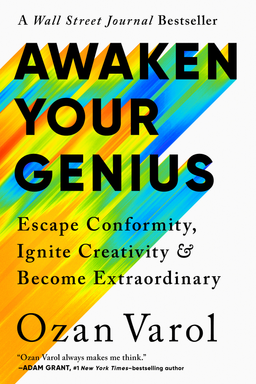
Awaken Your Genius cover

Awaken Your Genius

by Ozan Varol

Awaken Your Genius is a transformative guide that encourages readers to shed conformity and ignite their creativity. Through a five-step process, discover how to reconnect with your authentic self and unlock extraordinary potential, leading to a more fulfilling and original life.

Awaken Your Genius: Escaping Conformity and Reclaiming Authenticity

Have you ever felt like you were following a script someone else wrote for your life—acting in a role that doesn’t quite fit? In Awaken Your Genius, rocket scientist turned author Ozan Varol argues that most of us are sleepwalking through borrowed identities. We’ve been conditioned by schools, families, and cultures to conform—to color neatly inside the lines, to follow rules designed by others, to chase success benchmarks that have little to do with what truly matters to us. The book’s powerful premise is that each person comes into the world with a unique creative force—a genius—but over time, this genius gets buried beneath layers of social conditioning and fear. The challenge, Varol says, is not to become someone new, but to remember who we really are.

The Call to Wake Up

Varol opens with a metaphor drawn from Rumi’s poem “The Worm’s Waking”: a worm addicted to grape leaves suddenly realizes he’s the entire vineyard, an awakening that transforms consumption into creation. Similarly, we go through life in a dream state—repeating habits, clinging to identities, choosing convenience over curiosity—until something jolts us awake. That jolt can be painful but necessary, because waking up means realizing that much of what we believe isn’t ours. We’ve inherited beliefs from teachers, influencers, and algorithms that reward conformity over originality. “We sleepwalk through life,” Varol warns, “reaffirming the same thoughts and beliefs that limit our future.”

Redefining Genius

Varol reimagines genius as something innate and personal—not intelligence or talent, but authenticity. “A genius is the one most like himself,” Thelonious Monk once said, a quote that serves as the book’s heartbeat. By returning to our origins—in purpose, curiosity, and play—we reconnect with the wise, creative spirit we were born with. He contrasts this view with the myth of the lone genius popularized by biographies of Newton, Jobs, or Da Vinci. Real genius, he argues, isn’t solitary; it’s communal and iterative. It thrives when diverse, un-like-minded people bring their authentic selves together—“an orchestra of the un-like-minded,” as Varol calls it.

The Five-Part Journey

The book unfolds across five parts—Death, Birth, Inner Journey, Outer Journey, and Transformation—mirroring the stages of rediscovering the self. In Part I: The Death, Varol challenges readers to “uneducate,” “discard,” and “detox”—to peel away beliefs, labels, and mental clutter that cloud originality. Insightful stories, from choreographer Gillian Lynne to the downfall of Kodak, reveal how systems reward compliance even as they suppress brilliance. In Part II: The Birth, we learn how to rediscover our colors—embracing our multitudes instead of flattening ourselves into a single definition. Part III turns inward, exploring creativity through silence, play, and curiosity. Here, Varol urges us to stop forcing ideas and instead unblock the ones already within us, describing creativity as “catching the big fish” that swim beneath the surface of ordinary thought. The final two parts look outward—teaching us to detect bullshit, think skeptically, reject false gurus, and finally undergo metamorphosis by letting go of future expectations.

Why It Matters

In an era of algorithms and mass manipulation, thinking for yourself is a radical act. Varol’s message resonates deeply with today’s world of hustle culture and performative success. He shows how productivity myths, binary thinking, and tribal identities make us strangers to ourselves. Against that backdrop, awakening our genius becomes an act of liberation. The book doesn’t tell you to follow a rigid formula—it invites you to unlearn formulas altogether. You won’t find quick fixes or steps to “be extraordinary” here. Instead, Varol offers mirrors, shovels, and paper cuts—tools to help you excavate your own wisdom. Each reader’s path to originality is unique, but the destination is shared: living a life authored by yourself, not scripted by the crowd.

The Promise of Awakening

To awaken your genius, Varol says, is not to escape the world but to reshape it from within. It means disrupting—not for rebellion’s sake—but to reimagine possibilities. It means replacing autopilot with awareness, surrendering certainty for curiosity, and creating art that matters—whatever your medium may be. Those who answer this call become universe denters, shaping culture through originality and compassion. “No one can compete with you at being you,” Varol reminds us. In reclaiming that truth, we stop chasing borrowed dreams and start composing the melody that only we can play. That is the journey—and the revolution—of awakening your genius.


Uneducate: Reclaim Your Curiosity

Varol begins the journey with a provocative command: Uneducate. Education, in his view, has traded curiosity for conformity. Instead of drawing out what’s within us—the Latin root of educate means “to educe”—schools stuff students full of standardized answers. He contrasts this system with the inspiring story of Gillian Lynne, a misdiagnosed “problem child” whose doctor recognized that she was a natural dancer. Once placed in dance class, Lynne’s restless energy transformed into brilliance; she went on to choreograph Broadway hits like Cats and Phantom of the Opera. Her story reveals what happens when we stop medicating difference and start channeling it.

From Answers to Questions

As Neil Postman said, “Children enter school as question marks and leave as periods.” Varol builds on that, showing how formulaic learning turns creative minds into echo chambers. When students learn calculus for intimidation instead of curiosity—like Carl Sagan did before he connected it to interplanetary trajectories—they miss the joy of discovery. Reclaiming our curiosity begins with changing the questions we ask. Instead of “What did you learn?” try “What made you curious today?” This small shift transforms learning from rote memorization to exploration.

Letting Learning Flow

Education, Varol argues, should resemble play. When joy disappears, insight dries up. He cites studies showing that students who enjoy learning at age six perform better a decade later regardless of IQ or social class. His parents modeled this by letting him choose his kindergarten—within boundaries they had already vetted—instilling early the art of autonomous choice. Whether raising a child or leading a team, we can replicate this empowerment by shifting from the “what” to the “why.” Show people why their task matters, and curiosity replaces compliance.

Rediscovering the Artist Within

Perhaps the most poignant question Varol asks comes from Hallmark artist Gordon MacKenzie: “How many artists are there in the room?” In first grade, every hand shoots up. By sixth grade, only one or two dare. “Every child is an artist,” Picasso said; “the problem is how to remain an artist once he grows up.” Varol turns this into a call to arms: stop calling yourself a mere content creator—a term that reduces art to assembly lines—and rediscover your inner first-grader. Art isn’t just painting or music; it’s doing anything unconventionally, living creatively, and delighting in the act of making. To uneducate yourself, then, is not to reject learning but to rewire it—to move from compliance to curiosity and find the art waiting beneath the noise.


Discard: Shedding Skins and Identities

The second step in Varol’s transformation is Discard—learning the wisdom of snakes. Like a snake that outgrows its own skin, humans must shed outdated identities to survive inner growth. Varol draws from his own life transitions—from astrophysicist to lawyer to professor to author—to show that peeling back layers is painful but vital. When we cling to what’s comfortable, we grow blind and stagnant. Every false step we make by standing still keeps us trapped in yesterday’s self.

The Trap of Persistence

Society glorifies grit and tells us, “Never quit.” Varol challenges this myth with nuance: persistence is admirable only when the path still serves you. Continuing what no longer works is not grit—it’s fear in disguise. He uses the parable of the raft: once you cross the river, you must set it down in the forest or become trapped by your own tools. The sunk-cost fallacy and ego attachment keep most people clinging to expired jobs, relationships, and futures. As Joan Didion once reflected, “I have already lost touch with a couple of people I used to be.” Varol’s advice: own that evolution.

You Are Not Your Labels

Our identities—political labels, jobs, diets, tribes—become prisons of self-definition. We confuse who we are with what we believe. Varol urges readers to “drop the veil of identity” and practice what Buddhists call unbeing. Like Rebecca Solnit’s idea of “becoming no one and anyone,” freedom arrives when we trade rigid answers for fluid curiosity. Write your opinions in temporary ink, he suggests, reminding yourself that “what I believe” is always a work in progress.

Seeing Through New Eyes

To shed identity, we must learn to see the elephant in the room. Varol retells the parable of blind men arguing over whether an elephant is a snake, wall, or rope—each touching only one part of the truth. The goal isn’t to win arguments but to understand others’ perspectives. In today’s polarized world, this lesson is revolutionary: curiosity over victory. Seeing through someone else’s lens expands reality and cools the ego’s flame. “To argue and win,” Varol quotes Haruki Murakami, “is to break down the reality of the person you are arguing against.” By embracing ambiguity and rejecting binary thinking, we rediscover the beauty of complexity—and the freedom born from letting go.


Detox: Reclaiming Focus and Attention

After shedding old skins, Varol turns to mental hygiene in Detox. Just as our physical environment accumulates clutter, so does our mind. In the age of smartphones, social media, and infinite feeds, we’ve surrendered our most precious resource—attention. “Your attention isn’t free,” Varol warns. “You’re paying a fortune in fragmented focus.” He illustrates this through Beethoven’s deafness: when forced to turn inward and tune out external noise, the composer’s creativity soared. Instead of data overload, Beethoven listened to silence—and produced timeless music.

The Currency of Attention

Attention is non-renewable. If you spend your day checking Slack every five minutes, scrolling Instagram before bed, and refreshing news feeds before coffee, you’re hemorrhaging focus. Research cited in the book shows multitasking lowers memory retention and cognitive ability. Varol’s dream about the equation 0.8 × 0.2 = 0.16 symbolizes how divided attention reduces output. Living at fractions of ourselves leads to underperformance across life’s domains. The antidote is intentional focus—living deep instead of shallow.

Digital Detox and Mind Clutter

Information, like food, can be toxic in excess. Varol recounts his morning ritual of binging news and social media—a “digital rotation” that left him mentally fried. He compares this to eating a bucket of M&Ms for breakfast: stimulating but empty. His remedy is selective consumption. Prefer books over blog posts, long-form depth over breaking news, and evergreen wisdom over viral outrage. Sherlock Holmes once compared the brain to an attic: only limited space remains for meaningful furniture. When we fill it with junk, no room remains for insight.

Letting Go and Slowing Down

Varol dismantles hustle culture’s myth of productivity. The fear of silence and void, he says, keeps people trapped in “never-stop-never-stopping.” But true creativity thrives in stillness. Drawing wisdom from Aristotle’s axiom that “nature abhors a vacuum,” he flips it: sometimes emptiness is the soil of breakthroughs. Just as trees lie dormant before bursting into bloom, humans must pause between seasons of productivity. In that pause lies genius. Slow is smooth, smooth is fast—a motto from Navy SEALs that applies equally to problem-solving and art-making. Detaching from noise isn’t laziness; it’s a disciplined return to yourself.


Spectacularly You: Embrace Your Color

In Spectacularly You, Varol explores what it means to belong by being unapologetically different. He recounts growing up in Istanbul, hiding his favorite color—purple—to fit in with boys who only liked blue. From that early shame emerged a lifelong lesson: trying to fit in makes it harder to belong. Brené Brown defines belonging as being accepted for who you are, while fitting in means being accepted for being like everyone else. Varol’s journey through conformity—from buzz-cut school discipline to fraternity culture in the U.S.—illustrates how identity distortion produces emotional exile.

Finding Your Purple

Everyone has a “purple”—a trait or passion they hide to seem normal. Reclaiming it is the first act of genius. Varol’s love story with his wife Kathy becomes symbolic: when he finally admitted his favorite color was purple, she smiled and said she had always wanted to marry a boy who liked purple. That moment affirmed that authenticity attracts alignment. What we suppress for acceptance often becomes our superpower once revealed.

Making Art Through Authenticity

To be remarkable, Varol says, you must stop copying gospel songs like Johnny Cash did before his breakthrough at Sun Records. When Cash sang “Folsom Prison Blues”—born from personal truth, not imitation—his real voice emerged. Ordinary people chase trends; extraordinary ones bend rules to fit their unique contours. The same applies to businesses: Virgin America’s purple cabin lights or Ben & Jerry’s tongue-in-cheek “Schweddy Balls” flavor thrived because they embraced edges that others avoided. “The only way to attract people who like purple,” writes Varol, “is to show your purple.”

Stop Self-Imitating

There’s no more dangerous imitation than repeating yourself. Varol confesses that when writing this book, he initially tried to replicate the formula of Think Like a Rocket Scientist—until frustration forced him to discard it. Copying dilutes creativity; the sequel rarely matches the original. Great artists, from Joni Mitchell to Julia Child, reinvent by mastering first principles instead of repeating recipes. “Know the why, not just the how,” Varol advises. True mastery lies in adaptation, not adherence. By embracing your inner contradictions and evolving continuously, you become not just extraordinary—but spectacularly you.


Discover Your Mission: Living Deliberately

This chapter is Varol’s manifesto for purpose. He begins with the story of Sylvester Stallone, who refused to sell his Rocky screenplay unless he could play the lead—even when offered hundreds of thousands of dollars. Stallone’s stubborn faith illustrates what it means to choose yourself and align actions with calling. Living deliberately, as Thoreau said, requires clarity: not in predicting the future, but in knowing which truth you stand for right now.

Curiosity Over Passion

Varol dismantles the pop advice “follow your passion.” Passion is fleeting; curiosity sustains growth. He shares how Carl Sagan’s life mission wasn’t finding aliens—it was sparking humanity’s cosmic wonder. Even failure becomes fruitful when you’re guided by curiosity instead of applause. As theologian Howard Thurman said, “Don’t ask what the world needs. Ask what makes you come alive.”

Experimenting Your Way Forward

To find your mission, Varol recommends experimentation over deliberation. Don’t just debate options; test them. Try being a podcaster for ten episodes. Shadow professionals before committing to careers. Like Boyd Varty’s lion tracking metaphor, every “path of not here” is part of finding the “path of here.” Action reveals truth faster than contemplation.

Redefining Success

In chasing gold medals and external validation, people confuse recognition with fulfillment. Varol cites legends like Glenn Close and Isaac Asimov, who found joy in the process itself, not the prizes denied them. His antidote is a simple question: “Is this within my control?” Redirect attention from outcomes to effort, from applause to alignment. True success is living by inner metrics, not borrowed ones—and recognizing, like Joseph Heller told Kurt Vonnegut, that the richest gift is “the knowledge that I’ve got enough.”


Unlock the Wisdom Within: Thinking for Yourself

If the first half of the book dismantles conformity, Unlock the Wisdom Within teaches us to think independently. Varol likens creativity to fishing: shallow waters yield small ideas, deep waters yield big ones. His cure for automatic thinking begins with self-dialogue. “Abracadabra,” he reminds us, means “I create as I speak.” By talking to ourselves—through journaling, freewriting, or morning pages—we discover thoughts we didn’t know we had. Julia Cameron’s technique of writing unfiltered pages echoes this principle: creation begins when inner noise quiets.

Strategic Procrastination

Rather than forcing ideas, Varol recommends deliberate waiting—planting seeds, stepping back, and letting the subconscious process mature. Quentin Tarantino’s habit of floating in his swimming pool after writing sessions symbolizes this nonlinear method. Creativity doesn’t emerge from constant focus but from rhythm: focus and unfocus, tension and release.

Lose Your Mind to Find Ideas

Drawing on neuroscientist Charles Limb’s jazz improvisation studies and Carl Sagan’s eccentric tape-recorded “evening self,” Varol shows that genius depends on silencing the inner critic. During idea generation, suspend judgment completely—leave evaluation for later. Great artists don’t censor; they let chaos speak first. “Unreasonable often means reasonable not yet made reality,” he writes. Creativity is discovery, not productivity.

Community and Contradiction

Finally, Varol rejects the myth of the lone genius. Isaac Newton didn’t perfect gravity alone—he needed a friend to spot his mistake. Surround yourself with “an orchestra of the un-like-minded” who challenge blind spots. Encourage dissent, as Netflix’s culture of “farming for disagreement” proves. Diversity of thought, not uniformity of worship, is what unlocks collective wisdom. Thinking for yourself doesn’t mean isolation—it means thinking with yourself and others clearly, courageously, and curiously.


Let Go of Your Future: Embracing Uncertainty

In the penultimate transformation, Varol urges readers to let go of the future. We obsessively plan and predict, pretending that tomorrow obeys our logic. Yet experts fail miserably at foresight; economist Paul Krugman once dismissed the Internet as a fad. Varol illustrates this paradox with Wilbur Wright’s prediction that “no airship will ever fly from New York to Paris.” Ten years later, someone did. Certainty is seductive but deceptive. Real progress depends on surrender.

Surrender vs. Control

Worrying, Varol writes, “is a giant waste of imagination.” Instead of obsessing over outcomes, focus on what helps—a pragmatic practice akin to Stoicism (see Ryan Holiday’s The Obstacle Is the Way). Ask yourself, “Will this help?” If not, release it. Like the moths of the Industrial Revolution that changed color to survive soot, thriving in uncertainty means evolution, not resistance. Clinging to the familiar makes us visible prey; adaptation keeps us alive.

The Beauty of Not Knowing

Life’s most meaningful chapters weren’t scripted in advance—they unfolded through curiosity. Planning blinds us to better possibilities, like light-colored moths clinging to old trees. The antidote is improvisation. Varol borrows the comedian’s mantra “Yes, and…”: accept what life offers, then build on it. The future isn’t a ladder—it’s a jungle gym, messy but magical. Each uncertain step expands awareness. You don’t need a map to uncharted lands; you need trust in your inner compass.

Learning to Dance with Chaos

“The real universe,” Varol quotes Frank Herbert, “is always one step beyond logic.” Embracing that chaos turns fear into fuel. The future favors the open-minded who walk before seeing a path. Whether launching a business or starting a chapter in life, we go from not knowing to knowing only by acting first. Genius doesn’t predict—it creates. The courage to let go, paradoxically, becomes the ultimate form of control.


Metamorphosis: Dying to Become Yourself

Varol concludes with the poetic Metamorphosis—the moment when discovering your genius means dying to who you were. He compares transformation to the caterpillar entering its chrysalis. Inside, the creature dissolves into chaos, and only imaginal discs—cells of potential—survive. These imaginal discs are metaphors for our first principles: enduring talents and curiosities that persist through every rebirth. When we let old selves rot, those principles become wings.

Safety Nets and Straitjackets

Varol shares his own metamorphosis—leaving tenure as a professor after realizing his safety net had become a cage. Fear disguised as practicality kept him from flying. Only by shedding comfort could he live fully. “Letting go,” he writes, “can be an act of love.” Fame, jobs, even beliefs are compost for new selves. Joseph Campbell echoed this truth: “The earth must be broken to bring forth life.” Transformation demands breaking and rebuilding.

Becoming the Butterfly

Each season of decay nourishes the next creativity. A caterpillar doesn’t flee itself—it becomes itself. Its death is its evolution. Varol reminds us that while we owe gratitude to past versions of ourselves, we don’t owe anyone permanent loyalty to the person we used to be. Transformation may unsettle others, but awakening others through our own metamorphosis is part of the gift. “You don’t owe anyone the caterpillar you used to be.”

Living Uncarefully

The book closes with a poem and invitation: stop living carefully. When we chase safety, we silence spontaneity and strangle creativity. Life lived fully, he says, requires chaos, heartbreak, and rain—“because the purpose of life isn’t to be fine; it’s to be alive.” In letting go of control, we find our soul’s wings. The Greek word for butterfly, Varol notes, is psyche—the same as soul. The genius within isn’t about escaping the mess—it’s about dancing gloriously in it.

Dig Deeper

Get personalized prompts to apply these lessons to your life and deepen your understanding.

Go Deeper

Get the Full Experience

Download Insight Books for AI-powered reflections, quizzes, and more.