
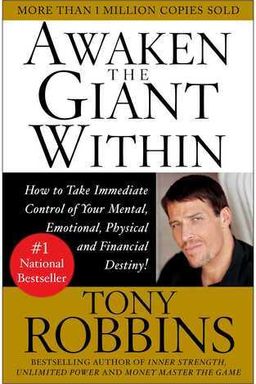
Awaken The Giant Within cover

Awaken The Giant Within

by Tony Robbins

Awaken The Giant Within provides a roadmap for taking control of your destiny. Tony Robbins reveals how altering beliefs, habits, and emotions can lead to a fulfilling life. By committing to positive change and harnessing the power of language and values, readers can transform their lives and make a significant societal impact.

Decisions Shape Destiny

Tony Robbins' central argument across his work is deceptively simple: you shape your destiny by the decisions you make and the meanings you attach to them. Each choice you make—conscious or unconscious—sets in motion a chain of focus, emotion, and action that defines your results. The quality of your life, Robbins insists, is the quality of your decisions.

But a decision here doesn’t mean a polite wish or preference. It is a moment of psychological commitment—literally “to cut off” other options—that signals absolute certainty to the nervous system. Robbins defines this as the act that transforms vague desire into neuro‑chemical momentum. History, he points out, is full of such pivotal decisions: Gandhi's turn to nonviolence, Rosa Parks’ refusal to move, and Lech Wałęsa’s climb over a wall rather than defer to injustice. Each illustrates how a single decision can redirect the course of a lifetime, or even a culture.

The Power of Conscious Decision

At every moment, you make three core decisions: what to focus on, what meaning to assign that focus, and what action to take. Change any of those three and the downstream effects alter the quality of your life. Focus anchors perception; meaning defines emotion; action transforms possibility into experience. Robbins' famous line—“it is in your moments of decision that your destiny is shaped”—is not motivational fluff. It is a neurological model: decision drives focus, focus shapes emotion, and emotion commands behavior.

He recalls the day he decided to change his life—moving from a janitor’s wage to leading seminars for thousands. That decision wasn't magical, but behavioral: he stopped tolerating mediocrity and started conditioning himself to act decisively. The result was a compound ripple that over a decade built a global movement.

Commitment Versus Preference

Robbins divides decision-makers into two types: the “interested” and the “committed.” Interested people act when it’s easy; committed people act whatever the cost. The distinction mirrors Jim Collins’ description of “Level 5 leaders”—those who subordinate comfort to purpose—and echoes Viktor Frankl’s insight that purpose gives suffering meaning. Preference is wishful; decision is directional.

To strengthen what he calls your “decision muscle,” Robbins offers practical drills: decide daily on something small, act immediately, and review feedback without self‑punishment. Errors, he reminds, are feedback—not identity. This shift in attitude turns indecision from paralysis into apprenticeship.

Pain, Pleasure, and Leverage

Underneath every decision is a more primal mechanism: the drive to avoid pain or gain pleasure. Everything you and every human does operates on that binary. Yet most people let pain and pleasure use them rather than using those forces consciously. To change any behavior, you must rewire the associations: link massive pain to the old pattern and massive pleasure to the new one.

This is leverage—an emotional threshold where the pain of staying the same outweighs the fear of change. Robbins illustrates this through case studies: an addict quitting after visualizing the devastation ahead, a person leaving an unhealthy relationship once remaining becomes more painful than solitude. Leverage is what makes decisions stick. You can wait for crisis to create it, or build it intentionally by vividly stacking the costs of inaction and the pleasures of transformation.

Decision Fuel: Belief and State

Two ideas underpin sustainable decision power: belief and state. Beliefs act as your internal GPS—they decide what’s possible before you even try. If you believe something is impossible, you won’t attempt it, regardless of logic. Robbins uses Roger Bannister’s four-minute mile as a parable of possibility; once Bannister proved it, dozens followed because belief had shifted the upper limit of what the nervous system considered achievable. Meanwhile, state—your body’s physiology and focus—determines whether you can access those beliefs. Emotion is created by motion; change your posture, breathing, or gesture, and you change your biochemical readiness to decide courageously.

From Intention to Power

Robbins wraps the section with an unforgettable warning he calls “Niagara Syndrome.” Most people drift through life like someone carried by a river, never deciding their direction until they approach the falls. Decision creates the canoe and the paddle—it’s how you design rather than drift. If you consistently decide with clarity, attach conscious meanings, act immediately, and learn fast, you become what Robbins calls “the architect of your own destiny.”

Core takeaway

Decisions are moments of creation. When you connect a decision to both emotional leverage and sustained action, you redirect not only your behavior but the trajectory of your life.


Belief, Conditioning and the Mind’s Code

Beliefs are the hidden software of your destiny. Robbins defines a belief as a feeling of certainty about what something means. It is the instruction your nervous system uses to interpret life. These beliefs are created through references—memories, experiences, or even imagined events—that act like table legs supporting an idea. The more emotional and numerous the references, the stronger the belief becomes.

How Beliefs Form and Harden

Most beliefs are not chosen rationally; they’re absorbed through repetition and emotion. Pavlov proved a neutral trigger can be made powerful by association, and Robbins extends this principle to personal psychology. If advertisers can condition you to connect pleasure with a soda brand, you can recondition yourself to associate fitness with joy or procrastination with disgust. The process is called Neuro‑Associative Conditioning (NAC): a six‑step system for rewiring emotional links so new associations replace old ones permanently.

The method combines leverage, pattern interruption, and reinforcement—what behaviorists recognize as operant conditioning blended with modern cognitive techniques. A smoker might be asked to overindulge until disgust replaces pleasure; a procrastinator might celebrate micro‑actions to hardwire satisfaction. In each case the brain re‑tags what it previously coded as relief or comfort.

Leverage and Thresholds

Change begins at threshold—the emotional moment when “enough is enough.” People don’t fail for lack of knowledge; they fail because the pain of change seems greater than the pain of staying stuck. Robbins teaches you to build leverage deliberately by visualizing the real cost of inaction in painful detail and the rich rewards of changing now. When internal pain outweighs inertia, resolution becomes automatic.

The Physiology of Certainty

Beliefs aren’t abstract—they’re biochemical. Expectancy can alter heart rate, immune response, and even drug efficacy (as shown by Dr. Beecher’s placebo studies). Conversely, learned helplessness—a belief that outcomes are uncontrollable—suppresses motivation and immunity. Replacing helpless beliefs with empowering ones (“This is temporary, local, and changeable”) reverses that biology. Your thoughts literally become chemical instructions to your cells.

Conditioning versus Programming

A key evolution in Robbins’ model is the move from “programming” to “conditioning.” Programming implies a technician fixing you; conditioning implies practice that you own. Like tuning a piano, change sticks only after repeated reinforcement. Use small “jackpot” rewards to create excitement and variable reinforcement—so new behaviors feel compelling, not forced. The principle mirrors Skinner’s behavioral findings, but Robbins infuses it with personal responsibility and joy.

Key message

Your mind runs on associations. When you consciously rewire pain and pleasure links through repetition and emotion, you reclaim the code that governs your destiny.


Master Your State and Emotions

Emotional control is not suppression; it’s skillful management of your inner state. Robbins calls state the sum total of your physiology, focus, and mental representation at a given moment. Master state and you master performance, decision-making, and relationships. This is the bridge between thought and behavior.

Physiology: Emotion in Motion

“Emotion is created by motion.” That’s not a slogan; it’s neurochemistry. Stand tall, breathe deeply, smile, use large gestures—and your hormones align with confidence and joy. Robbins proves this through simple exercises: power poses, deep breathing, even exaggerated smiles that rapidly interrupt negativity. Athletes like Larry Bird conditioned excellence through such embodied rehearsal; you can do the same to summon peak states on command.

Focus and Meaning

Focus determines feeling. Where attention goes, energy flows. Robbins compares focus to steering a race car—you go where you look. Focus on problems and you hit the wall; focus on solutions and you find momentum. Changing focus changes meaning, and meaning changes emotion instantly. That’s why empowering questions (like “What’s great about this?”) can dissolve frustration faster than any external change.

Transformational Vocabulary and Metaphor

Language builds emotional gravity. Words like “furious” or “devastated” amplify agony; swap them for playful labels (“peeved,” “a bit tweaked”) and the charge collapses. Robbins calls this Transformational Vocabulary—linguistic reframing that softens pain and intensifies joy. Likewise, metaphors sculpt emotion: see life as a dance and you move gracefully; see it as a battle and everything becomes conflict. Becoming a “metaphor detective” reveals hidden rules you live by.

Emotional Mastery: Action Signals

Negative emotions aren’t enemies; they’re Action Signals—feedback telling you to change perception or behavior. Robbins catalogues ten common signals (fear, hurt, anger, guilt, etc.) and pairs each with constructive antidotes like curiosity, determination, or love. He outlines a six-step method: identify, appreciate, get curious, recall past mastery, rehearse success, and act immediately. When you treat emotions as messages, not verdicts, you recover agility.

Practical takeaway

Change physiology first, focus second, language third—and your emotions will align. You become the cause of feeling, not its victim.


Questions: The Steering Wheel of Mind

Every thought you think begins as a question. Robbins’ insight is simple but profound: your habitual questions determine your attention, emotions, and destiny. Ask disempowering questions (“Why me?”) and you find despair; ask empowering ones (“How can I use this?”) and you find solutions. Thinking, in this model, is directed curiosity.

From Survival to Strategy

The story of Stanislavsky Lech—escaping a Nazi death pit by asking “How can I use this to escape?”—anchors this truth. His question reframed terror into problem-solving focus. Robbins parallels it with entrepreneur Donald Trump in the 1970s asking, “How can I profit while others fear?” and disability survivor W. Mitchell asking, “What do I still have?” Questions redirect focus from limitation to leverage.

Problem-Solving and Power Questions

Robbins provides a five‑step “Problem‑Solving Questions” ritual to stop emotional spirals: (1) What’s great about this? (2) What’s not perfect yet? (3) What am I willing to do? (4) What am I willing to stop doing? (5) How can I enjoy the process? He pairs these with Morning and Evening Power Questions—rapid routines that prime gratitude, excitement, and contribution. Over time, these questions condition your Reticular Activating System to find opportunity automatically.

When overwhelmed, Robbins demonstrates the technique himself—responding to 100 urgent memos by relocating his office to his backyard Jacuzzi while asking, “How can I enjoy this?” The result: same workload, different state.

Takeaway

Ask deliberately. The form of your question presupposes the frame of your answer—and therefore the emotional quality of your life.


Values, Rules and the Master System

Robbins describes every life as governed by a Master System—the interplay of state, questions, values, beliefs, rules, and references. This system filters reality and decides how you feel about everything. If decisions are the engine, this system is the programming that drives it.

Values and Hierarchy

Values are emotional compasses that determine what you move toward or away from. You always act to meet your highest values as you’ve unconsciously arranged them. Robbins teaches you to list two columns: moving‑toward and moving‑away values, then rank them. He shares his old hierarchy—Passion, Love, Freedom, Contribution, Growth, etc.—and explains how putting passion above health led to burnout. Redesigning his list with Health and Love on top changed his entire life dynamic.

Rules Define Emotional Access

Rules are the conditions you set for feeling emotions: “If I make everyone happy, then I can feel loved.” Problem: many rules are impossible or depend on others. Change the rule, and you regain control. For example, Laurie—a seminar attendee—couldn’t feel loved unless everyone approved of her. By rewriting her rule to “I feel loved whenever I express love,” she created instant access to joy. Audit your rules and align them with reality.

References and Identity

References are the experiences or stories you use as evidence for belief. Expand positive references—by reading biographies, traveling, or visualization—and you expand possibility. Roger Bannister built imagined references before any proof existed. Ultimately your cumulative references evolve into identity: the deepest belief about who you are. By consciously choosing a new identity (“I am disciplined,” “I am creative”), you trigger consistency pressure to match action to that label.

Core principle

When your values, rules, beliefs, and identity align, emotional conflict disappears and decisions become effortless. Incongruence—not circumstance—is the real source of suffering.


Creating a Compelling Future

If emotion is the engine of action, then goals are the fuel. Robbins defines a compelling future as a vivid, specific vision that pulls you rather than one you chase. The moment you decide exactly what you want and why, your brain’s Reticular Activating System begins filtering reality to highlight supporting opportunities. Like tuning a radar, focus reveals hidden paths.

Why Big Goals Work

Impossible‑seeming goals generate superior motivation because they ignite emotion. Robbins points to O.J. Simpson as a rickets‑afflicted child who vowed to break Jim Brown’s record—an absurd goal that produced the intensity to do so. Big vision creates big energy, a pattern echoed by Steve Jobs’ insistence on “a dent in the universe.”

Designing Your Vision

Robbins’ process covers four domains: personal development, career/economic, adventures or toys, and contribution. Brainstorm freely, assign timelines (1, 3, 5, 10, 20 years), and isolate your single most important one‑year goal per category. Then ask why each matters—because drive flows from meaning. Finally, take immediate action: one phone call, one enrollment, one message that begins momentum. Delay instantly dissolves decision power.

Modeling and CANI

To reach goals faster, Robbins borrows from W. Edwards Deming's kaizen and coins his own principle, CANI—Constant And Never‑ending Improvement. Add to that modeling: replicate the beliefs, strategies, and habits of those already succeeding. Bill Gates modeled bold execution before resources existed; Roger Bannister modeled the rhythm of speed; Soichiro Honda modeled persistence through ruin. Learning compresses when you model goodness precisely.

Rule to remember

Decide clearly, act immediately, observe results, and adjust repeatedly. This “Ultimate Success Formula” is how you turn vision into consistent progress.


Daily Mastery and lasting Transformation

All insight is worthless without habit. To make change enduring, Robbins condenses his methods into structured practice: the Ten‑Day Mental Challenge and the Seven‑Day Life Blueprint. Each transforms awareness into automatic competence—the bridge from learning to living.

The Ten‑Day Mental Challenge

For ten days, refuse to indulge in negative thinking for more than a minute. Interrupt immediately and redirect to solution‑oriented focus using the five Problem‑Solving Questions. If you slip, restart from day one. The goal isn’t perfection but conditioning: training your brain to pivot automatically from problems to possibilities. Accountability—telling three friends—adds social leverage and fun. Within ten days, participants notice old emotional patterns losing their grip.

The Seven‑Day Blueprint

Each day targets one life domain. Day 1 focuses on emotional destiny—choosing moods. Day 2 targets physical vitality, applying Stu Mittleman and Dr. Maffetone’s aerobic training to create sustainable health. Day 3 restores relationships via shared values and proactive communication; Day 4 addresses finances through five fundamentals: add value, save, compound, protect, and enjoy. Day 5 defines a personal Code of Conduct; Day 6 masters time through prioritization; Day 7 integrates rest and play—essential for rhythm and renewal.

Integration and Identity

Sustained results ultimately hinge on identity—what you believe yourself to be. Robbins’ story of Debra, who went from “timid” to “adventurous” after proving it through skydiving and firewalking, illustrates how action reshapes self-image. You can’t outperform your identity, but you can choose and condition a better one. Repeat it publicly, act congruently, and the mind’s need for consistency makes it real.

Final takeaway

Knowledge becomes power only when it becomes ritual. Daily emotional management, weekly review, and continual refinement turn temporary change into a new standard of living.

Dig Deeper

Get personalized prompts to apply these lessons to your life and deepen your understanding.

Go Deeper

Get the Full Experience

Download Insight Books for AI-powered reflections, quizzes, and more.