
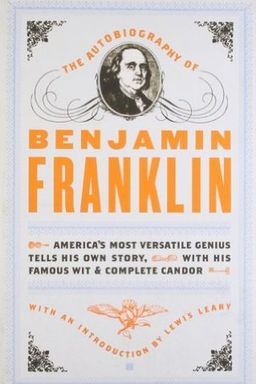
Autobiography of Benjamin Franklin cover

Autobiography of Benjamin Franklin

by Benjamin Franklin

The Autobiography of Benjamin Franklin reveals the personal journey of a Founding Father, showcasing his relentless pursuit of knowledge, ethical living, and innovation. Through his successes and failures, readers gain timeless insights into personal growth and self-improvement.

Benjamin Franklin and the Making of a Practical Genius

What does it really mean to build a life from nothing—and turn it into everything? Few stories illustrate this better than The Autobiography of Benjamin Franklin, a work that’s at once history, philosophy, and practical life manual. Franklin wrote his life story to show future generations how an ordinary person could, through discipline, curiosity, and public spirit, become extraordinary. His argument is simple yet profound: success and virtue aren’t inherited—they’re acquired through continual self-improvement and public usefulness.

In this book, Franklin contends that living well isn’t merely about wealth or status; it’s about cultivating wisdom, character, and usefulness to society. His life—from candle maker’s apprentice to world-famous scientist and statesman—is the experiment that proves his philosophy. Behind his scientific tinkering, moral essays, and political reforms lies one overarching message: self-discipline, reason, and steady effort can transform struggle into greatness. You learn to make virtue a habit, curiosity a tool, and thrift a means to generosity.

The Context and Spirit of Franklin’s Ambition

Franklin began writing his autobiography in 1771, in his late sixties, during a rare moment of rest from his diplomatic work in England. His purpose was not vanity but mentorship—he addressed the manuscript mostly to his son, William, so that future Franklins could follow his path. But the book grew beyond that: it became a model for the American dream itself. Franklin’s 18th-century world was turbulent: colonies fought for independence, science reshaped faith, and commerce was redefining social classes. In the middle of this, Franklin became the new archetype of success—not the aristocrat born to privilege, but the self-made man grounded in labor, learning, and civic virtue.

The autobiography covers his life from his boyhood in Boston through his rise in Philadelphia and beyond. It traces the development of his character, showing how setbacks became laboratories for self-mastery. Every chapter offers not just memory, but method—from his system for moral perfection to his practical plans for libraries, fire brigades, and universities. His tone is conversational and modest, frequently humorous, yet the lessons are enduring: be industrious, think critically, improve constantly, and serve the common good while securing personal happiness.

Why Franklin’s Ideas Still Matter

Franklin’s autobiography has influenced a vast range of thinkers—Henry David Thoreau admired its resolve for improvement, Napoleon carried a copy for strategy inspiration, and modern motivational writers (like Stephen Covey in The 7 Habits of Highly Effective People) borrow heavily from Franklin’s principles of habit formation and moral inventory. Franklin’s message transcends era and geography: he teaches that freedom is sustained through responsibility, and that virtue without practical action is wasted.

As you explore his ideas, you’ll learn how Franklin’s restless curiosity led him from soap-making to electricity, how his printing press shaped public opinion like an early internet, and how his moral philosophy balanced spirituality with pragmatism. You’ll see how he blended personal ambition with civic duty—the ideal of the Enlightenment gentleman who works for humanity as much as himself.

What You’ll Discover in This Summary

In the coming key ideas, you’ll travel through Franklin’s experiments in diligence and virtue, his relentless curiosity, his social inventions, and his political maturity. You’ll explore his famous “Thirteen Virtues” and his practice of turning morality into a measurable habit. You’ll uncover how he blended science and faith into reason, how he mastered self-education, and how he created community engines—the Junto, the first public library, and fire companies—that defined civic leadership for centuries.

Ultimately, Franklin’s autobiography invites you to test your own power to direct your life. It’s not simply about Benjamin Franklin—it’s about the possibility within every human being to become wise, useful, and fulfilled through discipline, learning, and service. As he famously put it, “Human felicity is produced not so much by great pieces of good fortune that seldom happen, but by little advantages that occur every day.” In these “little advantages,” you’ll find the entire art of living well.


Self-Education and the Power of Books

Franklin’s entire journey begins with books. Without formal schooling beyond age ten, he trained himself through reading—a lifelong apprenticeship to curiosity. He devoured his father's theological library, yet quickly turned to more practical thinkers like Plutarch, Defoe, and Addison. Each book shaped a new part of him: Plutarch taught him civic virtue; Addison taught the art of clarity and persuasion. His first job at his brother’s printing press gave him access to words, and words became his tools of power.

Learning by Practice

Franklin didn’t just read—he imitated. He rewrote essays from memory to practice rhythm and structure, a technique that resembles modern writing drills in composition or journalistic training. His deliberate study of style through mimicry (he used The Spectator essays as models) honed his persuasive voice. He learned geometry and logic from borrowed texts, then applied that logic to politics and invention. Every transaction of knowledge, for Franklin, had to translate into use. He wrote that knowledge “never grows stale when employed.”

Curiosity as a Way of Life

Franklin’s curiosity was democratic—he believed anyone could master useful learning if they were diligent. He saved his lunch money to buy books, converted to vegetarianism partly to save funds and mental clarity, and organized peers into discussion clubs (the Junto) to exchange ideas. Reading wasn’t solitary; it was a social exchange that built collective intelligence. His method of practical reading resembles today’s lifelong learning ethos (similar to Malcolm Gladwell’s notion of “deliberate practice”): test, share, refine, apply.

Building Institutions of Knowledge

From his passion for books came one of Franklin’s greatest social contributions: the public library. Frustrated that few could afford diverse collections, he gathered friends to pool their titles in 1731, forming the Library Company of Philadelphia—the first subscription library in America. This act democratized education, proving that learning could be a community resource, not a privilege. Later, he proposed educational reforms that blossomed into the University of Pennsylvania, reinforcing his belief that societies thrive when access to wisdom is shared.

Franklin’s Lesson for You

You don't need perfect conditions to learn—you need persistence and creativity. Franklin teaches that education is self-directed, continuous, and shared. Your mind grows not from privilege, but from practice, curiosity, and the will to use what you learn.


The Thirteen Virtues: Franklin’s Moral System

One of the most famous sections in Franklin’s autobiography is his structured plan for personal improvement—his chart of thirteen virtues. Instead of vague moral advice, Franklin created a scientific system to train character. Each week, he focused on one virtue, marking daily faults in a little book. Over time, he aimed to clear every line—perfect self-mastery through discipline. This was self-help before the term existed, balancing Puritan ethics with Enlightenment rationalism.

The Virtues Themselves

  • Temperance: Eat not to dullness; drink not to elevation.
  • Silence: Speak only what benefits others or yourself.
  • Order: Let every object have its place; every action its time.
  • Resolution: Perform what you ought; keep your promises.
  • Frugality: Waste nothing.
  • Industry: Always be employed in something useful.
  • Sincerity, Justice, Moderation, Cleanliness, Tranquility, Chastity, Humility.

Franklin added Humility late, inspired by his Quaker friend who teased him for pride. He patterned it after Jesus and Socrates—the masters of self-effacement.

The Method and Its Challenge

He treated moral behavior like a craft to learn by repetition. Each day’s mark showed his imperfections, teaching self-awareness and patience. “Order,” he admitted, was his hardest virtue, calling himself “incorrigible.” But that admission also became wisdom: striving mattered more than success. His chart of improvement prefigures modern habit-tracking and behavioral psychology (James Clear’s Atomic Habits reflects this lineage).

The Enduring Impact

Franklin’s moral system turned virtue into methodology. It showed that ethics could be practiced like any skill, cultivated through observation and habit rather than fear or ritual. His “speckled ax,” forever imperfect yet polished through effort, reminds you to aim at progress, not perfection.


The Life of the Industrious Printer

Every philosophy needs a proving ground, and Franklin’s was his printing shop. From his apprenticeship under his brother James to his later ownership of a flourishing press in Philadelphia, each job shaped his belief in industry and reputation. Printing demanded precision, patience, and mastery of communication—all virtues that defined Franklin’s wider success. His enterprise was never just about profit; it was about influence—the power to shape public thought with words.

Work as a Moral Discipline

Franklin saw labor as both survival and moral practice. His money habits—walking through streets pushing paper himself, dressing plainly—were performances of humility. But behind that simplicity was strategy: appearing industrious inspired trust and opportunity. He recounts how merchants began to give him their printing contracts because he seemed reliable. “It was,” he wrote, “visible that I was not above my business.” His ethic echoes Max Weber’s later concept of the “Protestant work ethic,” turning spiritual diligence into worldly success.

Poor Richard and Practical Wisdom

In 1732, Franklin used printing to broadcast moral humor. His Poor Richard’s Almanack became a best-seller filled with proverbs on thrift and patience: “A penny saved is a penny earned,” “Three removes are as bad as a fire.” Behind their wit lay economic philosophy—prudence builds independence, and independence enables virtue. These sayings shaped American ideals of self-reliance, inspiring writers from Emerson to modern productivity experts.

Commerce as Service

By treating his trade as public service, Franklin bridged business and ethics. His printing-office also produced civic pamphlets, laws, and reforms, binding private effort to public good. When he helped found Pennsylvania’s hospital and post office, he applied the same logistics mindset used in printing—organizational clarity for human benefit. Through the press, Franklin showed that enterprise can be moral and that steady craftsmanship is civic virtue in action.


Community Building and Civic Virtue

Franklin’s genius extended beyond laboratories and printing presses into civic architecture. He believed communities were moral organisms, strengthened by cooperation and shared intelligence. His early experiment in this idea was the Junto, a Friday-night club of tradesmen discussing ethics, science, and politics. The discussions led to practical projects: mutual insurance schemes, volunteer fire companies, and public libraries. Each institution began with a circle of conversation and expanded into lasting public structures.

The Junto Philosophy

Junto meetings taught democratic debate before America had democracy. Franklin banned dogmatism—no member could say “undoubtedly” or “certainly”—a technique borrowed from Socrates to keep discussion civil. He later credited this habit for his success in negotiations, proving that modest expression builds persuasion better than arrogance. (His approach resembles modern organizational leadership theories on psychological safety.)

Inventing Public Services

From group projects like fire brigades and libraries grew Franklin’s vision of communal responsibility. He argued that shared institutions elevate individuals. The Philadelphia Fire Company and public hospital emerged from this ethos of practical benevolence. His principle: when citizens organize voluntarily to solve problems, they become architects of their own prosperity. This concept, foundational to American civic life, influenced later reformers and social entrepreneurs (carried forward by Jane Addams and Andrew Carnegie).

Franklin’s Civic Rule

The spirit of community begins with conversation, grows through cooperation, and matures into institutions. Learn from Franklin: the most enduring innovations are not solitary—they’re social.


Scientific Curiosity and Worldly Philosophy

Franklin’s fascination with electricity turned him into an international celebrity. His home experiments—especially the famous kite in a thunderstorm—proved that lightning was an electrical phenomenon. Yet what makes his science remarkable isn’t just discovery but attitude: he treated nature as a teacher, not a mystery. He called his work “philosophical amusement,” yet its implications reached far across physics and philosophy.

Empirical Spirituality

Unlike many religious contemporaries, Franklin merged empirical science with moral humility. His experiments were acts of wonder, not arrogance. He saw divine design in natural laws—an Enlightenment faith that reason reveals God’s harmony. When his experiment succeeded, he did not glorify himself but thanked Providence for “understanding the language of the heavens.” This synthesis between science and spirituality gave his work an ethical dimension absent in pure rationalism.

Science for Society

Franklin’s scientific inventions—the lightning rod, the Franklin stove, bifocal lenses—were all public-minded technologies. He refused patents, claiming “we enjoy great advantages from others’ inventions; we should be glad of an opportunity to serve others.” His approach contrasted the commercial spirit of his era, showing that discovery can be generosity. His reputation earned him honors from European academies and friendships with thinkers like Voltaire and Hume, cementing his role as the Enlightenment’s practical philosopher.

Curiosity as Citizenship

Franklin embodied how scientific curiosity supports moral citizenship. He turned experimentation into civic virtue—testing, reasoning, and improving for the common good. To emulate him today is to see innovation not as ambition, but as participation in humanity’s progress.


The Art of Communication and Persuasion

Franklin mastered the subtle power of expression—how tone and humility can persuade more effectively than argument. As a negotiator, writer, and humorist, he understood language as social engineering. Early lessons from the Junto and his father’s dinner conversations taught him that opinion softened by reason carries weight. He cultivated the habit of saying “It appears to me…” rather than asserting certainty. This mildness helped him win both political battles and lifelong friendships.

Politeness as Strategy

His method combined clarity with psychological insight. In diplomatic tasks—from securing French alliance to mediating disputes—he translated emotion into reasoned charm. He joked, observed, listened, and deferred before guiding others to his point. His philosophy anticipates Dale Carnegie’s How to Win Friends and Influence People: persuasion through empathy, not ego.

Writing that Moves Nations

As a writer, Franklin wielded humor like diplomacy. His mock letters—such as “Rules by Which a Great Empire May Be Reduced to a Small One”—satirized British policy with wit strong enough to influence Parliament. Even his simple parables (“The Way to Wealth,” “The Whistle”) turned moral lessons into universal truths. His narrative style remains a model for communicators: moral clarity wrapped in wit and brevity.

Franklin’s Communication Ethics

Speak with candor but never cruelty. Reason persuades, humility convinces. In Franklin’s world, eloquence served peace rather than pride—a lesson every leader or writer can still learn.


Public Service and Leadership

For Franklin, public service was not a burden—it was the fulfillment of self-mastery. His roles ranged from clerk of the Assembly to diplomat and founder of civic institutions. Each began with practical reform—organizing fire brigades, improving street lighting, founding hospitals. He treated governance like engineering: identify inefficiency, design better systems, and persuade others by reasoning.

Leading through Example

Unlike the rhetoric-driven aristocrats of his era, Franklin led by visible deeds. His modesty—walking the streets in plain dress, rejecting pomp—was intentional influence. He said, “Virtue itself becomes infectious.” Later, as colonial representative in London, he practiced diplomacy rooted in patience and reason, embodying civic virtue against corruption and self-interest.

Law, Liberty, and Common Sense

His political thought joined freedom with discipline: liberty could survive only if citizens governed themselves by reason and mutual respect. Public welfare projects—the library, post office, and street paving—were not charitable extras but instruments of civilization. His essay “The Way to Wealth” distilled governance into practical ethics: collective prosperity depends on individual responsibility.

Through these institutions, Franklin helped define the American ideal of servant leadership—the idea that progress begins with citizens who serve before they demand. His life shows that great leaders don’t command—they coordinate humanity’s desire for improvement.

Dig Deeper

Get personalized prompts to apply these lessons to your life and deepen your understanding.

Go Deeper

Get the Full Experience

Download Insight Books for AI-powered reflections, quizzes, and more.