
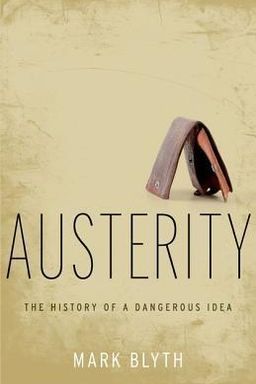
Austerity cover

Austerity

by Mark Blyth

Austerity by Mark Blyth exposes the flaws of austerity measures implemented during financial crises, revealing their detrimental impact on public welfare and economic recovery. Through historical examples and alternative strategies, Blyth advocates for economic policies that prioritize people over banks, challenging conventional economic wisdom.

The Politics and Economics of Austerity

Why do societies repeatedly turn to austerity—cutting public spending to cure debt—despite evidence that it fails? Mark Blyth’s Austerity: The History of a Dangerous Idea argues that austerity is less an economic necessity than a political choice dressed as moral virtue. It transforms private risk into public punishment, asking ordinary citizens to pay for banking crises they did not cause. Blyth’s central claim is simple: austerity does not reduce debt ratios, it deepens recessions, and it redistributes pain downwards.

You learn that austerity persists not because it works but because it fits powerful stories—about thrift, virtue, and the dangers of debt—that have deep historical and philosophical roots. Blyth excavates the intellectual lineage from Locke’s defense of property to Hayek’s faith in discipline, tracing how moral distrust of the state hardened into economic orthodoxy. He then shows how crises in banking, not bloated welfare states, triggered sovereign debt explosions—and how politicians turned this inversion into a justification for cuts. The book threads together history, political economy, and financial analysis to reveal austerity as an ideological constant masquerading as pragmatism.

From Banking Crash to Public Debt

Blyth begins with the 2008 financial crisis, showing how a private banking bust became sovereign debt through bailouts, guarantees, and collapsing revenues. The crisis began in the shadow-banking system—repo markets, securitized mortgages, and derivatives built on Gaussian models that mispriced risk. When those models failed, liquidity evaporated and governments stepped in to save banks deemed too big to fail. The losses turned into public liabilities. By 2010, states like Ireland, Greece, and Portugal were told to pay for stabilization with spending cuts, even though their debts derived from rescuing financial institutions, not profligate welfare spending.

How Ideas Became Policy

Blyth maps how austerity re-emerged after 2010 as the dominant policy framework. Monetarism, public-choice theory, and German ordoliberalism converged with IMF practice to create a global policy reflex: credibility through discipline. Economists like Alesina and Ardagna provided empirical backing for “expansionary austerity,” arguing that credible cuts would boost confidence and growth. Policy makers seized on those studies to justify fiscal consolidation in the Eurozone and the US. Yet, as Blyth shows, those findings collapsed under scrutiny: selective cases, poor controls, and omitted factors like devaluation or external demand.

A System Designed to Produce Austerity

The Eurozone’s design institutionalized austerity. With a shared currency but national fiscal responsibility, member states like Greece and Spain could not devalue to restore competitiveness. Their banks, massively larger than national GDPs, were “too big to bail” without outside help. Germany and the ECB refused debt mutualization, demanding instead that southern states cut budgets to reassure investors. The euro thus replicated the logic of the interwar gold standard: a system that forced internal deflation as the only path to adjustment. Blyth likens both systems to self-defeating machines—institutions that reward contraction until politics explodes.

The Human and Political Cost

The core of the book is moral and distributive. Austerity is not a neutral technocratic fix—it decides who pays for crisis. Cuts to social spending, wage freezes, and tax shifts hit lower and middle incomes hardest, while financial elites recover through rescued asset prices and stable profits. Blyth highlights how this imbalance fuels populism, nationalism, and distrust in democratic institutions. In case after case—from interwar Europe to post-2010 Greece—he shows austerity as a politics of punishment that erodes social contracts rather than repairing economies.

Alternatives Beyond Austerity

Blyth closes by outlining credible alternatives: financial repression, progressive taxation, and coordinated debt reduction. He revisits the postwar era, when regulated finance and mild inflation helped countries reduce debt-to-GDP ratios without slashing welfare states. He also points to fairer options—taxing offshore wealth, imposing haircuts on creditors, and restructuring banks—measures that acknowledge debt as a relational problem rather than a moral failing. The main takeaway is clear: you cannot cut your way to growth, and crisis resolution must confront distribution, not disguise it.

“Austerity is a dangerous idea precisely because it sounds moral but works political.”

This is Blyth’s haunting conclusion: austerity survives not through empirical success, but through the power of its story—the myth that shared pain restores virtue. The data, however, reveal that pain is not shared, and virtue rarely rewarded.

Across its chapters, Austerity challenges you to see fiscal policy as political economy in disguise, where moral tales justify structural inequality. By tracing history from Locke to Lehman, Blyth exposes the real function of austerity: to make the public repay the private sins of finance, all in the name of discipline and confidence.


From Banking Crashes to Sovereign Debt

You begin Blyth’s story in 2008, where what looked like a housing bubble became a global fiscal crisis. The key transition is how private risk migrated onto public balance sheets. Shadow banks—broker-dealers, investment houses, and hedge funds—financed themselves through repo markets, borrowing overnight with asset-backed securities as collateral. When those securities lost value, lenders refused to roll over funding, triggering a modern bank run across the shadow-banking system.

Derivatives magnified the contagion. Mortgage-backed securities and credit default swaps created correlated exposures across firms that believed themselves diversified. When defaults spiked, systematic exposures surfaced and leverage ratios of 30 or 40 to one destroyed equity cushions instantly. Governments stepped in with trillions in support—capital injections, loan guarantees, and emergency liquidity—to avoid total collapse. Estimates vary, but Blyth notes global banking rescues cost between $3 and $13 trillion.

When the Private Becomes Public

These interventions transformed a banking crisis into what appeared to be a sovereign-debt problem. Tax revenues plunged, social spending rose from automatic stabilizers, and bailouts ballooned liabilities. Ireland, once hailed as a model of fiscal prudence, saw debt rise from 25 to 106 percent of GDP between 2007 and 2012. Greece’s ratio shot from 106 to 170 percent despite repeated cuts. The moral narrative—irresponsible states brought this on themselves—was the opposite of reality: prudent states had socialized private banking losses.

This inversion shaped the next decade of policy. Politicians portrayed sovereigns as overextended households needing belt-tightening to “restore confidence.” In doing so, they asked the victims of crisis to pay for its perpetrators. Blyth reframes austerity as the political mechanism that transfers wealth from taxpayers to creditors by disguising structural rescue operations as fiscal prudence.

The Irish and Icelandic Contrasts

The clearest test comes from Ireland and Iceland. Ireland guaranteed every bank liability, bought toxic assets through NAMA, and imposed deep cuts to stabilize deficits. Debt exploded, unemployment hit double digits, and emigration soared. Iceland refused to guarantee private foreign creditors, let banks fail, imposed capital controls, and restructured under domestic management. The short-term pain was real, but recovery came faster; inequality even declined as financial rents vanished. The contrast becomes Blyth’s living laboratory: austerity is not inevitable—it is chosen.

You see that crisis management depends on narrative power. If elites frame debt as a moral excess, the burden shifts downward. If they treat it as a distributional conflict over who eats the losses, policy can spread adjustment fairly. Blyth’s first conclusion is thus historical and ethical: the public was made to atone for a private-sector failure through cuts falsely branded as responsibility.


The Intellectual Roots of Austerity

Austerity’s appeal is not just technical—it is moral and cultural. Blyth traces its ancestry to early liberal thinkers and twentieth-century heirs who distrusted state spending and inflation. This lineage explains why austerity recurs despite failure: its power lies in moral grammar, not empirical evidence.

From Locke to Ordoliberalism

John Locke saw property as a natural right and taxation as a potential tyranny. David Hume warned that public credit seduces nations into ruin. Adam Smith viewed fiscal parsimony as virtue. These classic liberal ideas created an enduring suspicion of debt as moral hazard. In the twentieth century, Austrian economists like Hayek and Mises argued that credit-fueled booms misallocate capital and demand liquidation through painful correction. German ordoliberals such as Eucken and Röpke later constitutionalized that sensibility into economic rules—price stability, fiscal restraint, and an independent central bank—embedded ultimately in the European Union and the euro.

Keynesian Rebellion and Return of the Old Order

For a few decades, Keynesian demand management displaced this orthodoxy. But after the 1970s stagflation crisis, monetarism and public-choice theory revived distrust in activist government. Friedman’s monetarism warned that fiscal stimulus only produced inflation. Buchanan and Kydland’s “time inconsistency” argument depicted politicians as spendthrift addicts needing institutional constraint—independent central banks, deficit limits, and automatic stabilizers. This intellectual shift closed the policy space for countercyclical action and normalized fiscal virtue as credibility.

Ideas That Outlive Their Evidence

By 2010, when crisis struck, austerity ideas were preloaded into institutions. The IMF, European Commission, and ECB reached for familiar scripts: cut deficits, reassure markets. Blyth uses this history to show that economic ideas function like software—if written long ago, they still direct action even when data invalidate them. Austerity survived by aligning with moral intuitions about virtue and guilt, reinforced by narratives that depicted debt repayment as duty and stimulus as sin.

“Austerity endures because it speaks to our sense of virtue, not our sense of arithmetic.”

In other words, it appeals to values—self-restraint, debt avoidance, stoicism—that play well politically but fail economically when generalized across nations.

Understanding that genealogy helps you see that fiscal policy debates are battles of ethics disguised as equations. Blyth shows the intellectual scaffolding that lets austerity repeatedly rise from its own ruins.


Why Austerity Fails Economically

Blyth dissects the claim that austerity restores growth and confidence. The data reveal precisely the opposite. Three interlocking flaws explain why cuts deepen crisis instead of curing it: the debt ratio trap, the fallacy of composition, and regressive distribution.

The Debt Ratio Trap

When governments cut in a recession, GDP shrinks faster than nominal debt, making the debt-to-GDP ratio rise. Greece’s austerity made its ratio jump from 106 to 170 percent; Portugal’s from 62 to 108 percent. Even the U.S. debt-ceiling compromise of 2011 rattled markets, depressing confidence instead of restoring it. Blyth calls this voluntary deflation—reducing wages and prices when debts are fixed in nominal terms, guaranteeing that ratios worsen.

The Fallacy of Composition

It might make sense for one country to tighten while others spend. But when all major economies cut simultaneously, global demand collapses. This “paradox of thrift,” as Keynes warned, means collective prudence becomes collective poverty. The Eurozone learned this the hard way: synchronized consolidation in 2010–12 crushed growth just when private deleveraging was already severe.

Distributional Regression

Austerity hits the poor hardest because they rely on public services and transfers, while the wealthy save more and benefit from asset inflation driven by central-bank support. Blyth’s Bill Gates bar analogy shows how averages mask inequality: one billionaire in a bar makes everyone “richer” statistically, though not in reality. Cuts destroy the ladders of mobility—education, housing, health—that once allowed people like Blyth himself, raised in working-class Scotland, to rise. Economically self-defeating and socially regressive, austerity serves as both a failed cure and unfair contract.

In short, the arithmetic doesn’t add up. Austerity reduces spending, investment, and wages all at once while claiming to raise confidence. The numbers suggest otherwise—growth slows, multipliers magnify cuts, and the debt burden increases mechanically. Blyth concludes bluntly: you cannot cut your way to growth, but you can cut your way into stagnation and political revolt.


The Euro: Austerity by Design

The Eurozone turned austerity from a policy into a structural condition. Blyth shows how its architecture—single currency, national debts, no fiscal union—ensures that crisis adjustment occurs through domestic deflation instead of exchange-rate shifts. The euro reproduces the logic of the classical gold standard: stability through shared pain.

Too Big to Bail

After 1999, European bond yields converged, letting periphery states borrow cheaply. Northern banks, assuming implicit backing from the ECB, bought southern debt in bulk. When crisis hit, national governments lacked the fiscal capacity to save their outsized banks—French banks held assets 2.5 times France’s GDP; top UK banks nearly 4 times Britain’s. With ECB rules equating all sovereign bonds as collateral, the system pulled weaker states into dependency. Because monetary policy was centralized but banking rescue was national, fiscal contraction became the only refuge.

Austerity as Currency Defense

Germany and the ECB resisted mutual debt guarantees. Their ordoliberal logic dictated that inflation and bailouts threaten moral hazard. Thus, austerity became the mechanism for demonstrating virtue and defending the euro’s credibility. Peripheral nations were cast as profligate sinners when in fact they were structurally trapped. The choice was cruel: perpetual austerity or bank and currency collapse. This system turned solidarity into supervision.

In Blyth’s reading, the euro makes austerity permanent not because leaders enjoy pain, but because alternatives—monetary expansion, debt mutualization, or controlled inflation—violate the union’s moral architecture. In this sense, the Eurozone’s crisis is not a failure of policy but the success of design: a currency built to enforce discipline even at the cost of democracy.


Historical Parallels: The Gold Standard and Interwar Lessons

To understand modern austerity, Blyth asks you to revisit the gold standard of the 1920s and 1930s. Then, as now, elites claimed fiscal virtue and fixed exchange rates ensured stability. In practice, those rules generated recurring depressions and political extremism. The historical analogy reveals that systems demanding permanent deflation cannot survive democratic pressure.

The Gold Standard Mechanism

Under gold, countries losing reserves deflated—cut wages, prices, and spending—to regain competitiveness. Surplus nations inflated softly. Adjustment relied entirely on domestic contraction, not external balancing. In democratic societies this became intolerable: high unemployment and wage deflation bred revolt. By the early 1930s, economies broke free one by one, and those who left gold earliest—like the United States under Roosevelt—recovered fastest.

Case Studies That Warn Today

Blyth reviews how similar logic unfolded in interwar America, Britain, Germany, and Japan. Hoover’s U.S. raised taxes in 1931, deepening the slump until Roosevelt devalued in 1933. Britain clung to parity, causing mass unemployment; Germany imposed draconian cuts that propelled extremist politics and Hitler’s rise. Japan’s gold obsession led to the Showa Depression and subsequent militarism. Where austerity ruled, democracy eroded. Where states reflated, recovery followed.

The Euro as Gold Without Gold

The euro repeats this architecture—a fixed currency without fiscal solidarity or political flexibility. Members cannot devalue or inflate away debt, leaving only internal wage cuts and spending restraint. This means Europe risks the same political feedbacks the 1930s revealed: stagnation, populism, and democratic decay. As Blyth summarizes, austerity is not only economically damaging; it is politically unsustainable when imposed repeatedly under fixed exchange regimes.

By looking backward, you see forward. The interwar era teaches that gold standards—and their modern electronic replicas—collapse not from lack of discipline but from too much of it. The lesson: no sustainable monetary order can demand endless austerity within democratic societies.


The Confidence Fairy and Its Collapse

Blyth devotes several chapters to debunking the so-called “expansionary austerity” thesis. This was the intellectual ammunition politicians used from 2010 to 2012, claiming that fiscal cuts could spark growth by lifting business confidence. When examined rigorously, the evidence vanishes.

Faulty Evidence and Selective Storytelling

Case studies by Giavazzi, Pagano, and Alesina cited Denmark and Ireland as examples where spending cuts preceded growth. Blyth and others show these “successes” coincide with strong external demand, currency devaluations, or inflows unrelated to austerity itself. Later IMF research (Guajardo, Leigh, and Pescatori) demonstrates that most consolidation reduces output, particularly when economies are already weak. When everyone cuts simultaneously—as in Europe 2010—the cumulative demand loss overwhelms any confidence gain.

The REBLL Mirage

Latvia, Estonia, Lithuania, Bulgaria, and Romania (the REBLLs) were hailed as new models of tough love producing quick rebounds. In reality, their recoveries followed GDP collapses exceeding 10 percent, mass emigration (Latvia lost 4 percent of its population), and dependence on export recoveries in Sweden and Russia. Austerity there worked politically because of small size, external trade ties, and sometimes divisive identity politics—not because contraction breeds growth. Their stories illustrate pain deferred, not triumph earned.

The empirical consensus now aligns with Blyth’s moral claim: “expansionary austerity” is a confidence fairy, not an economic law. It persists because it allows policymakers to sell pain as progress and to deflect responsibility from financial architecture to fiscal virtue. When you hear future promises that cuts will inspire investment, remember Blyth’s blunt proof—evidence says otherwise nearly every time.


Austerity’s Unequal Burden

Beyond theory, Blyth centers politics: who pays for austerity. Cuts seldom fall impartially. The affluent shield themselves with assets and flexibility, while the middle and low-income households lose jobs, benefits, and access. The policy thus becomes an upward redistribution disguised as necessity.

The Bailout and Redistribution Cycle

After 2008, banks received multi-trillion-dollar rescues while public budgets tightened. In the U.S., Blyth notes, the top 1 percent took a quarter of national income, while the richest 400 individuals owned more than the bottom half combined. Austerity austerity prolongs that imbalance: bankers’ mistakes become workers’ sacrifices. He calls this the “bait and switch”—private losses rebranded as public excess, then fixed through cuts to the very services that sustain shared prosperity.

Political Fallout

Persistent austerity produces populism and alienation. As growth stalls and inequality widens, anti-establishment movements gain strength, undermining democratic consensus. Historical parallels, from 1930s Europe to postcrisis Greece, show how economic contraction can breed authoritarian temptation. Blyth’s moral lesson is simple but urgent: fiscal consolidation without justice is both unstable and unethical.

In seeing austerity this way, you realize it is not just about deficits. It determines the social contract itself—whose security the state protects, whose risks are socialized, and whose hopes are deferred. Beneath technical debates about budget lines lies a moral economy of responsibility, one that austerity continually tilts toward the powerful.


Beyond Cuts: Practical Alternatives

Blyth ends not with despair but with options. History shows you can manage high debt without crushing growth. Two paths stand out—financial repression and progressive taxation—both politically demanding but economically logical.

Financial Repression Revisited

After World War II, nations used regulations, capital controls, and capped interest rates to channel domestic savings into government bonds. This “captive audience” system quietly reduced debts through growth and mild inflation—a liquidation tax on wealth rather than labor. Work by Reinhart and Sbrancia shows that the U.S. and U.K. cut debt ratios by several points annually without austerity.

Tax Fairness and Offshore Wealth

Progressive tax reform could raise revenue while reducing inequality. Economists Piketty, Saez, and Diamond calculate that higher top marginal rates—similar to those of postwar decades—would not harm growth. One-time wealth levies, applied to large fortunes, could raise near-double-digit percentages of GDP in crises. Complementary efforts to capture offshore assets, estimated in tens of trillions, expand fiscal capacity further. These measures confront debt through fairness rather than contraction.

Blyth insists that because debt is political, its resolution must be too. Financial repression and tax reform reorient who bears adjustment, challenging the recurring habit of making the bottom repay the top. The lesson closes the circle: austerity is not destiny, and alternatives exist if societies choose justice over orthodoxy.

Dig Deeper

Get personalized prompts to apply these lessons to your life and deepen your understanding.

Go Deeper

Get the Full Experience

Download Insight Books for AI-powered reflections, quizzes, and more.