
Idea 1
The Science and Strategy of Attention
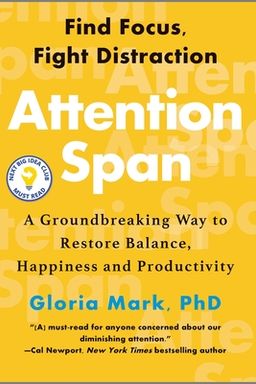
Why do you feel mentally exhausted by mid-afternoon yet still compelled to check your phone constantly? Gloria Mark’s work dismantles the myths of productivity and multitasking to reveal a physiological, psychological, and sociotechnical portrait of human attention in the digital age. Her central claim is clear: attention is a limited resource governed by cognitive, emotional, and environmental rhythms. You can’t just will focus into existence; you must manage your mental fuel and design your environment for balance and well-being.
Attention as a finite resource
Mark draws from neuroscience to explain that you burn mental energy through three attentional networks: alerting (staying vigilant), orienting (selecting what to process), and executive control (resisting distraction). These systems operate like a fuel tank. Once drained, you become impulsive and less capable of selecting priorities wisely. Experiments show that sustained cognitive control alters physiological markers—blood flow and heart rate—proving that attention depletion is not metaphorical but metabolic. You experience real fatigue when juggling decisions, resisting notifications, and switching tasks throughout the day.
A world of fragmentation
Modern work splinters your focus into minute fragments. Mark’s living lab studies have documented that people switch between computer screens every 47 seconds on average and between projects roughly every 10 minutes. After an interruption, they take about 25 minutes to resume the original task and often engage in multiple intermediate activities. This constant reconfiguration—the cognitive “gear change”—is costly, producing attention residue and stress spikes measurable through heart-rate variability. Multitasking isn’t simultaneous processing but rather serial distraction performed at great physiological cost.
The rhythm of attentional states
Instead of chasing continuous flow, Mark encourages cultivating a rhythm of alternating attentional states: Focus (high engagement, high challenge), Rote (high engagement, low challenge), Boredom (low engagement, low challenge), and Frustration (low engagement, high challenge). These states cycle throughout your day, creating natural peaks in focus (around late morning and mid-afternoon) and troughs in boredom (around lunch). The healthiest strategy isn’t prolonged focus but rhythmic shifts between demanding and restorative tasks—what she calls “rhythm as the new flow.” Rote activities like simple games or walks replenish resources and support creative incubation.
How technology and design hijack attention
Digital platforms capitalize on how your mind works. The internet’s node-and-link structure mirrors associative memory, inviting you into endless clicking loops. Algorithms continuously observe and adapt to your behavior, tuning recommendations on platforms like TikTok to exploit intermittent rewards and emotional triggers. The same design principles that foster creativity through association can also trap you in compulsive scrolling. From personalized feeds to rapid shot lengths in modern media, attention has become a commodity refined and sold through data. Recognizing these external influences is the first step toward reclaiming agency.
Human agency and self-regulation
Mark reframes the philosophical notion of free will through Bandura’s concept of agency: intentionality, forethought, self-regulation, and self-reflection. You can’t override all digital cues, but you can design practical friction and awareness mechanisms that preserve choice. Agency manifests when you plan how and when to allow interruptions, set hooks for breaks, or externalize unfinished tasks to quiet mental churn. This blend of psychology and design grounds freedom in structured habits rather than heroic willpower alone.
Toward balance and well-being
The book’s arc culminates in a shift from productivity to well-being. Managing attention connects directly to health: reducing interruptions improves heart-rate variability and lowers stress. Sleep replenishes depleted executive control, while short, deliberate rote tasks—solving a simple puzzle or walking in nature—refuel creativity and positive mood. These rhythms and recoveries translate to agency over both cognition and emotion. Mark calls for systemic change—organizational norms, humane digital tools, and policies like France’s Right to Disconnect—to protect attention as a public resource. You achieve sustainable focus not through relentless discipline but through intelligent rhythm, rest, and design that respects your mind’s limits.