
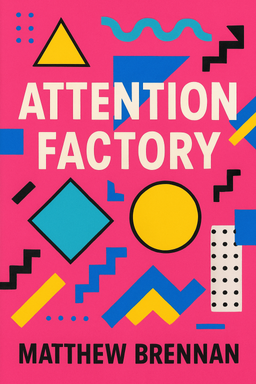
Attention Factory cover

Attention Factory

by Matthew Brennan

Attention Factory delves into ByteDance''s meteoric rise, showcasing how innovative technology and strategic foresight created TikTok, a global digital phenomenon. Through captivating stories and analysis, discover the transformative impact on the tech landscape and exciting lessons in technological advancement.

The Rise of ByteDance and TikTok: Redefining Global Attention

Have you ever wondered why you—or millions around the world—can’t stop scrolling short videos that seem perfectly tailored to your interests? Attention Factory: The Story of TikTok and China’s ByteDance by Matthew Brennan answers that question by chronicling how a once unlikely Chinese startup harnessed algorithmic recommendation and cultural insight to create a global phenomenon. Brennan argues that ByteDance, the company behind TikTok and its Chinese cousin Douyin, didn’t just build an app—it engineered a new digital habit, one where information seeks you instead of you seeking it.

At the heart of Brennan’s story lies the company’s revolutionary understanding of attention as a resource—the new oil of the digital age. ByteDance’s founder, Zhang Yiming, saw the shift coming before anyone else: smartphones would replace newspapers and televisions, and machine-learning algorithms would replace human editors. That conviction shaped ByteDance’s earliest successes with Toutiao, a news aggregation app run by AI, and later evolved into Douyin and TikTok, the short-video platforms that conquered both China and the world.

The Context of a Digital Revolution

When Brennan begins the story, China’s internet industry is a high-speed battlefield—crowded with copycats, dominated by giants like Tencent and Alibaba, and seemingly closed to global competition. Yet ByteDance, founded in a converted apartment by a small group of engineers in 2012, breaks all expectations. Zhang Yiming, a calm, rational entrepreneur obsessed with efficiency and data, believed early that personalized recommendation—not search or social networking—was the future of content delivery.

This insight built ByteDance’s first hit, Toutiao (“Headlines Today”), which used AI to show news articles suited to each individual reader. It then rippled outward as the company applied the same principles to short-form video. What resulted were Douyin in China and TikTok abroad—platforms that merged entertainment, social media, and machine learning into an experience almost impossible to look away from.

From Algorithms to Empires

The book makes a compelling point: ByteDance’s rise wasn’t just technological; it was cultural. Douyin didn’t simply adopt short-video trends—it refined them through China’s unique environment of cheap labor, intense competition, and mobile-first users. Brennan takes you inside the company’s “attention factory,” where engineers, growth hackers, and content managers experimented relentlessly with app features, aesthetics, and algorithms to drive engagement.

The so-called “virtuous cycle” became ByteDance’s engine: more engagement produced better data for recommendations, better recommendations led to higher engagement, and so on, until the app’s addictive precision seemed to read minds. Brennan explains how this model transformed an ordinary social app into a sophisticated behavioral loop—the perfect machine for monetizing micro-moments of human curiosity.

Why This Story Matters

Beyond the technological marvel, Brennan also traces the ripple effects: how ByteDance’s objective recommendation system challenged state-controlled media norms, how Douyin redefined Chinese youth culture, and how TikTok brought China’s innovation playbook to global audiences. In doing so, the book opens a window into deeper questions: How do algorithms shape identity? Who controls the world’s attention? And can a company from Beijing become a cultural superpower through code alone?

As you explore Brennan’s analysis, you’ll follow Zhang Yiming’s journey from a quiet student in rural Fujian to the world’s top tech entrepreneur, the evolution of AI-driven media from Toutiao to Douyin to TikTok, and how recommendation engines turned short videos into a global attention economy. The lessons extend far beyond social media—they reveal how the battle for attention now defines competition among nations, not just companies.

Ultimately, Brennan’s story is about transformation: of information into entertainment, algorithms into cultural forces, and curiosity into currency. The rise of ByteDance offers a case study in technological foresight, operational ruthlessness, and human psychology—how one company learned to give everyone exactly what they didn’t know they wanted, one swipe at a time.


Zhang Yiming and the Pursuit of Excellence

Matthew Brennan paints Zhang Yiming as a paradox: a quiet engineer who built one of the world’s noisiest platforms. Zhang’s defining trait was his lifelong quest for optimization. He viewed his company as a product continually refined through iterations—much like his own life choices. His journey from a small village in Fujian province to founding ByteDance mirrors China’s technological awakening.

The Making of a Rational Dreamer

Zhang’s upbringing in a scientifically minded family nurtured his curiosity. Instead of chasing prestige, he chose Nankai University based on four personal criteria—proximity to the sea, winter snow, balance of genders, and distance from home—illustrating his analytical yet unconventional thinking. This decision foreshadowed how he would later run his company: independent, data-driven, but guided by intuition.

In college, Zhang repaired computers and coded while others partied, cultivating patience and precision. He learned endurance—the ability to delay gratification—something he later used in building products that required long cold-start periods before success. His career at Kuxun, Microsoft, and Fanfou taught him both bureaucratic frustration and entrepreneurial freedom. These experiences shaped his conviction that recommendation, not curation, would drive the next wave of digital media.

Optimization as Philosophy

Zhang’s defining worldview was that efficiency trumps tradition. He bought his first apartment not through visits or negotiations—but by building a web scraper to crunch housing data and identify the optimal choice. That same logic underpinned his decision to sell that apartment to fund ByteDance. To Zhang, good decisions weren’t emotional—they were algorithmic. His mantra: “Build systems that learn faster than competitors.”

This mentality explains ByteDance’s experimental culture—running countless product tests, killing weak ideas quickly, and pouring resources into the ones that showed data-driven promise. Zhang’s view of entrepreneurship as a continuous equation-solving process contrasts sharply with charismatic leaders like Jack Ma or Steve Jobs, who motivated through narrative. Zhang motivated through logic and hardcore belief in iteration.

Beyond the Myth of Genius

Brennan avoids glorifying Zhang as a lone genius. Instead, he portrays a disciplined builder who empowered an ecosystem of talent—most notably his friend Liang Rubo and key hires from Baidu. Zhang’s “craving for excellence,” as his colleagues described, was contagious. It fostered ByteDance’s culture of precision, minimal hierarchy, and relentless experimentation—factors that later allowed the company to scale globally without collapsing into bureaucracy.

Reading Brennan’s account, you see that Zhang’s story isn’t about luck but a mindset: treating both company and self as evolving systems. His decisions—whether moving from search to recommendation, or from China to global markets—stemmed from the same algorithmic instinct: measure, test, optimize. In a world drowning in information, this is the logic that reshapes what you see on your screen every day.


From Toutiao to Douyin: The Attention Engine

What links a news app, a comedy feed, and a viral video platform? Brennan shows that they’re all puzzles solved by ByteDance’s single “recommendation engine.” Toutiao—literally “Today’s Headlines”—was the prototype that taught ByteDance how to match people with information better than any human editor could. It’s the story of how machine learning replaced journalism in deciding what millions read every morning.

The Core Mechanism: Recommendation

Instead of curated homepages or follow-based feeds, Toutiao analyzed each user’s behavior to predict what they’d like. Zhang Yiming shifted the industry’s paradigm: from people searching for content to content searching for people. Brennan describes this as the dawn of the “information push era,” paralleling how YouTube’s algorithm in 2011 transformed online video consumption (see also: John McFadden and Christos Goodrow’s work at Google).

Toutiao’s algorithm weighed metrics such as completion rate, time spent, likes, and shares—what Brennan calls “the attention currency.” High-performing content triggered a self-reinforcing cycle: more exposure, higher interactions, better data, even sharper predictions. The system effectively learned to read not just articles but human psychology.

Scaling the Factory

ByteDance refined its algorithms through relentless hiring, poaching Baidu’s top technologists like Yang Zhenyuan and Zhu Wenjia to upgrade its models. Toutiao’s backend, Brennan writes, relied on three profiles—content, user, and environment—to optimize each recommendation. The more people read, the smarter the system got, producing a “data flywheel” that became ByteDance’s secret weapon.

By 2014, Toutiao wasn’t just a news platform—it was an AI laboratory. When its bots began writing Olympic coverage faster than human reporters, the message was clear: ByteDance had redefined publishing. This AI-first mindset laid the technical and cultural foundation for Douyin’s success with video.

The Leap to Emotion

Toutiao taught ByteDance how to manage attention; Douyin taught it how to make that attention pleasurable. Brennan shows how the company’s transition from text feeds to full-screen mobile videos extended the same recommendation engine into entertainment. In this new world, clicks became swipes, and stories became dances. Once algorithms learned how long people watched each clip, they could predict desire—what Brennan calls “the machine reading your mind.”

The implication for you is profound: every swipe, pause, or replay teaches the algorithm who you are. Brennan’s chronicle of ByteDance’s evolution is thus a story about data as empathy—how cold equations craft intimate experiences. Understanding that mechanism helps you see TikTok not as magic but as mathematics disguised as art.


Douyin and TikTok: Engineering Emotion at Scale

When Douyin launched in China in 2016, no one imagined it would become the mold for a global cultural engine. Brennan reveals how ByteDance merged technology, operations, and aesthetics to create a viral ecosystem that feels personal and infinite. The story of Douyin’s evolution into TikTok is the blueprint for building modern attention platforms.

The Douyin Experiment

Unlike Western startups that focus on one product, ByteDance treated short video as a portfolio experiment—launching three apps (Xigua, Huoshan, and A.me) simultaneously. A.me, later renamed Douyin (“Shaky Sound”), was managed by Kelly Zhang and started with fewer than ten staff. Through months of near-failure, they learned that cultivating a passionate core user base mattered more than flashy features.

Their approach to growth was uniquely Chinese—labor-intensive “operations” involving one-on-one creator relationship management, contests, and rewards. The team courted art-school students and early creators, promising fame and visibility. Brennan describes their turning point as “nation-building”: treating creators as citizens whose success attracted new immigrants, echoing Musical.ly cofounder Alex Zhu’s metaphor of building an economy by making a few people rich first.

Designing Desire

From its sleek dark interface to its iconic neon musical-note logo, Douyin’s design captured youth identity. The product reframed short video from playful lip-syncs into a lifestyle stage—“Record Beautiful Life” became its slogan. The combination of beautifying filters, music hooks, and algorithmic distribution turned ordinary users into entertainers. Each video became a mini-narrative compressed into seconds, designed to trigger emotion before logic caught up.

Brennan highlights viral moments like the “Karma’s a Bitch” trend, showing how Douyin engineered repeatable creative formulas—challenges, reveals, transformations—that lowered the barrier to participation and multiplied engagement. Douyin wasn’t merely mirroring youth culture; it actively manufactured it.

TikTok and the Global Factory

The international counterpart, TikTok, applied the same infrastructure globally through localized content pools: Japan’s cautious creators, Thailand’s dancers, America’s meme-makers. Brennan explains how ByteDance’s motto “globalize the product, localize the content” allowed TikTok to fit different cultural expectations while keeping a unified addictive logic. Each country had its own recommendation loop, yet all pulsed from the Beijing-built backend.

When the two worlds merged—Musical.ly and TikTok in 2018—the result was a global platform unlike any other: a social network without social ties, powered solely by content and curiosity. Through Brennan’s lens, Douyin and TikTok represent not just apps but new emotional infrastructures—and your daily scroll is part of their grand experiment in engineered delight.


Algorithmic Culture and the War for Attention

If information is infinite, attention is the bottleneck. Brennan casts ByteDance as the pioneer of the global attention economy—the company that learned how to algorithmically mine human focus. The AI recommendation system behind TikTok isn’t simply a neutral tool; it’s a cultural filter shaping what billions see.

The Mechanics of Addiction

TikTok’s algorithm measures engagement with obsessive precision, tracking every micro-action—swipes, pauses, replays—to infer taste. Brennan likens this to “machine empathy,” where data points simulate emotional understanding. The result is a paradox: a soulless system that feels intimate. Like Netflix predicting your mood before you do, TikTok builds psychological momentum one clip at a time.

This design turns passive consumption into participation. Viral memes such as “Old Town Road” or “The Bottlecap Challenge” demonstrate how the platform transforms cultural artifacts into interactive trends, where watching effortlessly leads to creating. Each meme is a small-scale experiment in social psychology—the gamification of creativity.

Battles at the Top

Brennan frames global competition as ideological: Facebook, YouTube, and Tencent underestimated TikTok’s model of content discovery without followers. Their attempts to clone it—Lasso, Reels, Weishi—failed because ByteDance’s advantage wasn’t branding but time. Every minute users spent swiping added more behavioral data, deepening the moat competitors couldn’t replicate.

The implications reach beyond social media. ByteDance’s success exposes how power now lies not in owning platforms but in owning algorithms that interpret attention. As Brennan puts it, “TikTok is the digitization of American Idol”—anyone can become a star if the machine decides their video deserves exposure. It turns fame into a function of computation, not charisma.

The Price of Attention

Yet Brennan doesn’t ignore the darker side. Recommendation systems can amplify addiction, echo chambers, and manipulation. He recounts how Douyin and TikTok faced backlash for vulgarity in China and cringe culture abuse in the West. The same feedback loops that make the apps irresistible also make them volatile. The “attention factory” is not a utopia—it’s capitalism applied to curiosity, optimizing engagement regardless of emotional health.

For you, Brennan’s argument is clear: every scroll is a vote cast in the global algorithmic marketplace. Understanding how ByteDance designed attention helps you see not just what you consume—but why you can’t look away.


Globalization, Controversy, and the Geopolitical Moment

By the book’s end, Brennan shows how ByteDance went from startup to geopolitical hotspot. TikTok’s rapid spread placed a Chinese-owned app at the center of Western cultural life—a first in internet history. With success came suspicion: Was this just innovation or influence?

Crossing Borders

Yiming’s dream of globalizing ByteDance was radical. Chinese tech firms rarely thrive abroad due to cultural and political constraints. Yet by hiring top global executives—Vanessa Pappas from YouTube, Kevin Mayer from Disney—ByteDance embraced hybrid leadership. Brennan depicts this integration as an East-meets-West experiment: a Beijing data engine wrapped in Hollywood marketing charm.

TikTok localized content while keeping centralized technology. Japanese, Thai, and American feeds looked culturally distinct but shared the same invisible algorithmic spine. This allowed ByteDance to scale universally while maintaining compliance across divergent markets—a feat legacy giants never mastered.

Controversy and Politics

Success brought scrutiny. Brennan closes with TikTok’s entanglement in U.S.-China tensions—India’s ban, Trump’s executive orders, and debates over data sovereignty. The app that started as a tool for creativity became a symbol of digital geopolitics. Its algorithm, once admired for precision, was now feared for surveillance potential. Brennan maintains a balanced stance—neither pro nor anti-ByteDance—but shows how technology and politics have fused into one global narrative.

Ultimately, TikTok’s rise marks an inflection point: the first major victory of a Chinese consumer technology brand on the world stage. Brennan reminds you that learning about TikTok is learning about the future of global information wars, where attention is territory and algorithms are borders.

In the end, he leaves you with the humbling insight that this story is just beginning. ByteDance’s factories of attention will evolve, but the question remains—can humanity outthink the algorithms it created? That’s the challenge Brennan’s chronicle hands to us all.

Dig Deeper

Get personalized prompts to apply these lessons to your life and deepen your understanding.

Go Deeper

Get the Full Experience

Download Insight Books for AI-powered reflections, quizzes, and more.