
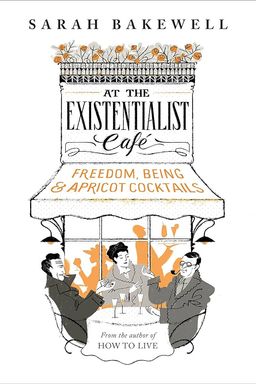
At The Existentialist Cafe cover

At The Existentialist Cafe

by Sarah Bakewell

At The Existentialist Cafe delves into the origins of existentialism, interweaving the lives of iconic philosophers with their influential ideas. Discover how existential questions can transform our understanding of freedom, responsibility, and the essence of being in this compelling and accessible narrative.

Freedom and the Task of Invention

What does it mean to invent yourself in a world without predetermined meaning? For the existentialists—Sartre, Beauvoir, Merleau-Ponty, Heidegger, and their allies—the answer begins with a defiant claim: existence precedes essence. You are not born with a fixed nature or divine blueprint. You become who you are through your choices, your acts, and your responses to the situations that confront you. That idea undercuts metaphysics that promise stable roles and rules and instead places the burden of creation on you.

The book traces how European thought, shaken by war, occupation, and totalitarianism, turns philosophy into a question of lived action. It begins with phenomenology, passes through Heidegger’s inquiries into being, and comes to rest in Sartre and Beauvoir’s insistence on freedom, responsibility, and moral engagement. It ends not in abstraction but in the cafés, streets, archives, and political struggles where these ideas take root.

From Phenomenology to Existentialism

Edmund Husserl’s phenomenology—his call to return “to the things themselves”—founds this tradition. Husserl asks you to suspend scientific or theological assumptions and describe your experience as it appears. That method reshapes European philosophy: Heidegger applies it to ontology, Merleau-Ponty to embodiment, and Sartre to consciousness and freedom. Phenomenology’s discipline of attention becomes existentialism’s method of honesty.

Heidegger then transforms the movement by introducing Dasein, the being that questions Being. You are never a detached mind but always a body in a world of tools, purposes, and others. When those tools break or when routines fail, you sense Being itself and confront your own finitude. This concern with authenticity versus das Man (“the they”)—the anonymous social conformism that dictates how one should live—will shape every existentialist after him.

Sartre’s Radical Freedom

Jean-Paul Sartre turns these insights into a public philosophy. For him, freedom is not a luxury but your fundamental structure. Even in prison or under occupation, you are free to choose how to respond. Yet that radical agency produces anguish: you can never escape the fact that you must choose and that every choice implicitly declares what you believe all humans should do. The student who asks Sartre whether to join the Resistance or care for his mother learns there is no rulebook—only invention.

To flee that responsibility, many people retreat into roles or excuses—what Sartre calls bad faith. Authenticity means acknowledging freedom, acting without alibis, and accepting consequence. That moral discipline grounds his politics and his rejection of honors; it becomes the connective tissue of his novels, plays, and essays.

Beauvoir’s Expansion of Freedom

Simone de Beauvoir extends existentialism to gender and social life. In The Second Sex she demonstrates that women are not born but made—shaped into the identity of “the other” through history, myth, and education. Her analysis fuses phenomenological attention with existential ethics: freedom is always embodied, situated, and constrained by structures that must be named before they can be changed. Beauvoir’s line between transcendence (self-project) and immanence (being reduced to an object) civicly translates existentialism into feminist and political critique.

Embodiment, Perception, and the Social World

Merleau-Ponty insists that consciousness is bodily. Perception is not a detached scanning of data but the way your body reaches into the world and receives its shape. His examples—holding a cup, driving a car, feeling phantom limbs—show that self and world interpenetrate. This insight recasts meaning, knowledge, and politics as embodied practices. It joins Sartre’s “gaze” analysis, where being seen converts you into an object, with Beauvoir’s recognition that some people live permanently under that objectifying gaze.

From Thought to Café to Politics

After 1945, existentialism leaves the classroom. Cafés like the Flore and Deux Magots become arenas for an embodied public philosophy. Les Temps modernes turns talk into political activism: support for strikers, resistance to colonialism, anti–death-penalty debates. Existentialists see ethics as practice—choosing, risking, and engaging despite ambiguity. That public presence transforms philosophy into culture: black turtlenecks, jazz clubs, and open moral argument.

Technology, Dissent, and Mortality

Heidegger’s later warning about technology—that it enframes beings as resources—anticipates ecological thought. Meanwhile, Husserl’s manuscripts, rescued from the Nazis, and Jan Patočka’s dissident phenomenology in Prague show how attention itself can be moral resistance: to witness truth when ideology lies. In Sartre’s final ethics, you test every judgment by the eyes of the least favoured—the oppressed whose view unmasks injustice. Even this principle, though noble, creates painful paradoxes about violence and responsibility in anti-colonial struggles.

The Human Bloom

As these thinkers aged, they faced decline and death with the same radical attention they had given to life. Beauvoir writes that death ends relation, not redeems it; Sartre loses his sight and revises his idea of salvation through writing. Yet the shared legacy is a way of looking: a demand to notice the subtle bloom of existence—the way experience glows with irreducible detail even amid disorder. To live existentially is to notice, to respond, and to create meaning out of circumstance.

Core message

You are not given essence; you invent it through action. Freedom is terrifying, but through disciplined attention, authentic choice, and care for others’ perspectives, you can transform contingency into a meaningful, responsible life.


Phenomenology and the Art of Attention

Existentialism begins with a change in how you look. Edmund Husserl proposed phenomenology as a rigorous way to describe experience without presupposition. His motto—“to the things themselves!”—invites you to confront the world as it appears, bracketing metaphysical or scientific explanations.

To do this, you perform the epoché, suspending judgment about what exists, and attend to intentionality, the structure by which consciousness is always directed toward something. This method transforms a cup of coffee, a song, or a conversation into legitimate philosophical fields. You train yourself to describe before explaining, to see before categorizing.

Heidegger’s Ontological Expansion

Martin Heidegger radicalizes the method. Rather than analyzing detached perceptions, he asks what it means to be. His term Dasein—being-there—refers to a human existence that is always already in a network of relations, tools, and purposes. You recognize Being when ordinary activity breaks down, when the hammer snaps and you suddenly notice existence itself. Heidegger calls this moment of awakening the path to authenticity.

At the same time, Heidegger warns against das Man, the social “they” that dictates empty routines. Listening to conscience—his metaphor for responding to your ownmost possibility—demands resisting this anonymous pressure. Yet his own Nazi involvement makes this ethics ambiguous, a lasting puzzle about how thought and politics intertwine.

Embodied Perception

Maurice Merleau-Ponty carries phenomenology into the body. In Phenomenology of Perception he shows that to see or reach is already to know the world bodily. Your hand, tool, or car merges into a single sense of self; you maneuver corners because your body “knows” space. Phantom limb phenomena reveal how identity and perception depend on lived embodiment. Perception, not abstract cognition, roots you in the world’s texture.

Merleau-Ponty’s idea of the chiasm—the intertwining of self and world—captures this reciprocity: what you touch touches back. The perceiving body becomes the site where self, others, and world weave together, forming the ethical and political foundation of later existential thought.

Insight

Phenomenology teaches you disciplined awareness: to describe lived experience faithfully before reducing it to theories. That attentiveness underlies existentialism’s demand for authenticity and its respect for concrete, human life.


Freedom, Anguish, and Authenticity

Jean-Paul Sartre uses phenomenology to uncover freedom at the heart of being. To be human is to be condemned to freedom: you must choose, even when you wish not to. There is no divine script or fixed essence to hide behind. The consequence is both glorious and terrifying—exhilaration that you are your own author, and anguish that nothing guarantees you’re right.

Bad Faith and the Temptation of Roles

To escape this vertigo, people pretend they are things. The waiter who acts his part so completely that he forgets his freedom, or the lover who claims to be “overwhelmed by passion,” both engage in bad faith. They deny responsibility by absorbing themselves into a predefined identity. Sartre says authenticity begins when you acknowledge that you are always more than any label—you are your choices in motion.

Freedom as Universal Responsibility

Every choice, Sartre insists, is a choice for mankind. When you act, you model what you think humans should be. Hence freedom is inseparable from ethics. The student who must choose between joining the Free French or staying with his mother bears full responsibility; no moral code can decide for him. To choose authentically is to invent values through deeds, not theories.

This radical autonomy ties to politics. After the war, Sartre argues for engagement—public action consistent with moral freedom. He founds Les Temps modernes to merge intellectual life with responsibility. Refusing honors like the Nobel Prize, he insists that a philosopher answer to the world, not institutions. (Compare to Kierkegaard’s leap of faith: Sartre’s leap lands in an atheistic void you must fill yourself.)

Key thought

Freedom is not about doing whatever you like; it is the unavoidable structure of existence. Authenticity means embracing that structure without excuses.


The Gaze, Gender, and the Other

Existentialism deepens when you encounter another consciousness. Sartre’s “gaze” dramatizes how the presence of the Other transforms your world. Alone in a park, you feel sovereign; seen by another, you become objectified. The glance you exchange reveals both connection and conflict: your freedom collides with someone else’s view.

Sartre’s famous keyhole scene captures this: as someone approaches, the voyeur realizes they are also watched. Selfhood depends on others’ recognition, yet that recognition can imprison. The gaze exposes how identity is always negotiated socially.

Beauvoir’s Feminist Correction

Simone de Beauvoir extends the theme in The Second Sex. She argues that women live constantly under the male gaze—not as momentary embarrassment but as structural subordination. Myths, rituals, and education teach women to view themselves as objects of attention rather than agents of transcendence. Her declaration that “one is not born but becomes a woman” means freedom is historically stifled by patriarchy’s definitions.

Using existential analysis, Beauvoir dissects how dependence, social expectations, and economic exclusion restrict projects. Liberation thus requires both personal authenticity and collective change. By describing how women internalize objectification, she inaugurates modern feminist philosophy.

Lesson

Freedom is inseparable from social relations. You gain or lose it in the gazes that define you, and resisting objectification begins the path to authenticity for both individuals and groups.


Ethics, Responsibility, and Political Engagement

Existential ethics arises when freedom faces the world’s suffering. Since you must choose, ethics means choosing well—not by formula but by accountable action. Sartre’s wartime examples evolve into a broad doctrine of commitment: intellectuals must engage the concrete situations of their time.

From Personal Choice to Collective Responsibility

In the postwar years, existentialists test their ideals through politics. Sartre and Beauvoir launch Les Temps modernes to unite literature, philosophy, and activism. They champion workers, colonial subjects, and political prisoners. Camus, while sharing moral seriousness, disputes their willingness to justify violence; his The Rebel insists that means cannot be sacrificed to ends. The fierce break between Sartre and Camus embodies the ethical tension between engagement and restraint.

Conflicted Commitments

Cold War ideology and anti-colonial movements strain friendships and principles. Merleau-Ponty rethinks Marxism after disillusionment; Sartre defends Communists under persecution, later supporting Algerian rebels alongside Frantz Fanon. These stances illustrate how existential ethics demands active risk. To act is to take sides, and to live authentically means accepting the guilt of imperfect choices.

Sartre’s later criterion—the viewpoint of “the least favoured”—urges you to test justice by imagining how it feels to the oppressed. Though morally potent, it raises dilemmas when oppressed groups’ interests collide. The point, however, endures: solidarity requires radical empathy balanced by critical thought.

Ethical insight

Existential ethics converts freedom into public action. To choose authentically is to bear the world’s consequences, not retreat into abstraction or innocence.


Writing, Art, and Self-Transformation

Sartre’s later work reveals another path to freedom: storytelling as self-making. In biographies like Saint Genet and The Family Idiot he examines how individuals transfigure adversity into meaning. Jean Genet, branded a thief, seizes the insult and invents a poetic identity. The act of narrating shame turns contingency into necessity—a creative reclamation of fate.

Life as Project

Each person, Sartre says, forms a fundamental project, a pattern of choices that give life cohesion. Artists exemplify this by reinterpreting their past rather than denying it. When Genet makes crime sacred, he demonstrates existential alchemy: converting social condemnation into a self-defined meaning. Similarly, Flaubert’s retreat into literature turns exclusion into aesthetic mastery.

This creative project differs from psychoanalysis: it replaces drives with decisions. You reclaim authorship of your story. Yet Sartre cautions that aesthetic transformation can become escapism if it ignores social responsibility—a tension between artistic transcendence and political duty that shapes his own life.

Freedom Through Narrative

Writing serves as existential action: it gives shape to being. In Words, Sartre portrays his childhood as material for reinvention—a counterstrike against humiliation. By naming his past, he owns it. Beauvoir’s memoirs perform the same labor, weaving personal agency with historical witnessing. The act of describing experience becomes ethical because it resists silence and fate.

Practical takeaway

When you transform your story into language or art, you reclaim power over circumstances. Existential freedom often begins with the courage to narrate your life truthfully.


Witness, Technology, and Legacy

The final movement traces how phenomenological attention becomes a politics of witnessing and a meditation on modernity’s dangers. Husserl’s manuscripts survive Nazi destruction thanks to Father Van Breda’s daring rescue, proving that even ideas rely on moral courage. The archive’s continuation in Louvain enables later thinkers from Merleau-Ponty to Jan Patočka to sustain and politicize phenomenology.

Phenomenology as Resistance

Jan Patočka in Communist Czechoslovakia reinterprets “going to the things themselves” as witnessing truth against imposed lies. His death after interrogation turns philosophical integrity into civic martyrdom. His student Václav Havel transforms this ideal into The Power of the Powerless, showing how refusing empty slogans reawakens moral reality—a political epoché. Attention becomes uprising.

Heidegger’s Technological Warning

Heidegger’s later essays, despite their author’s compromised past, clarify how modern technology frames the world as mere resource. He names this enframing: a worldview that turns rivers into hydroelectric potential and humans into material. The only antidote is Gelassenheit or letting-be—dwelling poetically with the world rather than exploiting it. This critique anticipates ecological philosophy and prompts a cautious hope: confrontation with danger may reveal a new care for Being.

Mortality and the Human Bloom

In their latter years, Sartre, Beauvoir, and Merleau-Ponty confront mortality as the final test of attention. Beauvoir’s reflections on death deny transcendence: life ends absolutely, which makes living honestly urgent. Merleau-Ponty’s notion of “the flesh of the world” and Beauvoir’s “imponderable bloom” converge as metaphors for fragile vitality that deserves care. The closing message: remain alert to the subtle light of lived experience as both moral practice and resistance to dehumanization.

Enduring insight

Existentialism’s legacy is not despair but vigilance: to witness truth, guard freedom, and honour the miraculous texture—the bloom—of ordinary being.

Dig Deeper

Get personalized prompts to apply these lessons to your life and deepen your understanding.

Go Deeper

Get the Full Experience

Download Insight Books for AI-powered reflections, quizzes, and more.