
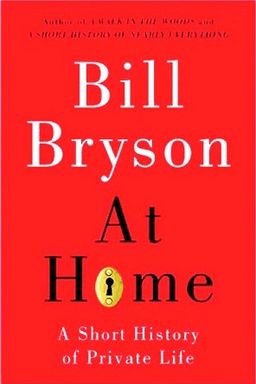
At Home cover

At Home

by Bill Bryson

At Home by Bill Bryson takes readers on a captivating journey through the history of domestic spaces and common household items. Explore the evolution of rooms like the kitchen and bathroom, and uncover the fascinating stories behind everyday objects, offering a fresh perspective on how our homes have been shaped by history.

The House as a Mirror of Civilization

Bill Bryson’s At Home: A Short History of Private Life is a sweeping journey through human history told through the lens of a single domestic space: his nineteenth-century rectory in Norfolk. Bryson argues that the history of civilization doesn’t just live in archives or battlefields—it is embedded in the walls, ceilings, and floorboards of the home. Every ordinary object and architectural choice, from the hinge of a door to the curve of a banister, carries stories of invention, labor, empire, and social aspiration.

The central idea is deceptively simple: the house is the stage where history hides in plain sight. By tracing the evolution of rooms, materials, and domestic routines—from kitchens and bathrooms to fuseboxes and telephones—you uncover the evolution of comfort, technology, and culture. Bryson transforms the mundane into a historical detective story.

History in the Ordinary

Bryson begins his exploration literally from the attic, peering down over Norfolk’s landscape, and invites you to see domestic life as the true main thread of history. Wars and inventions matter, but the texture of existence—eating, sleeping, heating, cleaning—defines the human story. By investigating how each part of the house came to be, Bryson reconstructs the material and cultural evolution of civilization, showing that innovation often grew out of humble needs: warmth, cleanliness, convenience, and security.

(Note: This approach resembles Fernand Braudel’s view of the longue durée—history as a slow accretion of habits and technologies shaping daily life.)

From Shelter to Symbol

In prehistory, homes emerged not as automatic human tools but as cultural inventions—responses to climate and social change. At Skara Brae, 2,500 BC, people constructed stone houses with built-in furniture, showing early sophistication. By the Middle Ages, English homes centered around communal great halls filled with smoke and bustle. The invention of chimneys, upstairs chambers, and separate rooms between the fourteenth and seventeenth centuries created privacy—and with it, the idea of the individual within the domestic sphere.

As rooms specialized—kitchens for cooking, drawing rooms for display—the home became not merely shelter but an instrument of social expression. Its design embodied new hierarchies and values. Bryson shows how this architecture of habit became a record of changing ideas about comfort, cleanliness, and class.

Technology, Trade, and Transformation

Domestic life, Bryson reveals, cannot be separated from global exchange. Pepper and spices drew explorers across the oceans; tea and sugar built empires; cotton and coal fueled the Industrial Revolution. The Crystal Palace of 1851 symbolized Britain’s technological triumph and previewed modern consumer culture—flush toilets for visitors were as revolutionary as Paxton’s prefabricated glass and iron design. Each domestic improvement depended on world-spanning networks: guano from Peru fertilized English gardens; American ice cooled Victorian drinks; whale oil lamps brightened parlors before kerosene replaced them.

Within the home, these developments reshaped work and comfort. Servants did what machines now do—heating water, scrubbing floors, hauling coal—until electricity, gas, and plumbing turned physical drudgery into mechanical labor. Yet progress came with hidden costs: exploitation, colonial extraction, and new environmental dependencies. Ordinary conveniences, Bryson insists, conceal extraordinary global histories.

Science, Health, and Hygiene

The domestic sphere also absorbed the revolutions in medicine and science. From the grim heroics of early surgery without anesthesia to the germ theory that transformed sanitation, Bryson traces how the house became a frontier of cleanliness. The bathroom, once unthinkable indoors, arose through intertwined advances in plumbing, water supply, and public health engineering. The shift from miasma to microbes (thanks to John Snow, Joseph Bazalgette, and Robert Koch) didn’t just change cities; it revolutionized private living. Clean water, bathrooms, soap, and sewers were technologies of morality as much as hygiene.

Microscopes, vitamins, and nutrition science further redefined the kitchen. What you cooked became an experiment in chemistry: preserving food via canning, refrigeration, and glass jars reflected human mastery over decay. You learn that every spoonful of salt or bread slice marks a long negotiation between biology, technology, and belief.

Comfort, Aesthetics, and the Machinery of Taste

Bryson’s exploration of comfort collapses the boundary between economics and design. Agricultural improvements in the eighteenth century generated wealth that translated into furniture, fabrics, and elaborate country houses. Pattern books by Chippendale and Hepplewhite democratized style. Taste became an industry; architecture and ornament proclaimed identity. Even the seemingly timeless lawn or landscaped garden began as aristocratic constructions of nature by figures like Capability Brown or Paxton, later transformed into suburban status symbols.

The home thus evolved into an aesthetic machine—absorbing light, heat, wires, and pipes invisibly while displaying beauty on its surfaces. Bryson’s writing brings together the hidden (plumbing, servants, microbes) and the visible (architecture, furniture, style) to show that the history of the home is the history of the modern world’s aspirations—comfort, control, cleanliness, and connection.

Why It Matters

For Bryson, studying the home is not nostalgia; it’s a method of understanding civilization’s anatomy. Your walls are archives of choices—technological leaps, imperial extractions, gendered labors, moral crusades. To see your own domestic surroundings historically is to realize how every comfort is contingent, every convenience hard-won. The light you flick on, the bath you draw, and the bread you eat are the end results of centuries of trial, error, invention, and exploitation.

Core message

The house is the ultimate microcosm of history—where empire meets architecture, science meets daily habit, and humanity’s grand story hides inside its smallest spaces.

By the time you finish Bryson’s journey room by room, you see that to live in a house is to inhabit the cumulative history of human effort. The ordinary is never truly ordinary; it is the archive of everything humanity has made of itself.


Origins of Home and the Birth of Privacy

Bryson begins by stripping home back to its earliest meaning: a shelter shaped by climate, culture and community. At Skara Brae and Çatalhöyük, he finds that even the simplest dwellings reveal sophistication—stone dressers, drainage, and storage—showing that domestic order predates cities and kings. Homes were collaborative, often communal—and privacy, as you know it, did not exist.

The Evolution of Domestic Space

In early medieval England, homes were essentially one smoky hall. The invention of the chimney in the fourteenth century revolutionized domestic architecture: by creating separate heat zones, it allowed for upstairs rooms, “great chambers,” and the emergence of private life. This architectural shift reshaped society—individual bedrooms encouraged discretion, family identity, and gendered spheres.

Over centuries, the home internalized technology and hierarchy. The kitchen separated from the hall; servants and masters gained distinct quarters. When Bryson’s own Norfolk rectory took shape, domestic life was a mapped hierarchy—front rooms for display, back spaces for work. Reading these partitions shows how class literally built itself into walls.

Insight

Privacy is not a natural right but a technological invention. Chimneys and corridors made solitude possible.

From Hearth to Heart of Culture

The idea of “home” expands as comfort rises. The invention of improved materials—brick, glass, plaster—and heated rooms made houses more permanent. With permanence came memory and identity: homes became repositories of lineage and taste. The evolution from movable hut to durable home is the material expression of civilization’s desire for continuity.

By the time we reach the Georgian and Victorian eras, the house had become a metaphor for order itself: rooms were moral landscapes, and how one organized them reflected one’s place in the world.


Industrial Materials and the Built World

Bryson demonstrates that the story of comfort is also the story of material science. From timber to brick, iron to steel, every innovation in substance alters economics, aesthetics, and social geography. Canvass White’s hydraulic cement on the Erie Canal linked inland America to Atlantic trade, while Bessemer’s steel turned architecture vertical and global.

Materials Create Empires

As each raw material rose or fell in cost, entire landscapes followed. Britain’s coal and clay abundance birthed brick cities; deforestation forced architectural adaptation; iron bridges and crystal palaces announced an industrial age of transparency and scale. The 1851 Great Exhibition showcased manufacturing as spectacle—Joseph Paxton’s prefabricated glass hall built in thirty-five weeks proved that modularity and speed would redefine building itself.

Designing for an Industrial Age

Bryson connects these feats to domestic life. Mass production of bricks, plaster, and pipes made comfort replicable. Your radiator, faucet, and gas line exist because of industrial logistics first tested in monumental projects. The same forces that erected the Crystal Palace or Eiffel Tower quietly equipped suburban villas and bathrooms with warmth and light. Materials became instruments of everyday luxury.

Key lesson

Each material innovation doesn’t just change what cities look like—it changes what people imagine as possible.

By the late nineteenth century, city skylines and households were made of the same story: modular, standardized, and designed to endure. The physical skeleton of modernity was forged in kilns, kilns, and mills long before it appeared in your living room.


Food, Empire and Global Taste

Bryson moves from structure to sustenance, showing that what you eat and drink has always been geopolitical. Bread, salt, and spice drove trade routes and wars. From Columbus seeking pepper to tea fueling the British Empire, kitchens became microcosms of global exchange.

Spice, Exploration and Exchange

Pepper and nutmeg financed voyages that expanded continents. The so-called “Columbian Exchange” swapped foods and diseases: from the Americas came potatoes, maize, and tomatoes, which quietly transformed Eurasian diets. Entire cuisines—Italian, Irish, Indian—depend on New World imports. In this sense, Bryson writes, taste reshaped the planet more profoundly than warfare.

Tea, Sugar and the Economics of Addiction

Sugar made slavery profitable; tea made empire respectable. The cup in your hand was once an object of political tension—from the Boston Tea Party to the opium wars. Victorians saw moral virtue in economy and cleanliness while consuming commodities built on exploitation. Bryson’s layered narrative insists you see your pantry as an imperial archive.

Preservation and Innovation

Advances in canning, ice transport, and refrigeration conquered perishability and freed societies from seasonal hunger. François Appert’s sealed jars and Frederic Tudor’s ice trade link entrepreneurs to housewives centuries later. Each preservation technology altered agriculture, diet, and gendered labor. Even nutrition science—vitamin discovery, mineral balance—predicted by scurvy cures and laboratory breakthroughs—arose from domestic concern: keeping people alive and well-fed indoors.

In this way, Bryson reframes the kitchen as the nerve center of globalization: every jar, spice, and recipe represents migrations of plants, microbes, techniques, and power.


Work, Servants and Hidden Labor

If comfort defines modern life, it once had human hands behind it. Bryson descends into the scullery to confront the invisible labor that sustained domestic grace. Nineteenth-century homes, even modest ones, relied on servants as today’s rely on electricity and plumbing. Their daily toil—fetching water, laundering, cooking—defined the tempo of the household.

Invisible Architecture

Architecture evolved to conceal labor: back stairs, underground kitchens and servants’ bells created smooth surfaces for leisure above. In the Carlyles’ house, the maid’s exhaustion was as structural as the chimney. Hannah Cullwick’s diary, written through grime and fatigue, captures the paradox: invisible workers holding up the illusion of effortless gentility. Modern conveniences—appliances, plumbing—merely replaced human drudgery with mechanical equivalents.

Moral Contradictions

Bryson threads this theme into broader Victorian contradictions: workhouses under the 1834 Poor Law punished poverty, while philanthropists like Barnardo rescued children with both mercy and manipulation. Labor and morality intertwined uneasily—service promised dignity but often concealed exploitation. In both household and institution, comfort depended on disciplined, unseen suffering.

Truth beneath comfort

Every convenience masks a labor system, whether human or mechanical. The servant’s vanished world persists inside our appliances.

By restoring servants to the story, Bryson reminds you that the home, far from a refuge from economics, has always been an instrument of it.


Light, Power and the Modern Miracle

Bryson treats the electrified home as a marvel only recently achieved. For millennia nights were candlelit slivers of shadow. The journey from tallow to tungsten reveals how science, commerce and fear advanced hand in hand.

Illuminating Progress

Rushlights, whale oil, kerosene and finally electricity each mark leaps in brightness and safety. The oil boom beginning with Edwin Drake’s 1859 well replaced whale slaughter with industrial extraction. Edison and Swan’s incandescent bulbs then turned light into a utility system—Pearl Street Station (1882) being the first urban power grid.

This transformation didn’t just extend your day; it changed social space. Evenings filled with reading, leisure and electrical appliances emerged. Light begot machines; technology begot habits.

Invention and Infrastructure

Bryson’s story of Edison’s concrete houses and Bell’s telephone shows that invention is never just an object but an ecosystem. Edison’s dream of cast-concrete homes failed under technical limits, while Bell’s telephone niche became a literal design feature of hallways. Once networks entered the home, architecture adjusted—wiring, fuses, sockets—and “connection” became a domestic condition.

The electric revolution thus completes the chain linking house to world. Energy, communication, and design fuse into a single system, making the modern home as much a node as a nest.


Health, Hygiene and the Sanitary Awakening

Cleanliness, Bryson argues, is not instinct but invention. From Roman baths to Victorian bathrooms, attitudes toward washing reveal the marriage of science, superstition and engineering. For centuries, fear of disease made water dangerous; by the nineteenth century, it became salvation.

From Miasma to Microbes

Edwin Chadwick’s “all smell is disease” captured Victorian logic, prompting sewers and street cleaning even before germ theory. John Snow’s mapping of the 1854 Soho cholera outbreak and Bazalgette’s massive sewer system redefined urban health policy. Their works transformed London’s filth into infrastructure, paving the way for domestic bathrooms.

The Bathroom Revolution

Early flushing toilets met resistance from limited plumbing and social taboos. Joseph Bramah’s designs, Crapper’s chain-operated cistern, and later U-bend traps solved the odor problem, but only when sewers existed could they spread. Porcelain, enamel and hotel innovation made private bathing desirable. Cleanliness became moral purity—an aesthetic of virtue as much as hygiene.

Civilization’s hallmark

Plumbing and public health reveal a culture’s true priorities more clearly than its monuments.

From sewers to soap ads, modern cleanliness is a triumph of infrastructure and imagination—proof that comfort depends as much on invisible pipes as on noble ideals.


Gardens, Fashion and the Aesthetics of Nature

Bryson turns outside to the garden to show how even “nature” is a cultural construction. From rigid Renaissance parterres to Capability Brown’s rolling landscapes, gardening charts a shift from geometry to illusion. The ha-ha and serpentine lake made estates look natural, even as they were engineered spectacles.

Plant Hunters and Empire

Exploration fed horticultural obsession. Joseph Banks, Robert Fortune, and others roamed the globe for tea, bamboo, and rhododendrons. Guano mining and chemical fertilizers (Lawes’s superphosphate) closed the nutrient loop that sustained Victorian gardens. The modern lawn—maintained by Budding’s 1830 mower and fertilizers—moved colonial botany into suburbia. Even grass, you learn, is an industrial artifact.

Clothing the Body as We Dress the Land

Fashion and landscape intertwine. Both express control over nature through artifice. Wigs, corsets, and crinolines mirror the sculpted terrain of estates—disciplining matter and body into elegance. Textile revolutions in cotton, silk, and industrial weaving replicate this aesthetic mastery on the human form. From Arkwright’s mills to Chippendale’s chairs, refinement depended on mechanized production and exotic imports.

By the nineteenth century, beauty had become a system—woven from soil, sweat, and steel—binding landscape, fashion, and empire into one continuous work of design.


Medicine, Mortality and the Price of Progress

Bryson confronts the uneasy history of medical advancement. Surgery before anesthesia, the black market of corpses, and the fear of premature burial reveal how progress emerges through pain, risk and ethical compromise.

Suffering and Science

Fanny Burney’s 1806 mastectomy without anesthetic epitomizes the ordeal that defined early surgery. Speed was survival, but infection still killed. Only with anaesthesia and antisepsis did healing outpace harm. Yet literature of the time—body-snatching scandals, the Anatomy Act of 1832—shows how science’s hunger for knowledge violated moral boundaries.

Death, Fear and Modern Rituals

Victorian taphephobia—the terror of being buried alive—led to alarmed coffins and waiting mortuaries. Cremation’s slow acceptance encapsulated society’s shift from spiritual taboo to pragmatic hygiene. Medical and funerary innovation intertwined, blurring the line between care and desecration.

Ethical lesson

Every life-saving discovery carries a moral ledger. Medicine advances not just through experiment but through confrontation with fear, law and conscience.

The domestic link endures: the clean bathroom, the safe surgeon, the sanitized hospital—all trace to the long struggle to rescue bodily dignity from ignorance and horror.


Memory, Heritage and the Modern House

Bryson’s journey ends where it began: in the house as historical witness. Britain’s obsession with both preservation and progress captures civilization’s double impulse—to build anew and to remember. From John Lubbock’s Ancient Monuments Act (1882) to the decay of hundreds of country mansions under economic strain, you see how heritage is always contested.

Archaeology and Loss

The same scientific impulse that preserved artifacts also destroyed contexts. Pitt Rivers’s disciplined methods emerged from centuries of careless digging, and economic depression later desecrated recent heritage as death duties forced estate sales. Furniture, paintings, and staircases migrated from ancestral halls to museums and mansions abroad. Preservation became a patchwork of sentiment and salvage.

What Remains

Bryson’s own rectory stands as an archive in miniature—a survivor of changing economies, materials and meanings. The final recognition is that history’s remnants are everywhere: in garden soils, attic beams, bricks turned black by coal smoke. What you call modern life is built from the residue of countless pasts. To look closely at your surroundings is an act of historical recovery.

Final thought

Your home is a museum you live inside. Understanding it reconnects you to the inventions, errors and hopes that built civilization.

Bryson closes with humility: history is not locked in grand monuments but seeps quietly through the plaster of ordinary walls—awaiting anyone curious enough to listen.

Dig Deeper

Get personalized prompts to apply these lessons to your life and deepen your understanding.

Go Deeper

Get the Full Experience

Download Insight Books for AI-powered reflections, quizzes, and more.