
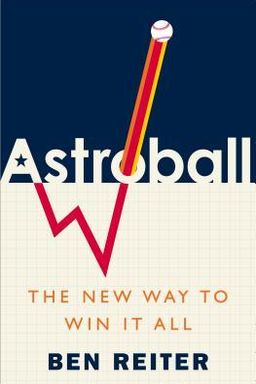
Astroball cover

Astroball

by Ben Reiter

Astroball uncovers the revolutionary journey of the Houston Astros, exploring how data analytics and innovative strategies propelled them to win the 2017 World Series. This engaging narrative offers insights into how technology reshapes traditional industries.

Astroball: How Data and Human Intuition Built a Champion

How do you build a champion in a world that worships data but is still ruled by human decisions? In Astroball: The New Way to Win It All, journalist Ben Reiter reveals how the Houston Astros transformed from one of the worst teams in baseball history into World Series champions—not by embracing data alone, but by reimagining what data even means. Reiter argues that the Astros' success wasn’t the victory of algorithms over intuition, but a blueprint for how humans and machines can work together to make better decisions.

A decade before their 2017 championship, the Astros were baseball’s laughingstock—mocked, bankrupt, and so irrelevant that their televised games drew a 0.0 rating. Yet behind the scenes, a quiet revolution was underway. Owner Jim Crane hired Jeff Luhnow, a former engineer and McKinsey consultant, to engineer not just a baseball team, but an entirely new decision-making process. Inspired by the principles behind Moneyball but frustrated by its limits, Luhnow set out to blend the cold logic of data science with the warm intuition of experienced scouts, creating a philosophy that Reiter calls Astroball.

Beyond Moneyball: A New Kind of Analytics

If Moneyball taught baseball how to find hidden value through overlooked data, Astroball taught teams how to trust data without worshipping it. Traditional analytics optimized for averages, but baseball (and life) happens at the edges—under uncertainty, in emotion, and in moments when the math feels wrong. Luhnow wanted to quantify the “gut” itself. To do it, he partnered with Sig Mejdal, a former NASA scientist and blackjack dealer turned behavioral statistician. Together they built an analytical system that incorporated not just measurable stats but also subjective inputs like work ethic, emotional resilience, and “growth mindset”—the belief that players can improve through effort.

Using tools like probabilistic modeling and something Sig called the STOUT system (Stats and Scouts), the Astros turned human judgment into data and data into human wisdom. They asked not, “Is this player good right now?” but “Can this player become great?” This was a subtle but radical shift—the same mindset guiding companies today trying to balance AI with emotional intelligence or institutions trying to make “smart” decisions without losing their soul. As Reiter argues, it’s a model for decision-making in the 21st century far beyond sports.

The Long Game: Losing to Learn

When Crane bought the Astros in 2011, he and Luhnow faced a team that was financially hemorrhaging and athletically bankrupt. Their plan wasn’t to win fast—it was to build a sustainable winner through what they called “radical transparency and data purity.” They gutted expensive veterans, embraced losing seasons as experiments, and reinvested in scouting, minor leagues, and technology. To outsiders, it looked like tanking; internally, it was controlled demolition. Luhnow even said, “Would you rather lose 98 or 107 games in 2012? In 2017 no one will care.”

They built Ground Control, a centralized database merging scouting reports, analytics, and medical data, essentially baseball’s first real-time decision network. This infrastructure allowed them to measure everything—not to dehumanize players, as critics claimed, but to understand them more deeply. When combined with behavioral psychology and cognitive bias research (from Daniel Kahneman and Amos Tversky), it enabled the Astros to remove emotion from bad decisions without removing humanity from the good ones.

Human Stories Behind the Numbers

Reiter humanizes the data revolution through personal stories: the undersized second baseman José Altuve who defied physical bias and learned to turn his small strike zone into a superpower; the mild-mannered pitcher Dallas Keuchel who reinvented himself using analytics to master precision over power; the intellectual shortstop Carlos Correa who applied “growth mindset” to rewire his swing; and the once-fatally flawed outfielder George Springer, who turned a stutter and a sky-high strikeout rate into tools for resilience. These players weren’t just data points—they were living prototypes for how Astroball’s philosophy worked in real life.

By 2017, all of these threads—risk tolerance, data humility, and belief in human adaptability—culminated in a poetic moment: the Astros signing Justin Verlander with two seconds to spare on the trade deadline, just days after Hurricane Harvey devastated Houston. It was a choice pure analytics would’ve discouraged. But intuition—and humanity—decided otherwise. Verlander helped deliver the city’s first championship just months later.

Why Astroball Matters

Reiter’s book isn’t just a sports narrative—it’s a manifesto for the age of AI and big data. The Astros won by understanding that data without empathy is blind, and empathy without data is naïve. Businesses, governments, and individuals all face this same paradox. How do you make decisions that are both smart and wise? Astroball’s answer: by fusing human insight with computational precision. As Reiter puts it, “Success is not man or machine, but man plus machine—as long as man remains in charge.”


The Nerd Cave and the Rise of Data-Driven Baseball

Jeff Luhnow’s Houston Astros were born not in a dugout, but in an office. Right after taking charge in 2011, Luhnow built a secretive analytics hub nicknamed The Nerd Cave—a war room combining statisticians, former physicists, engineers, and scouts. Their mission was to rebuild a dead franchise from mathematical first principles.

Building a Quantitative Brain

Luhnow and Sig Mejdal decided to apply the kind of intelligence work found at NASA or McKinsey to baseball. They replaced intuition-only evaluations with a system that captured every observable data point on a player—from swing trajectory to family history—and turned it into predictive output. Every player, major leaguer or high-school prospect, was assigned a “single number” value estimating future performance relative to cost.

But they didn’t abolish scouts; they quantified them. By running regressions on which scouts’ judgments proved accurate, they assigned weights to gut instincts. This created a feedback loop: scouts provided subjective data, models assessed predictive strength, and together they refined decision accuracy. Sig called this philosophy the essence of decision science (blending economics, psychology, and statistics).

When Data Meets Resistance

Not everyone loved this revolution. Traditional baseball men saw it as an “invasion of nerds.” Players sneered at defensive shifts designed by computers. And fans mocked the team’s losing streaks during its rebuild—printing “LASTROS” and “DISASTROS” T-shirts. Even other executives accused Houston of being soulless and robotic.

Sig defended their approach with behavioral science, citing Daniel Kahneman’s work on cognition: humans rely on heuristics, emotional shortcuts that lead to bias. The point of analytics was not to replace the gut, but to refine it—to make emotional truth statistically visible. Over time, this distinction paid off: systems like Ground Control could pinpoint undervalued minor leaguers (like Collin McHugh) based on spin rate before traditional scouts even noticed.

Creating Ground Control

Ground Control became the Astros’ version of NASA’s mission control. Every decision—draft pick, roster move, even in-game shift—ran through it. It wasn’t about removing human judgment, but about connecting every piece of the organization through a single data language. Partnerships between analysts and field coaches became routine. If the scouts spoke in metaphors, the data team spoke in math, and Ground Control translated between the two.

By 2014, despite being mocked as baseball’s outcast, Houston had transformed into one of the most analytically advanced organizations in sports. Their defeats in those early seasons weren’t evidence of failure—they were necessary data points. As Luhnow put it, “You hit on sixteen. Even if you lose, you keep hitting until the math works.” That patient marriage of intellect and conviction became the template for every future 21st-century sports rebuild.


Growth Mindset: The Human Side of Optimization

Growth mindset, a concept introduced by psychologist Carol Dweck, became one of the Astros’ most unlikely secret weapons. Instead of selecting players solely for their raw talent, Luhnow and Sig wanted ones who believed they could change—athletes hungry to learn, to adjust, and to grow smarter through failure. Reiter turns this philosophy into a unifying worldview across the Astros organization.

George Springer and the Science of Adaptability

Outfielder George Springer was a perfect test case. Highly gifted yet flawed—he struck out once every 3.7 at bats—he seemed doomed to stagnate. But coaches recognized his underlying trait: resilience. Springer had overcome childhood stuttering through patience and self-analysis. When coaches told him to calm his swing, he adapted quickly, retooling his motions through video and deliberate practice. Within three years, he evolved from a wild power hitter into an All-Star leadoff man.

(Compare this approach with the military’s philosophy in Team of Teams by Stanley McChrystal: adaptability beats perfection.)

Dallas Keuchel: From Mediocre to Mastermind

Pitcher Dallas Keuchel embodied what a growth mindset looks like in physical form. Initially seen as an underpowered journeyman, Keuchel used data from the Nerd Cave to identify his strengths—command and deception rather than velocity. He embraced analytics instead of resisting them. By adjusting pitch sequences and adopting the Astros’ sophisticated defensive shifts, he reinvented himself into a Cy Young winner. His evolution underscored the franchise’s core belief: progress is built, not given.

José Altuve: Short Stature, Limitless Focus

No story embodies growth mindset better than José Altuve. Rejected as too short (5'5") by most scouts, Altuve turned his supposed limitation—his tiny strike zone—into an advantage. Astute enough to adopt data-driven hitting theories, he refined his swing to focus only on pitches he could drive. Combined with his internal motivation, he evolved from an unheralded minor leaguer into the MLB MVP. Altuve proves that analytical improvement depends on emotional openness: success needs curiosity as much as calculus.

Through Springer, Keuchel, and Altuve, Reiter shows how human flexibility became just as measurable as physical ability. The Astros’ genius wasn’t just in predicting player potential—it was in cultivating it.


Turning Losses into Data: The Rebuild and Reinvention

Losing was the Astros’ laboratory. Between 2011 and 2013, they lost a staggering 324 games—the worst three-year stretch since the 1960s Mets. Yet this wasn’t mistake-driven chaos; it was controlled demolition. Each defeat generated actionable insight about process efficiency, player psychology, and team chemistry.

Long-Term Thinking in a Short-Term Sport

Owner Jim Crane committed early to the idea that true turnaround takes years. Unlike impatient teams who oscillated between rebuilding and overpaying for free agents, Houston accepted short-term pain for long-term sustainability. Like Bezos reinvesting Amazon profits, Luhnow refused to ‘band-aid’ the franchise. Instead, he traded veterans for prospects, funded analytics research, and accepted losing as a form of R&D.

Crisis as Course Correction

Of course, not every failure was strategic. The Brady Aiken fiasco in 2014—drafting a pitcher first overall only to void the deal over a medical exam—turned into a PR disaster. But even that misstep yielded insight: risk management matters more than optics. That unintentional failure ultimately allowed Houston to draft Alex Bregman the following year, one of the cornerstones of their championship team. In retrospect, the Aiken debacle illustrated Astroball’s hidden principle: every loss is a learning dataset.

From Mockery to Model

The franchise’s radical transparency—publicly explaining its rebuilding strategy—made it an easy target for critics. Yet as results compounded, the same methods others ridiculed became blueprints across the league. By 2015 the Astros were back in the playoffs; by 2017, they were champions. The lesson? In complex systems, progress looks like failure until the feedback loops mature. Astroball teaches that resilience isn’t about avoiding error—it’s about learning faster than your rivals.


Carlos Beltrán and the Science of Team Chemistry

While analytics built Houston’s foundation, Carlos Beltrán provided something algorithms couldn’t calculate: trust. Signed as a 40-year-old veteran, Beltrán became the team’s emotional architect, transforming a collection of statistically optimized players into a unified, inspired tribe.

Chemistry as Hidden Data

Economists at the Sloan Sports Analytics Conference called this the “David Ross Effect”—the measurable value of mentorship on team output. Beltrán embodied it. He created rituals (the post-game championship belt ceremony), bridged language barriers between Latin and American players, and modeled emotional calm under pressure. His presence validated Reiter’s thesis that chemistry isn’t fuzzy; it’s another form of data whose metrics haven’t yet been invented.

Mentorship in Practice

Beltrán mentored Carlos Correa and George Springer the same way veteran Luis Alicea once mentored him. He taught them to study video like scientists, to decode pitcher “tells,” and—more importantly—to think like strategists. His blend of wisdom and humility created psychological safety: young players could fail without fear. When Correa credited seven of his home runs to Beltrán’s advice, that impact became quantifiable.

Data Meets Empathy

Researchers like Kate Bezrukova and Chester Spell at Santa Clara University found that diverse groups succeed only when members bridge “fault lines”—divisions of culture or language. Beltrán intuitively did just that. The Astros’ multicultural harmony under his guidance wasn’t accidental; it was engineered through empathy. Reiter uses Beltrán to argue that emotional intelligence can be as decisive as statistical analysis in shaping high-performing teams—in baseball and beyond.


Two Seconds to Spare: The Verlander Trade and the Human Factor

Perhaps the most cinematic moment in Astroball comes on August 31, 2017, when the Astros acquire Justin Verlander at literally 11:59:58 p.m.—two seconds before the trade deadline. It wasn’t just a transaction; it was the symbolic merger of analytics and instinct.

When the Math Said No

Sig’s economic models discouraged the trade. Verlander was aging, expensive, and only marginally projected to improve team performance. But data couldn’t calculate emotion: Hurricane Harvey had just devastated Houston, morale was collapsing, and the players needed hope. Owner Jim Crane and Luhnow sensed this intangible urgency. They overrode the model—guided by empathy and narrative necessity, not percentages.

The Mentor Arrives

When Verlander landed in Houston, he brought the analytical curiosity and discipline to match the organization’s culture. He absorbed the Nerd Cave’s insights into spin axis and launch angles, tweaking his slider grip to adapt to newly “juiced” baseballs. He combined mechanical tinkering with veteran intuition. In five starts that September, he went 5–0 with a 1.06 ERA. The city, the data, and destiny had aligned.

A Lesson in Decision-Making

Reiter highlights this moment as the epitome of Astroball: a decision that looked irrational on paper but rational in human context. Luhnow’s final call—“You hit on sixteen”—captured the philosophy’s essence. You trust the math until your gut, honed by experience and empathy, whispers otherwise. Two seconds decided history—and proved that data is a compass, not a commander.


Winning the World Series: The Coin Toss and the Process

When the Astros reached the 2017 World Series, Sig Mejdal called it a “coin toss competition.” In a sport where statistical dominance guarantees nothing in a seven-game sample, luck becomes another variable to model but never control. Reiter narrates the impossible drama of the Astros-Dodgers series as the final test of the Astros’ philosophy: Can you plan for chaos?

Probability Meets Personality

Game Seven became the living embodiment of Astroball. Alex Bregman’s audacious throw home, George Springer’s rediscovery of confidence after a slump, and Verlander’s leadership all showcased how preparation met instinct. Every micro-decision reflected thousands of prior analytical choices—who to draft, how to shift, when to swing. Yet outcomes hinged on moments that no model could guarantee. Sig, chewing his rally towel in the stands, watched randomness play its final act.

Full Circle: Process Over Outcome

Winning the championship validated Luhnow’s process but also humbled him. He recognized that even perfect decision science can’t eliminate variance; it can only tilt odds. What matters isn’t being certain—it’s being less wrong than everyone else. “All models are wrong,” statistics pioneer George Box once said, “but some are useful.” The Astros’ model proved useful enough to make their own luck.

In the end, the team that combined empathy, analytics, and endurance beat pure talent. Reiter closes by suggesting that the Astros’ methods foreshadow how all industries will evolve—those who merge human intuition with machine intelligence will lead the future’s “World Series” of innovation.

Dig Deeper

Get personalized prompts to apply these lessons to your life and deepen your understanding.

Go Deeper

Get the Full Experience

Download Insight Books for AI-powered reflections, quizzes, and more.