
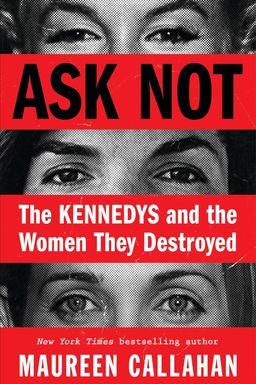
Ask Not cover

Ask Not

by Maureen Callahan

The author of “American Predator” puts forward a history of the Kennedy family that describes the abuse of women in its orbit.

Camelot’s Cost: Power, Secrecy, and Women’s Lives

What does it take to build a national myth so luminous that it blinds you to the harm beneath it? In Ask Not, Maureen Callahan argues that the Kennedy dynasty converted glamour and grief into political capital by repeatedly offloading the costs onto women. The book is not a tabloid roundup; it is a structural indictment. Callahan contends that the Kennedys’ power apparatus—family fixers, friendly media, legal firepower, and cultural reverence—shielded men while delegitimizing, isolating, or erasing women who were exploited, injured, or killed. To see this clearly, you must connect private abuses to public myth-making and track how narrative control became a core instrument of power, not an incidental perk.

You move through stories that at first seem discrete: sexual exploitation in the White House; Chappaquiddick’s delayed call for help; Rosemary Kennedy’s lobotomy and lifelong institutionalization; Marilyn Monroe’s entanglements with the brothers and the missing records around her death; Mary Richardson Kennedy’s descent amid reputation warfare; Carolyn Bessette’s posthumous vilification after a crash caused by pilot error; and the Martha Moxley case, where private probes and sealed files complicated justice. Each case repeats the same mechanics: control the narrative, insulate the powerful through institutions, and displace the victim. When those mechanisms activate, women’s lives become collateral to the project of dynasty.

How narrative beats accountability

Callahan shows you how image management functions like policy. Jackie Kennedy’s post-assassination stagecraft is the ur-example: from funeral choreography to the Life magazine interview that minted “Camelot,” she converted trauma into a sanctifying myth. That story made JFK timeless and unassailable in the public mind (compare to Elizabeth I’s image politics—but now supercharged by television). Later, the same narrative discipline appears when Caroline Kennedy and Maria Shriver reportedly lobby the History Channel to bury an embarrassing miniseries; the network complies. These are not random PR wins. They are the family’s muscle memory: define the frame early, make it visual, and equate criticism with sacrilege.

Sex, consent, and presidential privilege

Inside the White House, power translated into sexual access. Mimi Beardsley, a 19-year-old intern, describes being escorted by Dave Powers to Jackie’s own bed where President Kennedy undressed her and had sex within minutes. Diana de Vegh is alternately flattered and diminished by JFK, pulled into encounters that collapse her agency. Marilyn Monroe becomes the era’s most fraught emblem of this pattern—brought close for spectacle (the Madison Square Garden “Happy Birthday” in a skin-toned Jean Louis gown, with Bobby as escort), then kept at a distance when she threatened exposure. In each case, consent exists in a compromised space where refusal risks reputation or career. The aftermath is predictable: the women carry shame; the men retain status.

Chappaquiddick as a template

Ted Kennedy’s 1969 crash on Chappaquiddick, which left Mary Jo Kopechne dead, reads like a manual for crisis containment. Ted leaves the scene, calls fixers Paul Markham and Joe Gargan instead of police, receives a speech from Ted Sorensen, and accepts a light legal penalty. Coverage soon pivots from Mary Jo’s life to Ted’s prospects. The “Boiler Room Girls,” the talented staffers around the campaign, are shamed and surveilled. This pivot—make the powerful man’s fate the main character—recurs again and again (see also the rush to blame Carolyn Bessette after the 1999 plane crash that the NTSB attributes to JFK Jr.’s pilot error).

Medicine and the machinery of disappearance

The family’s approach to mental health and medicine is equally revealing. Joe Kennedy secretly arranges a lobotomy for Rosemary in 1941—a crude, devastating procedure that leaves her with toddler-level function—and then hides her away for decades. Later, psychiatric labels and sealed affidavits become tools to undermine Mary Richardson Kennedy during a bitter marital collapse with RFK Jr., even as she seeks help and documents her pain. Joan Kennedy’s alcoholism is tabloidized while Ted’s culpability surrounding Chappaquiddick recedes. Clinical language, in this world, often serves reputational protection rather than care.

Parallel justice and sealed truths

In the Martha Moxley case, you watch private wealth create a shadow investigation. Rushton Skakel hires Sutton Associates to examine his sons Tommy and Michael; the Sutton Report, buttressed by Academy Group profiling, deepens suspicion of Michael. Years later, public pressure and Dorothy Moxley’s relentless advocacy help bring a 2002 conviction—then a 2018 reversal for ineffective counsel. The state seals evidence in perpetuity, limiting future scrutiny. The same fog appears around Marilyn’s death, with reports of missing tapes, phone logs, and an ABC special pulled before airing. When powerful families can privatize evidence or memory, closure becomes optional.

The book’s central claim

Camelot’s glow did not just coexist with harm; it often required you not to see it. Power preserved itself by managing stories, instruments, and institutions—while women paid in bodies, reputations, and, too often, their lives.

Callahan does not deny agency to the women. Jackie becomes an editor with real cultural influence (Joseph Campbell’s The Power of Myth; Dorothy West’s The Wedding). Pamela Kelley, paralyzed after an accident, turns to disability advocacy at CORD. Carolyn Bessette asserts boundaries in a lopsided marriage. Mimi and Diana reclaim voice by telling truths that once felt unspeakable. But the ledger is stark. If you want a just public life, the book argues, you must resist dynastic reverence, demand primary evidence over curated lore, and center victims first. (Note: this throughline echoes the #MeToo era’s insistence on institutional accountability.)


Sex, Consent, and Oval Office Entitlement

Callahan argues that to understand sexual exploitation at the apex of power, you must examine how status, setting, and silence combine to short-circuit consent. In John F. Kennedy’s White House, proximity to the presidency functioned as a coercive force. The stories of Mimi Beardsley, Diana de Vegh, and Marilyn Monroe illustrate how unequal power reshapes choices, language, and aftermath. You see that consent is not just a yes or no; it is the net sum of risk, fear, and consequences in a room the woman does not control.

Three dynamics that define the room

First, there is radical asymmetry. The President is the world’s most powerful man; the woman is an intern, staffer, or actress bound to public reputation. Second, there is the private stage: bedrooms, pools, and bathrooms inside the White House—the very architecture muffles witnesses. Third, there is post-encounter minimization: the institutional impulse is to hush up, normalize, or pathologize the woman if she speaks. These dynamics do not simply amplify ordinary dating risks; they recode intimacy as a test of loyalty and deference.

Mimi Beardsley: summoned to Jackie’s bed

Mimi is nineteen when Dave Powers escorts her to the private residence. The President undresses her and has sex within minutes on the First Lady’s bed. She later struggles to define what happened, describing paralysis rather than free assent. The scene’s speed and setting matter. In a context where refusal can mean ostracism or career ruin, “going along” is not proof of mutual desire. Callahan wants you to see that absence of resistance is not the presence of consent when power works like gravity.

Diana de Vegh: intellect courted, person diminished

Diana’s story is not one-note. She experiences genuine attention—rides, conversations, praise for her intelligence—then is reduced to rushed, transactional sex that leaves her feeling small. This oscillation between flattery and humiliation is psychologically destabilizing. It keeps the victim near the flame, doubting her own perceptions. If you have watched similar patterns in powerful workplaces (see also Harvey Weinstein-era testimonies), you recognize the script: access is both gift and trap.

Marilyn Monroe: spectacle, secrecy, and surveillance

Marilyn becomes the era’s most public private secret. Her serenade at Madison Square Garden—Jean Louis’s rhinestone gown, Bobby as escort—serves everyone’s interests in the moment: ratings, aura, and the signal that she is inside the circle. Afterward, she is alternately pursued and iced out. In her final weeks, she reportedly calls the Justice Department repeatedly; later, investigators cite missing tapes, logs, and diary entries. Whether her death was suicide, accident, or homicide, the evidence trail’s gaps reveal how swiftly power can erase traces when a woman’s intimacy threatens reputations.

Institutional ripple effects

Behavior modeled at the top drips through an organization. When staff learn that the leader’s appetites override norms, gatekeepers adapt; they become enablers. Dave Powers’s role with Mimi is not an outlier—it’s an institutional adaptation to a boss’s entitlement. That same adaptation punishes dissenters, ridiculing or isolating them, and it primes the media to treat allegations as gossip to be neutralized. The cost is paid by women whose careers stall, whose reputations get smeared, and whose trauma becomes a punchline.

Consent in an unequal room

If refusal carries disproportionate social, professional, or physical risk, consent is compromised long before a word is spoken. Power sets the terms of desire.

How you apply this lens

When you evaluate historical or current claims, track three questions: Who controls the setting? What are the career or reputational costs of refusal? Who benefits from silence? If the answers stack toward the powerful, treat any apparent “agreement” with caution. At work, this translates into stronger guardrails: zero-tolerance policies for supervisor-subordinate relationships, independent reporting channels, and audit trails for VIP access (note: #MeToo’s key innovation is making institutional design part of the remedy). The book’s case studies insist that decency is not enough; you need structures that account for gravity’s pull.


Camelot as Myth and Machinery

Jackie Kennedy is both subject and strategist in Callahan’s telling: a woman devastated by violence who also masters the tools of public memory. You cannot understand the Kennedy legend without understanding Jackie’s stagecraft. She choreographs images that will outlast messy truths—then, decades later, she reinvents herself as a New York editor with real cultural sway. The tension between agency and complicity runs through her story: she protects her children and her place in history while buffering a dynasty whose private harms the public rarely saw.

Image as policy, grief as script

In the brutal days after Dallas, Jackie makes aesthetic and strategic choices that define a nation’s mourning. She sits by the casket, refuses to change out of her bloodstained suit, calibrates the procession’s angles for television, and guides Theodore White toward a Life piece that coins “Camelot.” These decisions are not mere ornament; they set the vocabulary for a presidency. (Compare to how Franklin Roosevelt’s fireside chats made radio governance; Jackie makes funeral television a form of statecraft.) The paradox is that her insistence on the raw truth of blood and loss produces an enduring image that also sanitizes the private dysfunctions behind the façade.

The shield of beauty

Camelot compresses complexity into a single, luminous frame: youthful vigor, cultural élan, and national promise. That frame, Callahan argues, becomes a moral camouflage. It invites you to forgive, forget, or simply never ask about the harms that sustained the glow. This is visible posthumously in how some media and allies privilege the family’s aura over hard truths—downplaying JFK’s exploitation of young women or Ted’s catastrophic decisions at Chappaquiddick. The more perfect the image, the easier it is to make criticism sound like sacrilege.

Suppression as cultural maintenance

The family’s later interventions show the myth still works as machinery. Caroline Kennedy and Maria Shriver reportedly lobby the History Channel to kill a miniseries deemed unflattering; the network backs off. This is not simply a skirmish over taste—it demonstrates that gatekeeping persists long after the original cast has left the stage. When you can determine which stories get greenlit, you steer the archive itself. (Note: this echoes how royal households historically granted or denied court access to shape chronicles.)

Trauma’s arc and reinvention

Callahan does not reduce Jackie to a manipulator. She traces years of PTSD-like suffering—flashbacks, nightmares, psychotic breaks after Bobby’s murder, and physical pain from cradling Jack’s head. Jackie’s later marriage to Aristotle Onassis buys autonomy from the Kennedy orbit but subjects her to new forms of control—humiliation and contractual demands—before she peels away into professional life. At Viking, then Doubleday, she begins at a modest salary, learns the craft, and acquires meaningful books: Joseph Campbell’s The Power of Myth, Dorothy West’s The Wedding. She helps save Grand Central Terminal, converting celebrity into preservation.

Agency and complicity, held together

How do you judge a woman who both protected a family legacy and suffered inside it? Callahan asks you to hold two truths: Jackie’s mythmaking sanctified a public story that helped shield men from scrutiny, and her editorial work later democratized culture beyond Camelot. That duality is not a loophole; it is the point. In a world where beauty can be weaponized, Jackie’s talent becomes both balm and blade. The lesson for you is not to pick one Jackie, saint or strategist, but to see how myth can do harm even when crafted from love and loss.

Why Camelot still matters

Once a myth becomes the lens, facts that don’t fit blur out. If you want accountability, you must learn to name the lens, not just the scene.

For your own media diet, Camelot is a case study in how aesthetics seduce judgment. Beautiful images can carry good policy and also conceal private rot. The remedy is not cynicism; it is method. Ask who benefits from the narrative, which voices are absent, and whether counter-evidence survives contact with gatekeepers. Only then do you see the whole stage, not just its lighting.


Chappaquiddick: Anatomy of a Cover‑Up

If you want to learn how power manages catastrophe, study Chappaquiddick. On July 18, 1969, Senator Ted Kennedy drives off a bridge on Martha’s Vineyard; Mary Jo Kopechne, 28, a campaign aide and gifted political operative, dies trapped in his car. What follows is a masterclass in triage for the powerful: delay, consult fixers, control the statement, center the man’s fate, and let time file the edges off outrage. Callahan reconstructs the sequence to show you not just what happened but how power narrates itself out of full consequence.

Timeline and intent

After the crash, Ted walks past nearby homes without calling for help. Instead, he summons cousin Joe Gargan and U.S. Attorney Paul Markham—family fixers—before contacting police. His driver’s license is expired; hours tick by. Later divers find the car upside down in shallow water. The opportunites to attempt a rescue were real; the choices not to seize them are, too. When Ted finally addresses the public, the televised apology crafted with Ted Sorensen acknowledges some fault while recasting the event inside the broader “Kennedy tragedy.”

How the victim disappears

Mary Jo quickly becomes “the girl,” a placeholder in headlines about a senator’s career. The human arc—her parents’ grief, her promise, her work with the Boiler Room Girls—shrinks while Ted’s future balloons as the news hook. That displacement is not incidental; it is the cover-up’s emotional hinge. If you can make the powerful man’s prospects the story, the dead woman’s life recedes to trivia. Muhammad Ali’s letter urging the Kopechne family to sue underscores the moral clarity many Americans felt, even as the legal system issued only a light penalty.

Collateral damage: the Boiler Room Girls

The women who powered the campaign machinery—Nance Lyons and others—become scapegoats in whispers and headlines. They are surveilled, harassed, and professionally sidelined. The pattern stings: when scandal erupts, women near the blast radius absorb the shrapnel. Careers crater while the principal recalibrates a path forward. Callahan’s point is structural: the gendered economy of scandal ensures women’s reputations serve as buffers for male survival.

Fixers, spin, and “Senatorial Privilege”

Crisis containment here looks familiar to anyone who studies modern PR. Get counsel in the room first. Script a contrite but narrow statement. Shape press access. Investigative work by Bob Woodward and Carl Bernstein, and Leo Damore’s Senatorial Privilege, later describe witness management and narrative scaffolding. Public skepticism surges in polls, yet the legal outcome lags behind the moral outrage—a gap that tells you reputation can still outrun accountability when institutions are pliable.

The crisis PR template

Delay reporting; activate insiders; control the first televised frame; pivot coverage from harm to “what it means” for the powerful; accept a limited penalty; outlast the news cycle.

Why it still instructs

Chappaquiddick is not just history; it is a recurring social algorithm. You saw echoes in later scandals where institutions rallied to reputational defense while victims scrambled for voice. If you want to interrupt the algorithm, flip the script: center the victim’s timeline, mandate immediate independent inquiry, require evidence preservation, and separate PR counsel from legal process. Newsrooms can counter the displacement effect by allocating coverage to the victim’s life and the mechanics of rescue foregone, not just to the principal’s polling prospects.

Callahan’s takeaway is unsparing. When dynasties encounter disaster, their first instinct is survival, not truth. If you want a politics that values human life over legacy maintenance, you have to make cover-ups costlier than candor.


Medicine, Diagnosis, and Domestic Control

The book’s most haunting chapters show how medicine and mental health systems can become instruments of power. In the Kennedy orbit, clinical language often serves reputational ends. Rosemary Kennedy’s lobotomy becomes the primal scene—a medicalized disappearance engineered by a patriarch—while later stories, like Mary Richardson Kennedy’s and Joan Kennedy’s, reveal how diagnoses, affidavits, and stigma can be weaponized. If you care about ethics and care, these cases press you to ask who medicine serves when prestige is on the line.

Rosemary: a life rewritten in an operating room

In 1941, Joe Kennedy arranges a prefrontal lobotomy for his daughter, Rosemary. Surgeons James Watts and Walter Freeman drill through the skull and sever frontal lobe tissue while she is awake, asked to recite and sing as they gauge cognitive changes in real time. The result is catastrophic: Rosemary regresses to toddler-level functioning and is institutionalized for the remainder of her life. The family issues euphemisms—she is “teaching,” living privately—while effectively erasing her from public view. Joe’s well-documented admiration for authoritarian eugenics and Rose’s Catholic piety (accepting suffering as virtue) form the cultural backdrop that rationalizes this violence. Ambition and shame converge; the vulnerable daughter pays for the spotless family brand.

Joan Kennedy: addiction in the shadow of scandal

Joan’s alcoholism accelerates after Chappaquiddick and a miscarriage she links to the stress of Ted’s actions. She becomes a public cautionary tale, her disease tabloid fodder that distracts from Ted’s culpability. Callahan is clear: the family’s apparatus manages perception; the woman’s health becomes a spectacle. What Joan needs—privacy with support, accountability structures for Ted—collides with what the family pursues: reputational triage for the male principal.

Mary Richardson Kennedy: labels as leverage

Mary’s marriage to RFK Jr. begins in glamor and ends in a bleak campaign of delegitimization. As the relationship collapses, finances tighten, diaries circulate, and psychiatric labels harden into public narratives about instability. RFK Jr.’s sealed affidavits and subsequent public claims after Mary’s suicide (even as he runs for office) function as reputational inoculation. Mary’s attempts to seek help—therapy, hospitalizations—are recast as evidence against her. The more she asks for care, the crazier the story makes her seem. This is the dark alchemy of stigma in elite families: diagnosis becomes a weapon, not a doorway to healing.

Isolation as punishment and tactic

Callahan traces a pattern of isolating women at precisely the moments they most need community. Mary is frozen out of social circles. Joan is quarantined in gossip columns. Carolyn Bessette’s world narrows as fame and a volatile marriage hem her in. Pamela Kelley—injured and paralyzed after a Kennedy-related accident—refuses isolation, building a life of advocacy at CORD. The contrast reveals the fork in the road: isolation preserves the family’s control; connection and voice threaten the brand but serve the person.

The ethical test

Do care pathways increase a person’s autonomy and dignity, or do they consolidate a family’s control? If it’s the latter, medicine is being misused.

What you can do differently

For families and institutions, the lesson is practical: separate clinical assessment from estate or custody disputes; create independent advocates for vulnerable adults; reject sealed mental-health narratives as political weapons; and normalize care-seeking without moralizing. For readers, it means resisting the reflex to equate a woman’s diagnosis with unreliability while treating a man’s contrition as full accountability. (Note: contemporary disability-rights and trauma-informed care frameworks offer more humane models than those that failed Rosemary, Joan, and Mary.)

The thread across these lives is simple and devastating: when image outranks integrity, medicine can become a scalpel for reputational surgery rather than a practice of healing. That is a choice, not a fate.


Media Memory, Blame, and Resistance

Who gets to write the last word—on a death, a trial, or a woman’s character—decides much of what history remembers. Callahan closes ranks on the media-politics nexus and the forms of resistance that pry it apart. You see how swift, misogynistic reflexes scapegoat women; how private power creates parallel justice; and how survivors and families reclaim oxygen through storytelling, activism, and persistence.

Carolyn Bessette: crash facts vs. instant blame

On July 16, 1999, John F. Kennedy Jr. flies a Piper Saratoga into thick haze without filing a flight plan, off radio, and against advice. The NTSB calls it pilot error tied to spatial disorientation and inexperience in instrument conditions. Yet tabloid narratives instantly target Carolyn—late, vain, drug-addled—despite zero evidentiary support. The gendered reflex is unmistakable: in mixed-status tragedies, the woman becomes the villain so the man can remain the hero. Even mourning rituals become contested territory as the Kennedy apparatus exerts control over autopsies, records, and swift cremations, straining relations with Carolyn’s mother, Ann. Facts exist (NTSB); the fight is to make them matter more than gossip.

Martha Moxley: private probes and sealed truths

In Greenwich, 15-year-old Martha Moxley is murdered in 1975 with a Toney Penna golf club traced to the Skakel home. In 1991, Rushton Skakel secretly hires Sutton Associates to investigate his own sons—Tommy and Michael—locking investigators under NDAs. The Academy Group profile sketches a likely adolescent, impulsive, intoxicated offender familiar with the site—qualities that point more to Michael. Dorothy Moxley’s decades-long advocacy, amplified by journalists like Len Levitt and Dominick Dunne, helps secure Michael’s 2002 conviction on circumstantial evidence. In 2018, the Connecticut Supreme Court vacates that conviction for ineffective counsel; Justice Carmen Espinosa dissents, warning that wealth afforded do-overs others rarely get. The state later seals the case evidence, throttling future scrutiny. The lesson is not the defendant’s guilt or innocence; it is that private power can both create and confound pathways to accountability.

Marilyn Monroe: missing tapes, missing closure

Marilyn’s final months weave celebrity into statecraft. After her breathless birthday serenade to JFK, she reportedly oscillates between access to Jack and Bobby and abrupt ejections that fuel despair. The night she dies, witnesses and later reports describe frantic searches for wiretaps, calls to the Justice Department, and, afterward, vanished tapes and surveillance logs. ABC pulls a program linking the Kennedys to her death at the eleventh hour. Whether you lean toward overdose, suicide, or homicide theories, the record’s voids are the point: when evidence disappears, certainty serves the powerful.

Gatekeeping vs. counter-archives

Media institutions can collude with or challenge dynastic narratives. The reported success of Caroline Kennedy and Maria Shriver in shelving a History Channel miniseries exemplifies soft censorship via influence. But counter-archives emerge: Mimi Beardsley’s memoir, Diana de Vegh’s testimony, Mary Richardson Kennedy’s diaries, Dominick Dunne’s reporting, Leo Damore’s Senatorial Privilege, and Dorothy Moxley’s attendance at every hearing. Pamela Kelley’s disability-rights work at CORD converts personal catastrophe into public benefit. Resistance takes many forms—memoir, litigation, FOIA battles, cultural work—and each chips away at curated lore.

Your playbook for truth

Prioritize primary documents (NTSB reports, court filings). Demand independent inquiries. Treat instant character smears as red flags. Support survivors’ storytelling. Push for unsealing historical evidence.

From myth consumers to record keepers

Callahan’s final invitation is practical. You are not just a spectator to Camelot’s afterlife; you are its archive. When you interrogate official narratives, amplify marginalized voices, and insist on transparency, you help shift culture from dynasty to democracy. (Note: this aligns with #MeToo’s collective verification ethic, where many voices and documents outweigh one polished press statement.) The work is slow and imperfect, but it changes the record—and that, finally, changes who history protects.

Dig Deeper

Get personalized prompts to apply these lessons to your life and deepen your understanding.

Go Deeper

Get the Full Experience

Download Insight Books for AI-powered reflections, quizzes, and more.