
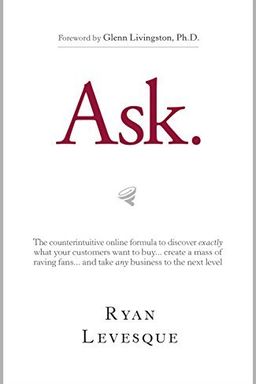
Ask cover

Ask

by Ryan Levesque

Ask by Ryan Levesque introduces the revolutionary Ask Formula, a method to uncover customer desires through strategic questioning. This book provides actionable insights and tools to personalize offerings, create loyal customers, and maximize business profits, making it an essential read for entrepreneurs and marketers.

The Power of Asking: Turning Questions into Business Growth

What if you could know exactly what your customers want before you create or sell a single product? In Ask, Ryan Levesque contends that the path to entrepreneurial success lies not in guessing, persuading, or shouting louder, but in asking better questions. His central argument is deceptively simple: people don’t truly know what they want, but they can tell you what they don’t want and what they’ve experienced. By learning to ask strategic, psychologically savvy questions, you can uncover their hidden desires, segment your audience, and deliver personalized solutions that customers feel were made just for them.

The Problem: Why Guessing Fails

Levesque opens with a challenge familiar to every entrepreneur: we’re all drowning in marketing noise. Thousands of messages bombard consumers daily, and as a result, traditional marketing—loud, generic, and impersonal—barely registers. The hard truth is that asking customers “What do you want?” doesn’t work. Drawing on Steve Jobs’ remark that people don’t know what they want until you show it to them, Levesque reframes customer discovery: rather than forcing prospects to imagine solutions, guide them to reveal their pain points. In Henry Ford’s famous terms, asking for “faster horses” won’t inspire innovation—it’s asking about what frustrates them about horses that yields insight.

The Promise of the Ask Formula

Out of years of trial, error, and recovery—from failed ventures and even a near-death experience—Levesque developed what he calls the Ask Formula. It’s not merely about surveys; it’s a structured methodology for transforming how a business learns from and speaks to its market. Through a sequenced process of surveys, feedback, segmentation, and personalized messaging, entrepreneurs can effectively “play doctor” with customers—diagnosing their true needs before prescribing solutions. The result is marketing that feels personal, authentic, and remarkably profitable.

The Journey Behind the Formula

Levesque’s story runs like a startup fable crossed with a survival tale. From his childhood fascination with Monopoly and early investing success, to his Ivy League study of neuroscience at Brown, to high-pressure corporate years in China, his life demonstrates obsessive curiosity about how people think and decide. The turning point came after his health crisis—being diagnosed with Type-1 diabetes and nearly dying. In that stillness, he realized his deepest joy was figuring out what people wanted and giving it to them. What began with Scrabble-tile jewelry tutorials on Etsy evolved into a multimillion-dollar business methodology.

How the Framework Works

The Ask Formula follows a six-step process summarized by Levesque as Prepare, Persuade, Segment, Prescribe, Profit, Pivot. It begins with a Deep Dive Survey to learn what customers say their biggest challenges are—never directly asking what they want to buy. From those insights, entrepreneurs construct micro-commitment surveys, funneling people into distinct “buckets” of needs and customizing offers accordingly. In later stages, the process automates testing, sales messaging, and follow-ups that yield consistent conversion rates across industries—from health and fitness to online education.

Why This Approach Matters

Levesque’s approach transforms marketing from manipulation into conversation. Instead of guessing and broadcasting, you ask and listen. This isn’t just ethical; it’s efficient. Businesses waste fortunes selling the wrong products to the right people or the right products the wrong way. By focusing on discovery rather than persuasion, Levesque argues, you remove guesswork from marketing. His clients have applied the formula to generate over $100 million in sales.

A Vision for Modern Marketing

Near the book’s conclusion, Levesque reveals an audacious vision: every homepage on the Internet will one day start with a survey funnel. He believes a world where every buyer is matched to perfectly tailored solutions will yield better customer experiences and seller profits. The book concludes not with a pitch but an invitation: to start asking smarter questions today. It’s both a practical manual and a personal manifesto. Where other entrepreneurs chase shortcuts, Levesque reminds you that sustainable success grows from curiosity, empathy, and the courage to ask.


From Neuroscience to Entrepreneurship

Ryan Levesque’s early life and education shaped his experimentation mindset. Growing up in a modest family, he obsessively pursued efficiency and strategy—skills later critical to business innovation. His Brown University training in neuroscience and fascination with how the brain learns gave him foundational insight: understanding behavior beats guessing. While his peers pursued traditional medical paths, Levesque sought the practical side of psychology—the mechanisms of decision-making and persuasion.

Learning from Diverse Experiences

Levesque combined intellectual curiosity with cultural immersion. Studying Chinese during Princeton’s infamous language bootcamp taught him discipline and incremental mastery—the same principles he later applied to market research. His experience in finance at Goldman Sachs and management training at AIG taught him the value of data and analysis, while also exposing him to the emptiness of pursuing corporate success devoid of autonomy. When offered a lucrative position at Goldman, he chose a less-paid but adventurous AIG role that promised experience in China. This choice—prioritizing growth over security—foreshadowed his entrepreneurial leap.

The Turning Point

In China, amid burnout and disillusionment, Levesque began seeking inspiration on how others launched online businesses. This journey led him to Gary Halbert’s direct-response writing and Dr. Glenn Livingston’s data-driven niche analysis. Their contrasting styles—Halbert’s emotional storytelling and Livingston’s statistical precision—became the twin pillars of the Ask Formula. He realized business success requires both heart and science: authentic communication plus analytical rigor.

(Comparison note: Like Halbert and Livingston, Levesque joins a lineage of marketers—Seth Godin’s empathy-driven messaging and Dan Kennedy’s structured direct response—but his hybrid of psychology and data gives the formula distinctive power.)


The Ask Formula Explained

At the heart of the book lies the Ask Formula, a framework built around carefully sequenced questioning to uncover—and satisfy—customer desires. It’s not about traditional surveys for demographics. It’s about guided self-discovery, positioning yourself as an advisor rather than a seller. The formula teaches you to ask questions that illuminate what customers love, hate, and hope for, then tailor products and messages to those discoveries.

The Six Core Phases

  • Prepare: Conduct the Deep Dive Survey to uncover major challenges and segment patterns.
  • Persuade: Build landing pages that frame your survey as diagnostic—helping people uncover insights about themselves.
  • Segment: Use micro-commitment surveys to guide users step by step, identifying distinct audience “buckets.”
  • Prescribe: Offer tailored recommendations and solutions based on survey results.
  • Profit: Maximize revenue by meaningful upsells and personalized sequences that fit each customer group.
  • Pivot: Continue refining through follow-up email surveys, learning why prospects didn’t buy and adjusting accordingly.

Why “Ask” Works

By asking open-ended and sequential questions, you bypass consumers’ confusion and reach emotional clarity. The process creates psychological momentum: once prospects start answering small, low-threat questions, they’re more open to sharing and buying. The Ask Formula turns superficial traffic into rich conversations, transforming data into empathy-driven strategy. Over time, it becomes self-optimizing—the business evolves as customers speak.

This formula has scaled businesses from water ionizers to tennis training. It merges neuroscience, copywriting, and survey analytics into one repeatable system—a “marketing brain” for digital entrepreneurs.


The Art of Asking Questions

Levesque insists that success depends less on the software or technology you use and more on how you ask. Most companies fail because they ask what customers want instead of what frustrates or motivates them. He illustrates this through relatable examples—such as friends trying to decide where to eat. People rarely know what they want, but they can quickly tell you what they don’t. Asking about aversions, past behavior, and precise pain points yields actionable insights.

The Psychology Behind Asking

Questions activate self-discovery. People are more engaged when they feel seen and invited to reflect. This approach draws on neuroscience: when questions provoke personal introspection, they trigger dopamine-driven curiosity, motivating completion. Levesque used this insight to design questions that convert cold traffic into active participants. As curiosity builds, resistance drops—a principle mirrored in social psychology research on commitment bias.

The Power of Counterintuitive Questions

Instead of “What product do you want?”, the Ask Formula encourages asking, “What’s your biggest challenge?” or “What happened in your life that made you look for this solution today?” This shift turns speculation into context. Entrepreneurs discover motivations that typical market research misses. For instance, Levesque’s Deep Dive surveys revealed that buyers of water ionizers weren’t motivated by alkalinity benefits but by fear of tap water contamination—transforming the entire marketing angle.

(Note: This insight parallels Clayton Christensen’s Jobs to Be Done theory—people don’t buy products, they hire them to solve specific struggles.)


Standing on the Shoulders of Giants

Before he created the Ask Formula, Levesque immersed himself in the teachings of legendary mentors. Copywriter Gary Halbert taught him the emotional art of persuasion, while psychologist-turned-marketer Dr. Glenn Livingston introduced him to statistical niche testing. Levesque’s breakthrough came by merging Halbert’s warm conversational style with Livingston’s data analytics—a fusion of intuition and measurement.

Learning from Gary Halbert

Halbert’s direct-response letters struck Levesque deeply; they felt like a friend speaking over dinner. He hand-copied every sentence of Halbert’s newsletters to internalize rhythm and tone. The lessons were clear: write like a human, not a corporation. Use short sentences, little words, and speak to one reader at a time. This humanistic communication later became Levesque’s secret weapon—connecting CEOs and everyday customers alike.

Learning from Glenn Livingston

Livingston’s method focused on empirical precision—using cluster analysis and web searches to measure market size before launching niche businesses. After buying Livingston’s damaged but valuable $2,000 course, Levesque watched all 20 hours and realized that metrics could de-risk entrepreneurship. Livingston’s insight—that success lies in selecting the right market before crafting the right product—gave Levesque the backbone of his formula. The result was a repeatable, scalable method to uncover profitable segments with surgical clarity.

Combining Halbert’s soul and Livingston’s science formed the DNA of Ask: data-driven empathy.


Applying the Formula in Action

Levesque proves his formula works across industries with compelling case studies. Two standout examples—Tennis training business Fuzzy Yellow Balls and water ionizer brand Live Energized—demonstrate the model’s versatility and scalability.

Fuzzy Yellow Balls: Segmenting the Tennis Market

Will Hamilton’s tennis instruction company was plateauing until Levesque applied the Ask Formula. Through a Deep Dive survey, they uncovered four distinct audience “buckets.” By redesigning the site and customizing messaging for each, they converted cold traffic profitably—generating $25,000 in the first week and $250,000 in six months. This showed how segmentation replaced one-size-fits-all campaigns with precise value alignment.

Live Energized: Reframing Motivation

Ross Bridgeford’s health company sold $2,000 water ionizers but struggled with skeptical audiences. Survey results revealed customers’ dominant fear was toxins—not alkalinity itself. Shifting messaging from benefits to risk relief triggered empathy and urgency. The launch generated $750,000 in five days, even selling out global inventory. The Ask Formula turned emotional insight into commercial performance.

Each success reflected the methodology’s core power: empathy-driven segmentation. When customers perceive you speak to their unique story, conversion multiplies.


Lessons from Crisis and Clarity

Levesque’s near-death experience is the emotional cornerstone of Ask. Diagnosed with Type-1 diabetes and hospitalized in the ICU, he spent a week confronting mortality and purpose. His revelation was simple yet profound: life’s highest calling is contribution, and his best contribution was teaching others how to listen. This moment crystallized his mission to share the Ask Formula publicly.

Reframing Success

Recovering from the ICU, Levesque resolved to build a legacy, not just a business. He revisited what energized him most—learning customer needs, solving problems, and empowering others to do the same. The result was a shift from solopreneur to teacher, from hustler to system-builder. His master plan: publish the entire formula and inspire a global movement where asking replaces guessing in business.

The Moral of His Story

Crisis gave Levesque clarity: entrepreneurship shouldn’t be driven solely by profit. Instead, it’s about creating mutual success—helping buyers and sellers both win. His experience underlined a principle echoed in modern purpose-driven business literature (similar to Simon Sinek’s Start with Why): the deeper your mission, the greater your endurance.

Through adversity, Levesque learned that asking questions doesn’t just build companies—it builds connection, empathy, and meaning.


A New Paradigm for Marketing

Levesque’s final vision extends beyond formulas—it’s a call to reshape online commerce through curiosity and personalization. He imagines a future where every homepage begins with a question, every offer emerges from dialogue, and every company co-creates its success with customers. The Ask Formula is not just technique; it’s a philosophy: marketing as listening.

Practical Impact

This paradigm transforms business economics. Instead of wasting resources on irrelevant audiences, firms invest in understanding niches, fostering long-term relationships, and re-selling through tailored communication. It requires humility—the willingness to admit you don’t know everything—and courage to ask anyway.

The Legacy of Asking

Levesque invites readers to join his mission, not as followers but as innovators who will expand and refine the method. His dream: that the Ask Formula becomes the standard language of digital empathy. Each question asked with sincerity inches businesses closer to trust-driven success. Asking, in this sense, is not merely marketing—it’s service.

In the end, Ask teaches that questions—not pitches—build the future of commerce, one conversation at a time.

Dig Deeper

Get personalized prompts to apply these lessons to your life and deepen your understanding.

Go Deeper

Get the Full Experience

Download Insight Books for AI-powered reflections, quizzes, and more.