
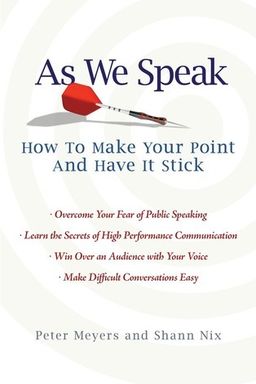
As We Speak cover

As We Speak

by Peter Meyers and Shann Nix

As We Speak empowers you to connect with any audience, whether in a boardroom or classroom. Discover techniques to conquer fears, craft compelling stories, and deliver impactful presentations that leave a lasting impression.

Speaking as a Gift: Communicating with Presence and Purpose

Have you ever stood before an audience, heart pounding, palms sweating, and thought, “Why am I doing this to myself?” In As We Speak, Peter Meyers and Shann Nix argue that our fear of speaking—whether in front of hundreds or in a tough one-on-one conversation—is wired deeply into our biology. But overcoming that fear doesn’t require erasing it; it means transforming it into energy, purpose, and presence. They contend that any one of us can develop what they call High Performance Communication, a practical art that allows you to speak with clarity, authenticity, and impact. The book is both a science-backed coaching manual and an emotional guide to becoming the kind of communicator people trust, follow, and remember.

As We Speak reveals that effective communication isn’t a matter of charisma or memorizing techniques—it’s an inside job. The authors, who’ve coached CEOs, diplomats, and media personalities, show that confidence and influence arise from aligning your content (what you say), delivery (how you say it), and state (how you feel while saying it). You’ll learn to recognize how fear hijacks your brain through what psychologists call an amygdala hijack, and retrain your attention toward the more evolved parts of your mind that can connect, inspire, and lead.

Why We Fear Speaking

In the book’s infamous opening scene, Meyers paints the universal nightmare: stepping on stage as your mind goes blank and your hands shake. The authors explain this scientifically—our amygdalae interpret public scrutiny as a life-or-death threat, the modern equivalent of being surrounded by predators. This primal system shuts down the frontal cortex, which processes language, leaving us literally speechless. Understanding this biological pattern is the first step to reclaiming control.

They emphasize that fear itself isn’t a flaw. As Shann Nix notes, “Fear is only excitement without the breath.” Like an athlete before a big race, you can channel your pre-speech adrenaline into focus and vitality by viewing it not as danger, but as energy for performance. Leaders, they argue, shouldn’t strive to be relaxed—great speakers are charged, alive, and present.

The Gift Mindset: Shifting from Self to Service

Meyers and Nix believe the surest antidote to fear is generosity. When you approach communication as a way to give a gift rather than prove your worth, you free yourself from the narcotic trap of self-consciousness. The book recounts a Parisian waiter who transformed his work by saying “bon appétit” with true sincerity—looking diners in the eyes and meaning it. In that simple shift, his routine task became a sacred act of service. As Meyers writes, “Your intention to give a gift trumps the necessity to be flawless.”

This principle applies universally—from presentations to hallway conversations. When you stop thinking, “Do I look smart?” and start asking, “How can I make a difference for them?” you rewire your attention from fear to contribution. The shift unearths authenticity, energy, and natural courage.

From Data to Emotion: The Real Language of Influence

Another foundational insight is that facts don’t move people—feelings do. The authors cite neuroscientist Antonio Damasio’s research showing that decision-making happens not in the logical left brain but the emotional right. We “decide with our gut” and then rationalize afterward. This means that giving your audience more charts and data won’t make you persuasive. High-performance communication must engage emotions through stories, metaphors, and vivid imagery. As the book notes, “They may forget what you said, but they will never forget how you made them feel.”

In this digital age, where information is free but connection is rare, your ability to craft emotional experiences sets you apart. “The information age is over,” the authors write. “Now we are starving for meaningful connection.” Like Simon Sinek’s idea from Start With Why, they emphasize that leadership depends less on what you know and more on what others feel when they listen to you.

The Three Dimensions of High Performance Communication

All of Meyers and Nix’s coaching funnels into three interdependent dimensions: content, delivery, and state.

  • Content is the architecture of your idea—the logic, emotion, and clarity of what you offer. You’ll learn how to design structures audiences can follow intuitively, like a ramp, a roadmap, and a “dessert” conclusion that leaves them satisfied.
  • Delivery concerns physical expressiveness—the music of your voice, the openness of your body, and your ability to create congruence between words and gestures. Congruence breeds trust; mismatched signals evoke doubt.
  • State is the invisible engine—the way you feel internally when you speak. If you’re anxious or defensive, no amount of polish will disguise it. But if you’re grounded, generous, and alert, your presence radiates.

Together, these form the foundation of what the book calls High Performance Communication—the ability to lead, inspire, and connect at any level. Each part of the book develops these elements across specific contexts: presenting an idea, handling confrontation, navigating crises, or even writing emails that actually get read.

Why This Matters Now

In an era of noise and distraction, Meyers and Nix argue that authentic communicators have a radical advantage. The trust crisis—across politics, organizations, and relationships—has made our voices our greatest currency. You can’t rely on authority or expertise alone anymore; people follow those who connect. The ability to “stand and deliver,” whether in a boardroom or a small team meeting, determines not just career success, but the quality of your relationships and influence.

“Good ideas are not enough,” they write. “The facts will not speak for themselves—it’s your job to make them come alive.”

In short, As We Speak redefines communication as an act of leadership and generosity. It’s not about performing—it’s about serving. If you want to persuade, comfort, inspire, or simply be heard, you must start where every great communicator begins: inside yourself. From conquering the amygdala to crafting emotional storytelling and speaking from purpose, Meyers and Nix lead you through the transformation from nervous speaker to powerful voice. The gift you give, ultimately, is not just your message—it’s your presence.


Mastering Content: Architecture of Influence

Peter Meyers and Shann Nix teach that content is the skeleton of your communication. You can’t build confidence on cluttered ideas or scattered stories. The authors reveal a three-step preparation formula—Outcome, Relevance, and Point—followed by a clear structure of Ramp, Road Map, Discovery, and Dessert. This ensures every conversation or presentation has purpose, flow, and resonance.

1. Define Your Outcome

You must know exactly what you want your listener to do, decide, or feel. Instead of vague goals (“I’ll share some ideas”), use precise language: “By the end of this talk, they will decide to fund Phase One of our project.” The more concrete the outcome, the easier it is to measure success. Like Stephen Covey’s principle in The 7 Habits of Highly Effective People—begin with the end in mind—the authors remind us that clarity is power. Without it, you’re just thinking out loud.

2. Make It Relevant

Listeners don’t care what you want to say—they care about what matters to them. The authors call this “the WIIFM principle” (“What’s In It For Me?”). To engage an audience, your opening ramp must show why this matters to them personally or professionally. For example, if your team is burned out, open with: “Every week, we’re losing 20 hours to unclear communication. Imagine if you got half of that time back.” Relevance creates curiosity and opens the emotional door.

3. Clarify Your Point

Many people talk endlessly because they haven’t clarified their single key message. Meyers and Nix urge you to boil your message down to one crisp sentence: “If they forget everything else, what’s the one thing I want them to remember?” It’s the verbal equivalent of a headline—like “Theater helps kids succeed in school,” or “Numbers tell human stories.”

4. Craft the Structure

The authors organize every high-impact talk into four stages:

  • Ramp: Capture attention with relevance and urgency before diving into information.
  • Road Map: Preview your journey—how long it’ll take, what you’ll cover, and what’s expected of the listener.
  • Discovery: Share three core “Points of Discovery,” because our brains process information best in threes.
  • Dessert: End not with more data, but a story or emotional close that shapes how your message will be remembered.

This architecture transforms even technical briefings into narratives people can follow intuitively. A Ramp hooks attention, Discovery provides insight, and Dessert seals the memory emotionally. Just as final notes make a song linger, the ending defines the experience.

5. Add Stickiness with Stories and Refrains

Drawing from Made to Stick by Chip and Dan Heath, the book warns: people forget 90% of what you say. To counter this, add memorable devices—stories, metaphors, and refrains. Winston Churchill once repeated “We shall fight” seven times to etch defiance into the public mind. Your refrains need not be dramatic—“That’s why we’re building this together” can unify a team when repeated with sincerity.

Through real-world examples—from a CEO saving his presentation to a father convincing his son to attend college—the authors prove that structure isn’t a cage; it’s a scaffold for freedom. When your ideas have shape, clarity, and relevance, your listeners relax because they sense you’re leading them somewhere worth going.


Delivering with Power: Voice, Body, and Eyes

You may have brilliant ideas—but if your body, face, and voice don’t match your words, people won’t trust you. Delivery, the book’s second pillar, teaches how to make “the music and the movement” of your communication congruent with your message. As the authors note, “The facts don’t speak for themselves—you make them come alive.”

Your Voice: The Sound of Authenticity

Most people dislike the sound of their own voice because it reveals what they’re feeling. Rather than disguising your emotions, Meyers and Nix teach you to sculpt your voice for clarity, emotion, and variety. Use abdominal breathing—the same technique singers and actors use—to support projection and control. Then develop three sliders: volume (soft to loud), pitch (high to low), and tempo (fast to slow). Varying these, along with intentional pauses, prevents monotony and emphasizes meaning. As they write, “Boredom comes from sameness.”

They even recommend reading children’s books aloud or “trailing” great audiobook narrators to exercise tone and phrasing. Over time, your vocal flexibility becomes an instrument for influence—able to express excitement, empathy, or conviction as needed.

Your Body: The Stage of Connection

In public speaking, people read your body before they hear your words. The authors emphasize congruence—when your words, gestures, and posture agree. Fear typically makes us shrink: crossed arms, hunched shoulders, nervous fidgets. Meyers and Nix propose “heroic neutral,” a stance of relaxed confidence: sternum up, hands free, body open. This position signals trust and readiness. Arms crossed say “I’m holding back”; open palms say “I’m giving.”

They also offer practical logistics: never read directly from text; capture information, internalize it, reconnect, and speak. Practice your entrance and exit like a performer—because presence starts before your first word and lingers after your last.

Your Face and Eyes: Windows of Truth

Facial energy communicates authenticity. We subconsciously scan micro-muscle movements around the eyes to detect sincerity. So, “wake up your face”—stretch it, smile gently, allow your eyes to light up. Avoid scanning an audience mechanically; instead, hold “connected conversations.” Look at one person for a complete thought (about three seconds), then shift to another. This creates intimacy and calm attention. As they remind us, “Forget about eye contact—have conversations instead.”

“If the body says one thing and the words say another, the audience believes the body.”

By joining vocal variety, physical expressiveness, and eye connection into a unified channel, you turn presence into credibility. Delivery, as Meyers and Nix redefine it, isn’t performance—it’s transparency. When you allow people to see what you mean, your message lands with both mind and heart.


Managing State: Turning Fear into Power

Your state—the internal condition of your body, emotions, and focus—speaks louder than your words. The third pillar of the book delves into this invisible factor that explains why confident people seem effortless and nervous people collapse. Meyers and Nix teach that you can deliberately manage your state through three levers: your body, your mind’s eye, and your beliefs.

1. The Body as a Lever

Biology leads psychology. If you breathe, stand, and move the way you do when you’re confident, your brain releases the same chemicals of confidence. Lift your head, expand your chest, and smile—these physical patterns send a message to your nervous system: I’m safe, I’m strong, I’m ready. The authors call this using “performance preparation patterns,” much like athletes or dancers who use rituals to summon peak states. Practice your pattern before each high-stakes event to train calm energy on demand.

2. The Mind’s Eye and Powerful Questions

Where attention goes, emotion flows. Most of us default to worry because our brains look for danger—“Will they like me?” “What if I forget?” These are sabotage questions that focus the mind’s eye on fear. Instead, ask empowering questions with positive presuppositions: “What’s the best part of this talk?” “How can I give them a gift?” “What’s exciting about this opportunity?” As the authors note, “Your brain will always find answers—but the question you ask decides which drawer it searches.”

3. Beliefs: The Filters of Reality

Fear often hides inside limiting beliefs. People tell themselves, “I’m not a speaker,” or “Numbers are boring.” These are stories, not truths. One executive they coached, a former police sergeant turned banker, believed his street background disqualified him. When he reframed his story—recognizing that his police skills (instinct, presence, persuasion) made him exceptional—his confidence soared. As biologist Bruce Lipton says, quoted in the book, “Your beliefs act like filters on a camera, changing how you see the world.”

From Fear to Excitement

By consciously managing these three levers, you convert fear into vitality. The surge of adrenaline before you speak is the same chemical that fuels elite performance—it just needs direction. As Meyers writes, “You’re not supposed to be relaxed before a big moment. The difference between performing and choking is what you do with the energy.”

“Fear and excitement are the same energy—only the breathing changes.”

This chapter transforms anxiety from an enemy into an ally. By moving intentionally, asking better questions, and rewriting your beliefs, you craft a mindset where courage feels natural, momentum builds, and your words carry emotional truth.


Courageous Conversations: Speaking When It Counts

High-performing individuals, the authors argue, don’t have fewer problems—they’re simply more willing to speak about them. Courageous conversations are those you avoid because they’re uncomfortable: confronting a colleague, asking for a raise, or admitting fault. Avoidance, however, breeds decay. Drawing on Dr. George Kohlrieser’s work in conflict negotiation, Meyers and Nix show how transparency strengthens trust and teams.

Put the Fish on the Table

At the International Institute for Management Development, leaders have a metaphor: “Put the fish on the table.” Hidden fish rot; openly cleaning them feeds the group. In conversation terms, that means naming uncomfortable truths early. The authors recount coaching a CEO whose staff whispered that he mumbled during presentations. No one dared tell him—until Meyers said it outright. The CEO paused, smiled, and said, “Finally someone tells me the truth.” The relationship deepened instantly.

Keep the Bond

In conflict, your goal isn’t winning—it’s preserving the bond. Without connection, persuasion fails. By separating the person from the problem (a concept from Getting to Yes by Fisher and Ury), you can challenge behavior without attacking identity: “Anthony, I need to talk about your punctuality,” not, “You’re irresponsible.” When people feel respected, they cooperate.

Ask, Don’t Monologue

Meyers encourages you to ask questions that drive dialogue: “What makes you see it that way?” or “What would make this easier?” Whoever asks the questions controls the direction. They also advise stopping after four sentences—our brains tune out longer monologues. Ask, listen, paraphrase, and acknowledge. Reward small concessions with smiles or affirmations to build momentum.

When Emotions Run Hot

If someone is angry, listen first. Don’t fix, defend, or counter. Let them vent. When you paraphrase their feelings accurately—“You feel betrayed because the shipment was late”—you build a bond that calms the brain’s threat response. Only then can logic return. As they write, “You can’t help someone you haven’t heard.”

Courageous conversations reframe leadership as emotional bravery—the willingness to face discomfort for the sake of truth and trust. Once you stop fearing others’ reactions, dialogue becomes discovery, not danger.


Leading Through Crisis and Technology

Whether addressing a scandal, a market collapse, or a global audience through screens, today’s leaders must communicate under pressure. Meyers and Nix dedicate significant attention to two increasingly common contexts: crisis communication and digital communication. Both test your clarity, empathy, and authenticity.

1. Crisis Communication Formula

During chaos, silence kills trust. The authors’ six-step formula mirrors Abraham Maslow’s hierarchy of needs: meet basic security first, then meaning.

  • Here’s what we know for sure
  • Here’s what we don’t know
  • Here’s what I think
  • Here’s what you can do
  • Here’s what you can count on from me
  • Here’s why it’s worthwhile

This sequence stabilizes emotion first, then locks in hope. They contrast BP’s catastrophic handling of the 2010 oil spill—defensive and aloof—with Odwalla’s honest, transparent response to its 1996 E. coli crisis, where the company recalled products immediately and took responsibility. The lesson: truth heals faster than spin.

2. Communicating Through Technology

To “warm” cold media, Meyers and Nix outline strategies for email, phone, and video. For instance:

  • Write short, clear emails with strong I:You ratios and front-load relevance.
  • On calls, vary vocal tone, ask frequent check-ins, and smile—listeners can hear it.
  • In video, look into the camera lens, not the screen; light your face warmly and move naturally—the eyes carry emotion.

Their advice reframes technology not as a barrier but as a tool for human connection. Whether crisis or conference call, your presence is still the message. Authenticity and empathy remain the ultimate connectors—no matter the medium.


Finding Voice and Vision

The final section of As We Speak moves from communication techniques to self-leadership. Influence begins with knowing who you are and what you stand for. The authors lead readers through exercises to define a personal vision and a relationship dashboard—tools for aligning your daily conversations with your deepest values.

Your Personal Vision

Borrowing from Stephen Covey’s idea that “all things are created twice,” Meyers and Nix ask you to write the toast you’d want people to give about you at your retirement dinner. What do you hope they say—about your integrity, creativity, compassion? From these imagined eulogies, you distill guiding principles. This “vision statement” becomes the compass for your communication choices: how you listen, manage conflict, and spend time.

The Relationship Dashboard

Every success boils down to relationships. The relationship dashboard helps you map your key connections—bosses, colleagues, family—and intentionally plan interactions that meet their emotional needs (certainty, significance, connection, growth). Like a pilot checking gauges, you see where energy or attention is low before a crash occurs. This tool turns influence into an ongoing practice of empathy and alignment.

Collaborate and Innovate

In creativity, most teams default to critique—“Yes, but …” The authors replace that with “Yes, and …” to amplify ideas. Borrowed from improvisational theater and practiced at innovation firms like IDEO, this method accepts all proposals for fifteen minutes before judging. When people feel safe, they share bolder ideas. Afterward, sift for the diamonds. The shift from dismissal to co-creation can transform a culture.

This closing principle—the fusion of authenticity, empathy, and structured imagination—summarizes the whole philosophy: great communication is not a performance, but a relationship. When your words serve a purpose bigger than ego, others don’t just listen—they’re moved.

Dig Deeper

Get personalized prompts to apply these lessons to your life and deepen your understanding.

Go Deeper

Get the Full Experience

Download Insight Books for AI-powered reflections, quizzes, and more.